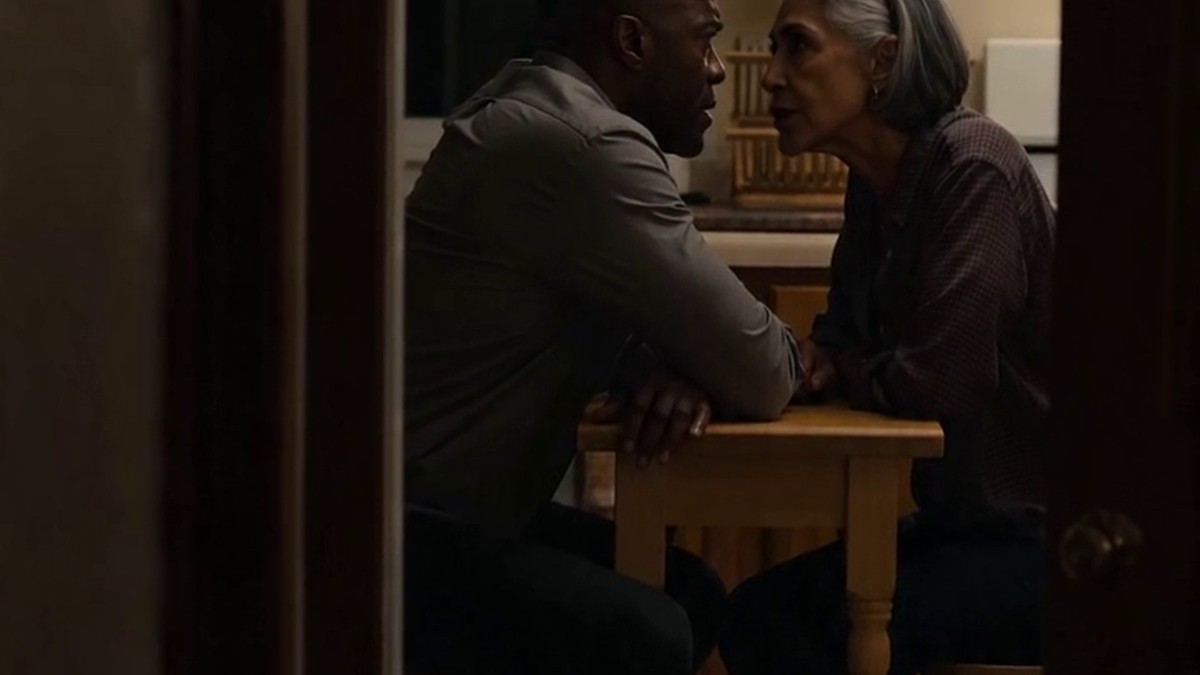
Gena smiled that smile of his—wide, dimpled, with a glint in his eyes that Ida had once mistaken for tenderness. Now she knew it for what it was: anticipation.
He settled across from her at the kitchen table, draped his warm hand over hers, and started talking. Measured, reasonable, as if he were thinking out loud instead of laying groundwork.
“Look, think about it,” he said. “Why hang onto that old place in that neighborhood? Pre-war building, shot plumbing. We sell it, we buy something decent. New construction, underground parking, an elevator. Ours, you get it? Yours and mine.”
Ida stared at his hand covering hers. His fingers were warm. His wedding band caught the kitchen light.
“I’ll think about it,” she said, and smiled back at him.
Gena didn’t know there was nothing left for her to think about.
Everything had shifted a week earlier—the night she padded toward the kitchen for a glass of water and froze in the hallway. His voice was coming through his mother’s half-open door.
Before that night, Ida possessed a quality she privately considered a weakness: she knew how to feel joy. Not loudly, not for show. Something inside her simply warmed, and she protected that warmth. She felt it for early spring, for good coffee, for the rare stolen hour with a book. Five years married to Gena, five years under the same roof as her mother-in-law Valentina Sergeyevna—and that capacity hadn’t vanished. It had just gone quiet.
When her mother called to say Great-Aunt Zoya had passed and left Ida her apartment—the one that smelled of old wood and valerian root, with potted ficus trees and a ticking grandfather clock—Ida cried first. She’d loved Aunt Zoya, the kind of person who never told you how to live, just sat beside you and listened.
After the tears dried, another feeling settled in.
Her own apartment. For the first time in five years—hers.
She hadn’t realized how deeply she’d been exhausted by existing in someone else’s space. Having to ask permission to move a shelf. Valentina Sergeyevna always materializing in the kitchen the moment Ida started to feel like she belonged there. That appraising squint, like Ida was an equation with the wrong answer.
Gena celebrated with her. Hugged her, said it was a stroke of luck, said things would be different now. Ida believed him. She had five years of practice believing Gena.
She woke after midnight. The apartment lay silent except for the refrigerator’s low hum. She rose, headed for the kitchen, and that’s when she heard her mother-in-law’s voice—low, precise, carrying an intimacy Valentina Sergeyevna never wasted on Ida. Almost tender.
“You don’t get it,” the older woman said. “That old apartment is hers. Inheritance, legal documents. If anything happens—you have zero claim to it.”
“Mom, we’re married,” Gena replied.
“Married.” Valentina Sergeyevna packed a whole treatise into that single word. “Exactly. If you sell the old one and buy new—that new one becomes joint marital property. Do you understand the difference?”
A pause. Ida pressed her palm flat against the hallway wall. The plaster was cold.
“Are you saying…”
“I’m saying you’re a grown man who needs to think about his future. Convince her to sell. Tell her new construction is better, that old buildings are a headache. She trusts you.”
Another pause. Then Gena murmured something too low to catch. They both laughed.
Ida walked back to the bedroom. Lay down. Stared at the ceiling and felt that warmth she’d protected so carefully drain out of her—slow, methodical, like water seeping into sand.
The next morning, she called her mother.
“Mom,” she said, “I want to transfer the apartment to your name.”
A long silence.
“Ida, did something happen?”
“Everything’s fine,” Ida said. “I just want to.”
Her mother wasn’t the kind to push with questions. She knew how to hear what lived underneath words. She paused a moment longer, then said, “Alright. Come over. Let’s talk.”
They met at a café near her mother’s building. Ida laid it all out—calm, no tears, surprised by her own composure. Her mother listened, held her hand, nodded occasionally. When Ida finished, her mother simply said, “I’m glad you heard that before you did anything irreversible.”
“So am I,” Ida answered.
They drank their coffee. Talked about Aunt Zoya—quiet, fiercely independent, a woman who had lived her entire life on her own terms. Ida thought that Aunt Zoya probably knew exactly what she was doing when she chose who would inherit those rooms.
Then they went to the notary.
The following days passed in a strange, doubled state. Externally, nothing changed: Ida cooked dinner, answered Valentina Sergeyevna’s questions about whether she’d paid the internet bill, watched series with Gena in the evenings. He was attentive, even affectionate. She could now read that affection, knew exactly what fueled it, and the knowledge didn’t hurt so much as hollow her out.
He approached the subject cautiously, testing approaches.
“You know, I’ve been thinking about the apartment,” he’d say, offhand. “Maybe we should check out some new developments? Just to understand the market.”
“Mm-hmm,” Ida would answer.
“There’s this complex that just opened. Good floor plans, I hear. Bright, spacious.”
“Interesting.”
He studied her—appraising, almost like his mother. Ida smiled back. Steady, placid. She’d learned it from him.
Valentina Sergeyevna was uncharacteristically pleasant during that stretch. Offered Ida her recipe for cabbage pie. Asked after her mother’s sister. Ida answered politely, with the same level smile. She had no interest in games. But she’d play if she had to—just to avoid rushing, to give herself those extra days to be absolutely certain.
She had no doubts at all.
The decisive conversation came on a Sunday. Valentina Sergeyevna had gone to visit a friend—a rare gift, given how little the woman left the apartment lately. Gena set the table, opened wine, put on music. The whole production was staged like a romantic evening, and Ida granted him this: he knew how to build atmosphere.
They ate. Drank a glass each. Gena started talking about the future—how good it would be to live separately, just the two of them, without a third presence constantly hovering. Ida listened and thought that he might actually believe what he was saying. Or at least he’d gotten very good at convincing himself.
“I’m ready,” he finally announced, his voice taking on that particular tone of a decisive businessman. “Let’s sell your aunt’s place. We’ll find a great new building, get a reasonable mortgage. We’ll have our own home, you understand?”
Ida set down her glass.
“Gena.”
“What ‘Gena’? I’m making sense. You’ve complained yourself about living with my mother.”
“I’ve complained.”
“Right. So here’s the opportunity. It’s falling right into our laps.”
Ida looked at him. He looked back, smiling, dimples perfectly in place, his eyes carrying that glint.
“Genochka,” she said, and her voice was quiet, almost sympathetic, “the apartment’s not mine anymore.”
The pause that followed stretched out long. Gena blinked.
“What?”
“What, you didn’t expect that? I transferred it. To my mom. A few days ago.”
He stared at her with the expression of a man who’s been spoken to in a foreign language—the words register, but the meaning refuses to land.
“Wait. Why?”
“It’s simpler this way,” Ida said.
“Simpler.” He repeated the word like he was tasting something unfamiliar. “Were you even thinking clearly? That’s—”
“Legal,” Ida supplied. “I have the right to manage my own property however I see fit.”
“Ida.” His voice had changed; the warmth had drained out, something harder surfacing. “Do you understand what you’ve done? We could have—”
“I understand,” she said. “That’s exactly why I did it.”
He stood. Paced the kitchen. Stopped at the window, staring out at the dark, wet street where streetlights bled into puddles.
“Is this about my mother? Did she say something?”
Ida didn’t answer. She simply watched him, and her gaze held no anger, no accusation, no triumph—nothing he could weaponize.
“Ida. I’m asking you.”
“I hear you.”
He turned from the window. Something in his face was shifting—she could see the machinery working behind it, options being sorted, explanations assembled.
“Listen,” he said, his voice shifting again, nearly soft. “Can we talk like adults? Something happened, you’re upset, I get that. But that’s not a reason to do something foolish—”
“I’m filing for divorce,” Ida said.
This time, the silence was different. Not surprised. Stunned.
“What.”
“Divorce, Gena. I’ve made my decision.”
He was quiet for a long beat. Then he sat back down. Picked up his glass, set it down without drinking.
“Because of the apartment,” he said finally—not as a question. A statement. As if he’d found an explanation that suited him.
“No,” Ida answered. “Because of everything else.”
Valentina Sergeyevna came home around ten. Her son sat behind his closed bedroom door; Ida was reading in theirs. The mother-in-law went to the kitchen, rattled the kettle, then stopped—maybe sensing that particular silence that settles after a conversation has changed things permanently.
She peered into the bedroom. Ida raised her eyes from her book.
“Everything alright?” Valentina Sergeyevna asked, her voice neutral but freighted with wariness.
“Everything’s fine,” Ida said. “Goodnight, Valentina Sergeyevna.”
The divorce took two months. It turned out simpler than Ida had anticipated—no children, no jointly acquired assets to fight over. Gena hired a lawyer, who studied the documents and informed his client that an apartment transferred to the wife’s mother bore no relation to marital property. Ida learned this from her own lawyer and understood it as confirmation: she’d heard everything correctly that night, and she’d understood everything correctly.
She moved in with her mother. Slept on the sofa in the living room, helped around the house, walked for miles through the city. At that time of year, the city was bare—no leaves, no ornamentation, just gray and alive, wet asphalt and the river smell. Ida walked and reflected that five years was a real chunk of life, and those five years had been hers, and something in them had been genuine. The genuine parts had just been smaller than she’d assumed.
Her mother didn’t interrogate. She cooked, set plates in front of Ida, sometimes sat beside her and shared the silence—a particular skill Ida had treasured her entire life.
One evening, her mother said, “You know the apartment is yours. Whenever you’re ready.”
“I know,” Ida replied. “Thank you.”
“We can transfer it back as soon as you say.”
“Not yet.”
Her mother nodded. They didn’t return to the subject.
One month passed, then another. Ida went back to work after her medical leave—officially taken for nervous exhaustion, with a doctor who studied her with understanding and asked no extraneous questions. Work revealed itself as the best thing that happened to her during those months: it imposed structure, demanded presence, left no room for endlessly replaying the same conversations.
Colleagues knew about the divorce. They didn’t pry—Ida felt grateful for that. Only Marina, with whom she sometimes grabbed coffee after meetings, said one afternoon, “You’re brave. Seriously.”
With men, Ida didn’t hurry. Not because she was afraid—or not only that. Something inside her had shifted that night in the hallway: she’d become more attentive to what hid beneath the words. A useful skill, even if the price of learning it had been high.
An acquaintance offered to set her up with someone.
“Not yet,” Ida said.
“Fair enough,” the acquaintance agreed, and dropped it.
Over time, Ida began to think about the apartment differently. Not as a loss. Not as a weapon. Just as space. Waiting for her. There were the ficus trees in their pots: she needed to find out if they were still alive, and if not, buy new ones. There was the grandfather clock, which had probably been silent for months. There was that particular window where Aunt Zoya used to watch the street, and that window held a special quality of morning light.
Ida wasn’t someone who could sustain hatred for long. It demanded too much energy, and her energy was needed elsewhere.
One Saturday, she took the keys and went to the apartment.
Both ficus trees had died. The clock stood still. The place was cold and dusty, not just the old-wood-and-valerian smell but the scent of somewhere unlived-in—that particular vacancy that accumulates in a space from which someone has departed.
Ida opened the window. Stood still. Looked out at the street.
Then she pulled out her phone and called her mother.
“I’m at the apartment,” she said. “I need to buy new ficus trees. And find someone who can repair the clock.”
Her mother paused a second, then said, “I’ll be there in an hour.”
Ida didn’t transfer the apartment back into her name for a long time—not because she forgot, and not because she didn’t get around to it. She simply realized one day that it didn’t matter. What mattered was this: she was here, the place smelled like old wood, a fine Petersburg drizzle fell outside the window, her mother was on her way with replacement plants, and they’d figure out together where to put them.
She set cups on the table and thought about Aunt Zoya, who had lived in this apartment for decades—on her own terms, owing nothing to anyone, with her ficus trees and her chiming clock and that special morning light.
It struck her as a very good example to follow.