She was on the floor, clutching the splintered half of a crutch, each breath coming harder than the last.
Nobody moved.
Nobody even flinched.
Then the sound cut through.
Boot heels on concrete.
Measured.
Unhurried.
A biker parted the ring of onlookers like they weren’t even there.
He didn’t speak. He just crouched down and retrieved the other crutch from where it had skidded.
Wiped it clean with the flat of his hand.
Set it gently within her reach.
The well-dressed woman across the way crossed her arms tight.
“Mind your own business.”
He didn’t even glance at her.
His attention had already moved to the torn handbag — and to what had shaken loose from it.
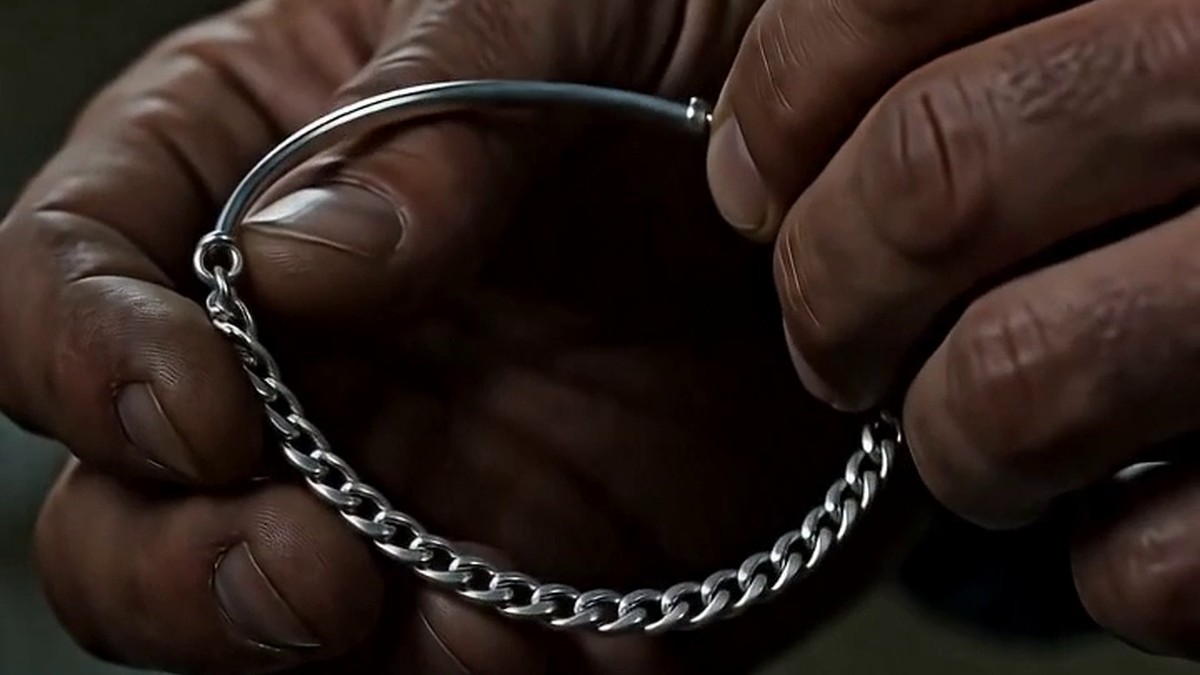
A small silver bracelet.
Worn thin.
Scratched dull.
Nearly erased by time.
He turned it over in his fingers.
And went completely still.
Stamped on the inner curve, in letters rubbed almost to nothing, were four words.
**Never stop looking.**
The air left his lungs.
The woman on the floor tilted her face up toward him.
Her eyes were drowning.
“You—”
The word barely made it out of her throat.
“…Daniel?”
Murmurs rippled through the crowd. Nobody understood.
The biker peeled the glove from his right hand.
A scar ran the length of his wrist — pale, old, permanent.
The woman sucked in a sharp breath.
Slowly, shakily, she raised her own hand.
The same mark.
Same location.
Same exact line.
The wealthy woman stepped back, her composure cracking at the edges.
“What the hell is going on?”
Neither of them looked at her.
The biker’s eyes stayed fixed on the bracelet, his jaw tight, and when he finally spoke it was barely above a breath —
“I’ve been looking for you for twenty years.”
Every person in that circle stopped moving.
But before she could find a single word to answer him —
A black SUV hammered to a stop at the curb outside.
Three men in dark suits hit the pavement hard.
The instant their eyes landed on the bracelet in his hand —
One of them threw his arm out and barked,
“Nobody leaves!”
Daniel stood up slowly.
He didn’t rush it.
He rose the way a man rises when he has decided something — fully, finally, with no room left for doubt.
The bracelet stayed in his fist.
The lead suit moved first. Broad shoulders. No neck to speak of. Eyes like a surveillance camera — recording, not seeing.
“Sir. Step away from the woman.”
Daniel looked at him the way you look at weather.
“No.”
A beat of silence so complete you could hear the fluorescent hum overhead.
The second man flanked left. The third held position by the door. Standard triangle. Professional spacing. These weren’t rent-a-cops.
The woman on the floor pressed her back against the pillar behind her. Her knuckles were white around the crutch he’d set within reach. But her eyes — her eyes were tracking everything. Sharp under the fear.
Twenty years hadn’t softened whatever was behind them.
The well-dressed woman had stopped retreating. She stood at the edge of the circle now, one hand at her throat, working through a calculation visible only to herself.
Daniel saw it.
He filed it.
“Who sent you?” he said. Not to the suits. To her.
The room caught that pivot. A few people stepped back instinctively, the way a crowd does when it realizes it’s been standing too close to something dangerous.
The well-dressed woman’s chin came up.
“I don’t know what you’re talking about.”
“Yes, you do.”
The lead suit stepped forward. “Last warning—”
Daniel turned on him, and something in his face made the man stop mid-stride.
Not aggression. Worse than aggression.
Absolute, bottomless calm.
“You put your hand on me,” Daniel said quietly, “and I will make sure every person in this building sees exactly what’s in your jacket pocket. All three of you.”
A pause stretched thin as wire.
The suit’s eyes cut to the well-dressed woman.
That was all Daniel needed to see.
He turned back to her.
“How long have you known where she was?”
The woman said nothing.
“How long?”
The word hit like a fist on a table. A child near the back started crying. Someone’s coffee cup rattled off a ledge somewhere behind the crowd.
The woman on the floor exhaled — a shaking, private sound.
“Elena.” Her voice came out cracked but clear. “Her name is Elena Marsh. She was my mother’s attorney.” She paused. Steadied herself. “And she was there the night they took you.”
The room went colder.
Elena Marsh closed her eyes for exactly one second.
When she opened them, the calculation was done.
“You have no proof of anything.”
“I have the bracelet.” His voice didn’t rise. “I have the scar. I have twenty years of paper trails that my firm has been building since two-thousand-and-nine.” He let that land. “We’ve been patient.”
Marsh’s composure was still intact — the outer shell of it, anyway. But something underneath had started to give.
“Your *firm*.”
“Did you think I spent two decades just driving around on a motorcycle?”
The lead suit glanced at the third man by the door. A look that meant something. The third man’s hand moved toward his lapel.
The woman on the floor moved faster.
She swung the crutch.
Not at anyone standing.
At the fire alarm on the pillar above her head.
The crack was enormous.
The shriek that followed was louder.
Red light pulsed through the terminal. The crowd buckled and split. People grabbed their bags and surged toward exits, the instinct older than reason — *get out, get out* — and in six seconds the contained circle became chaos.
Daniel was at her side before the second pulse.
He pulled her upright — arm around her waist, her weight braced against him — and she grabbed the crutch and they moved. Not fast. She couldn’t do fast. But deliberate. Through the press of bodies, with the alarm screaming overhead, toward the east corridor and the freight elevator he’d clocked when he walked in forty minutes ago.
Behind them, he heard Marsh’s voice cutting above the noise.
“Don’t let them—”
And then a suit’s shoulder hit a luggage cart and the sound of metal on tile swallowed the rest.
—
The freight elevator was slow.
Three floors of slow, with the alarm still going, muffled but present, a heartbeat made of noise.
They stood side by side in the yellow-lit box.
She was shaking. He could feel it — her whole frame was trembling against his arm, but she was upright and she was breathing and her jaw was set like a door bolted from the inside.
He looked at the bracelet in his palm.
Then at the scar on his wrist.
Then at her.
“Nadia,” he said.
Her name. Her real name. The one that had been taken from her along with everything else.
She turned her face toward him.
Her eyes were full but she didn’t let them spill.
“I stopped believing,” she said. “About four years in. I made myself stop.” A pause. “It was the only way to keep moving.”
“I know.”
“I looked for you first. Before you looked for me. Two years before I gave up.”
“I know that too.”
The elevator groaned to a stop.
The doors slid open on a loading dock — concrete and cold air and the smell of exhaust and rain on asphalt.
He stepped out first. Checked left. Checked right.
Then he helped her through.
The city spread out beyond the dock entrance, gray and enormous and indifferent, doing what cities do — churning on, regardless.
She tilted her face toward the overcast sky.
Breathed.
“What happens to Marsh?”
“Three federal investigators were already in the building,” he said. “They’ve been watching her for eighteen months. Tonight gave them what they were missing.”
“You planned this.”
“I had contingencies.”
She looked at him sideways.
“You’re very calm for someone who just found his sister in a train station.”
Something moved through his face.
It wasn’t calm.
It had never been calm.
It was the thing underneath calm — the thing a man builds over twenty years of loss and searching and dead ends and starting over — cracking now, quietly, at the edges. Not collapsing. Just finally, slowly giving way.
His throat moved.
“I didn’t know it was going to be today.” His voice came out lower than he intended. “I didn’t know it was going to be you.” He looked at the bracelet one more time. Turned it over. *Never stop looking.* “I just knew I couldn’t stop.”
Nadia stood still in the cold air.
Then she reached out and took his hand.
Not dramatically. Not with tears or speeches.
Just took it.
The same way you take hold of something you thought was gone forever and then — in an ordinary moment, on an ordinary gray afternoon, on a concrete loading dock behind a train station — find it again, solid and real and warm.
He held on.
They stood there a while, the two of them, while the alarm faded out behind them and the city moved around them and the rain started to come down in earnest.
Somewhere inside the building, Elena Marsh would be answering questions she’d been outrunning for two decades.
Out here, there was just the rain.
And the bracelet.
And the fact that neither of them had stopped.