My name is Rachel Bennett. Thirty-eight years old. Former U.S. Army. And the one thing the Army burns into you — the one thing that never fades — is this:
You don’t enter a fight unless you already know the outcome.
So that’s exactly how I built my anniversary party.
I reserved one of the premier ballrooms in downtown Chicago. I selected the band myself. I approved every tier of the cake. I had *Rachel & Eric – 10 Years* stitched in gold thread across every napkin in the room. To every guest who walked through those doors, it looked like a love story worth celebrating.
To me, it was a carefully built trap.
That morning, I ironed Eric’s favorite blue shirt with my own hands.
He kissed my forehead before the first guest arrived.
“You’ve really gone all out,” he said, smiling.
“I know,” I said.
My sister Natalie showed up in a red dress that knew exactly what it was doing. She pulled me into a long hug, both arms wrapped tight.
“I love you so much,” she murmured against my ear.
When she stepped back, I caught it — Eric’s cologne, faint but unmistakable, rising off her skin.
I’d first noticed that scent months earlier. It clung to him after his “late meetings,” the ones that had no names or details attached to them.
I asked about it once.
He laughed it off. “New air freshener in the car.”
I let it go.
Or I told myself I did.
I didn’t hire a private investigator because I suspected Natalie.
I hired one because I had stopped believing Eric.
Weekend crises with no explanations. Business trips to Nashville that produced no receipts. A Valentine’s Day where he left to buy flowers and came back three hours later, empty-handed, with a story that didn’t hold together.
Something was wrong. The question was how wrong.
I sat across from investigator Grant Miller and told him: “I just need to know who she is. That’s all.”
Two weeks later, his name came up on my phone.
“Rachel,” he said slowly. “Are you somewhere you can sit down?”
“I’m sitting.”
“The woman is family.”
My chest tightened like a fist closing.
A cousin? Some distant in-law?
Not my own sister. That thought didn’t even form.
Then Grant slid the photographs across the table.
Eric and Natalie. Leaving a hotel together, side by side. She was wearing the silk blouse I had bought her for her birthday.
That night, I understood something with total clarity: I had been sleeping next to one stranger and breaking bread with another.
For four months, I held that knowledge inside me like a stone.
I smiled through Christmas dinner. I raised a glass at birthday celebrations. I sat across from Natalie at my own table and watched her laugh and reach for the bread basket, and I said nothing.
I waited.
And then, in front of three hundred people, she took the microphone out of the DJ’s hand.
“I’m pregnant with Eric’s baby!”
The ballroom went still. The kind of still that has weight.
She found my eyes across the room and smiled at me.
My mother’s wine glass slipped from her hand and burst on the marble floor. My father gripped the edge of the table like a man on a tilting ship.
Eric didn’t say a word. He just lowered his eyes to the floor.
Every face in the room turned toward me, waiting to watch me fall apart.
I stood up slowly instead.
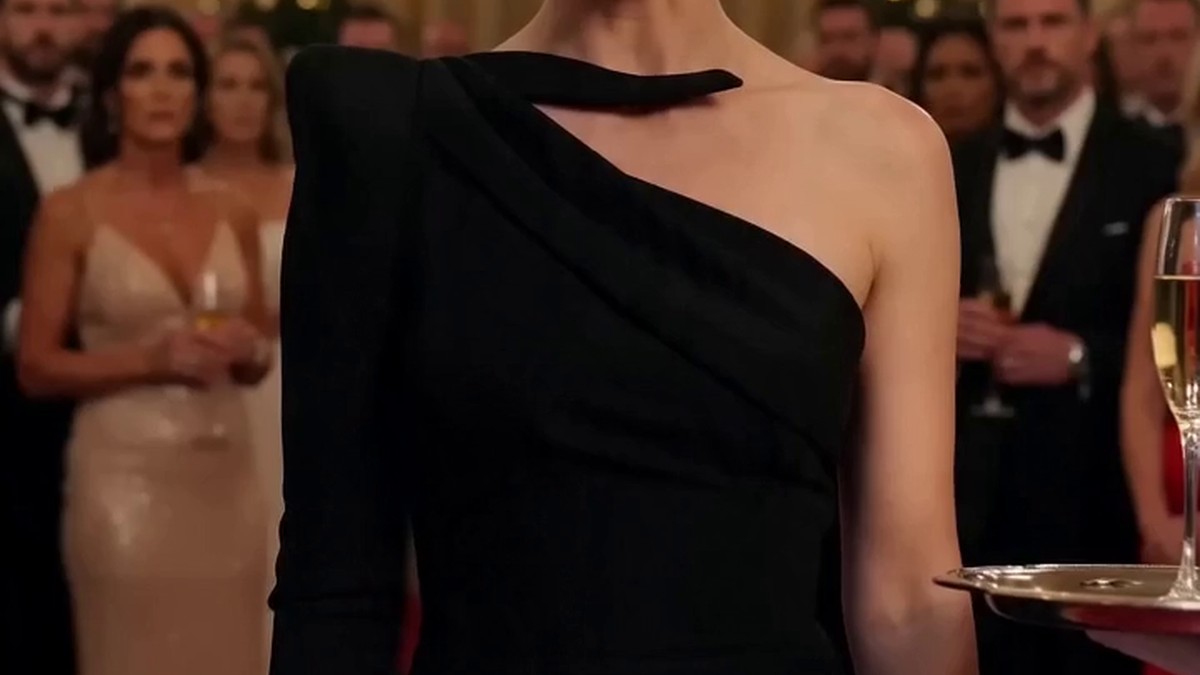
Straightened the hem of my black dress.
And walked toward her.
“Put the microphone down,” I said.
She laughed — a sharp, bright sound.
“No. People deserve to hear the truth.”
She raised her chin.
“Eric and I are in love. We’re going to build the family you were never able to give him.”
A low wave of whispers rolled across the room like a tide.
“This time,” she said, loud and clear, “I win.”
I smiled at her.
Then I looked toward the back of the room.
Grant rose from his chair. Without a word, he carried the red folder to the cake table, moving through the silent crowd like he had all the time in the world.
Something shifted in Natalie’s expression.
“Who is that?” she asked.
I reached out and gently lifted the microphone from her hand.
“He’s the man who has been sitting on one very important secret for the past four months.”
Grant opened the folder and held out a laboratory report stamped with an official seal. I raised it high enough that Natalie could read every line of it.
My voice didn’t waver once.
“Natalie,” I said quietly, “that baby is not Eric’s.”
The blood left her face so fast it was like watching a light switch off.
I took one step closer.
“And the man it actually belongs to is standing in this room right now.”
I turned toward the crowd and raised my hand, pointing past three tables — and every single guest spun around at once to see who I was about to name.
His name was James Holt.
Eric’s best friend of fourteen years.
His best man at our wedding.
The godfather of the child Eric and I lost in the third trimester, the one that turned our marriage into a cold, quiet country neither of us knew how to leave.
James was standing near the far wall with a glass of scotch raised halfway to his lips, and when three hundred heads swiveled toward him in unison, he set the glass down on the nearest table with the careful, deliberate movement of a man who has just run out of road.
Natalie made a sound I had never heard from her before.
Not a word. Not a scream. Something between the two — the kind of noise a person makes when the floor they’ve been standing on turns out to be a trapdoor.
“That’s not—” she started.
“Page four,” I said. “DNA comparison. When Natalie’s prenatal bloodwork came back last month, I already had two samples waiting at the lab — Eric’s, collected from his razor, and James’s, from the glass he left here last Thanksgiving. The results came back the same day. Eric’s markers didn’t match the fetal profile. James’s did.” I paused. “You do remember Thanksgiving, Natalie. You sat right next to me and told me I looked tired.”
The microphone was still in my hand. I didn’t need it anymore. The room was so quiet I could hear the candles.
Eric looked up from the floor for the first time since this began.
He looked at James.
James looked back at him.
Neither of them said a word, and in that silence something passed between them that no one else in the room could fully read but everyone could feel — the particular ugliness of two men realizing they had both been lied to by the same woman, and that one of them had burned down a decade of someone else’s life over it.
Eric’s face moved through about six different expressions in four seconds.
I recognized all of them.
I had worn every single one in the months since Grant slid those photographs across his desk.
“Rachel—” Eric said.
“Don’t.”
Just the one word. Soft. Final.
Natalie found her voice somewhere around then. She turned toward James, and for a moment I watched her calculating — still calculating, even now, even in the middle of everything — which version of the story could still be salvaged.
“James, just tell them—”
“Tell them what?” he said.
His voice was flat. No anger in it. Something worse than anger — the sound of a man who has already done the math and doesn’t like the total.
“Tell them it was a mistake. That we—”
“Were together for eight months,” he said. “While you were telling me Eric didn’t know about us. While you were telling Eric—” He stopped. “I don’t know what you were telling Eric.”
He looked at Eric then. A long look.
“I’m sorry,” he said. “I genuinely didn’t know. About you two. About any of it.” A pause. “I know you don’t believe that right now.”
Eric didn’t answer.
My mother had found her way to my father’s side. His arm was around her shoulder. She was staring at Natalie the way you stare at a photograph you’ve been looking at for years and are only now seeing clearly for the first time.
My father hadn’t let go of the table.
I crossed the floor to the cake table and reached under the white linen skirt. The envelope had been taped there since Tuesday. I had put it there myself with two strips of packing tape, and I had thought about it every single day since — every smile across a dinner table, every *I love you so much* murmured against my ear.
I held it out to Eric.
He took it without asking what it was.
He opened it and read.
Divorce filing. Asset division already completed. The house going to me — we’d bought it with my inheritance from my grandmother, and Grant had made sure that paper trail was airtight. Eric’s business accounts untouched. A clean, surgical split that gave him nothing to fight and nothing to accuse.
My attorney had called it “the most thoroughly prepared voluntary filing” she had seen in twenty-two years of practice.
“It’s already been submitted,” I said. “This is your copy.”
He stood there holding it.
I waited to feel something monumental. Some great cracking open of the chest.
What I felt instead was lighter than I expected. Like setting down luggage you’ve been carrying so long you forgot it had weight.
Natalie grabbed my wrist.
“You planned all of this,” she said. “You set me up.”
I looked down at her hand on my arm.
“I gave you three hundred witnesses and a microphone,” I said. “You did the rest yourself.”
She let go.
I turned to the room — all those faces, friends and colleagues and family, people who had danced at my wedding ten years ago and now stood holding their champagne glasses like props in someone else’s play.
“I’m sorry you were here for this,” I said. “I want you to know the bar is still open, the food is still hot, and the band—” I found the bandleader near the stage, gave him a single nod— “has a full set list. Enjoy the evening.”
Then I picked up my clutch from the head table.
And I walked toward the door.
Grant caught up with me in the lobby.
He handed me my coat without saying anything. I had asked him once, back in that first meeting, what he thought about cases like this. He’d said: *I think most people know the truth before they call me. They just need someone to carry it with them for a while.*
“You okay?” he asked.
“Ask me in six months.”
“Fair enough.”
I stepped out through the revolving door into the Chicago night. January. The kind of cold that has teeth. My breath came out in a white cloud and dissolved.
Behind me, through the glass, I could see the ballroom glowing warm and gold.
Natalie was still standing at the center of it, not moving, the red dress suddenly looking like the wrong thing to be wearing. James had his back to the room. Eric was still holding the envelope.
My mother found me outside three minutes later. She came through the revolving door fast, no coat, her arms folding tight against the cold, and she stopped in front of me and looked at my face for a long time.
“Why didn’t you tell me?” she said. Her voice had that particular quiet that means the shaking is happening inside.
“Because you would have wanted to fix it,” I said. “And there was nothing to fix. There was only something to end.”
She pressed her lips together. Her eyes were bright.
“My girl,” she said.
She put both arms around me and held on.
I let her.
For a minute, maybe two, standing on that sidewalk in the January cold with the city moving around us like it had somewhere to be — I let her hold me the way she used to when I was small and the world had done something I didn’t understand yet.
Then I stepped back. Straightened my coat.
“Go back inside,” I said. “Have dinner. It’s a good meal — I planned the whole menu.”
She laughed, the kind of laugh that’s very close to crying.
“Rachel Bennett,” she said.
“That’s me,” I said.
I hailed a cab.
The driver was playing something low and instrumental on the radio. The city scrolled past in light and dark, block after block of it, the lake invisible somewhere beyond the buildings but present — you could feel it, that particular pressure the water puts on the air in winter.
I had a room booked at a hotel on the north side. Not the apartment. Not tonight.
I had packed a bag two days ago.
Just me and four walls and morning coming when it came.
I leaned my head back against the seat and watched the city go by and I thought about a hundred things and I let myself think about them all, because the Army also teaches you this: after the operation is over, you sit with it. You don’t run from what you did. You account for every choice.
So I accounted.
I had loved Eric for eleven years, ten of them married. Some of that love had been real. Most of the last few had been habit. There is a difference, and it matters, and I had known the difference for longer than I wanted to admit.
I had loved Natalie for thirty-eight years, every single one of them. That love was real in a way that was going to cost me for a long time. That was the part that didn’t feel like victory. That was the part that sat in my chest like something broken that has been swept up neatly but is still broken underneath.
You can do everything right and still lose something you didn’t want to lose.
The cab stopped.
I paid. I got out. I walked through a lobby and into an elevator and down a quiet hallway, and I put the key card in the door and the light turned green and I went inside.
I set my clutch on the desk.
I stepped out of my heels.
I sat on the edge of the bed in my black dress in the dark room, and outside the window Chicago was doing what Chicago does — blazing and indifferent and relentless and alive — and I sat there for a while without moving.
Then I reached over and turned on the lamp.
I reached into my clutch and took out the one thing I hadn’t showed anyone tonight.
Not the divorce papers. Not the lab report.
The photograph.
Not Eric and Natalie. An older one.
Natalie and me. Twelve and nine years old. A summer somewhere, a lake, both of us squinting into the sun and laughing at something the camera couldn’t capture. Her arm was around my shoulder. My head was tipped toward hers.
I looked at it for a long time.
Then I set it face-down on the nightstand.
Not thrown away. Not burned.
Just face-down. For now. Until I knew what to do with it.
I lay back on the bed and stared at the ceiling.
Tomorrow would begin the long, ordinary machinery of what came next — attorneys and paperwork and the small brutal work of dismantling a shared life. My name staying Bennett or going back to something older. Friends choosing sides. Rooms to repaint. A bed to sleep in alone that I would slowly stop thinking of as alone.
All of that was coming.
But tonight there was only the ceiling, and the city outside the glass, and the particular, unfamiliar sensation spreading through my chest that it took me a long moment to identify.
Not triumph. Not grief. Not rage.
Space.
Just — space.
Room to breathe that I had not had in years.
Room to be exactly and only myself.
I closed my eyes.
And for the first time in a long time, I slept without listening for anything.