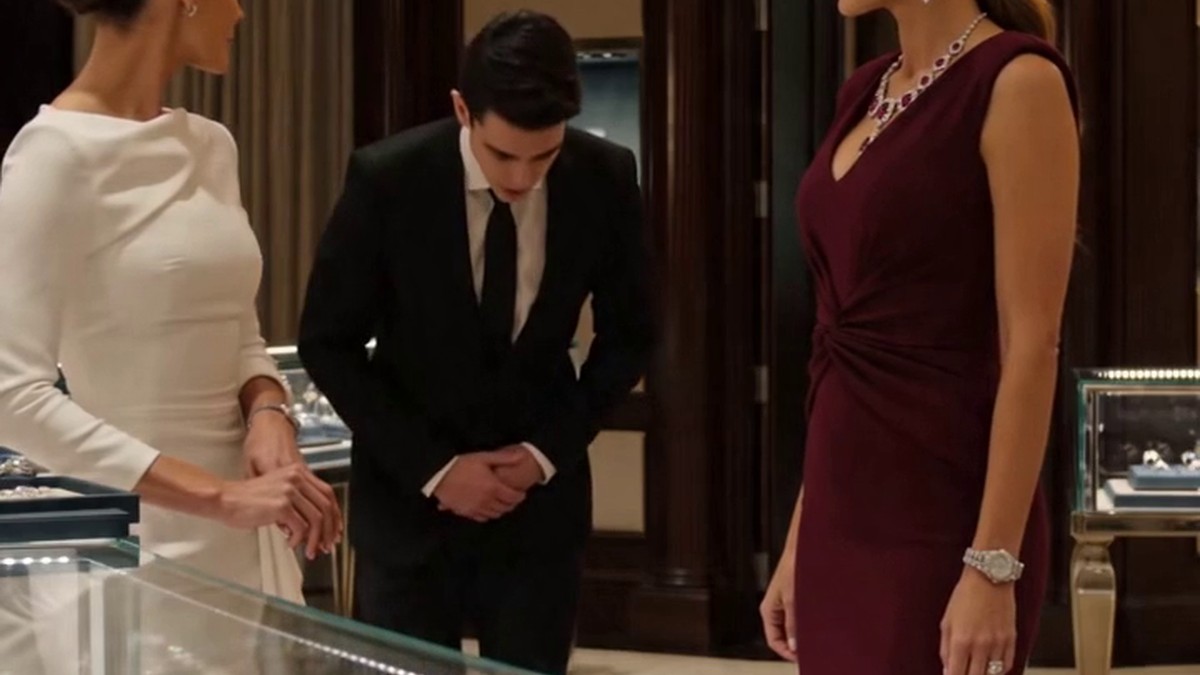
The woman in the wine-red dress moved like she owned the floor beneath her heels, every step deliberate, every glance a small act of cruelty. Gold accents ran along the seams of her outfit like decorative armor. Beside her, a man in a black suit kept pace, watching. She zeroed in on her target: a woman in a clean white blazer standing near the far counter, composed and still.
The red-dress woman didn’t slow down. She didn’t even pretend to think twice.
“You? In here?” A sharp little laugh, just loud enough to carry. “This place is a little out of your league, don’t you think?”
The man in the black suit frowned. He leaned slightly toward his companion, his brow creasing with something between confusion and discomfort.
“Do you actually know her?”
The camera tightened on the woman in white. She didn’t flinch. Didn’t blink. Her jaw stayed level, her gaze steady — the kind of silence that doesn’t come from defeat but from absolute certainty. She was waiting.
The woman in red turned to her companion with the slow, satisfied smile of someone who enjoys the sound of her own contempt.
“I know who she is,” she said. “She never climbed out of the gutter.”
A lie dressed up like a fact. She delivered it with pleasure.
Then the room shifted.
A jeweler’s employee in a fitted black suit cut through the boutique at a near-jog, moving with the kind of focused urgency reserved for people who actually matter. He passed the couple without a glance — didn’t register them, didn’t acknowledge them — and pulled up directly in front of the woman in white, dipping into a short, precise bow.
“Ma’am, I apologize for the wait. Your private collection is ready whenever you are.”
Total deference. Not a trace of doubt about who was important in this room.
The faces of the woman in red and her companion collapsed in the same instant — panic flickering behind the eyes, certainty crumbling, the whole performance falling apart at the seams. The dramatic score swelled and cut sharp.
The screen went dark on exactly that moment. Their humiliation, frozen mid-breath, complete.
The lights didn’t stay dark for long.
They never do.
—
The boutique hummed back into itself — the soft pulse of ambient music, the low conversation at the far end of the counter, the quiet shift of someone near the door pretending they hadn’t been watching. The world resumed. But the air in the room had changed in the way air changes after lightning: sharp, ionized, impossible to ignore.
The woman in white moved toward the employee without a word. She carried herself the way people carry themselves when they’ve long since stopped needing to announce anything. Her heels barely made a sound on the marble floor.
The woman in red didn’t move at all.
She was still standing in the same spot, and something had gone wrong in her posture — that slight collapse between the shoulder blades, the chin dropping half an inch. The man beside her, the one in the black suit, had stepped back without seeming to realize he’d done it. Just a few inches. Just enough.
“Lydia.” His voice came out careful. Low. “Who is she?”
Lydia — because that was her name, the name she wore like the gold on her seams — didn’t answer right away. She was recalculating. You could see it in her eyes, the way a person looks when they’ve played a card facedown and flipped it over to find it wrong.
“It doesn’t matter,” she said, quieter than before.
“It clearly does.”
—
Across the room, the employee — Marcus, his name tag read, gold letters on black — was leading the woman in white through a side door barely visible in the paneled wall. He held it open with the practiced grace of someone who had done this for important people before and understood that importance doesn’t need a performance. It simply is.
But she stopped at the threshold.
She turned around.
It was the first time she’d looked directly at Lydia since the whole thing started, and the look itself was not what Lydia expected. No satisfaction. No cold smile to mirror her own. Just a kind of quiet attention — the way you might look at something that used to hurt you and notice, with faint surprise, that it no longer does.
“Lydia,” she said.
One word. The name dropped into the room like a stone into still water.
Lydia’s jaw tightened. “I wasn’t talking to you.”
“No,” the woman in white agreed. “You were talking about me.” She took a step back from the doorway, back toward the floor. “You’ve been doing that for a long time. I thought I should finally be here when you did it.”
The man in the black suit turned slowly toward Lydia. “You’ve done this before?”
—
There’s a particular silence that follows a question like that — not empty silence, but loaded silence, the kind that holds too many answers and none of them good. Lydia opened her mouth. Closed it. Opened it again.
“She’s nobody,” she said, and the word came out frayed at the edges. “She came from nothing. We all knew it. She always acted like she was better than—”
“Her name,” Marcus said, and his voice was polite in the way a closed door is polite, “is Catherine Ellison.”
He said it simply. He didn’t need to say more. But the man in the black suit heard it, and something moved across his face — recognition, then the particular horror of someone who has just understood exactly how badly they misread a room.
Catherine Ellison.
The name that appeared in the financial section. The name on the foundation that funded the community arts wing three blocks over. The name that, six years ago, had quietly purchased the building that housed the very boutique they were standing in.
Lydia knew the name. Of course she knew it. That was the thing that was unraveling her from the inside out — she had known it all along and chosen, in her performance of contempt, to pretend she didn’t.
—
Catherine let the silence do its work.
Then she walked back to the center of the room — not aggressively, not theatrically — just to the place where she could be seen clearly, and she looked at the man in the black suit first, because he hadn’t been cruel to her, only complicit, and there was a difference.
“She and I grew up in the same neighborhood,” Catherine said. “Same block, actually. Same school for two years.” She paused. “She used to be kind. In the third grade she gave me half her lunch because mine had been stolen.” Another pause, and something almost tender moved through her expression before she shut the door on it. “I’ve never forgotten that.”
The man turned to Lydia with something new in his face. Not anger. Worse. Disappointment, the kind that ages a relationship ten years in ten seconds.
Lydia’s composure was gone now — not explosively, not in tears or shouting, but the way expensive makeup melts under heat. Slowly, and then all at once. The gold accents on her dress caught the boutique’s light and threw it back and it looked, for a moment, less like armor and more like decoration. Something worn for an audience that was no longer watching.
“I built a life,” Catherine said, and her voice was quiet but absolute. “You told yourself a story about me that made it easier for you not to. That’s fine. That’s yours to carry.” She tilted her head, the smallest degree. “But don’t do it in front of me again.”
—
She turned back toward the side door.
Marcus held it open again, and she stepped through without looking back, and the door closed with a sound barely louder than breathing.
The boutique settled into itself. Music, low light, the cases full of things that existed to remind you where you stood.
The man in the black suit straightened his jacket slowly, deliberately, like a man deciding something. He didn’t look at Lydia when he spoke.
“I’m going to get the car,” he said.
“Daniel—”
“I’ll get the car.”
He moved toward the exit, hands in his pockets, and the boutique employees found other things to look at, the way people do when they’ve witnessed something they’ll tell later, at home, quietly, in their kitchens.
—
Lydia stood in the center of the room alone.
The gold necklaces caught the light. The diamond rings refracted it into bright little shards across the glass cases. The air smelled of money and something else now — not judgment, exactly. Something more intimate than that.
She reached out and touched the glass of the nearest case. Cool under her fingertips.
In the third grade she had given half her lunch to a girl who’d had hers stolen. She had forgotten that. She had let herself forget it, carefully, over years, because it was easier to rewrite a person than to explain why you’d stayed small while they’d grown.
Catherine Ellison, the sign should have said. This building belongs to Catherine Ellison.
But it didn’t say that. It just held the light, the way beautiful things do, indifferent to who was looking.
Lydia’s hand dropped from the glass.
She walked out into the afternoon without buying anything, the door swinging shut behind her, the bell above it chiming once — light, clean, and final.