Every day, dozens of students walked through its doors. Some chased dreams of the grand stage. Others were sharpening their skills for competitions. And a handful simply wanted to move better, to push themselves deeper into the world of dance.
The school’s lead choreographer was a young man named Daniel.
Young in age — not in discipline. He had already carved out a name for himself as one of the sharpest instructors around. Students respected him for it. In his studio, there was no drifting, no half-measures. Every movement was either right or it was done again.
That morning, the main hall was running its usual rehearsal.
Music filled the room as dancers worked the barre. Some were drilling pirouettes. Others were hammering out their jumps. Daniel moved between them like a current, never still, always watching.
— Higher with that leg.
— Keep your spine straight.
— Don’t lose your center.
— From the top. Again.
The room had a pulse. A focused, almost electric hum.
Then the door swung open.
Every head turned.
Standing in the doorway was an elderly woman.
She looked to be around eighty years old.
She wore a black ballet training dress, white tights, and a pair of clean ballet slippers. Her silver hair was pulled into a precise bun. A small gym bag hung from her hand.
Silence held the room for a long beat.
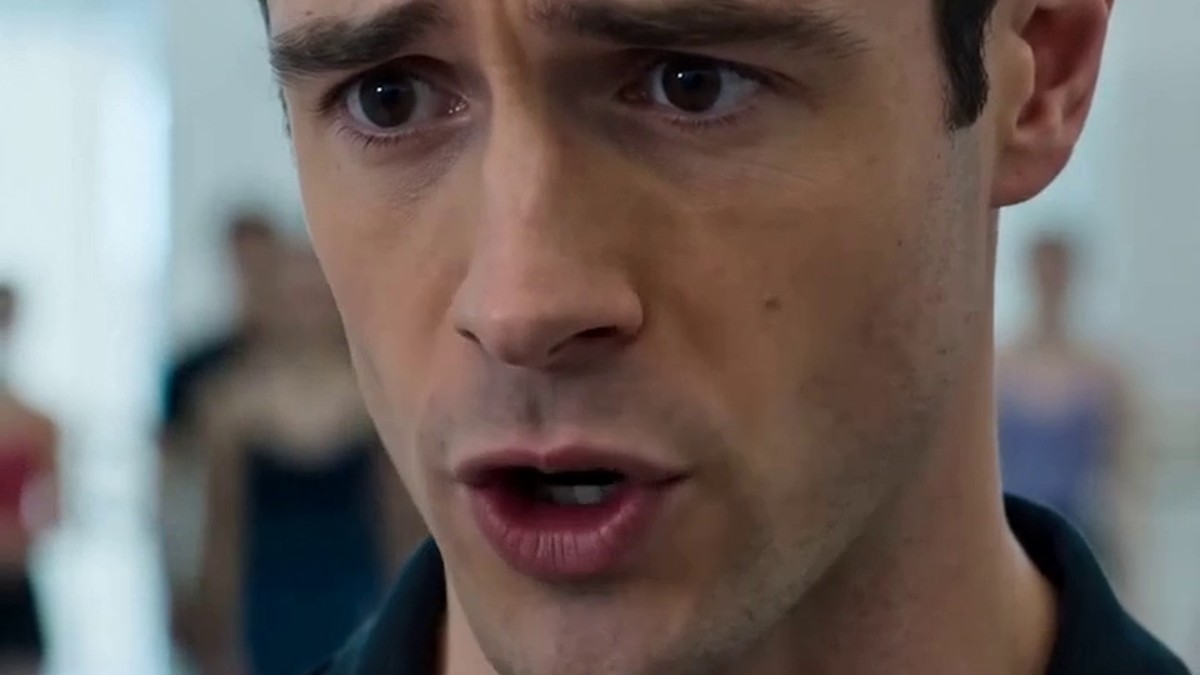
Then Daniel’s brow folded and he walked toward her.
— Ma’am, I think you may have the wrong address.
The woman looked at him, steady and unhurried.
— No. I’m here for the ballet class.
A few students exchanged glances.
Smiles were already forming at the edges of the room.
Daniel exhaled slowly.
— I understand, but ballet places serious demands on the body. At your age, the risk of injury is real — joints, a fall, a fracture. And that responsibility falls on me.
— I won’t be breaking anything.
— Even so, I can’t take you on.
— Why not?
— Because ballet isn’t the right place for someone like you.
The woman’s eyes stayed level.
— Someone like me — meaning what, exactly?
He hesitated. Just a flicker.
— Elderly. You won’t be able to go en pointe, let alone execute turns or grand allegro work.
A ripple of laughter moved through the hall.
Some students weren’t even trying to hide it now.
One girl turned away and pressed her hand to her mouth.
A young male dancer near the mirror shook his head slowly.
— She actually came here to dance?
— Must’ve mixed this up with a seniors’ social club.
The laughter spread, a little louder this time.
The woman stood there and let it all wash over her.
Not a flicker of anger crossed her face. No wounded pride. No trembling lip.
Just stillness.
And then she did something that stopped every single person in that room cold.
She set down her bag.
Slowly. Deliberately.
She walked to the center of the floor.
No one spoke. No one moved. The music had stopped — someone had killed it without even realizing they’d done it. The only sound was the soft press of her slippers against the hardwood.
She reached the middle of the room and stopped.
She stood with her back straight and her chin level and her hands loose at her sides. Not performing stillness. Just inhabiting it — the way a building inhabits silence. The way old stone holds cold.
Then she lifted her arms.
First position.
The motion was unhurried. Unhurried but absolutely precise. Her wrists curved with the kind of muscle memory that doesn’t come from practice. It comes from ten thousand hours of practice, burned so deep it becomes reflex, becomes breath, becomes bone.
She rose onto demi-pointe.
Both feet. Clean as a line drawn with a ruler.
And then she began to move.
—
No music.
She didn’t need it.
She moved through a sequence — a slow adagio, arms unfolding like something waking up after a long winter — and the room went so quiet that you could hear the air in it. You could hear the fabric of her dress. You could hear your own blood.
The girl who had pressed her hand to her mouth dropped her hand.
The young man near the mirror stopped shaking his head. He stood very still, the way you stand when you’re watching something you don’t have words for yet.
Daniel didn’t move at all.
He stood where he’d stopped when she crossed the floor, and he watched her, and something in his face was changing. The professional distance — the instructor’s practiced remove — was draining out of it. What replaced it was rawer and more honest.
Recognition.
She went into an arabesque.
Her standing leg held firm. Her extended leg rose — not to the height of a twenty-year-old, no, the years had taken that — but the line of it, the intention of it, was so clean and so true that it didn’t matter. It was like watching a sentence written by someone who has spent their whole life learning exactly which words to use and which ones to leave out.
Perfection isn’t always the same as flawlessness.
Sometimes it’s something quieter. Something older.
Something that knows.
—
She held the arabesque for a long beat.
Then she came back through to center, transitioned through a slow relevé, and lowered herself down with the same deliberateness she’d used for everything else. She let her arms return to her sides. Her chin stayed level.
She looked at Daniel.
He opened his mouth.
He closed it.
“Who are you?” he finally said. And the question came out differently than he’d meant it to. He hadn’t meant it to sound like an answer to something. But it did.
The woman reached into the collar of her training dress and drew out a thin chain. A small pendant. She turned it between her fingers and then let it fall against her chest without showing him what it was.
“My name is Eleanor Marsh,” she said.
One of the older students near the barre inhaled sharply.
Daniel looked at her.
“Abramova’s student,” the student said, barely above a whisper. “The Eleanor Marsh. From the Kirov. From — she was the first American soloist the Kirov ever—”
“Second,” Eleanor said, with a small correction that was not unkind. “Gina Torres was first. I was second.” A beat. “We argued about it constantly.”
The room had changed shape.
It was the same room — same mirrors, same barre, same afternoon light coming through the high windows — but it held something different now. A new weight. The good kind. The kind that comes when a place has been visited by something real.
Daniel stood in the center of it and looked at the woman he had nearly turned away.
—
He took a breath.
“I owe you an apology,” he said.
Eleanor regarded him.
“Yes,” she said. “You do.”
Not cruel. Not warm. Just honest. The way someone speaks when they have stopped needing approval from the room they are standing in.
“I assumed,” he said. “I saw your age and I assumed you couldn’t—”
“You assumed I was here to be managed,” she said. “Not taught.”
He took that. Didn’t deflect it. Didn’t reach for a qualification.
“Yes,” he said. “That’s what I did.”
She studied him for a moment, the way a teacher studies a student who has just made the first correct movement after a long string of wrong ones. Seeing whether it’s real. Seeing whether it will hold.
Then something softened slightly at the corners of her eyes.
“I’ve been dancing for seventy-two years,” she said. “I don’t need you to protect me from ballet. I need you to give me something worth doing in the time I have left.”
The silence that followed wasn’t uncomfortable.
It was the kind that forms after something true has been said, and everyone in the room needs a moment to let it settle into them.
—
Daniel picked up the remote and turned the music back on.
He walked to the barre.
“From the beginning,” he said. “All of you. But this time—” he glanced toward Eleanor “—I want you watching her port de bras. Not just seeing it. Watching it. Because what she does with her arms is what most of you have been missing for the last six months and you don’t know it yet.”
No one laughed now.
No one looked away.
Eleanor took her place at the barre — not in the back, not tucked away, but mid-center, where the light was good and the angles were visible — and she lifted her arms again.
First position.
The music started.
And the room, which had begun the day as just another rehearsal, became something else: a place where seventy-two years of devotion stood at a barre and showed twenty-year-olds what it looked like to truly mean it.
—
Afterward, when the session was over and students were gathering their bags and filtering out into the hallway, the young man who had stood by the mirror — the one who had shaken his head, who had said *she actually came here to dance* — crossed the room to where Eleanor was carefully rolling the top of her gym bag closed.
He stood there for a second, not quite knowing how to start.
She looked up at him.
“I’m sorry,” he said. “For earlier. I was—”
“Young,” she said.
He blinked.
“That’s not an excuse,” she added. “But it is a reason. And reasons can be worked with.” She picked up her bag. “Come back tomorrow with your arms a little softer and your pride a little quieter, and we’ll see.”
He nodded. Opened his mouth. Closed it.
She walked past him toward the door.
Daniel was standing there.
He held the door open for her, and she paused in the frame, and she looked at him the way you look at someone when you’ve decided, provisionally, to give them a second chance.
“Tomorrow,” she said.
“Tomorrow,” he said.
She walked out into the corridor. Her slippers were silent on the floor. Her back was straight. Her chin was level.
The door swung shut behind her.
And in the studio, in the mirror-lined room where the afternoon light was going golden and the music had gone quiet again, not one person moved for a long moment.
They were all still seeing it.
The arabesque. The arms. The absolute certainty of someone who had chosen one thing — one hard, beautiful, demanding thing — and had never once let go of it.
Seventy-two years.
And counting.