She wasn’t wearing shoes.
She drifted to a stop right beside my chair.
I was at dinner with Veronica — the woman I intended to spend the rest of my life with.
The child gripped the fabric of her dress in both fists.
“I’m hungry,” she said, barely a whisper. “Can I have something to eat?”
Veronica pressed her fingers to her lips.
“That is absolutely revolting.”
The girl’s chin dropped to her chest.
I should have slid my plate toward her without a second thought.
Instead, with every eye in the room on me, I let vanity do the talking.
“You have to go.”
She turned to leave.
That’s when I saw it — a thin silver chain looped around her neck.
My hands went cold.
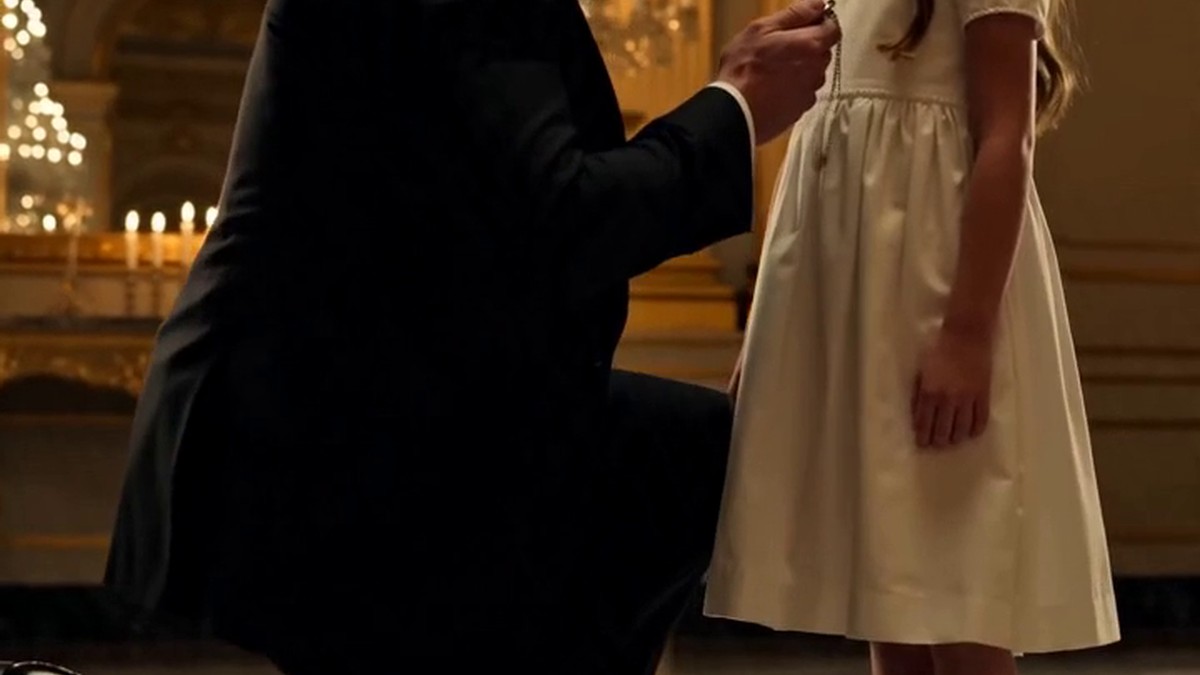
I caught the heart-shaped locket before she could take another step.
“Where did you get this?”
The little girl flinched.
“My mom gave it to me.”
That locket had been made for my daughter, Anna, on her sixteenth birthday. I had tucked a photograph inside — Anna and her mother, who was already gone by then.
Eight years ago, Anna walked out the door after I refused to bless her marriage to a young mechanic with nothing to his name.
I was certain she’d come back.
She didn’t.
After her husband died, my investigators hit wall after wall — no address, no bank records, nothing solid to follow.
I clicked the locket open.
The photograph was still there.
On the other side sat a newer picture — Anna, holding this little girl.
“What is your mother’s name?”
“Anna Reed.”
The ballroom walls dissolved.
Anna had taken her husband’s last name when she left.
I went down on one knee in front of the child.
“What do they call you?”
“Maisie.”
“Where is your mother right now?”
Her eyes filled.
“She got sick. They took her away in an ambulance.”
Veronica’s hand landed hard on my shoulder.
“That child could have stolen that necklace off someone’s neck.”
Maisie shook her head.
Then she reached into the locket herself and drew out a small square of paper, folded tight.
My home address, in Anna’s handwriting.
Below it, six words.
*Find my father before it’s too late.*
I read those six words three times.
Each time, they landed like a fist to the sternum.
My fingers wouldn’t stop shaking. I folded the paper carefully and pressed it into my breast pocket, against my heart, where it belonged.
Veronica squeezed my shoulder harder.
“Sit down. You’re making a scene.”
I looked up at her hand. Then I looked at her face — that perfectly composed, immaculate face I had been planning to wake up next to for the rest of my life.
I stood slowly.
“Take your hand off me.”
Her eyes went to glass. “Excuse me?”
“I said take your hand off me.”
She did. Then she laughed, the way people laugh when they want a room to believe they’re in on the joke.
“You cannot be serious. You don’t even know that child.”
I looked at Maisie. She was watching me with enormous dark eyes — Anna’s eyes, I realized. I had just been too rattled to see it.
“She’s my granddaughter,” I said.
The word landed in the room like something dropped from a great height.
I bent down and picked Maisie up. She weighed almost nothing. She smelled like rain and cold air, as if she’d been walking for a long time.
She wrapped her arms around my neck without hesitation.
Children do that. They decide to trust you before you’ve earned it.
I carried her straight out of the ballroom.
—
She’d come from St. Catherine’s Hospital on Meridian Avenue — she told me this in the car, her chin propped on my shoulder, her voice flat with the particular exhaustion of a child who has been frightened for too long.
Her mother had collapsed at their apartment that morning. A neighbor called 911. Maisie had ridden in the back of the ambulance, holding Anna’s hand, until a nurse told her she had to wait outside.
She’d waited for two hours.
Then she remembered the piece of paper her mother kept tucked inside the locket. The paper Anna had told her to use only if something very bad happened.
So Maisie had walked.
Four miles. No shoes, because she’d left them beside her mother’s bed for when Anna woke up.
I kept my eyes on the road and said nothing for a long moment.
Then I said, “You were very brave.”
She pressed her forehead against my jaw. “Is my mom going to die?”
I had spent thirty years in boardrooms learning how to answer questions I wasn’t prepared for.
I had nothing.
“I don’t know,” I said. “But we’re going to get to her right now.”
—
St. Catherine’s smelled like antiseptic and coffee and the particular kind of dread that accumulates in waiting rooms. A nurse at the front desk looked at me the way people look at expensive suits — with a species of suspicion that money tends to produce.
I told her who I was. She pulled up a screen, typed something, looked at me again.
“Are you immediate family?”
“She’s my daughter.”
Another pause. Another look.
“Room 408. Cardiac wing. But sir, visiting hours—”
I was already moving.
—
The door to room 408 was half open.
I stopped in the hallway.
Anna was in the bed with her eyes closed and an IV line in her arm and a monitor above her tracking her pulse in green peaks. She looked smaller than I remembered. Her hair, which had always been black and long, was cropped short now. There were lines at the corners of her eyes that hadn’t been there when she was twenty-three.
Eight years.
I had lost eight years of watching those lines form.
Maisie slipped down from my arms before I could stop her. She crossed the room in four quick steps and climbed into the chair beside the bed and took her mother’s hand in both of hers.
That was when Anna opened her eyes.
She found Maisie first. Relief moved across her face in a wave. Then she looked past her daughter, toward the door where I was standing with both hands in my pockets because I didn’t know what else to do with them.
Her expression didn’t collapse or soften. It just went very still.
“Maisie,” she said. “Go ask the nurse for some juice, sweetheart.”
“Mom, I don’t want juice.”
“Please.”
Maisie looked at me. Then at her mother. She slid off the chair and padded out past me without a word, though she let her small hand graze my wrist as she went.
The door fell mostly closed behind her.
Anna and I looked at each other across the length of that room.
I had rehearsed this conversation a hundred times over eight years. I had entire speeches assembled and waiting. Measured, articulate, the kind of thing I was known for.
I crossed the room and I sat in the chair Maisie had just left warm, and I put my elbows on my knees, and I said:
“I’m sorry.”
It came out roughly. Not like a speech at all.
Anna’s jaw tightened. “You should be.”
“I know.”
“He was a good man, Dad.” Her voice cracked on the last word — the first time she’d used it. “You never gave him a chance to show you that. You never gave *me* a chance to show you I knew what I was doing.”
“I know.”
“He worked himself half to death trying to prove something to a man who wasn’t even looking.” She pressed her free hand flat against the mattress. “The shop he built — he built it to show you. Did you know that? He never said it, but I knew. He wanted you to come around one day and see what he’d made.”
My chest had become something mechanical, grinding.
“What happened to him?”
She was quiet for a moment. “Accident at the shop. Three years ago.” She looked at the ceiling. “He was thirty-one.”
The silence after that had shape and weight.
“I looked for you,” I said. “After. My people couldn’t—”
“I didn’t want to be found.” She turned to look at me directly. “I was angry enough to disappear.”
“You had every right.”
She blinked. Like she’d expected resistance and didn’t know what to do with the absence of it.
“The locket,” I said. “Why did you keep it?”
She was quiet for so long I thought she wouldn’t answer.
“Because it had Mom in it.” She said it simply, with no accusation. “I was mad at you. I was never mad at her.”
Her mother’s face — gone eighteen years now — lived in that tiny oval of silver. I had given Anna the locket because I hadn’t known what else to give her. I had never been good at the small expressions. I was better at the large ones: estates, accounts, arrangements. The intimate gestures always arrived too late or too wrong.
Like tonight.
“Your heart?” I asked, nodding toward the monitor.
“Arrhythmia. They’re saying I’ve had it for years without knowing.” A ghost of something crossed her face — wry, tired. “Stress, apparently. Imagine that.”
“Anna.”
“I’m going to be alright. It’s manageable. I just need to—” She stopped. Started again. “Maisie’s been taking care of me more than a seven-year-old should have to. I didn’t have anyone else to call. And I didn’t want her to have no one, if something—” She pressed her lips together hard.
“You wrote my address down for her.”
She nodded once.
“You kept it.”
She nodded again.
Something finally gave way inside my chest. Something I had been propping up with stubbornness and shame for eight years.
“Tell me what you need,” I said. “Tell me what I can do.”
She looked at me for a long time. Her mother’s eyes in her face. Maisie’s eyes in miniature.
“I don’t need your money, Dad.”
“That’s not what I’m offering.”
She searched my face.
“I’m offering to show up,” I said. “Whatever that looks like. However long it takes. I’m not going anywhere.”
The door opened.
Maisie came back carrying a small paper cup of apple juice with the same solemn focus she’d probably used to walk four miles through a cold city in bare feet. She stopped when she saw her mother’s face.
“Mom? Are you crying?”
Anna wiped her cheek quickly. “No.”
“You are.”
“I’m fine, bug.”
Maisie looked at me. Looked at her mother. Then she climbed back into the chair, set her cup on the bedside table, and took Anna’s hand again. She considered the whole situation with the gravity of someone who has been processing complicated adult emotions for most of her short life.
“Is he staying?” she asked her mother.
Anna looked at me.
“Yes,” I said.
Maisie nodded as if this were simply a logistical matter being sorted out. Then she picked up her apple juice and sipped it and rested her head against her mother’s arm.
—
I stayed until midnight.
I stayed until Anna’s breathing went slow and even and the monitor settled into its steady green rhythm and Maisie fell asleep curled at the foot of the bed like a small serious cat.
I stepped into the hallway and stood there for a while.
My phone had fourteen missed calls. Veronica. Then her assistant. Then our mutual attorney, which meant she’d moved quickly and deliberately, the way she moved through everything, and I found I couldn’t locate a single feeling about any of it.
I turned the phone face-down in my hand.
A nurse passed me in the corridor and said nothing.
I thought about a mechanic I’d never met, who had built a shop in a dead man’s line of sight, who had died young without ever getting the acknowledgment he’d worked toward.
I thought about Anna at twenty-three, standing at my door with her bags packed and her chin raised, waiting for me to call her bluff.
I hadn’t.
She hadn’t.
We had both been so convinced of our own rightness that we’d handed eight years to it without even noticing the cost.
Through the window in the door, Maisie shifted in her sleep. Her hand found her mother’s arm and held on.
—
In the morning I brought coffee and a bakery bag from the place two blocks down that Anna had apparently been to before, because when Maisie opened the bag and found the almond croissants she said *these are Mom’s favorite* with the certainty of someone confirming a known fact.
Anna sat up in bed with her hair flattened on one side and hospital light on her face and accepted the coffee without comment.
She took a sip.
She looked out the window.
“There’s a park near our apartment,” she said. “Maisie likes the one with the fountain.”
“Okay,” I said.
“She starts second grade in September. She’s reading already. Actually reading, not just memorizing books.”
“That sounds like you.”
Anna almost smiled. “Don’t push it.”
“Right.”
She held the cup in both hands. Maisie was already onto her second croissant, dusting flakes across the blanket with total contentment.
“One thing at a time,” Anna said. Not to me, exactly. More like a rule she was setting for herself.
“One thing at a time,” I agreed.
It wasn’t forgiveness. Not yet. Forgiveness is built slowly, in small rooms, over ordinary mornings. It doesn’t arrive all at once — it accumulates, the way trust does, the way the lines around the eyes of someone you love accumulate, while you’re busy looking away.
But it was a beginning.
And this time, I wasn’t going to waste it.