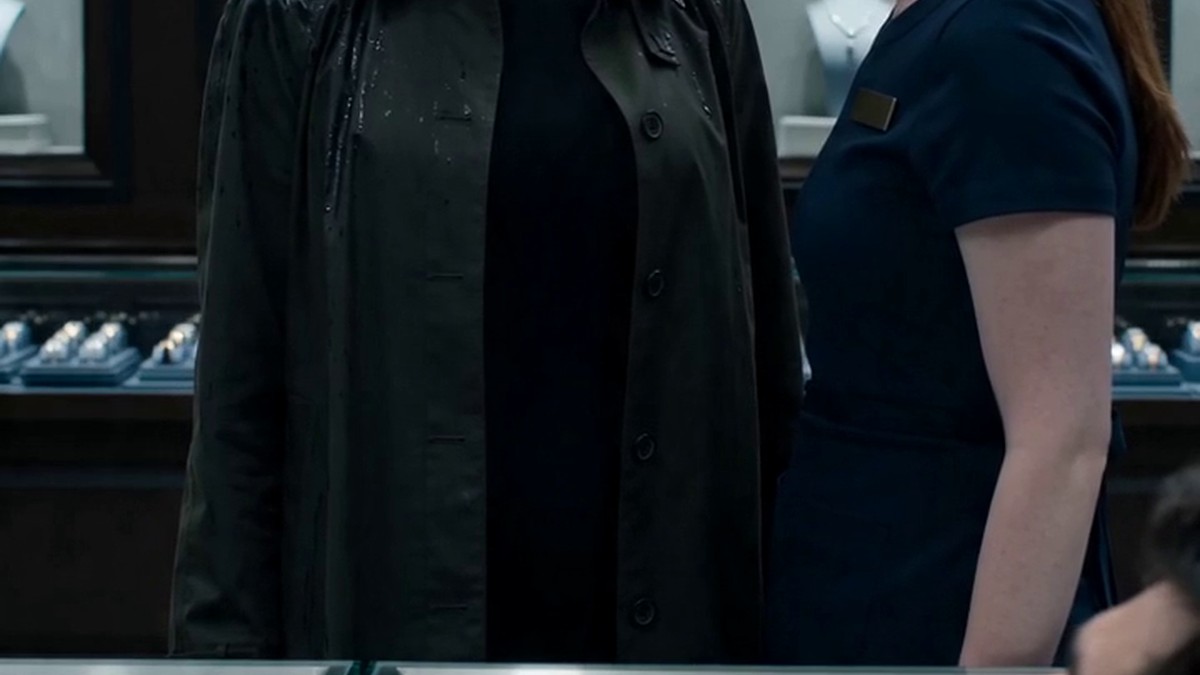
Rain came down in slow sheets over the city when an elderly woman in a wheelchair pushed through the door of Hart & Co. Jewelers.
Her brown coat was soaked through.
Her hands wouldn’t stop shaking.
And pressed against her chest — a watch.
Old.
Small.
The crystal scratched, the strap darkened by decades of wear.
It didn’t look like much. It didn’t catch the light. It carried no diamonds, no flash, no obvious worth.
But the woman held it the way you hold the last thing left of someone you loved.
Behind the counter, Vanessa Cole glanced up.
Black suit, immaculate. Smile, practiced. Eyes, already calculating.
At Hart & Co., Vanessa had learned to sort people fast — those worth her attention, and those who weren’t.
“Good afternoon,” the woman said, her voice barely above a whisper. “I need some help with a watch.”
Vanessa gave it one look. Less than a second.
“We work by appointment only.”
“I can wait.”
“There’s a minimum service fee.”
“I understand that.”
The woman dropped her gaze to the watch in her lap. Her fingers moved across the tarnished metal slowly — not nervously. Tenderly. Like she was touching a face she missed.
Jonah Reed, a young employee barely three weeks on the job, stood still and watched her.
“I just need someone to look at it,” she said softly. “It stopped yesterday.”
Vanessa exhaled — the kind of sigh that isn’t tiredness, it’s contempt dressed up as tiredness.
“Ma’am. That watch isn’t worth the cost of opening it.”
The woman lifted her eyes.
“I didn’t come here to ask what it’s worth.”
The sentence landed and sat there, heavy, in the air between them.
Vanessa didn’t flinch.
“Then I’d suggest trying a repair shop in your neighborhood.”
Jonah stepped forward.
“I can take a quick look. Could be something simple.”
Vanessa turned toward him like a door slamming shut.
“Nobody asked for your input.”
The woman pulled the watch tighter against her chest.
“It belonged to my husband.”
That should have been enough.
It wasn’t.
Vanessa reached across the counter, picked up the watch between two fingers — tips only, like she was handling something she didn’t want on her skin — and held it up just long enough to make her judgment clear.
“We don’t repair feelings here.”
Then she raised her hand.
And dropped the watch into the wastebasket behind the counter.
The sound it made was nothing. A dull knock. The sound a small thing makes when it hits the bottom of a bin.
But the woman flinched like something inside her had just been struck.
For a moment, nobody moved.
The diamonds kept sparkling in their cases. The soft background music kept playing. The rain kept dragging itself down the windows.
And Vanessa said:
“We don’t service junk.”
The woman looked down at her hands.
She didn’t cry.
That was the worst part.
Because some people have been worn down so many times, over so many years, that the tears stopped coming long ago. There’s nothing left to defend yourself with. Just silence.
Customers looked away. The security guard found something interesting to study near the door. Every other employee went perfectly still.
Nobody moved.
Except Jonah.
He came out from behind the counter.
“Jonah.” Vanessa’s voice was a warning.
He kept walking.
“Jonah — don’t you dare.”
But Jonah was already at the wastebasket. He crouched down. Reached in. And pulled the watch out.
It had collected a little dust on the way down.
It was still the same watch the woman had carried in against her heart.
Jonah found a soft cloth and cleaned it — slowly, carefully, the way you handle something that matters even if you don’t yet know why — then knelt beside the wheelchair and set the watch gently into the woman’s trembling palm.
“It matters to you,” he said quietly. “That’s reason enough.”
She looked at him.
And something in her face, something that had gone taut the moment she’d walked in, finally let go.
Vanessa let out a short, cold laugh.
“You just ended your career over this.”
Jonah didn’t look away from the woman.
“Then I’ll lose it for a good reason.”
The whole store went still. Not politely still. Completely, deeply still.
The woman closed her fingers around the watch. Slowly at first — they were still trembling. Then they steadied.
Like she’d just remembered who she was.
She reached into her coat. From an inner pocket she drew out an envelope — cream-colored, old, well-kept, sealed.
Vanessa’s eyes narrowed.
“What is that?”
The woman didn’t answer.
She broke the seal. Unfolded a photograph.
The edges had gone yellow with age. In the image: a young man in a dark suit, standing outside a jewelry store on what must have been its opening day. Beside him, a young woman on his arm. And behind them both, a sign:
Hart & Co.
Same store. Same name. Same dream, decades younger.
And on the young man’s left wrist —
the watch.
The exact watch Vanessa had just thrown in the trash.
The smile disappeared from Vanessa’s face.
She looked at the photograph. Then she looked at the black-and-white portrait mounted on the far wall of the store.
Jonathan Hart.
The founder. The man whose name was on every bag, every receipt, every velvet box, every gold plate mounted beside the entrance.
Same man.
Same watch.
Vanessa took a step back.
“That’s… the founder.”
The woman raised her gaze. Her voice came out quiet.
But every person in that store heard it clearly.
“And I am his wife.”
The room forgot how to breathe.
Jonah was still kneeling. Vanessa had gone the color of chalk. The security guard bowed his head. The customers looked at each other with the particular shame of people who watched something happen and chose not to act.
The woman held the watch against her chest.
“My name is Eleanor Hart.”
The name moved through the room like a current.
Hart.
The woman in the wet coat.
The woman who had been ignored.
The woman who had been humiliated.
The woman who had just been told her husband’s watch was junk.
She was the founder’s widow.
Then the frosted glass door of the private office opened, and Richard Vale, the store’s director, appeared in the frame.
Gray suit. Perfect tie. Face completely drained of color.
But Jonah noticed something the others didn’t, not right away.
Richard didn’t look surprised.
He looked afraid.
Eleanor noticed it too.
She studied him for a long moment, with a sadness that had clearly been living inside her for years.
And she whispered:
“You already knew.”
Richard Vale said nothing.
Which was its own kind of answer.
The silence stretched long enough that everyone in the room understood — not just that he knew, but that he had always known. That he had watched this woman wheel herself through his door, soaking wet, holding her dead husband’s watch like a prayer, and he had made a choice.
He had let it happen.
Eleanor looked at him the way you look at someone who has disappointed you past the point where disappointment has a name.
“I called ahead,” she said. “Three days ago. I spoke to your assistant. I told her my name.”
Richard opened his mouth.
Closed it.
A customer near the door quietly set down the bracelet she’d been examining and walked out. No one stopped her. No one noticed. Every eye in the room was fixed on Eleanor Hart.
“I told her I wanted to come in,” Eleanor continued. “To see the store. To see if it still felt like him.” A pause. “She said someone would be ready to receive me.”
Vanessa’s head turned toward Richard.
Slowly. Like a needle finding north.
And something shifted in her face. Not remorse — not yet. Something colder. The realization that she had been used.
“You told me to be on guard today,” she said, her voice careful and flat. “You told me if an elderly woman came in trying to claim any — association — with the store, to send her away. That she was confused. That there’d been an incident before.”
Richard said, “Vanessa —”
“You told me she wasn’t lucid.”
The word landed in the room like something dropped from a height.
Eleanor closed her eyes for just a moment.
When she opened them, she was still steady.
“My husband built this store with the money we saved for eleven years,” she said. “We lived in a one-bedroom apartment on Clement Street. He repaired watches at the kitchen table. I kept the books by hand in a spiral notebook.” Her thumb moved over the face of the watch in her lap. “This was the watch he wore the day he signed the lease. He said he wanted to remember what it felt like to be starting. So he never replaced it.” A beat. “He wore it until the morning he died. And then I kept it.”
Nobody breathed.
“I have been in a care facility for two years,” she said. “Richard arranged it. He said it was the right thing, after Jonathan passed. He said he would look after the store until the estate was properly settled.” She looked at Richard directly. “That was fourteen months ago. The estate was settled ten months ago. In my name.”
Richard Vale had gone still in the way that large men go still when they realize they are cornered. Not frightened exactly. Calculating. His eyes moved — to the door, to the customers, to Jonah, to the envelope in Eleanor’s hand.
“Eleanor,” he started, “you have to understand the complexity —”
“I came today,” she said, as if he hadn’t spoken, “because my lawyer advised me to. Because there were documents he couldn’t explain. Transfers he couldn’t account for. Contracts signed in the name of the store that didn’t go through the board.” She drew a second paper from the envelope. “Jonathan never had a board. He had a wife.”
She held out the paper.
Jonah, still crouching beside her wheelchair, looked at it.
He was twenty-four years old and three weeks into his first real job and he had no idea what he was reading. But he could see the letterhead. He could see the notary stamp. He could see the words *sole proprietorship* and *surviving heir* and, at the bottom, her signature.
*Eleanor Anne Hart.*
He stood up slowly.
“I’ll call whoever you need me to call,” he said quietly.
She looked at him — this young man who had knelt in the middle of a jewelry store to retrieve something from a trash can because it mattered to someone. This young man who had said *that’s reason enough* like it was the most obvious thing in the world.
“I know,” she said.
Richard took a step forward. His voice dropped into something practiced and smooth, the register of a man who had talked his way through hard rooms before.
“Mrs. Hart, I think if we step into the office and discuss this calmly —”
“I think,” said Eleanor Hart, “that we will discuss it here.”
It was the same quiet voice she’d used all along.
But something was different in it now. Not harder. Just — complete. Like a door finally closing on a room that had been left open too long.
Richard stopped walking.
“My husband loved this store,” Eleanor said. “He loved it the way some men love a child — not because it was perfect, but because he had made it and it was his, and he was responsible for it.” Her fingers, completely steady now, moved once more across the watch face. “He would come home some nights and tell me about the customers. Not the sales. The customers. The woman who brought in her grandmother’s brooch. The man who needed his father’s cufflinks resized for his son’s wedding.” She paused. “He believed that every piece of jewelry in this store was a chapter of someone’s life. That we were, in a small way, the keepers of those stories.”
The store was utterly silent. The background music had stopped at some point — no one could have said when.
“And today,” Eleanor said, “I walked in here carrying the last chapter of his, and someone threw it in the trash.”
Vanessa Cole had been standing motionless for several minutes. Her face had passed through contempt, then anger, then the particular white vacancy of someone confronting the exact shape of their own worst moment. She was not a stupid woman. She understood what she had done. And she understood, too, that she had done it because she had been shaped by this place — by its metrics and its sorting and its quiet daily cruelty — into someone who could do it without hesitating.
She looked at the watch in Eleanor’s hands.
She looked at the wastebasket.
She looked at Jonah.
She said nothing. There was nothing adequate to say. So she said the only thing she could.
“I’m sorry.”
It wasn’t enough. She knew it wasn’t enough. The words dropped into the room and lay there, small and insufficient against the size of what they were trying to cover.
Eleanor looked at her for a long moment.
“I know,” she said again. And that was all.
Two of the customers had left. The others remained, caught — the way people are caught when they witness something they know they will not forget. The security guard near the door had his head bowed, one hand pressed flat against the wall beside him.
Richard Vale made one more attempt.
“I’ve only been protecting the store’s interests. Jonathan would have wanted —”
“Don’t.” Eleanor’s voice was very soft. “Don’t tell me what Jonathan would have wanted. I was married to that man for fifty-one years. I know what he wanted.”
She reached into her coat one final time.
The last item from the envelope was a business card. She held it out, and Jonah took it.
“That’s my attorney,” she said. “Would you be willing to call her and let her know I’m here? She’s been waiting.”
“Yes,” Jonah said. “Absolutely.”
He was already moving toward the phone at the counter — his counter, the one he’d stood behind for three weeks learning the difference between platinum and white gold — when Eleanor said his name.
He turned.
“Jonah.”
She was looking at him with an expression that made him feel, for a reason he couldn’t have fully articulated, like someone had just handed him something fragile and told him he was exactly the right person to hold it.
“The watch,” she said. “Would you be able to look at it? The movement, I mean. I’d like to know if it can be fixed.”
He came back. Took it gently from her outstretched hand.
He turned it over. Opened the caseback with a tool from the counter, the way the senior watchmaker had shown him in week one. Looked at the movement inside.
It was old. A manual wind, mid-century, Swiss. The coil spring had simply run down — not broken. Not worn. Just stopped.
He looked up.
“It just needs winding,” he said. And he could hear, in his own voice, the wonder of it. “That’s all. It’s fine. It’s been fine all along.”
Eleanor Hart looked at the watch. Then she closed her eyes, and her chin dipped slightly toward her chest, and the breath that came out of her was slow and long, the kind that carries something with it when it goes.
When she opened her eyes, they were bright.
Jonah wound the watch carefully, the small crown turning between his fingers, feeling the spring take up tension. He listened. Looked. Then he heard it.
The tick.
Small, steady, clean.
The watch resumed its counting of time as if it had simply been resting.
He held it out to Eleanor. She took it. Pressed it against the center of her chest and held it there with both hands.
And she sat in that store — her store, as it turned out, had always been her store — and listened to it keep time against her heartbeat. And nobody in that room said anything, because there was nothing to say that would improve upon the sound of a watch that had been rescued from a trash can and now ticked steadily against the chest of the woman who had always been its rightful keeper.
Richard Vale left quietly. No one asked him to leave. He simply went, the way people go when they have been seen completely and have nothing left to argue. His attorney would call the following morning. Eleanor’s attorney would be ready.
Vanessa Cole gathered her things from beneath the counter. She set her employee badge on the glass, very precisely, in the center. She put on her coat. She walked to the door.
She paused.
She turned back — not toward Eleanor, not quite — more toward the space between them. Toward something she couldn’t name.
Then she walked out into the rain.
—
The watch, the jeweler’s report later confirmed, was a 1961 Longines manual movement in remarkable condition. Conservatively valued — though Eleanor had no interest in the valuation. She had the crystal replaced, the case polished, the strap fitted with new leather. She wore it on her wrist to the first board meeting she chaired the following month.
Jonah kept his job.
He didn’t receive a promotion, not right away. He received something rarer — a conversation with Eleanor Hart in her office on a Tuesday afternoon, in which she asked him what he wanted to learn and then listened to his answer for a long time before she spoke. She told him that Jonathan had always said the best people in this business were the ones who understood that jewelry was not about objects.
It was about the weight of what people carry, and the care with which they carry it.
Jonah thought he knew what she meant.
He is beginning to.
—
Outside, the rain had slowed to something barely there — more mist than rain, catching the late light from the store window in small bright points, as if the air itself was threaded with something worth keeping.
The sign above the door read *Hart & Co.*
It always had.
Now it simply meant what it was always supposed to mean.