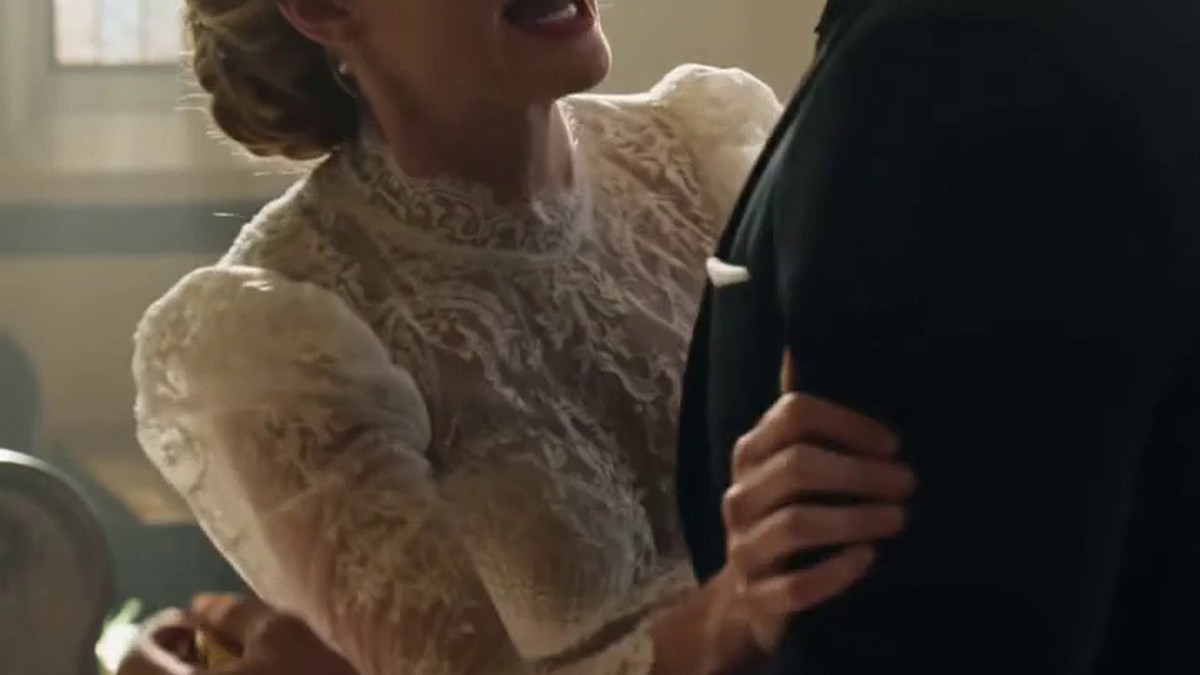
A woman in a long beige dress cut straight down the center aisle, moving like someone who had already decided the cost was worth it. Guests turned. Whispers died. Whatever she was clutching in both hands, she wasn’t letting go.
She reached the altar.
The bride stepped forward to meet her. White lace mask, crystals catching the light, and underneath it all — fury. Pure, uncontained fury.
“You ruined my wedding.” Her voice could have cut glass. “Why were you touching my husband’s things?”
The woman in beige didn’t step back. She broke open instead — tears spilling, hands pressed together, trembling fingers wrapped around an antique pocket watch on a thin metal chain.
“Please.” Her voice cracked on the word. “Just have him open it first. One second. That’s all I’m asking.”
The bride didn’t give her a second. She reached out and snatched the watch with a violence that silenced the entire room, then turned her back.
“Give me that watch. Now.”
But it was the groom who caught it. Young, tuxedoed, composed just long enough to take it from her hands and open it himself — maybe to settle things, maybe out of instinct he couldn’t name.
The gold case swung open.
Inside, worn soft at the edges, a sepia photograph stared back at him. A young woman. A face from another time that had no business being there.
His eyes went wide.
Not surprise. Something colder than surprise — recognition landing like a blow.
The woman in beige held his gaze and didn’t flinch. Tears ran freely down her face as she spoke the words that turned the chapel into a courtroom.
“The same woman in the hidden photograph my mother kept. The one she carried for twenty-five years without telling a single soul.”
The silence that followed was total.
One last shot of the groom — frozen, breathless, the life he thought he was stepping into dissolving in real time beneath his feet.
“What are you telling me?” he managed. Barely a voice. Barely a sound.
And then the world came down.
The chapel exhaled. Then it inhaled again, wrong, the way a room does when everyone realizes they’ve witnessed the first line of something that can’t be unwritten.
The woman in beige — her name was Clara, though no one in that room knew it yet — pressed her fingertips to her collarbone and found her breath.
“Her name was Marguerite Holt,” she said. “She was twenty-two years old in that photograph. She spent the next forty years pretending she didn’t exist.”
The groom’s jaw worked silently.
“That’s my mother,” he said.
Not a question. A body identifying its own wound.
Clara nodded once. Something in her face broke open wider, the way grief does when it finally finds the person it’s been looking for.
“I know,” she said. “I know it is.”
—
The bride hadn’t moved.
She stood three feet to the left of the altar, the bouquet still clenched in her fist, crystals catching the candlelight in a way that seemed obscene now — all that brightness in the middle of all this. Her maid of honor reached for her arm. She shrugged it off without looking.
“Explain.” One word. Flat as iron.
Clara didn’t look at the bride. She looked at the groom — at his face, which had gone the color of old bone — and she said it quietly, the way you say something you’ve rehearsed ten thousand times in the dark.
“My mother was Elena Vasquez. She cleaned hotel rooms in Galveston for thirty-one years. She never married. She never talked about her past. But when she got sick last spring — really sick — she started talking. She’d wake up at three in the morning and she’d say this name. *Marguerite. Marguerite.* Over and over, like a prayer she’d been saving.”
The groom pressed the gold watch case to his chest without realizing he’d done it.
“When she was lucid enough,” Clara continued, “she told me. She and your mother — Marguerite — they were close. Twenty years ago, before I was born. Your mother had a secret she’d been carrying since she was a girl. A son she’d given up. Adopted out through a private arrangement, no paper trail, no record. She was seventeen. She had no choice. Or she believed she didn’t.”
Somewhere in the pews, a woman began to cry — soft, private, barely audible.
“My mother kept that photograph because she was the only person Marguerite ever told. The only one who knew you were out there somewhere.” Clara’s voice dropped. “She made me promise. Before she died. She made me find you first.”
“First,” the groom repeated.
“Before you built your whole life on a foundation she — before you —” Clara stopped. Started over. “Your mother tried to find you. Twice. The agency gave her nothing. She stopped looking after your grandmother threatened to cut her off entirely if she kept disrupting things. She carried that guilt until the day she died.”
The groom closed his eyes.
The bride moved then — not toward him, but around him, positioning herself like a point of land against a rising tide.
“This is insane,” she said. The fury had not left her voice. It had simply changed shape. “You walked into my wedding with a story and an old photograph and you expect us to — what? You expect us to just —”
“I have letters,” Clara said.
The word dropped into the room like a stone into water, and the ripples went everywhere at once.
“Letters your mother wrote to mine. Nineteen of them, over twelve years. She wrote about the boy she’d given up. She described him.” Clara reached into the beige folds of her dress and produced a small bundled packet, rubber-banded and worn at the corners. “She described the exact shape of his eyes. The way he laughed too hard at his own jokes before anyone else even smiled. The birthmark he had behind his left ear.”
The groom’s hand went to the back of his left ear.
A reflex. Pure and damning.
The bride saw it. The whole chapel saw it.
“She described him,” Clara said, her voice barely holding now, “so that I would know him when I found him. So I wouldn’t make a mistake.” She looked at the groom with something that was too exhausted to be hope and too alive to be grief. “I didn’t make a mistake.”
—
For a long moment, no one moved.
Then the groom sat down on the altar steps — just sat down, right there in his tuxedo, on the marble — and pressed both hands over his face.
The bride stared at the back of his bowed head. The bouquet loosened in her grip, stem by stem, without her seeming to notice.
The officiant — a silver-haired man who had been standing frozen behind the pulpit for the last four minutes — took a single step forward and then thought better of it.
Clara stood where she had always been standing. She didn’t move toward him. She understood, maybe better than anyone, that some distances can only be closed from one direction.
She waited.
It was the bride who finally broke the architecture of the moment. Not with fury this time. Something else — something less practiced, more human.
“Did you know?” she asked. Her voice came out small. “Did you know before today that you were —”
“Adopted,” the groom said, from behind his hands. “I always knew I was adopted. They told me when I was six.” He lifted his face. His eyes were dry, which somehow made it worse. “What I didn’t know was that she was looking for me. That she — I thought she just —”
He stopped.
Tried again.
“I thought she just didn’t want me.”
The words fell out of him like something that had been lodged there for thirty years, waiting for exactly the right moment to finally break loose.
Clara crossed the distance between them. She didn’t ask permission. She sat down on the altar steps beside him — this stranger she had spent eleven months and most of her savings finding — and she held out the bundle of letters.
“She wanted you,” Clara said. “She wanted you so much it ate her alive.”
He took the letters. He held them the way you hold something you’re afraid to open and more afraid to put down.
Around them, the chapel had gone completely still. The candles burned. The white flowers caught the light. The guests in their seats had become something more than witnesses — they’d become the ring of people who happen to be present when someone’s life divides itself cleanly into before and after.
The bride lowered herself to one knee on the cold marble floor in front of him. Her gown pooled around her like a tide. She reached up and pulled the lace mask from her face with both hands, and set it aside, and looked at him with nothing between them.
“Hey,” she said quietly.
He looked at her.
“We don’t have to do anything right now,” she said. “Okay? We don’t have to decide anything.”
Something in his face shifted. Not resolution — something softer than that. Permission.
He looked at Clara. She was watching him steadily, the way people watch when they’ve wanted something for so long that actually having it feels unreal.
“Did she —” He cleared his throat. “Did she say anything else? About — about what she wanted me to know?”
Clara reached into her dress one more time.
A single folded page. The paper soft from handling, the ink a little faded. She placed it in his open palm and closed his fingers around it.
“She wrote it for you,” Clara said. “I never read it. It wasn’t mine to read.”
—
He opened it alone.
Not that night — that night was long and complicated and full of conversations that had to be had and guests who had to be released into the dusk. The wedding was not cancelled so much as quietly suspended, the way a held breath eventually becomes breathing again. Some guests hugged them. Some left without speaking. The florist stood in the parking lot for twenty minutes not sure what to do with himself.
The bride sat with Clara in the church’s small side room, two women who had started the day on opposite sides of a door, drinking bad coffee out of styrofoam cups and saying very little and meaning most of it.
He opened the letter on the steps of the chapel, alone, in the blue hour after everyone had gone, when the candles were burning down to their last inch and the white flowers had begun to bow their heads.
His mother’s handwriting was small and careful and slanted slightly left, the way a person writes when they learned it young and never quite unlearned it.
He read it once.
Then he folded it back up along its original creases, placed it inside the gold pocket watch, and closed the case with a quiet click.
He sat there for a while with the watch warm in his palm.
The night came in around him, easy and patient and full of stars, and somewhere past the dark edge of the parking lot a car started up and drove away, and the chapel settled into its old bones, and he breathed.
He thought about a woman he’d never met who had loved him every day of his life from a distance he hadn’t known existed. He thought about a girl in a beige dress who had crossed a room full of strangers to hand him something irreplaceable. He thought about the woman inside who had taken off her mask on a marble floor and said *we don’t have to decide anything right now* — and how that might be the most honest vow anyone had ever made him.
He didn’t have a name for what he was feeling. He wasn’t sure there was one.
But he kept the watch.
He kept the watch, and he kept the letter inside it, and when he finally stood up and went back inside to find the two women waiting for him — he found them at the same table, talking, Clara laughing at something unexpected, her shoulders finally loose — he understood that something had ended here tonight, yes.
But not everything.
Not even close to everything.
Some things, it turned out, were only just beginning.