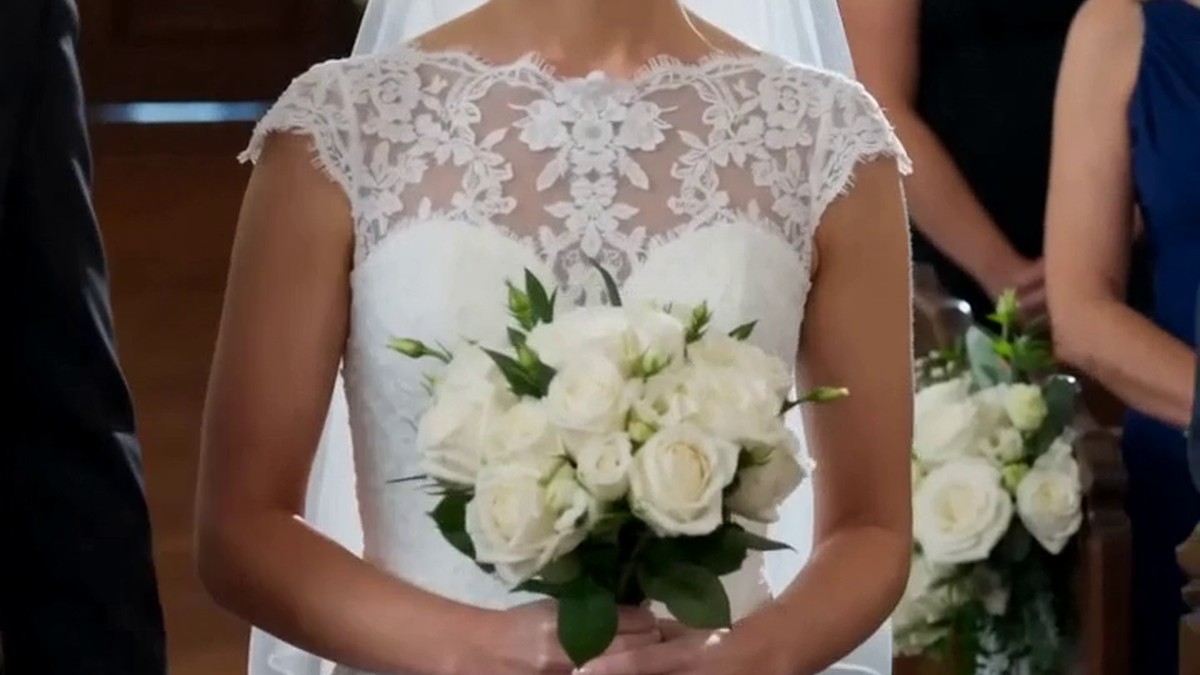
Helen Grant stumbled backward against the floral arch, one hand flying to her cheek. The white roses swayed above her. Every guest in the hall went perfectly still.
Halfway down the aisle, the bride stopped walking. Her bouquet shook in her grip like something alive.
Victoria Brooks stood her ground in front of Helen, pearls trembling at her throat, face contorted beyond anything a wedding day should hold.
**Groom’s Mother:** “Stay away from my husband.”
Helen lowered her hand slowly. The red mark bloomed across her cheek. She didn’t look like a woman caught. She looked like a woman who had been carrying something unbearable for a very long time.
Her eyes drifted past Victoria — past the frozen guests, past the wavering candlelight — and found Martin Grant standing near the front pew. He looked like a man who had just watched the floor disappear beneath his feet.
**Bride’s Mother:** “Maybe say that to yourself.”
The violinist’s bow stopped mid-stroke. The silence that followed had weight to it.
Martin’s color drained. Sophie — the bride, his daughter — shifted her gaze between her parents with the expression of someone watching two worlds collide. Ethan Brooks, the groom, stared at his own mother as though seeing a stranger wearing her face.
Then Martin stepped forward. Shoulders down. Eyes down. Everything down.
**Bride’s Father:** “She was with me last night.”
That landed harder than any slap.
Charles Brooks, Victoria’s husband, grabbed the back of the nearest pew like the room had tilted. Ethan’s voice cracked when he finally spoke.
**Groom:** “Mom. Tell me he’s lying.”
Victoria’s mouth opened.
Nothing came out.
Sophie looked at the man she had planned to spend her life with. Then she looked at the people standing behind them — her father, his mother — each one holding a different shape of betrayal.
She pulled the engagement ring off her finger with one quiet, deliberate motion.
**Bride:** “Both families lied to us.”
The wedding was over before the vows ever had a chance to begin.
The ring made a small, bright sound when it hit the stone floor.
Nobody moved to pick it up.
Sophie set her bouquet down on the nearest pew — gently, almost tenderly, as though the flowers were not to blame — and walked toward the side door of the chapel without looking back. Her dress whispered against the floor. That sound was the loudest thing in the room.
Ethan watched her go. He didn’t chase her. He was still standing in the exact spot where his world had rearranged itself into something unrecognizable, and his legs hadn’t yet remembered how to function.
Then he turned to his mother.
“How long.”
It wasn’t a question. The period was audible.
Victoria opened her mouth again. The pearls at her throat caught the candlelight one last time before her hand came up to cover them, as if she could physically hold back whatever truth lived there.
“Ethan—”
“How. Long.”
Charles Brooks let go of the pew. He straightened slowly, the way a man straightens when he has decided that dignity is all he has left and he will not surrender it in a church. He looked at his wife — really looked at her — and something passed across his face that was worse than anger. It was recognition. The quiet, devastating click of a puzzle piece that had always been slightly wrong finally snapping into place.
“Tell him,” Charles said. His voice was very soft. “Tell our son.”
Victoria’s composure fractured along a line that must have been there for years.
“It wasn’t — it wasn’t what it looks like right now—”
“It was last night,” Martin said, from behind her. His voice was flat and airless, emptied out. “And the night before that. And before that, Victoria.”
He wasn’t looking at Victoria. He was looking at the floor, at some middle distance between the altar and the door Sophie had walked through, as though he could still see the shape of what his daughter’s face had looked like. As though he would be seeing it for a very long time.
Helen hadn’t moved from her spot near the arch. The red mark on her cheek had deepened to something livid. She stood very still, arms at her sides, and she did not speak. There was nothing in her posture that resembled innocence. There was nothing in it that resembled guilt, either. There was only exhaustion — the particular exhaustion of a person who has been keeping a secret that was never really hers to keep alone.
A woman near the back of the hall whispered something to her husband. Someone’s chair scraped. One of the flower girls had started to cry in the confused, reflexive way small children cry when the emotional weather in a room turns suddenly dangerous. Her mother scooped her up and carried her out without a word.
The guests were beginning to understand they needed to leave. They moved in clusters toward the doors, not quite looking at one another, carrying the story they would be telling for the rest of their lives.
But the six of them — Martin, Helen, Victoria, Charles, Ethan, and the empty space where Sophie had been — remained frozen in the wreckage at the front of the church.
Ethan crossed the distance to his mother in four steps.
He was not a man who raised his voice. He never had been. It was something Sophie had once told Helen she loved about him, back when Helen was still someone Sophie confided in, back before all of this. *He gets quiet when he’s upset. Not cruel. Just quiet. Like he’s thinking.* He was quiet now. His eyes were red at the rims, but his jaw was set.
“I need to know if you knew who she was,” he said. “Before the engagement. I need to know if you knew.”
Victoria looked at him for a long moment. Something moved behind her eyes.
“I suspected,” she said. “When Martin came to the rehearsal dinner. I recognized him. The way he—” She stopped. Started again. “I thought I was wrong. I wanted to be wrong.”
“But you weren’t.”
“No.”
“So you said nothing.” Ethan’s voice didn’t break. It thinned. “You let Sophie walk down that aisle today — you let her get this far — and you said nothing.”
“I didn’t know what to say.”
“You could have said *stop*.” His voice cracked on the last word, just slightly, and then he pressed his lips together and looked away. Toward the ceiling. Toward the stained glass where the morning light was cutting through in long, colored blades. “You could have said stop before today. Before the dress. Before the — God, before the *invitations*—”
Charles put a hand on his son’s shoulder. Ethan didn’t shrug it off. He stood there, his father’s hand on him, staring upward at the light, doing the private arithmetic of how much time and love and hope had gone into preparing for a marriage that had just been executed in a matter of minutes by the people who were supposed to love them both most.
Helen finally moved. She reached down and picked up the ring from the floor.
She held it in her palm and looked at it for a moment — the small, careful diamond, the delicate band, the whole compressed future of it — and then she walked to Ethan and held it out to him.
He looked at her hand. At the ring. At her face.
“She’ll want this back eventually,” Helen said. “Not now. But eventually.”
Ethan took it without a word and put it in his jacket pocket.
Martin looked at Helen across the altar space between them. Twenty feet of marble and memory and the ruins of two families. The look on his face was not love exactly. It was something older and more tired than love. It was the look of a man who had made choices he believed were private and was only now fully comprehending that private things become public eventually, that they grow, that they leak through the walls of even the most carefully constructed lives.
“I’ll tell her,” he said quietly. “Everything. I’ll tell Sophie everything.”
“She deserves to hear it from you,” Helen said.
“I know.”
“Not later. Today.”
“I know.”
He walked toward the side door. The same door Sophie had used. His footsteps echoed in the emptying chapel.
He stopped at the threshold and turned back, once, and looked at the space — the flowers, the candles, the pews, the scattered programs with his daughter’s name printed on the cover in gold script — and his expression was the expression of a man attending a funeral and knowing that the death was partly his doing.
Then he went through the door.
Helen stood alone near the altar.
Victoria was still there. She hadn’t moved since her son had stepped away from her. She stood in the center aisle with her shoulders slightly rounded, her composure fully gone now, her face raw beneath the makeup. She looked older than she had an hour ago. She looked like a woman meeting herself honestly for possibly the first time.
She and Helen looked at each other across the empty church.
No more crowds to absorb them. No more ceremony to impose its rules. Just two women and the long, tangled thing between them.
“I didn’t plan it,” Victoria said. Her voice was barely above a whisper.
“Neither did I,” Helen said. “For whatever that’s worth.”
It wasn’t worth very much. They both knew it.
“Did you love him?” Victoria asked. And then she shook her head, a small, quick motion, as if catching herself. “Don’t. I don’t want — I don’t need—” She pressed her fingertips to her eyes. “I don’t know why I asked that.”
“Because it would change something,” Helen said. “If the answer was no.”
“Would it?”
Helen considered her.
“I don’t know,” she said, honestly.
Charles stepped to his wife’s side and touched her elbow. Not warmly. Not coldly. The touch of a man who has not yet decided what he feels and is too disciplined to perform an emotion he hasn’t sorted out. “We should go,” he said.
Victoria nodded once. She didn’t look at Helen again. She let her husband steer her down the aisle, between the empty rows, past the abandoned programs and the rice in little paper cones that would never be thrown.
At the door, Charles paused.
He looked back at Helen.
“I’m sorry,” he said. “For my wife’s—” He stopped. Reorganized. “I’m sorry you were struck.”
It was a strange, formal thing to say. It was also, Helen understood, the truest thing he was capable of saying in that moment. He was a man standing in the rubble of his marriage, and he was still trying to be decent. There was something almost unbearable about that.
“Thank you,” she said.
He nodded and walked out.
The doors swung shut behind them, and the sound rang once in the empty chapel and died.
Helen stood alone among the roses.
She looked at the arch above the altar, the white flowers still perfectly arranged, still beautiful, still completely indifferent to what had happened beneath them. A single petal detached and floated down, slow and spiraling, and landed on the stone floor like a small, private punctuation mark.
She thought about Sophie. About the look on her daughter’s face when she had finally understood — that particular sequence: confusion, then calculation, then the awful crystalline clarity of it all. Sophie had always been quick. Too quick, sometimes. Quick enough to do the math before anyone else could intercept it, before anyone could soften the answer.
Helen had not protected her from this. That was the truth she would carry out of this building. She had protected herself — her own privacy, her own complicated life — and her daughter had walked down an aisle in a white dress into the center of it.
The candles were still burning.
She blew them out, one by one, moving along the altar rail in the empty church, until only the colored light from the stained glass remained, falling across the stone floor in long, broken patterns.
Then she went to find her daughter.
Sophie was in the small garden on the south side of the chapel, her dress spread around her on a stone bench, her heels off, her bare feet on the grass. She was not crying. She was looking at the sky with the focused expression of someone performing careful, necessary emotional surgery on themselves — deciding what to save, deciding what to cut away.
She heard her mother’s footsteps and didn’t turn.
Helen sat down beside her on the bench. The stone was cold through the fabric of her dress. Neither of them spoke for a long moment.
A bird moved somewhere in the hedgerow. Traffic hummed faintly beyond the garden wall. The city continuing its indifferent business.
“How long have you known?” Sophie said.
“That Martin was seeing someone.” Helen paused. “Long enough that I should have told you sooner.”
“That’s not what I asked.”
Helen closed her eyes briefly. Opened them.
“Six months,” she said. “I’ve known who Ethan’s mother was for six months.”
Sophie absorbed this. Her profile didn’t change. Only her hands tightened briefly in her lap.
“So at Christmas,” she said. “When we all had dinner. You already knew.”
“Yes.”
“Why didn’t you—”
“Because I was afraid.” Helen said it plainly, without decoration. “I was afraid of exactly this. I kept thinking there was a version of events where it would just — resolve. Where your father would end it, or I would end it, and no one would ever have to—” She stopped. “I was wrong.”
Sophie turned and looked at her mother.
There were so many things in that look. Grief and fury and love and the particular exhaustion of someone who has just had their faith in the fundamental stability of things shattered before noon on what was supposed to be the best day of their life.
“I love Ethan,” Sophie said.
“I know.”
“That doesn’t go away because our parents were stupid.”
“No,” Helen agreed. “It doesn’t.”
Sophie looked back at the sky. A long, quiet beat.
“He’s going to need time,” she said. “We’re both going to need time.”
“That’s allowed.”
Sophie reached over and took her mother’s hand. Not warmly, exactly. Not forgivingly, exactly. But she took it, and she held it, and she didn’t let go.
“You’re going to tell me everything,” Sophie said. “Later. When I can hear it.”
“Yes.”
“All of it.”
“All of it,” Helen said.
The garden held them in its late-morning quiet. The roses along the wall were a deep, saturated red, and the light was the kind of light that makes everything look like it matters, which is either a comfort or a cruelty depending on where you’re standing.
Helen didn’t know yet which one it was.
She suspected it was both.
She held her daughter’s hand in the ruins of the morning and waited for whatever came next.