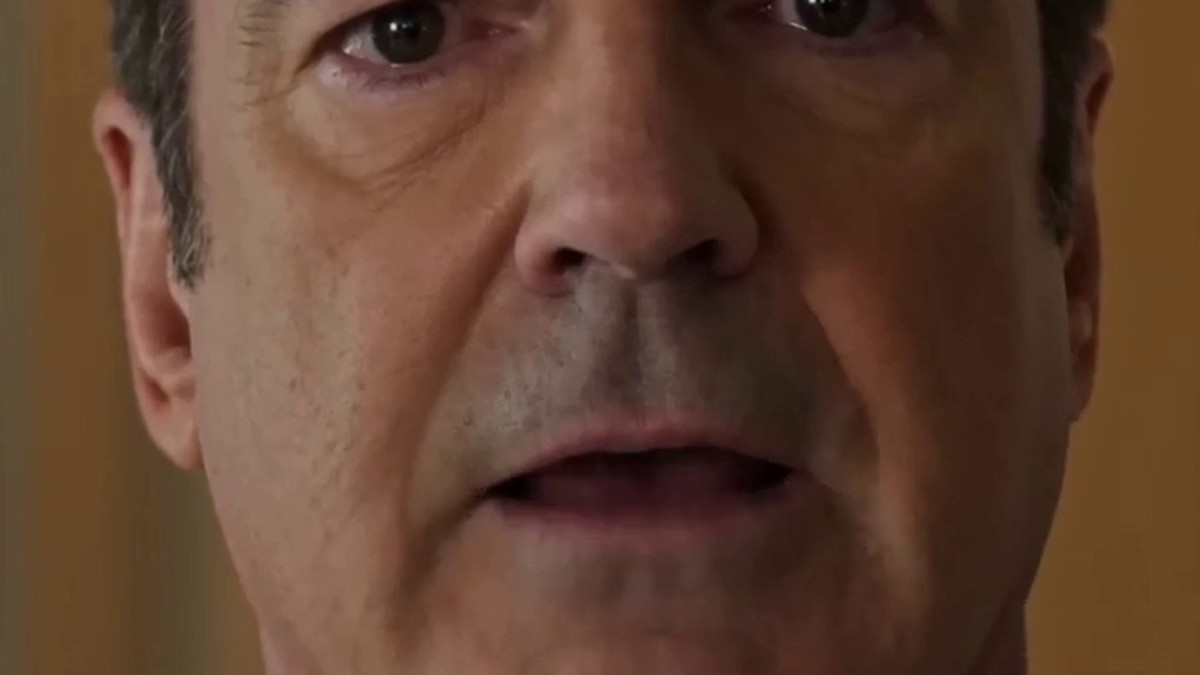
Nobody moved.
Marianne Whitaker stood in the center of the bridal suite, a pale strip of fabric twisted in her grip. Across from her, Evelyn Moore pressed the torn edge of her sleeve against her arm — and that’s when the light caught it.
A gold bracelet. Sliding into view like a confession.
Marianne’s expression cracked before she could stop it.
She knew that bracelet. Not the way you know jewelry. The way you know a scar.
She had worn it on her twenty-fifth anniversary. Her husband had looked her in the eyes and told her it was lost — somewhere on a business trip, gone, what a shame.
It was not lost.
It was on another woman’s wrist.
When Marianne spoke, her voice had no softness left in it. “Stay away from my husband.”
Evelyn didn’t flinch. Her eyes were glassy with tears she refused to let fall, and her chin stayed exactly where it was. “Then ask him why he keeps finding his way back to me.”
The bride, Lily Moore, stood between them, looking from her mother’s wrist to the bracelet to her mother’s face. “Mom.” Her voice was quiet and scared. “Where did that come from?”
A sound at the doorway.
Richard Whitaker had gone the color of old ash. He was standing at the threshold, perfectly still, as though stillness might make him invisible.
It didn’t.
Behind him, his son Ethan — the groom — had stopped breathing.
No one had heard them come in. No one had known they were there.
Richard’s throat moved as he swallowed.
“I gave it to her.”
Marianne turned and looked at her husband the way you look at something you are seeing clearly for the very first time.
“You gave her my anniversary gift.”
Not a question. Never going to be a question again.
The room had gone so quiet you could hear the silk of Lily’s gown whispering as she shifted her weight.
Ethan stepped around his father. His face was doing something complicated — the jaw tight, the eyes moving fast, assembling a picture he’d been refusing to assemble for years. He looked at Evelyn Moore. He looked at the bracelet. He looked at his father standing in the doorway like a man waiting for a verdict.
“How long,” Ethan said. It wasn’t quite a question either.
Richard opened his mouth. Closed it. The silence answered for him.
“How *long*,” Ethan said again, and this time it had an edge that could cut glass.
“Ethan —” Richard started.
“Don’t.” The word landed flat and final. “Don’t say my name like that right now.”
Lily hadn’t moved. She was standing in the center of the room in ten thousand dollars worth of lace and hope, and she was looking at her mother with an expression Marianne recognized — she had worn that expression herself, a long time ago, in a different room, before she’d learned not to ask certain questions.
“Mom.” Lily’s voice had changed. It was steadier now, and somehow that was worse. “Tell me.”
Evelyn’s chin was still up. But her hand had dropped to her side, and the bracelet caught the light again — gold, small, damning — and she let out a long breath through her nose.
“It wasn’t supposed to be today,” Evelyn said quietly. “It wasn’t supposed to be ever. It ended.”
“When?” Marianne asked.
“Three years ago.”
“And before that?”
Evelyn looked at her. Really looked at her, and for just a moment, something human and exhausted moved across her face. “Eleven years.”
The number dropped into the room like a stone into still water. The ripples went everywhere.
Marianne laughed. It was a short, ugly sound, nothing like her real laugh, and it scared everyone in the room including herself. Eleven years. Ethan had been in high school. She had been planning her twenty-fifth anniversary party. She had been calling caterers and choosing flowers and thinking that they had made it — that whatever roughness there had been in the early years had smoothed itself out the way she’d always believed it would.
She looked at Richard.
He was still standing in the threshold, half in and half out, like a man who hadn’t decided yet which world he belonged to.
“Come in,” she said. “Or leave. But stop standing in the doorway.”
He came in.
That was its own kind of answer.
—
Lily sat down on the edge of the chaise in her wedding dress. Just sat down, suddenly and completely, as though her legs had made a decision without consulting her. The veil shifted forward over her shoulder and she didn’t fix it.
“I knew something was wrong,” she said, to no one in particular. “I always knew. I thought it was me.”
“It was never you,” Evelyn said sharply. The first sharp thing she’d said. “Don’t you dare make it yours.”
“I spent ten years thinking our family was —” Lily stopped. Pressed her lips together. Started again. “I thought we were just *sad*. I thought that was just how families were. Quiet and careful and nobody quite looking at each other at dinner.” She looked up at her mother. “That was why.”
Evelyn said nothing.
“Was it —” Lily gestured vaguely toward Richard, and the gesture encompassed everything — the bracelet, the years, the ruined morning. “Was he the only one?”
“Yes,” Evelyn said. “And I’m not going to defend it.”
“Good,” Lily said. “Because I wasn’t going to let you.”
Ethan was standing very still near the window. He’d put some distance between himself and his father without appearing to move, the way you drift away from something without acknowledging that you’re drifting. He was looking out at the garden where the chairs were set up in rows, the white ribbons already tied to the ends of the aisle, the florist’s assistant still fussing with an arrangement near the altar.
People were already arriving. Marianne had seen a car in the drive on her way upstairs.
She thought about that — the guests, the schedule, the cake in the kitchen, the photographer checking his light — and she felt the whole architecture of the day pressing down on her from outside, and she thought: not yet. Give me one more minute inside this room before the rest of it.
“Richard.” She said his name the way you say the title of a book you’ve already finished. “The bracelet. When you said it was lost —”
“I know what I said.”
“Did you think I’d forget? Did you think —” She stopped herself. Reorganized. “What exactly did you think?”
He looked older than he had an hour ago. That was the thing about a truth finally arriving — it aged everyone in the room. “I didn’t think,” he said. “I just kept not thinking. That was how it worked.”
“Eleven years of not thinking.”
“Yes.”
“And you,” she said, turning to Evelyn. “You came today. You came to your daughter’s wedding wearing the thing.”
Evelyn looked down at her wrist. For the first time since the sleeve had torn, something like shame moved across her face. “I forgot I had it on. I know how that sounds.”
“It sounds like you wanted to be caught,” Marianne said.
The silence confirmed it. Even Evelyn didn’t argue.
—
It was Lily who broke it.
She stood up from the chaise. Smoothed the front of her dress with both palms, a slow and deliberate gesture, like someone pressing a letter flat before sealing it. She reached up and fixed her veil.
Then she looked at Ethan.
He turned from the window.
They looked at each other across the wreckage of the room — across the parents and the secret and the bracelet and the eleven years of what everyone had quietly agreed not to know — and something passed between them that was private and load-bearing and not for anyone else in that room.
“Are you okay?” he asked.
“No,” she said. “Are you?”
“No.”
She nodded. That seemed to be what she needed to hear.
“Then we’re honest,” she said. “That’s where we start.”
She walked to the door. Paused with her hand on the frame and looked back at her mother. Her voice was quiet, but it had iron in it.
“After the ceremony,” Lily said, “we’re going to talk. All of us. In a room, with no one standing in the doorway.” She looked at Richard. Then back at her mother. “Both of you owe me a real conversation. Not today. But soon. And you’re going to give it to me.”
Evelyn nodded once, something collapsed and grateful in it.
Richard said, “Yes.”
Lily left.
Ethan followed her.
—
Marianne stood alone with Richard and Evelyn and the gold bracelet and the particular silence of a thing that has finally been named.
She looked at the bracelet one more time.
Then she looked at her husband.
“Take me home after this,” she said. “We have a lot of not thinking to undo.”
He didn’t argue. He didn’t try to reach for her hand or tell her it would be all right. He had the decency, at least, to understand that there were no right words yet — that there was only what came next, and it would be hard, and it would take a long time.
“Okay,” he said.
Marianne straightened her jacket. She picked up her clutch from the vanity table. In the mirror, she looked at her own face — the face of a woman who had just seen something clearly for the first time and could not now unsee it — and she thought: *well*. Well.
She walked to the door.
Outside, in the June light, a string quartet had started to play.
The guests were finding their seats.
Down a long white aisle, between rows of white ribbons and summer flowers, two people who had chosen honesty as their starting place were about to make a promise.
Marianne stepped out of the bridal suite and walked toward the music.
She did not look back.