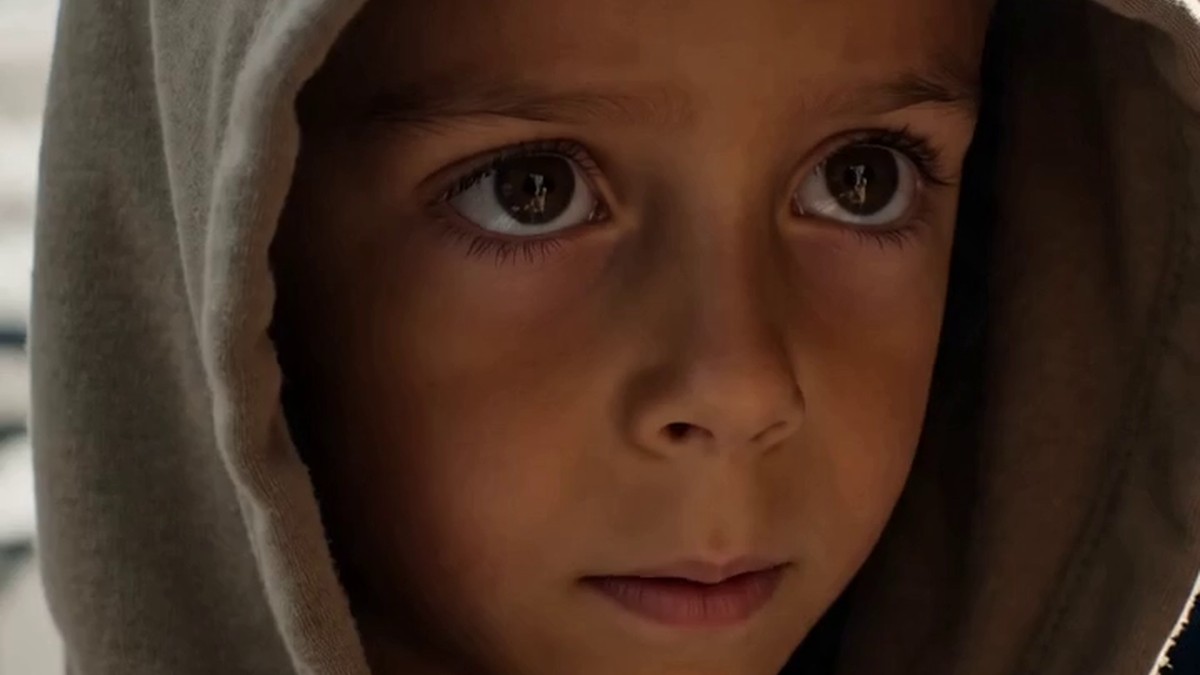
People assumed he was another stray kid drifting too close to the patio. Bare feet on hot pavement. Grime streaked across his cheeks. A hoodie three sizes too big swallowing his whole body. But something about the way he stood stopped people cold. No trembling lip. No outstretched hand. No fear.
Just his eyes — fixed directly on her.
The woman near the fountain set her coffee down with the careful precision of someone buying herself a single second. The boy took another step forward. Around them, tourist cameras swung over without anyone quite deciding to aim them.
“…she has the same hair,” he said. Barely above a breath.
The woman manufactured a laugh. It didn’t hold. “I’m sorry?”
“My mom told me I’d find you here.”
Every drop of color left her face at once.
His hand moved to his hoodie pocket and came back out holding a ribbon — old, soft, its edges unraveling from years of being carried instead of stored. The crowd’s collective exhale was audible when they saw it. The pattern matched the ribbon laced through the woman’s hair exactly. Same rare design. Same tiny initials stitched into the fabric.
“She said you’d call it impossible,” the boy murmured. His eyes had gone glassy, tears built up and refusing — somehow — to fall.
The woman surged to her feet so fast her chair cracked against the stone behind her.
“Where is she?” The question came out as a whisper scraped raw.
The boy gave her nothing.
Instead he turned — slow, deliberate — toward the crosswalk glowing green across the street.
A woman was standing there in the light.
Still. Watching.
And just as the camera swung wide enough to find her face —
the screen went black.
The video cut out at four seconds past the two-minute mark. It had eleven million views by morning.
Comments flooded in faster than anyone could read them. *Who is she? Where was this filmed? Is the boy okay?* Someone freeze-framed the final image — a pale smear of a face across a boulevard, blurred by distance and bad compression — and posted it in seventeen different forums before sunrise. Algorithms fed it to strangers who couldn’t say why they kept watching it again.
Nobody knew the café. Nobody knew the city. Nobody knew the ribbon.
But everyone felt the thing the video had done to them, that particular ache just below the sternum, the one that arrives when something you’d given up on turns out to still be alive somewhere in the world.
—
Her name was Nora.
She hadn’t slept in two nights by the time the video found her inbox, sent anonymously, no subject line. She’d watched it standing at her kitchen counter in yesterday’s clothes, a cold mug of coffee sweating onto the tile beside her. She watched it four times before she trusted what she was seeing.
Then she sat down hard on the floor and stayed there a while.
The ribbon had been her mother’s. A specific thing, irreplaceable — dark blue silk threaded with a chevron pattern so narrow it looked like stitching from a distance, two initials worked into the tail end in cream thread: *E.H.* Elaine Hartwell. Dead eleven years. Nora had given that ribbon to her sister Claire as a peace offering the last time they’d spoken.
The last time they’d spoken, Claire had told her not to call again.
That had been nine years ago. The boy in the video couldn’t be more than seven.
The woman at the café table — the one whose color had drained from her face the instant she’d seen the ribbon — was a stranger. Just someone who had happened to sit near the fountain, whose hair ribbon had caught a small boy’s eye and sent him one table in the wrong direction before he’d corrected himself. But Nora barely registered her. What she couldn’t stop watching was the moment before the screen went black: the figure at the crosswalk, still and watching, blurred by distance and compression until she was barely more than a pale smear against the afternoon light. Nora had played those final three seconds eleven times, pressing her thumb against the pause icon, trying to sharpen something the camera refused to give her.
She almost could have sworn she knew that silhouette.
—
The café was in Lisbon. It took Nora four hours to find it — the fountain in the background, the particular angle of the afternoon light, the blue-and-white tile visible along the bottom edge of the frame. She booked the first flight she could get, which left at six in the morning, which meant she didn’t sleep that night either.
She sat on the plane with the ribbon’s twin in her coat pocket — she’d always kept the one their mother gave her — and pressed her fingers against it through the fabric for the entire four-hour flight like it was a pulse she was checking.
*She said you’d call it impossible.*
She hadn’t even gotten the chance.
—
Lisbon in October smelled like rain that hadn’t arrived yet, like stone warming in pale sun, like coffee ground fine enough to feel in the back of your throat. Nora walked out of the taxi and stood at the edge of the café’s patio and felt her legs go uncertain under her.
The fountain was there. The same chairs, wrought iron, their backs curling like question marks. She chose a table near the fountain — the one that matched the angle of the video — and she sat down and ordered coffee she wouldn’t taste and she waited.
She didn’t know what else to do.
An hour passed. Then another. The lunch crowd rose and thinned. A waiter asked twice if she was ready for the check and she said no both times without looking up.
She was almost certain she was wrong about everything — the city, the plan, the whole lurching leap of it — when she heard bare feet on stone.
She didn’t look right away. She made herself breathe.
Then she looked.
He was standing at the entrance to the patio. Same hoodie, enormous on him, the hem reaching his knees. Same bare feet. Same terrible stillness. His eyes found hers across the scattered tables and chairs and he didn’t flinch from the recognition he saw in her face, just absorbed it, like a kid who’d been told exactly what expression to expect.
Nora set her cup down.
“You came back,” she said, and her voice was steadier than she had any right to.
The boy crossed the patio and stopped three feet from her table. Up close she could see the shape of his face more clearly than in any frozen frame, and what she saw there pressed the air out of her chest. He had Claire’s jaw. Their mother’s eyes — that particular grey, that particular depth, the kind that looked like they were already accounting for your next sentence before you’d spoken it.
“She said you would,” he said. Matter-of-fact. “She said you’d get on a plane as soon as you saw.”
“Where is she?”
He reached into the pocket of his hoodie. Not a ribbon this time. A folded piece of paper, soft at the creases from being refolded many times, the kind of wear that comes from being read and put away and read again. He held it out.
Nora’s hands weren’t steady anymore when she took it.
—
*Nora —*
*I’ve been writing this letter for three years and I still don’t know how to start it. So I’m going to let Mateus start it for me. He volunteered. You’ll understand when you meet him.*
*I’m sick. It’s been going on for a while and I should have called you eighteen months ago when the diagnosis first came in and I didn’t and I’m sorry. I was afraid of too many things at once to name them all. I was afraid you’d come and it would be terrible between us the way it was the last time and that you’d leave again and I’d be worse off than before.*
*I was afraid you wouldn’t come.*
*I kept the ribbon. I keep it with me. I’ve been telling Mateus about Mom for two years. He asks about her the way kids ask about things they feel like they almost remember but don’t — this particular hunger in the questions. He asked me once if he’d ever meet anyone who’d known her, and I said maybe, and then I said your name.*
*He’s been asking to find you ever since.*
*About the video — I want you to understand how it happened. There was a week in September when I felt almost like myself again. Mateus had been planning something for months, asking about the café near the fountain, asking if he could borrow my phone. I let him. I didn’t know what he meant to do until he’d already done it. He filmed himself approaching a stranger at the patio — a woman whose hair ribbon caught his eye from across the street, some trick of the light — and he used it. He used the confusion, the stranger’s reaction, all of it, because he said he needed something that would make people stop scrolling. Then he uploaded it and sent it to your email himself, from my account. He found your address in an old message I’d saved and never deleted.*
*I should have done this myself, years ago. Instead my seven-year-old did it for me. That tells you something about him. It probably tells you something about me, too.*
*I’m not writing this to make you feel guilty. I’m writing it because I’m tired of being afraid and I’m tired of the nine years and I want you to meet your nephew before — I just want you to meet him.*
*The woman you saw at the crosswalk at the end of the video — that was me. Mateus wanted proof I was there, wanted me in the frame somehow. It was a good week. I was there. I watched him do the whole thing from across the street and I didn’t stop him because I didn’t want to.*
*I’m at the hospital on Rua Saraiva de Carvalho. Room 14. I’ve been here three weeks since that good week ended.*
*If this is too much, if you’re not ready, I understand. I’ve always understood more than I let on. That was maybe the problem.*
*Come anyway.*
*— Claire*
—
Nora read it once. Then she pressed it flat against the table and read it again with her palm over the paper like she was trying to keep it from escaping.
When she looked up, Mateus was watching her with those grey eyes that knew things.
“She cried when she gave me that,” he said. “But not while she was writing it. She wrote it very fast.”
Nora thought about the figure at the crosswalk, blurred and still, watching from across the boulevard. She thought about playing that three-second clip eleven times in her kitchen, pressing her thumb against the pause icon, trying to see clearly what the camera refused to give her. She’d known that silhouette. Some part of her had known it immediately and hadn’t let herself believe it.
“How far is the hospital?”
“I know the bus.”
—
Room 14 was at the end of a corridor that smelled of antiseptic and the particular staleness of air that moves only through machines. A nurse glanced at Nora and then at Mateus and nodded once, the kind of nod that means *we’ve been expecting something like this.*
Claire was awake.
She was smaller than Nora remembered her, or maybe it was the bed, or the light, or nine years of imagining her wrong. Her hair was shorter now, and the ribbon — their mother’s ribbon, its mate to the one in Nora’s coat pocket — was tied around her wrist, which Nora saw and had to look away from for a moment.
They looked at each other across the room.
Mateus sat down in the chair beside the bed with the ease of long practice and picked up a battered paperback from the nightstand and opened it, as though he’d decided this particular part of the plan was for the two women and he was politely stepping out without leaving.
Claire said, “You got on a plane.”
“I got on a plane.”
“I wasn’t sure you would.”
“Yes you were.” Nora’s voice broke on the last word and she didn’t try to stop it. “You were standing at that crosswalk. You watched him do the whole thing. You were sure.”
Something shifted in Claire’s face. Something that had been held very tightly for a very long time.
“I hoped,” she said. “That’s different.”
Nora crossed the room. She sat on the edge of the bed and she took her sister’s hand and she felt against her palm the silk of the ribbon on Claire’s wrist and she thought about their mother wearing it, thought about the kitchen in their childhood home, thought about every year that had been allowed to go past like water past a stone.
“I have the other one,” Nora said. She pulled it from her coat pocket, laid it beside Claire’s hand.
Claire looked at the two of them together for a long time. The same rare chevron pattern. The same faded cream stitching at each tail end. *E.H.* and *E.H.* Reunited in a hospital room in Lisbon, eleven years after Elaine Hartwell had left anyone who loved her.
“Mom would have something to say about that,” Claire said softly.
“She’d say it took us long enough.”
Claire’s laugh was short and a little ragged and entirely real.
From the chair, without looking up from his book, Mateus said: “She would have said *finally.*”
Both sisters looked at him.
“She talked about you,” he told Nora. His grey eyes lifted from the page, steady and serious and somehow ancient for his age. “Mom talks about you a lot when she thinks I’m asleep.” He paused. “I’m not usually asleep.”
Nora looked at her nephew — this small person who had found her across eleven million screens and a continent, who had carried a ribbon through a foreign city on bare feet, who had stood at a café patio and said *my mom told me I’d find you here* with a certainty that had undone a stranger in a single breath.
“How long have you been planning this?” she asked him.
Mateus considered the question with his mother’s seriousness.
“A long time,” he said. “Mom showed me the café near the fountain once. I knew how to get there. I knew what the ribbon looked like.” A pause. “I waited until she was having a good week. So she could be there. So she could see.”
Claire made a sound that was trying not to be crying.
“A good week,” she said.
“It *was* a good week,” Mateus said, with the calm authority of someone who had decided this and was not interested in debate. Then, more quietly: “This is a better one.”
—
Later, after the light in the corridor had gone amber and the nurses had come and gone and Mateus had fallen genuinely asleep in the chair with his paperback open on his chest, Nora and Claire sat together in the quiet and talked the way they hadn’t in nine years. Not about the fight. Not about what had been said and what it had cost. About their mother’s kitchen. About a summer they’d spent at the shore when they were girls, before anything had gone complicated. About the particular way their mother used to hum without realizing she was doing it.
Small things. Real things. The kind of things that hold the shape of a person long after the person is gone.
At one point Claire fell asleep mid-sentence, which was abrupt and a little frightening until Nora watched her breathe and understood it was just exhaustion, honest sleep, the kind that comes when a thing you’ve been braced against finally stops.
Nora didn’t leave.
She pulled the second chair close and she sat and she watched her sister sleep and her nephew sleep and she held both ribbons in her hands, one in each, and she thought: *eleven years, and it took a seven-year-old and a camera phone and eleven million strangers.*
She thought: *it doesn’t matter.*
She thought: *I’m here.*
Outside the window, Lisbon moved through its evening, all that ancient stone going gold under the last of the sun. Somewhere in eleven million comment sections, strangers were still asking what had happened to the woman at the crosswalk, to the boy with the ribbon, to the look on the stranger’s face when all the color left it.
The answer wasn’t filmed.
It was just this: two ribbons laid flat on a hospital blanket, two women on either side of nine lost years, and a small boy with his grandmother’s eyes sleeping peacefully in a chair — because he’d done what he came to do, and he’d known from the beginning how it would end.
He’d inherited that certainty from somewhere.
From a woman who had hummed without realizing.
From a family that, even when it broke, had never quite let go.