For most people, it was comfort. A refuge.
For ten-year-old Ethan, it was agony.
His stomach cramped as his eyes locked onto an abandoned plate at a nearby table. Half a triangle of toast. A scattering of home fries. One lonely strip of bacon curled at the edges.
Practically nothing.
To him, it looked like salvation.
He hadn’t put food in his mouth in almost two days.
He edged closer, slow and careful, and stretched his fingers toward the toast.
A hand crashed down on the plate like a gavel.
“Just what do you think you’re reaching for?” The manager’s voice cracked through the room like a whip.
Every conversation died instantly.
Ethan went completely still.
“I… I’m just hungry.”
“That’s what thieves say.”
Before a single person could move or speak, the manager snatched the plate, crossed to the trash can, and scraped every last scrap into it. The metal lid swung shut with a hollow clang that rang through the silence like a verdict.
Everyone watched.
Not one person stood up.
Ethan dropped his chin to his chest, biting down hard against the burn behind his eyes.
Then a voice came from somewhere behind him.
“That’s enough.”
The diner’s cook walked out through the kitchen doors.
He didn’t say another word. He simply turned and went back the way he came.
A few minutes went by.
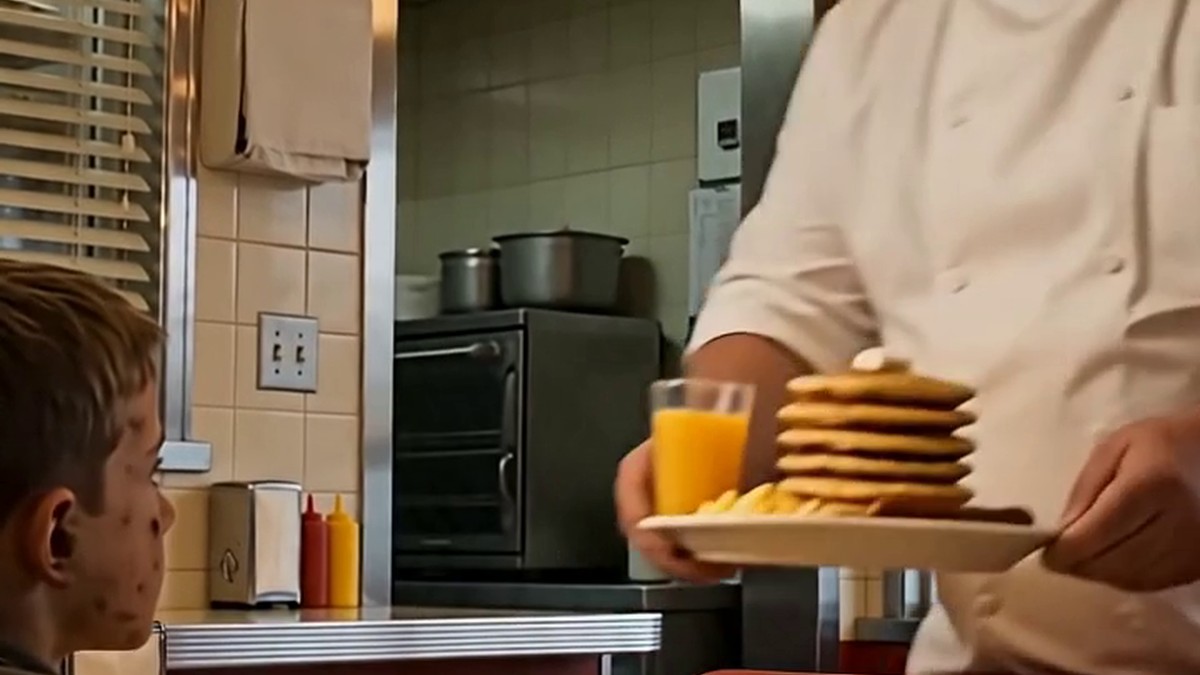
He returned carrying a plate that stopped Ethan cold — a breakfast so full and real it barely seemed possible. Tall pancakes glistening with syrup. Scrambled eggs. Fat sausage links. A tall glass of orange juice catching the light.
The cook set it down in front of the boy without ceremony.
“Sit,” he said quietly. “And eat.”
Ethan stared at the plate, then up at the man.
“No catch?”
The cook’s face softened into a grin.
“No catch.”
Ethan ate. Somewhere between the first bite and the last, tears ran down his face and he didn’t bother to stop them.
When he finally pushed back from the table, he dug into his pocket and produced a coin — silver, old, scratched nearly smooth by time and handling.
“It’s everything I’ve got,” he said, barely above a whisper.
The cook folded Ethan’s fingers back over it and pressed his hand shut.
“Hold onto it.”
Ethan gripped the coin tight inside his fist.
Then he raised his eyes and looked straight at the man who’d fed him.
“I’ll come back for you,” he said. A promise, not a pleasantry. “One day.”
The cook smiled and nodded the way adults do when they don’t believe something but don’t want to say so.
He never expected to see that boy again.
Twenty years dissolved like smoke.
Then, on a gray and rain-soaked morning, a black limousine rolled to a stop directly in front of the diner.
The driver stepped out first — pressed jacket, white gloves — and opened the rear door.
The man who emerged wore a charcoal suit cut close and expensive. His shoes threw back the wet light of the street. He was tall, broad through the shoulders, with steady hands and an economy of movement that comes only from people who’ve learned to be certain.
He stood on the sidewalk for a long moment.
He looked up at the diner sign. Old neon, the letters a little faded. The “D” in the word still buzzed faintly even in daylight, the way it always had.
He pushed the door open and walked in.
The smell hit him first.
Warm bread. Melted butter. Dark coffee.
It reached somewhere under his ribs and pulled.
—
The diner had changed the way things change when no one intends to let them go. New stools at the counter, same counter. A repainted wall, same layout. The same bell above the door that rang once on the way in and once on the way out.
The lunch crowd was light. A woman reading at the window table. Two men in work jackets over coffee. A teenage girl with headphones and a plate of fries.
The man in the charcoal suit didn’t sit.
He walked straight to the counter and spoke to the young waitress wiping down the coffee station.
“I’m looking for the cook,” he said. “The one who’s been here a long time.”
She tilted her head. “You mean Ray?”
“If Ray’s been here about twenty years, then yes. Ray.”
She looked at him the way people look at strangers in expensive suits who walk into places that don’t usually see them.
“He’s in back,” she said. “But he doesn’t really come out front during the rush.”
“Tell him a boy named Ethan is here.”
She studied him a beat longer.
Then she went through the kitchen doors.
—
Ray was sixty-three years old. His hands had done the same work for four decades — cracking eggs, turning bacon, flipping pancakes on a flat-top grill that he knew the way a pianist knows his keys. He wasn’t loud about what he did. He was never loud about anything.
When the waitress leaned in and said the name, something shifted in his face that he didn’t fully understand.
*Ethan.*
He hadn’t thought about that morning in a long time. The boy with the hollow eyes and the silver coin. The boy who’d looked at him across a plate of pancakes like he’d never seen kindness and wasn’t entirely sure it was real.
*I’ll come back for you.*
Ray had nodded and smiled the way you do. The way you always do.
He wiped his hands on a dish towel, hung it over the oven rail, and walked out through the kitchen doors.
—
They recognized each other in the strange, layered way of people who knew each other in a different version of time. The man in the suit. The boy in the memory.
Ray stopped a few feet away.
“My God,” he said, quiet enough that only Ethan heard it.
Ethan crossed the distance between them and offered his hand.
Ray took it.
They shook — and then Ethan pulled the man in and held on for a moment, the way you hold on when a handshake isn’t enough for what you’re trying to say.
“You got big,” Ray said, when they stepped back.
Ethan laughed — a real laugh, sudden and clean.
“You got old,” he said.
“Twenty years tends to do it.”
They sat at the counter. The waitress came over and Ray waved her off gently, then poured two coffees himself from the station behind the counter.
—
Ethan spoke plainly. He’d learned to do that — strip away ornament, say the actual thing.
He told Ray about the years after that morning. The shelter. The caseworkers. The family that took him in at twelve, the ones who were the first people who actually meant it. A teacher who caught something in him and refused to let it go quiet. A scholarship. Then another. Work that mattered to him — a nonprofit, built from a basement, designed to do one specific thing: make sure no child in the city spent two days without food.
“It’s in eleven states now,” he said. “As of last month, twelve.”
Ray held his coffee mug in both hands and listened.
He didn’t say *I knew it* or *I always believed in you.* He was too honest for that.
What he said was: “Tell me about the hard parts.”
And Ethan did.
The funding that collapsed in the third year and took two staff members and most of his savings with it. The city councilman who’d tried to bury them over a zoning dispute that was really about politics and grudges. The morning he’d sat in his car outside an empty building and genuinely didn’t know if he could walk back in.
“What made you walk back in?” Ray asked.
Ethan was quiet for a moment.
“I kept thinking about a plate of pancakes,” he said. “About what it meant that someone just — did that. No reason. No angle. Just *here*.”
He turned his coffee cup slowly on the counter.
“I thought if that was possible — if that kind of thing could just happen — then it was worth trying to build something around it.”
Ray looked at his coffee.
He didn’t say anything for a while.
“You know what I thought,” Ray said finally, “when you walked out that door? I thought I hope someone decent finds that kid. I hoped it. But I figured it was probably already too late.”
“It almost was.”
“But it wasn’t.”
“But it wasn’t.”
—
Then Ethan reached into the breast pocket of his suit jacket and laid something on the counter between them.
A coin. Silver. Old. Scratched nearly smooth by time and handling.
Ray stared at it.
“You kept it,” he said.
“I kept it.”
Ray didn’t touch it. He just looked at it the way you look at something that’s been carrying more weight than it was ever designed for.
“I want you to have it,” Ethan said. “I’ve been carrying it a long time. I think it belongs with you now.”
Ray shook his head slowly.
“It never belonged to me.”
“It does now.” Ethan pushed it across the counter. “You put something in me that morning that I’ve spent twenty years trying to pass on. That coin is — it’s the receipt. For what you gave me.”
Ray looked at the coin for a long time.
He picked it up.
He held it between two fingers the way you hold something small and surprisingly heavy.
“You came all the way here for this?” he said.
“I came all the way here because I told you I would.”
Ray set the coin down carefully in front of him on the counter. His jaw tightened briefly — the way men who are not used to crying brace against it.
“How’d you find me?” he asked. “After all this time?”
“I’ve known where you were for about six years,” Ethan said simply. “I just needed to have something to show you first. Something worth walking back through that door.”
Ray looked at him.
“And now?”
Ethan folded his hands around his coffee cup.
“Now I want to tell you that we’re opening a kitchen,” he said. “A real one. Community-based, connected to the program. We need someone who knows how to feed people — not just technically. Someone who knows *what it means*.”
Ray went very still.
“I’m sixty-three years old,” he said.
“I know.”
“I’ve been standing on this same tile floor for thirty-one years.”
“I know that too.”
Ray looked around the diner. The worn counter. The neon that still buzzed. The bell above the door.
“They need me here,” he said.
“They need someone here,” Ethan said, carefully. “That’s not the same thing.”
The words landed soft, but they landed true.
Ray turned the coin over in his fingers. Tails. Heads. Tails.
Outside, the rain had begun to let up. The wet street caught the gray light and threw it back in long silver ribbons.
—
He didn’t answer right away.
He poured them each another cup of coffee without being asked. He settled back onto the counter stool. He was quiet in the way of someone not avoiding an answer but turning it over, looking at all its sides, making sure it was real before he handed it back.
Finally he set the coin flat on the counter.
“You’d really want a sixty-three-year-old cook,” he said.
“I want *you,*” Ethan said. “There’s a difference.”
Ray exhaled — slow, from somewhere deep.
And then, quietly, the way he’d told a ten-year-old boy to sit down and eat twenty years ago — no ceremony, no drama, just the simple weight of meaning it —
he said: “Alright.”
—
They finished their coffee.
The waitress came back and filled the cups a third time without asking, the way good waitresses always do.
The rain stopped entirely somewhere in the middle of that third cup, and through the window the street began to lighten, the wet asphalt going from black to gray to something almost silver in the returning sun.
When Ethan finally stood to leave, he buttoned his jacket and looked at the older man.
“You smiled,” he said. “That morning. When I told you I’d come back. But you didn’t believe me.”
Ray considered denying it.
“No,” he admitted. “I didn’t.”
“Why’d you smile anyway?”
Ray thought about it the way he thought about most things — not quickly, but fully.
“Because you needed me to,” he said.
Ethan nodded.
He held out his hand.
Ray shook it.
And this time, neither of them let go first.
—
On his way out, Ethan paused with his hand on the door.
He looked back once.
The coin sat on the counter where he’d left it — small and silver and worn almost smooth, catching the light from the window the way ordinary things sometimes do when they’ve been carrying an extraordinary weight.
Ray was already moving back toward the kitchen.
Still the same walk. Still the same hands.
But something in his shoulders, Ethan thought, was different.
The bell above the door rang once on the way out.
He stepped into the clean, washed air.
And kept walking.