He hated the cathedral bells cascading over Fifth Avenue like the city had appointed itself guardian of a feeling he no longer trusted. He hated the white roses hemorrhaging from every archway, hated the string quartet threading melody through air too thick with other people’s tenderness. Most of all, he hated the empty seat to his left.
That seat shouldn’t have mattered.
Grayson was thirty-four. A billionaire before most men his age had learned to shake hands without flinching. He owned towers and holding companies, private jets and glass-walled penthouses full of expensively curated quiet. He had walked through hostile takeovers, outlasted public scandals, and stared down boardrooms packed with older men who were absolutely certain he would break.
He hadn’t broken.
But his knuckles were white around a champagne flute.
Because two years ago, that seat would have been hers. Samara Brooks would have been sitting there, close enough that he could catch the scent of her perfume over the candle smoke. And if he hadn’t let arrogance calcify into cruelty at exactly the moment she needed something softer — if pride hadn’t made him say the things he said — maybe this wedding wouldn’t feel like a verdict being read aloud.
Maybe he’d have been the one standing at that altar.
Instead he sat in the front pew of St. Adrian’s Cathedral while his childhood friend Ethan Walker married Claire Davenport beneath a ceiling full of painted angels. Guests pressed handkerchiefs to the corners of their eyes. Cameras strobed. Someone leaned toward their neighbor and murmured, *beautiful, isn’t it?*
Grayson kept his smile calibrated and his eyes dry.
Beautiful things were treacherous. They had a way of illuminating exactly what you’d destroyed.
—
The reception swallowed everyone whole inside the Langford Hotel’s ballroom — crystal chandeliers fracturing light across polished marble, Manhattan burning gold beyond the tall windows. Grayson delivered the toast he had promised Ethan: controlled, charming, the kind of brevity that made people assume depth. The room laughed when he wanted laughter. Claire kissed his cheek. Ethan grabbed him in a hug and said, *thanks, Gray, really,* with enough sincerity to make Grayson feel the hollowness inside his own ribs.
He made it to the bar before the feeling could show.
“Whiskey. Neat.”
The bartender didn’t editorialize. Billionaires at weddings were permitted their private miseries, provided the cufflinks were costly enough.
Grayson carried his drink to the balcony and let the city sprawl below him. Yellow cabs inched through the canyon of the street like slow sparks. A saxophonist somewhere on the sidewalk sent notes curling upward into the dark. New York was indecently alive, loud and luminous and utterly unbothered, and Grayson stood above it all in a tailored black suit feeling like a man haunting his own life.
His phone buzzed. A congratulatory message — the Chicago real estate deal had closed. Another victory to add to the ledger.
He nearly smiled.
He was always winning something.
Deals. Headlines. Square footage. Rooms full of people applauding.
And not one person waiting for him when he got home.
—
“You look like a man at his own arraignment.”
Ethan appeared at the balcony door, bow tie slightly loosened, holding nothing.
“You should be dancing,” Grayson said.
“I was. Claire dispatched me.”
“Tell her the patient is stable.”
“She won’t believe me. You have the eyes of someone being sentenced.”
“That obvious?”
Ethan settled against the railing. “Only to someone who’s known you since you were eleven and terrible at hiding things.”
Grayson took a long sip. “Then stop knowing me.”
A pause stretched between them, comfortable enough to mean they’d been friends too long to let silence be awkward.
“Is this about Samara?”
The name landed like a fist against cartilage. Grayson’s jaw set.
“Don’t.”
“You loved her.”
“Ethan.”
“And you never said it right. Not once when it counted.”
Grayson turned to look at him — a look that had ended negotiations, cleared rooms, made men reconsider their positions entirely.
Ethan didn’t move.
“Enjoy your wedding,” Grayson said quietly.
His friend lifted both hands in surrender. “Fine. But one day you’re going to have to accept that carrying the wound doesn’t give you permanent license to stay wounded.”
He never got his answer.
Because something shifted inside the ballroom — not laughter, not applause, but the particular quality of silence that falls when a room of two hundred people all inhale at once. Heads turned without anyone knowing why. Conversations collapsed mid-sentence. The orchestra stuttered.
Ethan looked back through the doors. “What—”
Grayson was already moving.
—
She was standing at the entrance.
His mind tried to refuse it. Tried to reassemble her into something safer — a hallucination assembled from whiskey and two years of bad sleep, a ghost conjured by the occasion. But she didn’t dissolve.
Samara Brooks.
Her dark curls swept back with a pearl clip. A deep blue dress, elegant without announcing itself. Her brown skin catching the chandelier light like it had been designed specifically for her. She looked older than the woman who had walked out of his penthouse with tears she refused to let him see — but not worn down. Refined. The kind of change that comes from surviving something and deciding not to apologize for still being there.
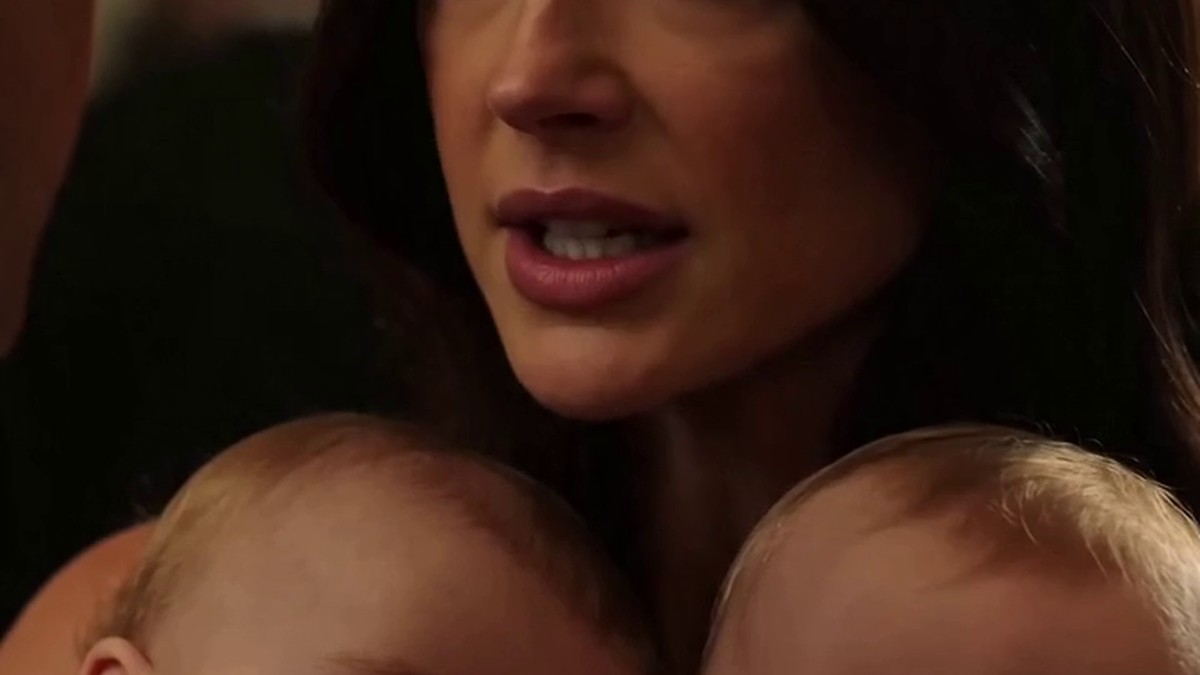
And she was holding two babies.
One on each hip.
The ballroom went soft and distant around Grayson, the way sound goes underwater.
The boy wore a small navy suit, one hand fisted in the fabric of Samara’s shoulder. The girl wore cream with a satin bow, her tiny fingers wrapped around Samara’s necklace like it was something precious she had decided to claim. Neither could have been much past a year old.
Grayson’s glass slipped from his hand.
It hit the carpet and didn’t break.
The boy turned his head toward the noise.
Gray eyes.
Not hazel. Not blue. Gray — the specific shade Grayson had seen in mirrors his entire life and in his mother’s old photographs and nowhere else, not once, until right now.
The girl blinked. And the particular shape of her nose, the small serious crease already forming between her brows, pulled him violently backward through time — to a framed photograph in the hallway of the Holt estate, a baby boy his mother had never stopped pointing at, saying *you had that look from the very beginning.*
His lungs forgot what they were for.
Samara was scanning the room with the careful composure of someone managing controlled panic. Smiling at the guests who approached. Answering what she had to answer. And then her eyes moved across the ballroom and found him.
She went completely still.
Everything that passed between them in that moment required no language. It crossed the crowded room in the span of a breath — shock, grief, accusation, a fear so specific it could only belong to this exact situation. And beneath all of it, like bedrock under floodwater, something that two years of silence and distance and deliberate forgetting had never once managed to touch.
“Gray.” Ethan’s voice, low and careful, at his shoulder. “Are those—”
“Don’t,” Grayson said. The word came out stripped of everything except urgency.
He crossed the ballroom.
People parted without quite knowing why — some ancient, animal instinct about men moving with that particular gravity. The orchestra had recovered and was playing something gentle and irrelevant. Candles flickered in his wake. Somewhere behind him he heard Claire’s soft intake of breath and knew that Ethan had already told her with a look.
Samara didn’t run.
He’d half-expected her to. Half-expected the controlled panic to break into motion, those heels turning, the blue dress disappearing through the entrance and back into the two years of silence she had clearly constructed with enormous care. But she stood her ground the way she’d always stood her ground — chin lifted a fraction, eyes steady, the twins settled against her hips like she’d learned to carry the weight of everything alone and made it look like a choice.
He stopped three feet from her.
Close enough to see that her hands weren’t quite steady. Close enough to catch the perfume — the same one, God help him, the same jasmine and something darker underneath — rising above the candle smoke.
“Samara.”
“Grayson.” Her voice was even. Professional, almost. The voice she used when she was deploying every resource she had just to stay upright.
The boy was watching him with those gray, devastating eyes.
The girl had released Samara’s necklace and was staring at him with the deeply serious assessment of someone who has been alive for fourteen months and has already developed opinions.
“I didn’t know you’d be here,” Samara said.
“Ethan’s my oldest friend.”
“I know that. Claire’s mine.” A pause, precisely measured. “I thought you’d send a gift and an apology note.”
That landed. He absorbed it.
“We need to talk.”
“We are talking.”
“Samara.”
Something flickered across her face — not quite pain, not quite anger, but the specific exhaustion of a person who has rehearsed this conversation in the dark a hundred times and is furious to be having it here, under chandeliers, in front of two hundred wedding guests.
“Not here,” she said finally. “Not like this.”
“Then tell me where.”
—
They found a small antechamber off the main hallway — a room that existed to hold coats and forgotten things, its single window overlooking the street below. Samara set both babies on a blanket she produced from a bag with the practiced efficiency of someone who had learned to be prepared for every contingency. The boy immediately began investigating the carpet’s fringe. The girl sat upright and regarded Grayson with that same grave attention, as though she was deciding something.
He could not stop looking at them.
“Their names,” he said.
Samara was standing by the window. Her back was partially to him. Outside, the saxophonist from the sidewalk was still playing, the notes reaching them faint and mournful through the glass.
“Eli,” she said. “And Nora.”
“How old.”
“Fourteen months.”
He did the math he’d been doing since the ballroom. It wasn’t complicated arithmetic. It was just devastating.
“You were pregnant when you left.”
The silence that followed was its own form of verdict.
“I didn’t know,” she said. “Not when I walked out. I found out three weeks later.”
“And you didn’t—”
“Call you?” She turned then, and the composure was still there but the edges of it had gone sharp. “Grayson. You told me I was a distraction. You told me that what we had was a — how did you phrase it — *a habit you’d indulged past its usefulness.*” Her voice didn’t break. She had, he understood, already spent the breaking. “I was not going to call you.”
The words he’d said came back to him now with the clarity that only genuine shame produces. He remembered the boardroom logic he’d applied to her — the cold calculus of a man who was terrified of needing anything he couldn’t control, dressing his fear up in the language of rationality. He remembered the look on her face. He had told himself she was strong enough to absorb it.
He had been a coward naming himself pragmatic.
“I was wrong,” he said.
“Yes.”
“What I said to you was—”
“Wrong,” she said again. “You already used that word. It covers it.”
Eli had pulled himself upright using Grayson’s trouser leg. He didn’t seem to require permission. He just gripped the fabric in both fists and hauled himself up and stood there, swaying slightly, looking up at Grayson with an expression of mild triumph.
Grayson went very still.
Instinctively — before thought could organize itself into hesitation — he reached down and steadied the boy with one hand. Eli grabbed his finger. His grip was startling. Categorical. The grip of someone who had already decided this particular person was load-bearing.
Across the room, Nora made a sound of protest, as though she objected to being excluded from whatever was happening, and Samara moved to pick her up with the automatic grace of someone who had been responding to that specific sound for over a year.
They stood like that for a moment — the four of them in a coat room off a Manhattan hotel hallway, a saxophonist playing below, two hundred wedding guests on the other side of a wall, the whole enormous machinery of the life Grayson had built humming somewhere in the background, irrelevant.
“I’m not asking you to forgive me tonight,” he said. His voice came out lower than he intended. “I’m not asking you for anything. I just—” He looked at Eli, still wrapped around his finger. At Nora, watching him from Samara’s arms with her small serious brow. “I need you to know that I understand what I cost us. Not abstractly. I understand the *weight* of it now.”
Samara looked at him for a long time.
“You cost us two years,” she said. “And they don’t have a father’s name on the documents because I didn’t know if you’d want to be on them, and I wasn’t going to put your name on something and have you treat it the way you treated me.”
The blow landed exactly as she intended. He didn’t deflect it.
“I want to be on them,” he said.
“Grayson—”
“I know that’s not a negotiation I can open tonight. I know I have no right to walk in here and make demands. But I want you to hear it once, clearly, from me, with no boardroom logic attached to it.” He held her gaze. “I want to be their father. Actually be it. And I know I have to earn that. I know I have to earn everything from the ground up. I’m not asking you to hand it to me.”
The saxophonist below shifted into something slower.
Nora reached out and grabbed a fistful of Grayson’s jacket lapel. He turned to her, surprised. She looked back at him with those dark eyes that were entirely Samara’s and pulled, as though testing the material, as though gauging whether he would hold.
Something cracked open in his chest.
Not broke. *Opened.* The distinction mattered more than he could have explained.
Samara watched her daughter holding onto the man who had destroyed her and then apparently decided to keep his jacket anyway. A sound escaped her — not quite a laugh, not quite a cry, the compressed noise of a person who has held a feeling in so long that its release has no clean category.
“She does that to strangers,” Samara said. “It’s embarrassing.”
“I’m not a stranger.”
“No.” Her voice was quieter now. “No, you’re not.”
—
They didn’t resolve it that night. Real things don’t resolve in hotel coat rooms over the course of twenty minutes while a wedding continues thirty feet away. What happened instead was smaller and more durable than resolution.
They went back to the reception — separately at first, then gravitating toward the same table without quite deciding to. Ethan found them and had the wisdom to say almost nothing, only squeezing Grayson’s shoulder once with the grip of someone who has been waiting two years to do exactly that. Claire sat with Samara and spoke quietly, their heads together, while Eli fell asleep against Grayson’s chest with the unconscious authority of someone who had simply determined this was an acceptable place to be.
He sat there with this boy’s weight against him and the noise of the celebration moving around them and did not reach for his phone, did not check the market, did not calculate anything.
He just held on.
—
Six months later, on a Thursday morning that smelled like rain and coffee and the specific chaos of two toddlers who had recently discovered that kitchen cabinets open, Grayson sat on Samara’s apartment floor building a block tower that Nora destroyed with systematic joy every time it reached four stories.
They weren’t back together. That was a conversation they were having in slow, careful increments — therapy, honest confessions delivered without the armor he used to wear, arguments that ended with actual resolution instead of his silence calcifying into weapons. He was learning to say the thing he meant on the first attempt instead of the third. It was harder than any deal he had ever closed.
It was also the only work he’d ever done that felt like it was building something real.
Eli brought him a block — a red one — with the gravity of a person making an offering.
“Thank you,” Grayson said seriously.
Eli seemed satisfied. He sat down beside him with the comfortable assumption of someone who has already decided this man belongs here, in this apartment, on this floor.
Samara appeared in the doorway with two mugs, her dark curls loose, wearing a sweater she’d clearly stolen from his side of the closet she’d started letting him leave things in.
She looked at the demolished tower. She looked at Nora’s expression of pure demolition-satisfaction. She looked at Grayson on her floor with a red block in his hand and her son pressed against his side.
“The city called,” she said. “Something about a rezoning deal. They said it’s urgent.”
“It can wait.”
She raised an eyebrow.
“It can wait,” he said again.
She handed him the coffee and sat down on the floor beside him, close enough that her shoulder pressed against his, close enough that he could catch the jasmine above the smell of rain and breakfast and morning.
He didn’t reach for his phone.
He placed the red block on the tower.
Nora eyed it. Reached out one deliberate hand.
And Grayson, for the first time in longer than he could account for, laughed before the thing could fall.