This was Elena’s night.
Communications director of the Vane Group. Composed. Formidable. The kind of woman who chose her words the way a surgeon chooses a blade. And tonight she stood at the heart of it all, wrapped in a white silk Haute Couture gown cut to bare her shoulders — the clean line of her collarbone, the quiet strength of her neck, all of it deliberate. Against her sternum rested a diamond necklace worth more than most people’s lifetimes, a betrothal gift from the family she was about to marry into. Every lens in the room found her. Every gaze held.
Julian stood beside her.
The heir. The golden one. Black tuxedo cut to precision, his large hand settling at the curve of her waist with the practiced ease of a man who had always known where he belonged. The five-tier wedding cake loomed before them — a white architecture of sugar flowers so thin they trembled in the air like something alive. A waiter extended a silver knife, its handle etched with flowing ribbon work, handle-first, ceremonial as a crown.
Julian leaned close.
“Ready, my queen?” His voice warm. Low. Sure of itself.
Everything aligned. The flowers. The diamonds. The assembled weight of old money filling every gilded chair.
Then the ballroom doors swung open.
A stranger walked in — someone who belonged to none of it — and spoke exactly seven words.
Seven words, and the dream cracked straight down the middle.
Before midnight, someone would be in handcuffs.
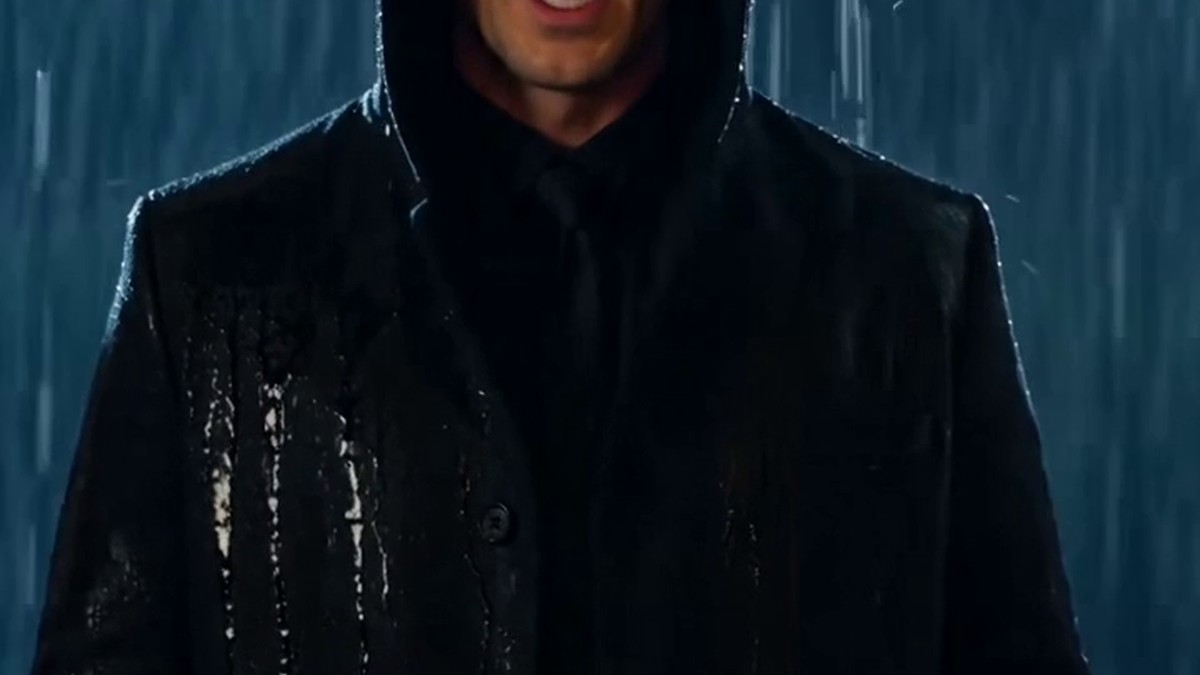
The doors had not been opened so much as thrown — wide, both panels, the way you open a door when you are not afraid of the sound it makes. The man who entered was lean and unhurried, wearing a dark overcoat that still held the cold of the street. He was no one’s idea of a wedding guest. He stopped at the edge of the marble floor, looked once across the room — cataloguing, assessing, the eyes of someone whose job is to see what others prefer stays hidden — and then he spoke.
“Elena Vane. You need to come with me.”
Seven words. Flat as a verdict.
The room didn’t erupt. It went the other way — that sudden, airless quiet that falls when something real enters a room built entirely for performance. A hundred champagne flutes arrested mid-air. The string quartet’s bow stilled mid-phrase. And Elena, at the center of all that crystalline silence, did not flinch. Not visibly. But the knife she’d been about to take from the waiter remained in his hand, and the hand she’d reached toward it didn’t complete its arc.
Julian stepped forward first. His composure was good — the composure of a man who’d grown up managing scenes — but there was a tightening in his jaw, a thing he couldn’t quite contain.
“Who let you in here?” Low, controlled, directed at no one and everyone. “Somebody get security.”
“Your security already knows I’m here,” the man said. He reached inside his overcoat and produced a credential wallet, flipping it open in a single practiced movement. “Detective Aaron Marsh, Financial Crimes Division. I’m not here to make a scene, Mr. Vane. I’m here to speak with your fiancée.”
*Mr. Vane.* Not *Julian.* The distinction deliberate, precise — the kind of distance a detective maintains when he wants you to understand this is not personal, this is institutional, and institutional is worse.
Elena set down the hand that had reached for the knife and turned to face him fully. Her gown caught the chandelier light as she moved — all that white silk, all those diamonds — and for a moment she looked like exactly what she was supposed to be: the rightful center of this room, this night, this story. But her eyes, dark and measuring, were already doing their own calculation.
“All right,” she said.
Just that. *All right.*
Julian’s hand caught her arm. “Elena—”
“I’ll hear what he has to say.” She removed his hand the way you remove something placed carelessly on a surface that belongs to you. “Give us five minutes. Keep the room calm. You’re good at that.”
It was not a compliment. Julian held her gaze for one long moment, something moving across his face that no one in the room could name, and then he turned back to the assembled guests with a smile that cost him nothing and promised them everything was fine.
—
They stood in the corridor behind the ballroom — Elena, Marsh, and the two men who had appeared silently at Marsh’s flanks once the doors were closed. Subordinates. Witnesses. The corridor was long and still carpeted in deep hotel red, wall sconces throwing warm amber light that made everything look slightly warmer than it was.
Marsh didn’t waste the gesture of preamble.
“Three weeks ago, twelve million euros moved through the Vane Group’s Luxembourg subsidiary into a shell account in Malta. Yesterday, that account paid out to a private security contractor currently under federal investigation for facilitating the disappearance — and probable murder — of two journalists in Eastern Europe.” He paused. “Your signature is on the authorization, Ms. Vane.”
She didn’t look away. “You said my name wrong,” she said. “My name isn’t Vane yet.”
“It won’t be,” Marsh said. “That’s why I’m here tonight.”
A beat of silence in the amber corridor.
“You think I authorized it,” she said. It wasn’t a question. It wasn’t quite a denial.
“I think you signed the document. What I don’t yet know — what I’d very much like to understand before this goes any further — is whether you knew what you were signing.”
Elena looked at the wall for a moment. Not at the wall — through it, through the plaster and the gold and the roses, toward something farther back.
“Who else has seen this authorization?” she asked.
“Right now? My team. A federal prosecutor. And the person who brought it to us.” Marsh reached into his coat again and produced a photograph, small and printed on plain paper. He held it out.
She took it. Looked at it. Her face did something quiet and complicated.
The photograph showed a man she recognized — a man she’d known for eleven years — passing an envelope to someone outside a building she also recognized, because she’d stood in front of that building once, a long time ago, when she’d believed she understood what she was walking into.
The man in the photograph was Thomas Vane. Julian’s older brother. The one who had never quite forgiven their father for giving the heir’s crown to the younger son. The one who had smiled at her across every dinner table for three years with warmth she had never managed to entirely trust.
The one who had placed the document in front of her six weeks ago and told her it was a routine approval for a quarterly compliance filing.
Her handwriting on that page. His lie underneath it.
—
She walked back into the ballroom alone.
The string quartet had started again — someone’s decision, a small mercy — and the gathered guests had redistributed into approximations of their earlier configurations, the way people do when they’ve agreed collectively to pretend. Julian was at the far end of the room near the bar, and she could see Thomas not far from him, a glass of something dark in his hand, speaking to an older couple with the ease of a man who feels entirely safe.
That ease. That specific, practised safety. She had watched it for years and called it charm.
She crossed the marble floor. The room noticed her return — lenses lifted, attention followed — but she was not walking toward the cake or the cameras or Julian. She was walking toward Thomas.
He saw her coming and smiled. The same smile. Warm, open, generously lit.
“There she is,” he said. The older couple made polite noises and drifted away, as people do when they sense a family moment approaching.
“Thomas.” She stopped two feet from him. Close enough to be private. Far enough to be clear.
“Everything all right? Julian said there was some—”
“Stop.” She said it quietly. Not a shout. Quieter than a shout, which is worse. “I know about the Malta account. I know about the authorization. And I know who handed me that document and told me it was nothing.”
Something moved across his face. Not guilt — not exactly. Something older than guilt. The look of a man who has been running a calculation for a long time and has just heard the number come up wrong.
“Elena.” His voice dropped. “You don’t understand the full picture—”
“Detective Marsh is in the corridor,” she said. “He has the authorization, the account records, and a photograph of you making the transfer of the original documents. He also has your phone records from the past ninety days.” She let that settle. “I’ve been cooperating with his investigation for three weeks.”
The glass in Thomas’s hand shifted its angle — a small, involuntary thing, the body registering what the face refused to.
“You—” He stopped. Started again. “You’ve been cooperating.”
“Since the day after you put that paper in front of me. I recognized the Malta account name. I’d seen it before, in files I wasn’t supposed to see, in a server partition I found by accident eight months ago. I didn’t know what it meant then. I started to understand when you needed my signature on something you wouldn’t explain.” She looked at him steadily. “You chose the wrong person to use, Thomas. I don’t sign things I don’t understand. I went back and read everything.”
The ballroom hummed around them. Crystal and roses and the low music of money at rest. And Thomas Vane, who had spent thirty years learning how to stand in rooms like this, seemed for the first time uncertain of where to put his weight.
“The journalists,” he said. Low. Almost inaudible.
“Yes,” she said. “The journalists.”
Julian appeared at her shoulder — she had felt him moving toward them across the room, had tracked him in the periphery of her attention without turning. He looked between them, read something in the geometry of how they were standing, and the warmth in his face went through several changes very quickly.
“What’s happening?” he asked.
“Ask your brother,” Elena said.
A long moment. Julian looked at Thomas. Thomas looked at the floor.
And then the ballroom doors opened again — Marsh and his two subordinates, and two uniformed officers who had been waiting in the hotel lobby, and the quiet certainty of what came next moved through the room like a change in air pressure.
—
The handcuffs were not dramatic. They rarely are, in reality. Thomas went without a scene — the Vane composure held even here, at the end of its usefulness, which was perhaps the most Vane thing about the whole evening. He was walked out through a service exit, sparing the room the performance of a perp walk down the main aisle, past the white roses and the cathedral light.
The guests rearranged themselves again, more slowly this time.
Julian stood very still in the center of the marble floor, his black tuxedo immaculate, his hands at his sides. The five-tier cake loomed at his back. The chandeliers went on scattering their brilliant indifferent fire.
Elena stopped beside him.
“You didn’t know,” she said. Not a question. She had reached this conclusion three weeks ago, when she’d gone through every file, every transfer, every authorization request with Marsh’s team. Julian’s name was nowhere in it. Thomas had kept him clean — out of affection, possibly. Or because a useful brother stays useful longest when he stays ignorant.
“No,” Julian said. His voice was flat and stripped and honest in a way she had not often heard from him. “I didn’t know.”
“I know you didn’t.” She looked at the place where the doors had closed. “He used us both. He needed a transaction big enough to be invisible inside the Group’s quarterly movement, and he needed a signature that wasn’t his. He needed me to become a Vane first, on paper, so the authorization would hold.” A pause. “He arranged this timeline. The engagement announcement, the wedding date. He needed tonight to happen.”
Julian turned to look at her. Something in his face was raw and working — the expression of a man dismantling something he’d built with care and finding the foundation rotten.
“The diamond,” he said. “The necklace. He suggested it. He said it was traditional.”
“I know.”
“And you wore it anyway.”
She touched the necklace at her sternum — all that cold fire, all that weight. “Evidence,” she said simply. “Marsh needed documentation of the full gift chain. The diamonds were purchased through the same Malta account.”
Julian looked at her for a long time. The music had stopped again, finally, and the room was very quiet.
“Three weeks,” he said. “You’ve known for three weeks. You came here tonight knowing.”
“I needed him in this room. He wouldn’t be anywhere else. Thomas lives for these rooms.” She looked around at the gold and the roses. “I needed Marsh to take him somewhere he couldn’t run.”
“And us?” Julian asked. “Tonight. The cake. All of it. Was any of it—”
“Real?” She considered this honestly, the way she considered every question that mattered. “The investigation was real. The coordination with Marsh was real. What I feel about you — ” she paused, and the pause was not performance — “is real enough that I’m telling you this now, instead of letting you hear it from someone else.”
He breathed out slowly.
“But?”
“But I’m not going to marry into this tonight,” she said. “I’m not going to marry into anything tonight. The name, the family, the ceremony — all of it needs to wait until I know what’s left of it. Until you know what you’re inheriting.” She looked at him directly. “That’s fair. That’s the only fair thing I have left to offer you.”
Julian held her gaze. The heir. The golden one. A man who had always known where he belonged, and who now stood in a room that had rearranged itself entirely around him.
“Okay,” he said. Just that. *Okay.* And then, very quietly: “Thank you for not running.”
“I don’t run,” she said. “That’s not how I do things.”
—
She left the ballroom just before midnight — not through the service exit, not in handcuffs, but through the main doors, both panels, the way you leave when you’re not afraid of the sound it makes. The night air of the street hit her like clarity. The white silk, the diamonds, the weight of the evening — all of it she carried with her, because she was not someone who sheds things and pretends they didn’t happen.
Marsh was waiting on the steps.
“He’s in custody,” he said.
“I know,” she said.
“You understand there will be months of this yet. Depositions. A trial.”
“I know that too.”
He studied her for a moment — this woman in a Haute Couture gown and a necklace that was now evidence, standing on hotel steps at midnight with the composure of someone who had decided, long before tonight, how the evening would end.
“You could have told us sooner,” he said. “We would have handled the arrest another way.”
“Yes,” she agreed. “But you wouldn’t have gotten Thomas in that room. You wouldn’t have gotten the full gift chain documented in public, in front of witnesses.” She looked at him steadily. “You needed tonight as much as I did.”
Marsh had the look of a man who would not confirm this out loud, but did not deny it either.
A car came for her — her own car, her own driver, not a Vane car, not tonight. She got in, and the door closed behind her, and the hotel receded in the window — all that gold light spilling out into the cold street, all those roses still perfect inside, the chandeliers still throwing their brilliant fire across the empty marble floor.
She took the diamond necklace off and placed it carefully in her bag. Marsh would have it by morning.
She didn’t cry. That wasn’t what she felt.
What she felt was something quieter and more durable — the particular stillness of a woman who had looked at something enormous and complicated and dangerous, and had not looked away, and had survived the looking. Who had carried a secret through weeks of roses and rehearsals and the performed certainty of *this is my life now*, and had carried it cleanly, and had set it down on her own terms.
The city moved past the window. The night was cold and clear.
Elena leaned her head back against the seat and let the silence be what it was — not emptiness, not loss, but the sound a story makes when it finally, honestly, ends.