She touched the edge of one diamond earring, kept her smile aimed at the cameras, and said it like an instruction—
“Keep her away from me.”
The red carpet moved on. Flashbulbs detonated in rapid succession. Interviewers chuckled at nothing. Security closed the gap.
Because to everyone watching, she was just another kid who’d slipped the barricade.
Small. Hair tangled. An oversized hoodie swallowing her whole. Sneakers worn thin at the toes.
Nobody thought to look twice.
Nobody noticed she wasn’t reaching for a photo.
The little girl went still.
She looked up.
And said, quietly enough that it almost disappeared—
“You really don’t remember me?”
The actress stopped. Not in any way the cameras could catch. Just a single beat. One breath held too long.
Then the smile returned. Flawless. Practiced. A mask that had never once slipped in public.
Security moved toward the child.
That’s when the girl raised her wrist.
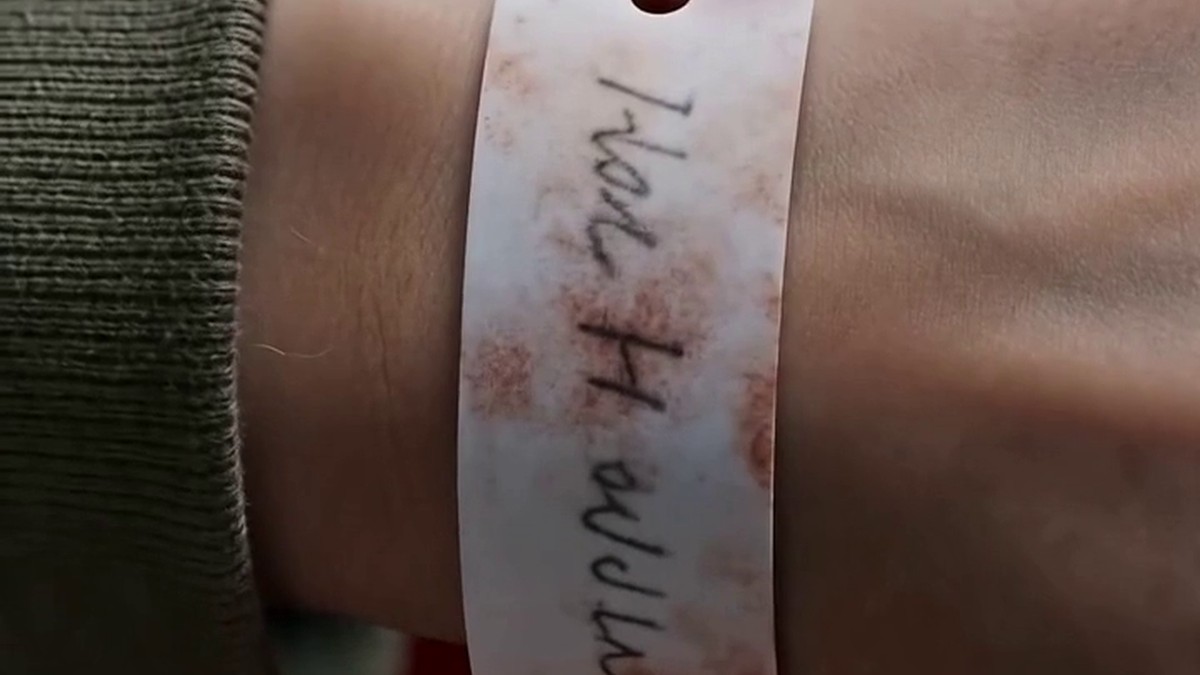
A faded pink ribbon. Tied around something old. A hospital bracelet, worn nearly colorless with time.
The actress glanced at it.
And forgot how to breathe.
The cameras kept firing. Nobody in the crowd understood what they were seeing.
But her face changed.
Not slowly. Fast. Too fast for someone who’d spent twenty years controlling every expression she’d ever made.
She took one step forward.
Then another.
Her eyes pulled toward the bracelet like gravity.
Close enough now to read what was written on it.
Three words.
Not printed by a machine.
Written by hand.
Her handwriting.
She whispered—
“…no.”
Someone near the press line let out a nervous laugh. It died instantly.
The child held her wrist tighter. Lifted her chin.
“You wrote this.”
The actress stared.
Because she remembered.
A hospital room. Rain streaking the window. The sound of machines. A newborn wrapped in white. A promise she made to herself because there was no one else in the room to make it to.
Her legs nearly buckled beneath her.
The reporter let the microphone drop.
The crowd went quiet in the way crowds only go quiet when something real is happening.
The girl looked at her. Eyes unsteady. Voice barely holding.
And asked the question.
The one that split everything open.
“Then why did they tell me—”
She swallowed hard.
“—that you never wanted me?”
Not a single camera moved.
No one breathed.
The actress pressed her hand over her mouth.
Because it came back all at once—something she had spent years burying under awards and contracts and red carpets exactly like this one.
The papers. The meeting. The clause she initialed without reading because she trusted the people sitting across the table.
For the first time in her entire career, she forgot the cameras existed.
She stepped toward the girl.
Hands shaking at her sides.
And whispered—
“Who brought you here?”
The little girl pointed.
Not at the crowd. Not at any of the security. Not at the press.
Behind the cameras. Standing apart from everyone. Still and unhurried, the way people are still when they’ve been waiting a very long time.
An older woman. Watching. A brown envelope held loosely in both hands.
The actress looked at her.
And went white.
Because she knew her. Immediately. Without question.
The woman who had sat across from her in that hospital room and told her, in a calm and practiced voice—
that her baby hadn’t survived.
The world narrowed.
Red carpet. Flashbulbs. Two hundred strangers pressing against velvet ropes.
None of it existed anymore.
There was only the woman with the envelope.
The actress moved without thinking. Not toward the cameras, not toward her publicist already cutting sideways through the crowd with murder behind her eyes. Toward the woman. Directly. The way you move when something inside you has been waiting eleven years to walk in a straight line.
Security stepped to intercept.
She said one word. Flat. Absolute.
“Don’t.”
They stopped.
She crossed the press line. Left the red carpet entirely. Stepped off the edge of the world she had built so carefully, one award at a time.
The crowd parted. Not because anyone moved them. Because something in the air had changed pitch.
The older woman didn’t run. Didn’t flinch. Just waited, still as a painting, while the actress closed the distance between them.
Up close, she looked older than memory. Hair gone fully gray. The skin around her eyes mapped with years. But the posture was the same. The stillness was the same.
The practiced calm of someone who delivered bad news for a living.
The actress stopped two feet away.
Her voice came out quiet. Controlled. The way a fire is controlled when it’s still deciding whether to spread.
“Tell me your name.”
The woman tilted her head slightly. “You know who I am.”
“I know what you told me.” Her jaw tightened. “I want your name.”
A pause. Something moved behind the woman’s eyes. Not guilt, exactly. Calculation. Eleven years of it.
“Margaret Hale,” she said.
“Margaret.” The actress let the name sit in her mouth. “And what do you do, Margaret?”
“I used to work in private placement.”
“Used to.”
“I retired.”
“Two years ago?” A beat. “Or right around the time this one—” she glanced back at the girl, who had followed close, close as a shadow, “—started asking questions?”
Margaret Hale said nothing.
The publicist arrived at the actress’s elbow, breathless, a hand hovering near her arm.
“Sienna. Sienna, we need to—the Vanity Fair people are waiting and this has already gone—”
“Walk away.” Sienna didn’t look at her. “Right now.”
“The cameras are—”
“Are watching me stand still on a sidewalk.” Now she looked. Hard. “Walk away, Dana.”
Dana walked away.
Sienna turned back to Margaret Hale.
“The envelope,” she said.
Margaret looked down at it. Almost surprised it was still in her hands.
She held it out.
Sienna didn’t take it immediately. She looked at it the way you look at something that might detonate. Then she looked at the little girl standing at her left, small inside that oversized hoodie, chin still lifted with a bravery that cost something.
She crouched down.
This close, the girl’s eyes were extraordinary. Dark. Deep-set. The kind of eyes Sienna had only ever seen in photographs of herself, aged seven, in the single album her grandmother had kept in a shoebox under the bed.
“What’s your name?” she asked.
“Clara.” The word came out careful. Like it had been rehearsed for a different audience.
“How old are you, Clara?”
“Eleven.”
Sienna absorbed that. Eleven. Because she’d been in that hospital room in February, eleven years and nine months ago, twenty-two years old and terrified, and they had told her—
They had told her—
“Who brought you to me?” She said it softly now. Not an accusation. A real question.
Clara glanced at Margaret. Then back.
“She found me first,” she said. “But she wasn’t going to bring me. A teacher helped me. At school. I did a project—” her voice wobbled and steadied, “—about genetics. And my foster family had some papers. In a box. I found your name.”
Sienna felt something shift in her chest. Tectonic.
A school project. A box of papers. An eleven-year-old detective with her mother’s eyes.
She stood. Took the envelope from Margaret Hale. Opened it.
Inside: documents. Three pages of them. Signatures at the bottom of each. Her own, unmistakable. And one she didn’t recognize.
But the clause was there. Paragraph seven, sub-section C, the words typed in the same clean font as everything else.
*In the event of infant mortality, all records pertaining to the birth shall be sealed and the placement agreement rendered void.*
She read it twice.
Then she looked up at Margaret Hale.
“She didn’t die,” she said.
It wasn’t a question.
Margaret stood very still.
“She was placed,” she said. “The family was vetted. She was—”
“She was *sold*.” The word hit the air like something thrown against concrete. “Tell me she wasn’t sold.”
“The placement fee—”
“Tell me.”
The silence that followed was the loudest thing on the street.
One of the cameras, still rolling, caught it all. A journalist on the press line had his phone raised, not understanding the story yet, only sensing the gravity of it the way animals sense weather.
Margaret Hale looked at the ground. For the first time, the composure cracked. Just at the edge. A single fault line.
“You weren’t going to keep her,” she said quietly. “You were twenty-two. You had nothing. The contract protected—”
“*I* was twenty-two.” Sienna’s voice dropped to something barely audible and twice as dangerous. “I was twenty-two, and I was alone, and someone sat across from me and said my daughter was dead, and I signed papers I never read because I was grieving.” She took one step closer. “You made a decision for me. You decided I wasn’t enough. And you took her.”
Margaret Hale said nothing.
There was nothing left to say.
Sienna turned back to Clara.
The girl was watching her with those dark, careful eyes. Trying to read the outcome before it arrived. Braced for it the way a child braces who has been handed back before.
Sienna kneeled again, right there on the sidewalk, in a dress that cost more than some people made in a month, in front of every camera that was now, all of them, turned in her direction.
She looked at her daughter.
“I didn’t know,” she said. The rawness of it scraped her throat. “I want you to know that. I signed papers I didn’t read and I believed what they told me and I have thought about you—” her voice fractured and she let it, “—every single February for eleven years.”
Clara’s chin was trembling now.
The bravery was still there. But underneath it was something younger. Something that had been waiting, too.
“They said you were famous,” Clara said. “They said that’s why. That you didn’t want—” She stopped. Swallowed. “I thought maybe you just didn’t want me specifically.”
Something broke completely open in Sienna’s chest.
“No,” she said. It came out almost like a sound of pain. “No. Not specifically. Not ever.”
She reached out slowly, telegraphing the movement, giving the girl every chance to pull back.
Clara didn’t pull back.
She looked down at the hospital bracelet on her own wrist. Then she held it out, small hand steady now, an offering.
Sienna took her wrist gently. Read the three words written in her own handwriting. Words she’d written at two in the morning in a hospital room with a broken pen she’d had to press down hard to make work.
*Come back to me.*
She had written it on the bracelet before they took her daughter away for what she was told were routine tests. A private joke between herself and the universe. A message she never imagined would travel eleven years and deliver itself back into her hands.
She pressed her thumb over the faded ink.
Then she looked up at Clara.
“I’ve been looking for ways to deserve you ever since,” she said. “I didn’t know that’s what I was doing. But I was.”
Clara stared at her for a long moment.
Then she did something no one on the press line could have predicted.
She sat down. Cross-legged, right there on the sidewalk, like this was the end of a long trip and she had finally reached somewhere worth resting.
And she said, very quietly—
“Okay.”
Just that. One word. Carrying everything.
Sienna sat down beside her. On the sidewalk. On the red carpet’s edge. Two hundred cameras trained on them both.
She didn’t think about any of it.
She thought about February. About rain on a hospital window. About a pen pressed hard against a paper bracelet because she needed to leave something behind.
About the eleven years that had passed, and the years that hadn’t yet.
Behind them, she heard Dana’s voice rising in pitch. Heard Margaret Hale’s footsteps finally moving—away, quietly, the way people move when they understand the story has already been told and their part in it is finished.
The journalist with the raised phone would later say he’d filmed a thousand red carpet moments, and this was the first time he’d ever seen the carpet matter less than the sidewalk.
Clara leaned slightly. Not fully. Just enough.
Sienna didn’t move. Didn’t make it bigger than it was.
She just stayed.
That was the whole of it.
Two people, sitting still, figuring out what comes next.
The flashbulbs kept firing.
Neither of them looked up.