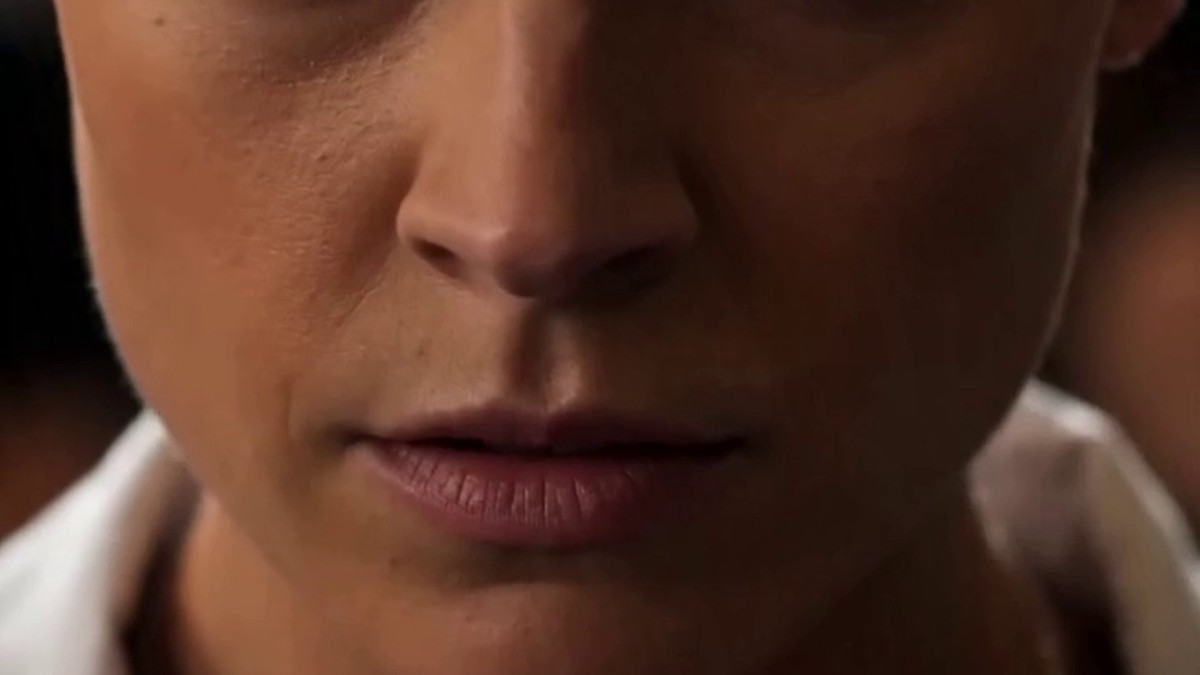
The voice cut through the rooftop gala like a blade. Camera flashes strobed across the exclusive charity event high above Manhattan while the golden grid of the city burned beneath the open sky.
Live jazz drifted from the terrace bar.
Politicians.
Celebrities.
People with more money than conscience.
And standing beside the champagne tower —
a young waitress, silver tray balanced in perfectly steady hands.
Plain black uniform.
Hair pulled back without a single strand out of place.
Gray eyes, still as lake water.
Too still.
Cassandra Vale noticed right away.
She moved across the terrace in designer heels and a white dress that cost more than most people’s cars, nearby guests shifting nervously out of her path.
“You spilled wine near my guests.”
“No, ma’am.”
The answer came quietly.
Respectfully.
But without a trace of fear.
Cassandra smiled the way a shark smiles.
“Girls like you need to learn when to say sorry.”
A few guests offered awkward, obligatory laughs.
The waitress never dropped her gaze.
That was what did it.
Cassandra reached out and grabbed the edge of the silver tray.
Then she shoved it violently downward.
Wine glasses exploded across the terrace floor. Guests stumbled back. The jazz stopped mid-note, as if the musicians themselves were holding their breath.
The waitress looked down at the shattered glass.
Then she slowly raised her eyes back to Cassandra.
“You really don’t remember me.”
It wasn’t a question.
Something crossed Cassandra’s face — fast, small, nearly invisible.
But it was there.
“Security.”
Two guards started moving toward the waitress.
And then —
she reached beneath the collar of her uniform.
And pulled out a silver necklace she’d been wearing against her skin, hidden from the world.
The pendant caught the rooftop lights and held them.
Cassandra went absolutely still.
Because hanging from that chain —
was the exact same family pendant that had vanished from the Vale estate during the murder investigation.
Twelve years ago.
—
The two guards stopped.
Not because anyone told them to.
Because every person on that rooftop had gone completely silent, and in silence like that, movement feels like a crime.
Cassandra’s eyes were locked on the pendant.
Her champagne flute tilted slightly in her hand.
Just slightly.
But the waitress caught it.
She caught everything.
“You do remember,” the waitress said.
Her voice was still quiet.
Still even.
The way a fuse is quiet right before the house goes up.
Cassandra recovered fast — she always recovered fast, that was the skill that had kept her at the top of every room she’d ever walked into — and her expression went smooth and cold as marble.
“Get that woman off my event.”
“Your event,” the waitress repeated.
She looked around at the terrace. The politicians. The cameras. The glittering skyline behind them, bearing witness.
“Your family’s charitable foundation.” A pause. “The Elena Vale Memorial Fund.”
The name landed like a stone through glass.
One of the guests — a silver-haired senator whose face appeared regularly on Sunday morning news programs — took half a step back.
Cassandra’s jaw tightened.
“Elena Vale was my sister,” she said. “And you will not say her name.”
“She was my mother.”
—
The jazz didn’t come back.
Nobody moved.
The waitress — the woman — reached up and unclipped the necklace with steady fingers. She held it out in her open palm so the lights could find it properly. The pendant was a small oval locket, sterling silver, engraved with a single letter on the back.
*E.*
“Elena gave this to me the night she died,” the woman said. “I was six years old. She put it around my neck and told me to hide in the closet and not make a sound no matter what I heard.”
Something moved through the crowd. Not a sound. More like a pressure change. The kind you feel in your ears before a storm.
“My name is Nora.” She let that sit for a moment. “Nora Vale. And I’ve been waiting twelve years to stand in the same room as you and say that out loud.”
It had taken nearly two of those years just to arrange this moment — cultivating the right contacts in the catering industry, building a clean work history under a name that wouldn’t trigger Cassandra’s lawyers, angling for the specific placement on tonight’s staff roster. The foundation always used the same catering firm for its annual gala. Nora had simply made herself indispensable to that firm, one event at a time, until the assignment was hers by default.
Cassandra laughed.
It was a beautiful laugh. Practiced. The laugh of a woman who had laughed her way through boardrooms and courtrooms and every accusation that had ever come near her.
“This is a stunt,” she said, turning to address the crowd rather than Nora, playing to the audience the way she always had, always would. “Some kind of performance. This woman is a deranged—”
“I have the full forensic report.”
Cassandra stopped.
“The one that was sealed.” Nora’s hand went to the inside pocket of her uniform jacket and came back with a folded envelope. “The one your lawyers buried. The one that placed you in the east wing of the estate at eleven forty-seven PM — twenty minutes before my mother’s death was ruled an accident on the staircase.”
“That report doesn’t—”
“Exist?” Nora said. “It does now.”
—
The silver-haired senator’s aide was already on his phone.
Two of the other guests had quietly removed themselves to the far edge of the terrace, wanting distance without wanting to be seen wanting it. A woman in a red dress stood perfectly still, hands folded in front of her, watching Cassandra with an expression that was not surprise.
Cassandra saw that look.
Nora saw her see it.
“How long?” Nora asked, and for the first time her voice shifted — just barely, just under the surface — like something deep in the water turning toward the light. “How many of them knew? How many people at this party tonight are here because you made them complicit?”
“You have no idea what you’re talking about.”
“My mother found out what you were doing with the foundation money,” Nora said. “The real foundation. The one your father started before he died and left to her — not to you. She found the accounts. She found where the money was going.” She took one step forward. “She told you she was going to the authorities. And two days later she fell down a staircase.”
“Accidents happen.”
The words came out before Cassandra could stop them.
Not a denial.
Not even close.
The aide’s phone was at his ear. The woman in the red dress had closed her eyes for a moment, just a moment, the way people do when they’ve heard something they’ll have to decide whether to live with.
One of the security guards — the younger one, the one who’d started walking toward Nora when this began — had stopped walking and was looking at his feet.
Cassandra turned to him.
“I said remove her.”
He didn’t move.
“Tyler.” Her voice dropped, sharpened. “Now.”
“I can’t do that, Ms. Vale.”
A beat.
“There are twelve people filming this,” he said quietly. He wasn’t apologizing. He was just telling her the truth.
—
Cassandra turned back to Nora.
And for a moment — just a moment — the performance dropped.
What was underneath it wasn’t guilt. Nora had prepared herself for guilt, had imagined this scene a thousand times in a thousand different rooms, had rehearsed the version where Cassandra broke and the version where Cassandra raged and the version where Cassandra sobbed and begged.
What was underneath it was something closer to recognition.
Two women who had grown up in the same house that held the same secret.
One of them had built a life on keeping it.
One of them had spent twelve years becoming someone who could walk back into that world and make it give her the truth.
“She loved you,” Nora said. And her voice was different now — not soft, exactly, but real. The kind of real that cuts cleaner than anger. “She used to defend you. To our father. To everyone. She said you were just scared. That you’d never learned how to want things the right way.”
Something moved across Cassandra’s face.
She killed it fast.
But Nora had already seen it.
“And she was probably right,” Nora said. “But she’s still dead. And I was still six years old in that closet. And I still heard everything.”
—
The envelope passed to the senator’s aide before the night was over.
It didn’t need to. Three of the conversations that started on that terrace in the following ten minutes would have been enough. Two of them involved people who had been waiting for exactly this kind of opening. The kind of opening that lets you walk away from a sinking ship and call it conscience.
Cassandra Vale was escorted off her own rooftop event at eleven twenty-three PM by two men in dark suits who were not her security guards — federal investigators from the Financial Crimes unit whose card the senator’s aide had been holding for the better part of a year, waiting for a night exactly like this one, when the evidence was in the right hands and the witnesses were too numerous to pressure into silence. They were courteous. They were efficient. They did not raise their voices.
She walked with her chin up.
She didn’t look at Nora again.
Nora watched her go.
She didn’t feel what she’d expected to feel. Not triumph. Not relief, exactly — relief was too small a word and also too large. What she felt was closer to the morning after something ends. That particular quiet. The way the air sits differently.
She looked down at the pendant in her hand.
The locket still opened the way it always had, the tiny hinge stiff from years of disuse. Inside was a photograph so small you had to hold it close. A woman with gray eyes and dark hair, laughing at whoever was behind the camera.
Nora had memorized that laugh a long time ago.
She closed the locket.
Around her, the terrace was noise and motion and phones and whispers — the machinery of consequence grinding into gear — but inside that noise she found the still point she’d learned to carry with her. The one she’d built in the years after the foster homes and the courtrooms and the sealed files and the lawyers who told her there was nothing to find. The one she’d needed to become the kind of woman who could walk into a room like this with a silver tray and steady hands and wait.
Just wait.
Until the right moment.
The jazz started up again somewhere behind her.
Nora put the necklace back on. Pressed the pendant once against her chest, over her heart, the way her mother had when she was small.
Then she picked up the champagne flute that had rolled and come to rest against her shoe — unbroken, somehow, in all the chaos — and set it carefully upright on the tray.
Old habit.
She walked off the terrace.
The elevator carried her down through the floors of the building, past the glowing city on every side, past all those lit windows and all those lives, and by the time the doors opened at street level, the night air hit her like the first breath after surfacing.
She stood on the sidewalk.
Manhattan went on around her, indifferent and brilliant.
Nora Vale looked up at the rooftop, still glowing above the skyline.
And for the first time in twelve years, she didn’t see the closet when she closed her eyes.