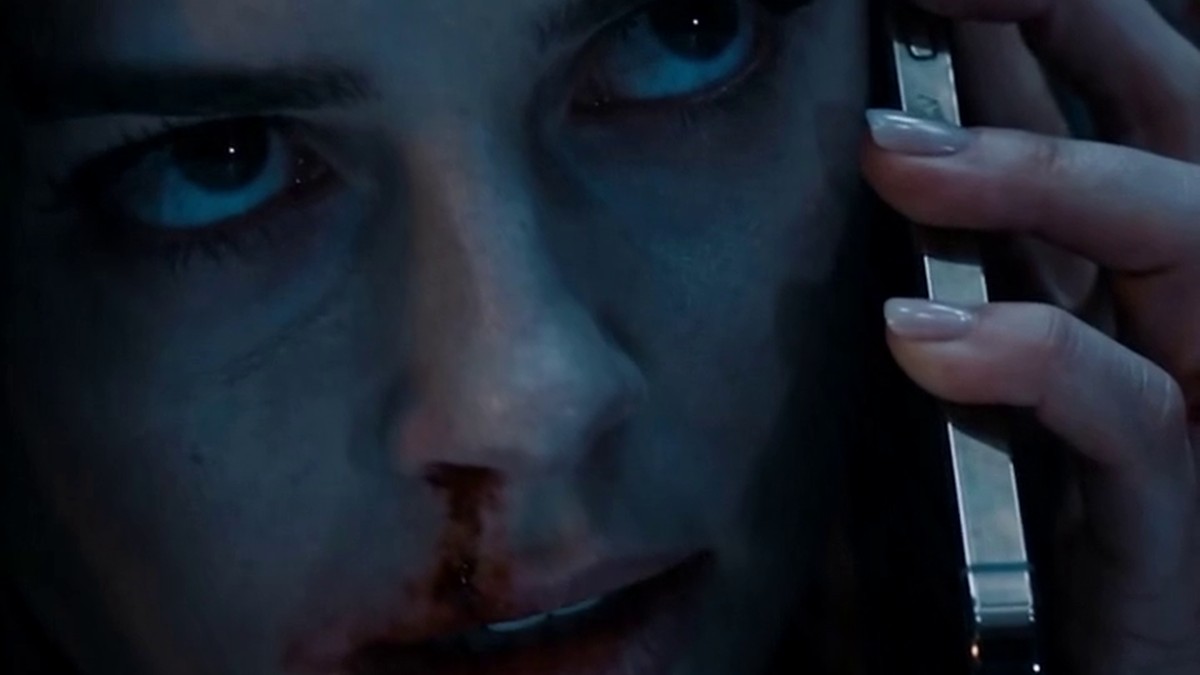
“Dad… just like you told me. Burn it all down.”
Five minutes later, the man who thought he was untouchable stood paralyzed in pure terror, understanding far too late that he had picked the wrong woman to break.
—
My name is Evelyn Vale, and the very first lash taught me something I would carry forever.
My husband, Adrian Vale, had stopped seeing me as a person.
By the twentieth strike I quit screaming, because every sound that left my throat only seemed to delight Vanessa — the woman who had claimed my place in his life as though it were rightfully hers. She was draped across a velvet sofa with a crystal flute dangling from her fingers, watching my degradation the way someone watches a film they’ve already seen and still enjoy.
“Again,” she said, lips curving. “She rolled her eyes at me while I was speaking.”
Adrian didn’t pause. His grip tightened around the leather riding crop without a flicker of hesitation.
He had locked every door of our sprawling estate outside Dallas. Sent the entire household staff away. Ordered me to kneel beneath the crystal chandelier — the same one we had chosen together, three years before, in a showroom where he had held my hand and called me his whole world.
Every strike rang through the hollow mansion like a bell no one would answer.
Every one dismantled another wall of the life I had genuinely believed we were building.
When I married Adrian he was magnetic — ambitious, electric, the kind of man who made a room rearrange itself around him. I mistook that fire in his eyes for drive. After the wedding, the same fire curdled into arrogance and contempt, and eventually into something I no longer had a word for.
He mocked my clothes.
He laughed at my stillness.
Whenever someone asked about my family, he would announce cheerfully that my father was a retired accountant living somewhere overseas — some harmless, invisible man of no consequence whatsoever.
I never corrected him.
My father had told me not to, years before any of this.
“Never show a man the strength of your shield,” he’d said. “Let him believe you’re defenseless. He’ll show you exactly what he’s made of.”
He was right.
Vanessa knew only that Adrian wanted her, and that I was in the way. Every week she manufactured something new. I had insulted her. Stolen jewelry. Sabotaged her career. Threatened her. The stories grew wilder each time because Adrian wasn’t searching for the truth. He was searching for permission.
By the one hundred ninety-ninth strike, my vision had started dissolving at the edges.
At two hundred, he dropped the riding crop onto the marble beside me like a man setting down a tool he’d finished with.
“There.” He was breathing hard. “Maybe now you understand what respect looks like.”
Vanessa recrossed her legs and smiled the way people smile when they’ve won something small but satisfying.
“Apologize to me.”
I lifted my head slowly. My lips tasted like copper.
“May I use my phone?”
Adrian laughed — a full, unhurried laugh that filled the room.
“What exactly are you planning to do? Call the police? They’re going to hear how you attacked Vanessa first.”
He was utterly certain of himself. He had disabled every security camera in the house before the night began. He had thought of everything.
What he had not thought of was the pendant resting at my collarbone.
It looked like a diamond. It was also an encrypted audio recorder, installed by my father’s private security team two months earlier — two months after Adrian shoved me down a staircase and I lay at the bottom listening to him walk away.
That fall killed the last thing in me that had wanted to believe in this marriage.
From that night forward I had moved quietly and deliberately. Copied financial records. Photographed forged invoices. Catalogued every threat. Built a documented case showing that Adrian and Vanessa had been funneling company money through her fictitious consulting firm for the better part of two years.
My father had wanted to move immediately.
I asked him to wait.
Walk out too early and they would have the time and the resources to make everything disappear. I needed them to be so confident, so comfortable, so certain of their own safety — that they destroyed themselves.
Tonight they had done exactly that.
With fingers that shook only slightly, I unlocked my phone and pressed the number I had known by heart since childhood.
He answered before the first ring finished.
I looked directly at Adrian when I spoke. My voice was steady.
“Dad… just like you instructed. Ruin his life.”
It was the first moment all evening that Adrian’s certainty showed a crack.
Across the room, Vanessa set her champagne glass down slowly, as though sudden movements might make things worse.
Neither of them knew what my father actually was.
Neither of them had ever thought to ask.
And as headlights cut hard across the mansion windows — one set, then another, then more — I watched the blood leave Adrian Vale’s face all at once, like a tide going out and never coming back.
The first car door that slammed outside was followed by five more in rapid succession.
Adrian moved to the window. Whatever he saw there drained the last color from his face.
“Who did you call?”
I didn’t answer him. I pressed my back carefully against the wall and stood. Every muscle in my body registered the effort. Two hundred strikes worth of effort.
“Evelyn.” His voice had changed registers entirely. The command was gone from it. What was left sounded almost like a question. “Who did you *call*?”
—
My father’s name is Thomas Wren.
He retired at sixty-two from a career in international private equity, which is what the official biography states. What the official biography omits is the two decades before that — advising three successive U.S. administrations on financial intelligence, dismantling offshore shell networks that funded things governments prefer not to name publicly, and building, over forty years of careful relationship maintenance, a personal network that stretched across regulatory agencies, federal courthouses, financial crime divisions, and the offices of men who make other powerful men’s problems evaporate.
Adrian had heard the word “accountant” and stopped listening.
I had been counting on exactly that.
The doorbell rang once, formally.
Then the front doors opened without anyone from inside answering them.
—
There were six of them — four men and two women, all in dark civilian clothing, none of them raising their voices. One carried a slim leather portfolio. Another carried nothing at all and somehow managed to be the most frightening person in the room by a significant margin.
Behind them, framed in the doorway like a man entirely at ease in spaces other people found threatening, stood my father.
Thomas Wren was seventy years old. He wore a gray wool blazer and no tie, and he looked like someone’s pleasant grandfather arriving for Sunday dinner, which was a costume he had spent decades perfecting.
His eyes found mine immediately.
They traveled across me — the torn fabric, the marks on my arms, the copper dried at the corner of my mouth — and something moved through his face that was not grief and was not rage. It was colder and more deliberate than either. It was the expression of a man cataloguing damage and calculating appropriate response.
“Evelyn.” He crossed the room to me directly and took both my hands in his. His grip was gentle. “Are you able to stand?”
“Yes.”
“Are you in pain?”
“Yes.”
“Both of those answers are fine,” he said. “You won’t be in either situation much longer.”
Then he turned.
—
Adrian had positioned himself near the fireplace, which I recognized as an instinct toward the only solid wall in the room. Vanessa had not moved from the sofa. She had, however, put the champagne glass entirely down, and both of her hands were visible, folded tightly in her lap, which told me she had assessed the room faster than Adrian had.
She was smarter than him. She had always been smarter than him. It was one of the reasons this had taken so long to unravel — she was the one who’d constructed the invoices, maintained the paper trails, understood which threads to cut. Adrian had provided the ego and the signature. Vanessa had provided the architecture.
My father understood this too. I had briefed him in detail.
He stopped in the center of the room and regarded them both with the particular patience of someone who has already won and is simply waiting for the other party to understand it.
“Mr. Vale.” He didn’t extend a hand. “My name is Thomas Wren. I believe you’ve mentioned me. Retired accountant. Somewhere overseas.”
Adrian’s jaw tightened.
“Whatever she told you—”
“My daughter has told me a great many things over two years,” my father said. “Tonight she told me one specific thing, which served as an instruction I’ve been waiting to act on. I want to be precise with you about what happens next, because I find that precision is charitable. It removes the period of confusion that people in your position tend to experience.”
He nodded to the woman with the portfolio.
She opened it and placed a single document face-up on the coffee table.
“Federal prosecutors in the Northern District of Texas were contacted forty minutes ago,” my father continued. “The full financial documentation — wire transfers, fabricated vendor registrations, forged corporate signatures, and the operating history of Vanessa Sloane’s consulting firm, which has never consulted on anything — has been in their possession since eleven this evening. The audio recording from tonight will be transmitted the moment my daughter’s physician confirms her injuries.” He paused. “Her physician is currently in the driveway.”
Vanessa’s composure broke first.
It broke quietly — not in a scream but in a sudden stillness, the stillness of someone who has just recalculated every available exit and found them sealed.
“You cannot have—” She stopped herself. Looked at me. Something shifted in her expression that I hadn’t expected. Something that looked, briefly and horribly, like genuine surprise. “You never—you were nothing. He said you were *nothing*.”
“He was mistaken,” I said.
“The pendant,” she said softly. Her eyes dropped to my collarbone. Her voice went almost meditative, as though she were solving a puzzle for its own sake. “The whole time.”
“The whole time.”
She sat back. She looked at her hands. And then, with a composure that I grudgingly recognized as remarkable, she straightened her spine and said nothing further.
Vanessa Sloane was smart enough to know when to stop talking.
Adrian was not.
—
“This is *harassment*.” He took a step forward. One of the men near the door moved in direct response — not aggressively, just repositioned himself between Adrian and the rest of the room with the casual efficiency of someone for whom this is habitual.
Adrian stopped.
“You’ve been in my house for four minutes,” he said, his voice rising toward its old commanding register and almost reaching it. “You don’t have any authority to—”
“I’m not law enforcement,” my father said pleasantly. “I have no authority whatsoever. I’m a retired accountant visiting his injured daughter. The individuals accompanying me are her legal counsel and support staff.” He tilted his head slightly. “What I have instead of authority, Mr. Vale, is the complete financial history of Vale Group going back eleven years, a forensic accounting team that has been working that history for seven months, and a number of longtime professional relationships with people who do have authority and who find the work I’ve brought them this evening quite interesting.”
He let that land.
“You have two options,” my father said. “You can spend tonight making phone calls to the lawyers and associates you believe will protect you, and they will tell you, one by one, what they are no longer able to do for you. Or you can sit down and listen to the terms my daughter is prepared to offer, which are substantially more generous than what a federal court will offer you in eighteen months.”
The clock on the mantle ticked once into the silence.
“She is being *generous*,” he repeated, and his voice carried a register that made the word sound like the most devastating thing in the room, “because she is a better person than this situation required her to be.”
—
I looked at Adrian.
The man I had married — electric, magnetic, the man who rearranged rooms — was standing with his back against a fireplace in his own house, and he was diminished. Not broken. Not destroyed. Simply returned to actual size, the way a fire looks small and ordinary once you take it outside and let the sky put it in proportion.
I had loved him.
That was the truest thing in the room, and also the one that had cost me the most.
I had loved a version of him that may never have existed, or may have existed for only the length of a courtship, or may have been something real that he had simply chosen, incrementally, to abandon. I didn’t know which version was true. I had stopped needing to know.
“The terms are simple,” I said. My voice came out level. I was surprised, and then I wasn’t. I had been rehearsing this in some form for two years without knowing that’s what I was doing. “Full and uncontested divorce. The house in Sedona and the investment accounts in my name. A signed statement, witnessed and notarized, confirming the source and circumstances of my injuries this evening. Your cooperation with the financial investigation.” I paused. “In exchange, I recommend leniency on the personal charges. Not the financial ones. Those aren’t mine to negotiate.”
Adrian stared at me.
I watched him search for something — a leverage point, a weakness, a version of me that was still kneeling under the chandelier — and I watched him fail to find it.
“You planned this,” he said. There was no accusation in it anymore. It had moved into something stranger. Almost like recognition.
“I prepared for it,” I said. “There’s a difference.”
—
He signed.
Not that night — that night his lawyer was reached by phone within the hour and informed of the situation in terms that produced a brief silence and then a series of rapid professional recommendations. But within seventy-two hours, in a conference room with four attorneys present and my father seated quietly in the corner, Adrian Vale signed every document that was placed before him.
Vanessa Sloane cooperated with federal investigators in exchange for a reduced charge, as I had anticipated she would. She was precise and organized in her testimony, and the prosecution was grateful. She served fourteen months. I held no opinion about this. She had made her calculations and I had made mine, and neither of us owed the other anything.
The Vale Group restructured. Several people lost their positions. Several others kept theirs, which mattered to me, because they had been good employees who had simply worked for a man who didn’t deserve them.
Adrian pled guilty to two counts of financial fraud. The personal charges — the ones from that night, documented and transmitted and attached to a medical report that ran to eleven pages — were part of a civil proceeding that settled in a way that I am not permitted to detail but that my attorney described, with professional understatement, as appropriate.
—
I stayed in the Dallas house through the fall.
It was too big for one person, and I was too tired to care about that for a while.
My father came and stayed for three weeks, which was longer than he’d stayed anywhere in years. He brought groceries and made dinner most evenings and watched documentaries about birds, which had always been a secret interest of his that he never advertised.
One evening I found him standing under the chandelier in the main room — the one I had chosen with Adrian in that showroom, three years back. My father was looking up at it with his hands in his pockets.
“I’ll have it taken down,” I said.
“Don’t do it on my account,” he said. “It’s a beautiful chandelier.”
“It is,” I admitted.
He looked at me for a moment. “You held on a long time.”
“You told me to.”
“I know.” He nodded slowly. “I want you to know that was the hardest phone call I’ve ever not made.”
I thought about that. About my father, two years of documented patience, his hand probably hovering over a phone a hundred times.
“It needed to be my call,” I said.
“Yes,” he said. “It did.”
He put his arm around my shoulders, carefully, in the way he had learned to do since the doctor’s report. We stood under the crystal chandelier, and the light it threw was genuinely beautiful, cold and fractured and scattered across every wall, and I decided that I would keep it. That it had been mine before it was a symbol of anything. That I had chosen it and I would choose to keep it and it would mean what I decided it meant.
Which was, in the end, the whole point.
—
The pendant sits in a drawer in my bedroom now.
I don’t wear it. I don’t need to. Whatever it was built to capture, it captured. Whatever needed recording has been recorded. What’s left is just a diamond — or the thing shaped like one — and I have no use for things that only look like what they are.
I sleep with the windows open now.
I had not noticed, until I stopped, how long I had been living in a house with every window closed.