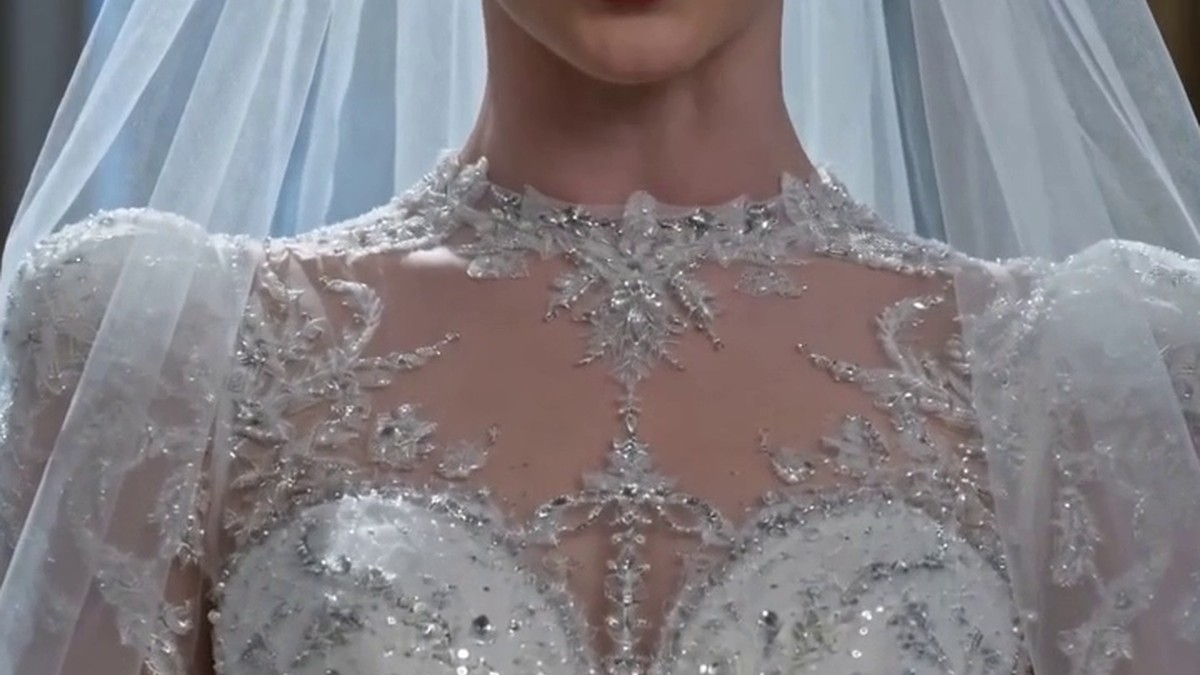
A woman in sharp black cut through the crowd and squared off against the bride. No warning. No hesitation. Just the cold, deliberate cruelty of someone who had rehearsed this moment.
“A woman like you never belonged in this family,” she said. Her voice carried to every corner of the room.
The groom — impeccable in cream, spineless in every other way — managed a faint, useless murmur. “Mom… what are you doing?”
“Saying what everyone here is already thinking.” She swept the room with her eyes, hunting for allies, inviting the crowd to join in.
She found none.
The bride didn’t flinch. She didn’t cry. She reached down, pulled the diamond ring from her finger — an enormous, glittering thing — and set it down on the nearest table with a single, deliberate *clack*. The sound rang out like a gavel.
“Then they should hear the whole truth.”
Her voice was ice. It silenced the room completely.
“I paid your debts. I saved your house. When this family had nothing — absolutely nothing — I was the one holding it together.”
The words detonated in the silence.
Around the room, faces shifted — shock, confusion, then something rawer: the visceral panic of people watching a secret get dragged into the light. The mother’s composure crumbled. The illusion of wealth, of lineage, of power — all of it dissolving in real time in front of two hundred witnesses.
The bride stepped back from the altar.
“Today I’m not losing a husband.” She let the words land. “Today I’m cutting loose an ungrateful family.”
Then she turned.
Head high. Stride steady. Not a single backward glance.
She walked out of that hall and left them exactly where they deserved to be — frozen, exposed, and stripped of every lie they’d built their world on.
The doors swung shut behind her with a sound like a closing chapter.
Outside, the corridor was cool and dim and mercifully empty. The noise of the hall fell away — muffled, distant, like something happening underwater. Her heels clicked against marble. Once. Twice. Then she stopped.
She pressed one hand flat against the wall and breathed.
Just breathed.
Her chest was doing something complicated — not quite grief, not quite relief. Something in between. Something she didn’t have a name for yet.
She had rehearsed this day a hundred times. The flowers, the vows, the first dance. She had not rehearsed *this*. But standing in that quiet corridor, bouquet still in her hand because she’d forgotten to drop it, she realized some part of her had always known. Some quiet, watchful part that had been waiting for the mask to slip.
It had.
She set the bouquet against the wall. Gently. Almost tenderly. The white roses looked absurd down there on the floor, but she didn’t have the heart to just drop them.
*Small mercies,* she thought. *You’re still you.*
—
Back inside, the silence lasted exactly four seconds longer than anyone expected.
Then the murmuring started.
Two hundred people simultaneously discovering they had nothing to look at but each other, and the woman standing at the front of the room who had caused all of this. Margaret Harlow — mother of the groom, architect of tonight’s catastrophe — stood at the altar with her arms at her sides and her chin lifted and her expression doing everything it could to hold the shape of dignity.
It was not succeeding.
“Margaret.” One of the older women in the front row — gray-haired, pearl-necklaced, carrying the kind of quiet authority that doesn’t need to announce itself — spoke from her seat. She didn’t stand. She didn’t need to. “What on earth have you done?”
“I simply stated the truth.”
“You stated *a* truth.” The woman set down her champagne glass. “It seems there were several others you conveniently left out.”
Margaret opened her mouth.
She closed it.
The room watched.
Her husband, Gerald, appeared at her elbow — a soft, defeated man who had spent thirty years perfecting the art of being invisible beside her. He touched her arm. She shook him off. He touched it again, more firmly this time, and something in his face had changed. Something old and buried.
“That’s enough,” he said quietly. “That is *enough*, Margaret.”
She looked at him as though he’d spoken in a foreign language.
—
The groom found her in the corridor.
He had loosened his tie somewhere between the altar and the door, and he looked — there was no other word for it — *undone*. Like a man who’d just watched the blueprint for his entire life catch fire.
“Elena.”
She turned. Looked at him. Gave him the full, clear weight of her attention.
“I’m sorry,” he said. “I need you to know that I—”
“Don’t.” Her voice was steady. Not cruel. Just final. “Daniel. Don’t apologize for her. You’ve been doing that for three years and it hasn’t changed a thing.”
He stopped.
“You knew,” she said. “You knew what she thought of me. You knew how she talked about me when I wasn’t in the room. I found that out a long time ago and I stayed anyway because I loved you and I thought—” She paused. Collected herself. “I thought love was enough to fix it. That if I just worked hard enough, gave enough, proved enough—”
“Elena—”
“The house, Daniel.” She said it quietly. The words that had detonated the room, now just between the two of them. “I paid off the mortgage on that house. Did you know that? Did she tell you that when she came to me, it was because there was no one else?”
The look on his face told her everything.
He hadn’t known. Or he had known, vaguely, the way you know things you’ve decided not to examine too closely.
“She told me it was a loan from a family friend,” he said. Barely above a whisper.
“She told you what she needed to tell you.” Elena looked at him for a long moment. This man she had loved. This man who had not been, in the end, brave enough to be worth it. “I don’t blame you for all of it. I want you to know that. But I need you to understand something.”
She waited until he was really looking at her.
“I am not a remedy. I’m not a solution to your family’s problems. I am a person. And I deserved to be treated like one.”
He didn’t have an answer for that. There wasn’t one. They both knew it.
She picked up her bouquet from the floor. Old reflex. Something to do with her hands.
“Go back inside,” she said. “Your guests are waiting.”
—
He did not go back inside.
He stood in the corridor long after her footsteps faded, one hand against the wall in almost the exact spot where hers had been, and he thought about three years. About all the moments he had smoothed over and explained away and quietly absorbed. About the way she had smiled through dinners that must have cost her something. About the fact that she had been holding his family together and he had let himself believe it was effortless.
*Because it was easier,* he thought. *Because if it was effortless, you didn’t have to feel guilty about it.*
—
Inside the hall, the party had achieved something remarkable: the total collapse of social performance.
The catering staff moved uncertainly between tables. The string quartet had stopped playing — no one had told them to, but it had seemed right. Guests stood in clusters, speaking in low, urgent voices, phones appearing with the furtive inevitability of phones at disasters.
Margaret had retreated to a corner with Gerald and her sister Constance and she was explaining — loudly, to anyone who would listen — that she had simply been looking out for her son’s interests, that the girl had always been inappropriate for the family, that anyone who knew the full picture would understand—
“I know the full picture.”
The voice came from across the room. Older woman. Silver-haired. Dr. Patricia Voss, who had known the Harlow family for twenty-two years, who had sat at their table and listened to Margaret perform wealth she didn’t have and confidence she’d borrowed and social standing she’d been coasting on for a decade.
“I know the full picture,” Patricia said again, louder now, not unkindly but without any softness either, “because Elena told me. Two years ago. She came to me because she didn’t know what to do and she was trying, Margaret. She was genuinely *trying* to make this work.”
The corner of the room was very quiet.
“And this is what she got for it.”
Margaret’s mouth opened. Her sister touched her arm. For once, Margaret let herself be touched.
The silence that followed was not comfortable. It was the silence of reckoning. The specific, terrible hush of people who had accepted a version of events that was no longer available to them.
—
Elena was in the parking lot when her phone buzzed.
She looked at the screen. *Daniel.*
She didn’t answer.
It buzzed again. Then a text: *Where are you. Please.*
She stood beside her car in the evening air, the white of her dress luminous under the parking lot lights, bouquet of roses still in her hand because apparently she was committed to it now. Somewhere across the city, her apartment was exactly as she’d left it three days ago when she’d started moving things to his place. Her coffee maker. Her books. The small painting she’d bought at a street market the year she graduated and hung in every apartment she’d ever lived in because it was *hers*.
She would get her things. She would figure out the logistics. She would handle all of it — she was, after all, the woman who had held a family together when they had nothing. She could certainly hold herself together now.
But first she just stood there for a moment.
The night was warm. The air smelled like cut grass and car exhaust and, faintly, the roses she was holding. Two hundred people were behind her in that hall, and the full weight of everything that had been said and done was still settling, and she was — what? Sad? Yes. Relieved? More than she’d expected. Exhausted in a way that went deeper than tonight, that had been building for three years of smiling through dinners and absorbing small cruelties and telling herself it was worth it.
She set the bouquet on the hood of her car.
Opened the door.
Got in.
Sat with her hands on the steering wheel and her eyes straight ahead and let herself feel, for exactly sixty seconds, the full shape of what she was leaving behind.
Then she started the engine.
The headlights came on. The GPS asked her where she wanted to go. She typed in her address — her address, her apartment, her coffee maker and her books and her painting — and pulled out of the parking lot without looking back.
Behind her, the lights of the venue blazed on.
She drove toward the dark, and the dark felt, for the first time in a long time, like something she’d chosen.
Like the beginning of something clean.