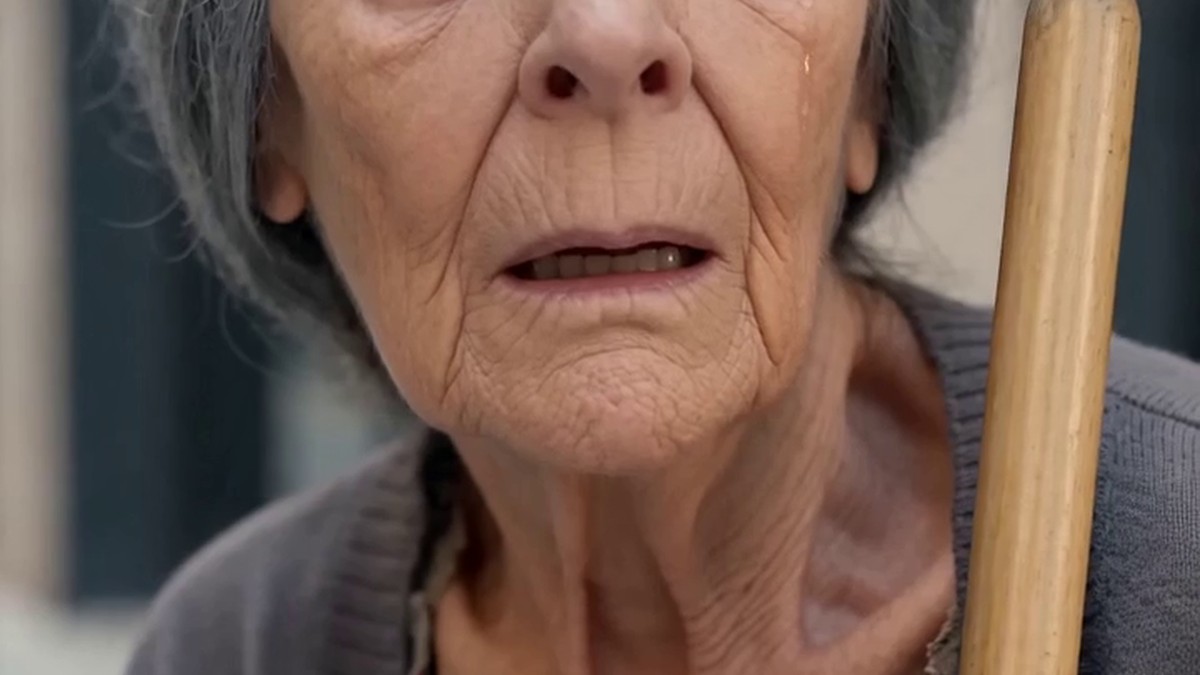
Her clothes had lost their color long ago. Her shoes were giving up. And every time she lifted that broom, her tired hands trembled with the effort. Most people who passed by drew their own conclusions — that she swept those streets because she had no other choice. Because the money was all that mattered.
Nobody knew the real reason.
That bright afternoon, Martha was working quietly through the dust and fallen leaves when three young women stepped out of an expensive boutique across the street. Designer dresses. Jewelry that caught the light. Sunglasses that probably cost more than everything Martha had ever owned put together.
The moment they noticed her, the whispering started.
“Get a look at what she’s wearing,” one of them said, loud enough to make sure Martha heard. “The street almost looks cleaner than she does.”
The others laughed — the kind of laugh that’s meant to land like a blow.
Martha dropped her gaze and kept sweeping, arranging her face into something that said she hadn’t heard a word. But a tear broke free and traced its way down her deeply lined cheek.
One of the girls reached into her bag, pulled out a paper cup, and dropped it deliberately onto the clean sidewalk.
“You missed a spot,” she said, smiling like she’d done something clever.
Martha stopped.
Her fingers tightened around the wooden handle. She said nothing.
Then — a sound split the square open. Hard brakes. A long black luxury car pulled up directly behind the three women. The rear door swung wide, and a tall man in an expensive suit stepped out onto the pavement.
The girls straightened up instantly. Smoothed their hair. Smiled, certain that someone important had arrived.
The man didn’t so much as glance their way.
His eyes found Martha, and the color drained clean out of his face. He said one word — barely a whisper — and it stopped everything around him cold:
*”Mom?”*
The square held its breath.
The three women turned in unison, smiles already arranged — the kind women like them kept ready, polished and automatic, for men who stepped out of cars like that.
But the man was already moving past them.
He crossed the distance to Martha in four long strides, and before she could say a word, before she could even straighten up, he folded himself in half and took her trembling hands in both of his. The broom handle swayed between them like a flagpole in wind.
“Mom.” He said it again, quieter this time. “What are you doing out here?”
Martha pulled one hand free and pressed it flat against his cheek the way she’d done when he was small enough to believe that gesture could fix anything.
“The same thing I do every morning, Daniel.” Her voice was steady. “What are *you* doing here? You said Thursday.”
“I came early.” His jaw was tight. “I tried calling.”
“Phone’s charging.”
He glanced down at her shoes — the left one split along the sole, the leather gone gray and soft as wet paper. Something moved across his face that he didn’t entirely manage to control.
“Let me take you home.”
“I’m not finished.”
“Mom—”
“I’m *not finished*, Daniel.”
—
Behind them, the three women had not moved. The one who’d dropped the cup — her name was Kelsey, twenty-four years old, her father’s credit card warm in her wallet — stood very still. She was doing the math. The car. The suit. The way every person within eyeshot had suddenly found somewhere else to look. The math was not landing in her favor.
The tallest one, Brianna, touched her arm. “Do you know who that is?”
Kelsey shook her head.
“That’s Daniel Marsh.” A pause. “The Daniel Marsh.”
The name meant nothing for a half-second, and then it meant everything. Marsh Properties. The new civic center. The waterfront development that had put this entire town on a different map. His face had been on the cover of the regional business journal three months running.
Kelsey looked at the paper cup sitting on the clean pavement.
She looked at the old woman, still holding the broom.
She looked at Daniel Marsh, who was now looking directly at her.
—
He had seen it. All of it. He’d watched from the back seat as the car pulled around the corner — watched the cup leave Kelsey’s hand, watched it hit the ground, watched his mother’s fingers tighten on that broom handle. Watched the tear.
He’d seen the tear.
He straightened up slowly and turned to face the three of them.
He didn’t raise his voice. Men with what he had didn’t need to.
“Did one of you drop that?” He nodded toward the cup.
Nobody answered.
“I’m going to ask one more time, because I was raised to believe people have the decency to answer a direct question.” His eyes moved from one face to the next. Calm. Absolute. “Did one of you drop that cup on the ground this woman just cleaned?”
Kelsey opened her mouth. Closed it. Then, very quietly: “It was an accident.”
“Pick it up.”
The square was silent enough now that a pigeon landing on the fountain rim made everyone flinch.
“Excuse me?” Kelsey said.
“Pick. It. Up.” He said each word with the deliberate patience of someone who had not repeated himself in years and found the experience instructive. “Find the nearest trash can. And then you’re going to apologize to her.”
“Daniel.” Martha’s voice came from behind him, soft but with the weight of someone who’d carried whole lifetimes. “Don’t.”
“Mom—”
“I said don’t.” She came around to stand beside him, and the two of them faced the women together — the old woman in her colorless coat and splitting shoes, and the tall man in the four-thousand-dollar suit. “They’re young. They made a mistake.” She looked at Kelsey, not with contempt, not with the wounded flatness of someone defeated, but with something that was almost — not quite, but almost — kind. “That’s what young people do. They make mistakes and then they decide who they want to be after.”
Kelsey stared at her.
The cup was still on the ground.
Kelsey bent down and picked it up.
She didn’t say anything. She walked to the trash can at the corner of the square, dropped it in, and came back. Her friends had retreated three steps without seeming to notice they’d done it.
“I’m sorry,” Kelsey said. Her voice had lost its shape a little. “What I said was — I’m sorry.”
Martha nodded once. That was all. That was enough.
—
In the car, Daniel sat beside her and kept looking at her hands — the swollen knuckles, the calluses layered over calluses, the thin gold band that had been loose for twenty years and that she’d had resized twice and refused to remove.
“You don’t need to do this,” he said. “You know you don’t. I’ve told you—”
“I know what you’ve told me.”
“Then why?” He turned toward her. He’d asked this before. Every time, she’d changed the subject or laughed it off or simply pretended not to hear him. But something about today — the cup, the tear he’d watched trace its way down her face from the back seat of the car — made him need an answer that would hold.
Martha looked out the window at the square receding behind them. A woman with a stroller cut across the clean pavement. Two old men sat at the café table by the fountain, arguing gently over a chessboard.
“Your father swept that square,” she said finally.
Daniel went still.
“Forty-one years. Before you were born, before we had anything worth speaking of. He woke up every morning at five and he swept those streets because he said it was the one thing he could do that nobody could take from him.” She folded her hands in her lap. “He said a clean street was an honest thing. That it didn’t ask for credit. It just was.”
Daniel didn’t speak.
“He died on a Tuesday. You remember — you were eleven.” Her voice stayed even, the way voices go even when a person has had decades to make their peace with something and still hasn’t quite finished. “Wednesday morning I woke up at five out of habit. I didn’t know what to do with myself.” A faint smile. “So I went and got the broom.”
The car moved through the quiet streets.
“Thirty-six years,” she said. “I’m not going to stop now.”
Daniel looked at her for a long moment. Then he reached over and covered her hands with his — the way she’d always covered his when he was young and frightened and certain the dark outside his window had something to say about him.
He didn’t argue.
—
What Kelsey did with the rest of that day, nobody knows for certain. But the women at the boutique across the square noticed that the following morning, a young woman they didn’t recognize came and stood at the edge of the sidewalk for a while, watching the old sweeper work. She didn’t say anything. She didn’t need to. She watched until Martha moved around the corner and out of sight, and then she left.
Martha never knew she’d been there.
She was too busy with the work — the slow, aching, honest work of keeping something clean, out of love for a man thirty-six years gone, in a square that had no idea it was being tended to like a grave and a garden all at once.
The black scarf under her chin. The trembling hands. The broom lifting and falling in the early morning quiet.
The same thing she did every day.
The same thing she would do tomorrow.