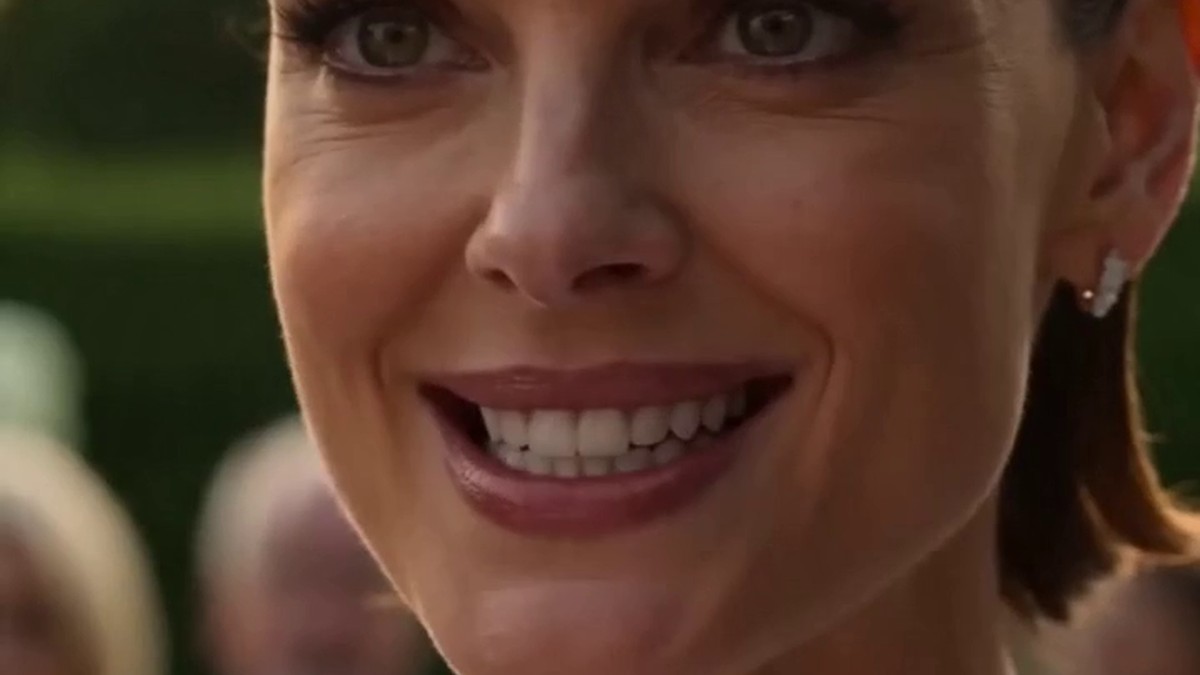
He had counted on my silence. Men like Richard always do.
But when I stepped onto that patio and saw his hand settled against Chloe Vance’s lower back — easy, practiced, belonging there — something in me went stone-cold and absolutely still. I lifted my voice above the jazz, above the clink of crystal and the murmur of strangers in expensive clothes.
“Richard.” Every syllable landed clean. “I need you to return this to whoever left it wedged under the seat of your truck. Because the moment I touched it, I nearly came apart.”
The music stopped like someone had cut a wire.
All around me — white hydrangeas, towers of champagne, candlelight catching the rims of glasses — two hundred people turned and stared. I stood in the center of it holding a white box with a red satin bow, and Richard looked at me the way a man looks when the floor disappears beneath him.
“What the hell are you doing here?” He moved toward me, voice low, jaw set — that particular kind of anger that had always been enough to send me backward.
Not tonight.
I glanced at Chloe. Then back at him. “Returning something,” I said.
Chloe tilted her chin and let a slow smile spread across her face. “I’m sorry — have we met?” As if my husband hadn’t been sneaking out of her bed for months.
I stepped forward and pressed the box into her hands before Richard could move. She lifted the lid. The red lace spilled across her fingers like something shameful. Somewhere behind me, a champagne flute hit the patio and exploded.
Her embarrassment curdled fast. “How completely pathetic,” she said, her voice hardening into a blade. “Is this really what you’re doing? Making a scene because you can’t figure out how to hold onto your own husband?”
It landed exactly where she meant it to. But I had already decided I wasn’t giving her my tears.
Richard grabbed my arm above the elbow. “We’re leaving,” he breathed against my ear. “Right now.”
I looked down at his fingers pressing into my skin. Then I looked up — at the camera mounted above the patio doors. At the one angled toward the fountain. At the one fixed on the front gate. Richard followed my gaze, and his grip went slack. He was only fearless in the dark, in rooms where no one who mattered could see him.
Chloe laughed. She recited the portrait Richard had painted of me — dramatic, fragile, clingy, a woman so tethered to her husband she couldn’t navigate a utility bill on her own. A few guests politely studied the ground. Others stepped closer.
I let her finish.
Then I told the garden that Richard had been half-right. The version of me he had described — she existed. She would have slipped into a back room, pressed her hands over her mouth, and swallowed the whole disaster whole. She would have been home when he got there, composed and careful, ready to believe whatever he offered.
“But she’s been gone for twenty-one days,” I said.
Richard’s face changed. Because he knew exactly when twenty-one days ago was. He knew what I had found beneath that back seat: the lingerie, a hotel receipt from a midtown Manhattan property, a room key card, a bottle of French perfume that had never been mine.
What he did not know was that I had found it all and said absolutely nothing.
I washed the dishes that night. I smiled across the dinner table. I waited until his breathing deepened and his body went heavy, and then I opened the laptop he had always assumed was beyond me.
The affair was only the surface.
Underneath it: encrypted correspondence, phantom contracts, wire transfers dressed up as consulting fees, and a network of shell companies that existed nowhere except on paper — and in the financial records of the Vance family hospital system. Chloe’s electronic signature appeared on documents. In private messages, Richard promised her a future while referring to her in other threads as his “access point.”
For twenty-one nights, I copied everything while he slept beside me.
The red lingerie was never the point. It was the door — the thing that got me inside this garden, surrounded by every person Richard had been playing at once.
I raised my phone. The screen lit up between Chloe’s hands as her family watched from across the patio.
“I didn’t drive out here to fight you over him,” I said. “I came to show you how deep his lies go. Including the ones he’s been telling you.”
Richard went the color of ash. The smile left Chloe’s face like a light switching off. And in the silence that pressed down over the hydrangeas and the shattered glass and the dead jazz, I opened the first file.
The first document was a wire transfer.
Four hundred and twelve thousand dollars, routed through a consulting firm called Mercer Whitfield Partners LLC — a company that existed on paper and nowhere else — into an offshore account registered in the Cayman Islands. Dated fourteen months ago. Bearing Richard’s electronic signature and the authorization code of the Vance Memorial Hospital Foundation.
I tilted the phone so the garden could see it.
Chloe’s mother moved first. Margaret Vance was seventy-one years old and had the posture of someone who had never in her life been surprised in public. She crossed the patio with deliberate steps, her champagne still in hand, and looked at the screen the way you look at something you suspected was there but prayed you’d never have to see.
She didn’t say a word.
Richard said, “That’s completely out of context—”
“There are forty-seven more,” I said.
The second document: a shell company incorporated in Delaware, twelve days after Richard joined the Vance Foundation’s advisory board, its sole registered agent a paralegal who would later tell a federal investigator she’d been paid three thousand dollars in cash to sign her name and forget about it.
The third: a thread of encrypted messages between Richard and a man named Sorensen — a name that meant nothing to me until I cross-referenced it against the wire transfers and found him receiving a twenty percent cut on every transaction. In one message, Richard described Chloe as “the golden key.” In another, he wrote that she was “genuinely in love with me, which makes everything easier.”
I read that one aloud.
The garden went so quiet I could hear the candles.
Chloe’s chin dropped. The red lace was still in her hands, spilling over her fingers, and she stood there holding the symbol of what she thought was a love triangle and watched it reshape itself into something far uglier. Not a rival. A tool. Not a woman he wanted badly enough to risk his marriage. A signature. An access point. A golden key he had found and used and planned to discard the moment the last transfer cleared.
“Chloe.” Her mother’s voice was careful. Measured. The voice of a woman locking a vault. “Come here.”
Chloe didn’t move.
Richard turned to me, and his face had shed every layer it had been wearing for as long as I’d known him. The charm, the easy authority, the particular warmth he switched on when a room required it. All of it, gone. What was left was smaller than I expected. “You have no idea what you’re doing,” he said.
“I’ve been doing it for three weeks.”
“You’ll destroy everything—”
“You destroyed it. I’m just showing people where you hid the pieces.”
He lunged for the phone.
He was faster than I’d anticipated — a reflex, desperate and graceless — and his hand closed around my wrist before I could step back. The grip was hard. Not the controlled anger from earlier. Something past that. Something that admitted it had run out of options.
Two men materialized out of the crowd before I had to decide what to do next. I didn’t know either of them. I would later learn that one was Margaret Vance’s personal attorney and the other was her eldest son, Thomas, who played college lacrosse twenty years ago and still moved like it.
Richard released my wrist.
He looked at his hand as if it had done something without his permission.
“There are people you should call,” Margaret said to her son, still not raising her voice, still holding her champagne with the self-possession of someone accustomed to crises that had to be managed quietly and completely. Thomas was already walking toward the gate with his phone at his ear.
I stood where I was. My wrist ached. My heart was slamming against my ribs in a way I hadn’t expected, because I had rehearsed this moment forty times and in none of those rehearsals had I accounted for what my body would do when it actually arrived — the cold sweat, the slight tremble in my knees, the specific grief that has nothing to do with love and everything to do with realizing you shared a bed for nine years with someone who was always performing.
Chloe was still holding the white box.
She set it down on the nearest table — carefully, like it was something that might break — and then she looked at me for a long time. I expected rage. I think I was even prepared for it.
What I wasn’t prepared for was the way her face collapsed, just briefly, before she caught it and put it back together. The way she seemed, for just that one unguarded second, as blindsided and as stupid-feeling as I had been twenty-one days ago, crouched on the floor of a pickup truck, holding something red and lace-fine that didn’t belong to either of us.
“He told me you didn’t understand him,” she said. Quiet. The cruelty had gone out of her voice, which was worse in some ways, because what was left sounded almost human.
“I know.”
“He said you’d been checked out for years.”
“I know what he said.”
She looked past me at Richard, who was standing very still in the way animals go still when they calculate whether running is still possible. “Did he use my family’s money to fund his—”
“Yes.”
She picked up a champagne flute from the table beside her. Looked at it. Set it back down.
“All right,” she said, to no one in particular.
The attorney was already inside making calls. Someone had turned off the decorative lights along the garden path — I don’t know who, or why that was anyone’s priority — and in their absence the only illumination was candlelight and the blue-white glow of the phone still in my hand. The guests had stopped pretending to look elsewhere. A cluster of them stood near the fountain. A few had simply left. One woman was crying softly behind a hedge, which seemed to me both ridiculous and absolutely correct.
Richard tried once more.
He stepped toward me and lowered his voice to the register he used when he wanted to seem like he was offering something. “We can fix this,” he said. “We can go home, sit down, and we can fix this together.”
Nine years ago I would have wanted that more than almost anything.
I looked at him — really looked, the way you stop looking at someone you live with, the way you start looking again once you understand who they actually are — and I felt the last of it leave me cleanly. Not with drama. Not with the relief I’d imagined. Just a quiet evacuation, like a room someone finally stops heating.
“The files were transmitted to the FBI field office in Manhattan at 9:14 this morning,” I said. “And to the New York State Attorney General. And to the foundation’s board. You can’t fix it. It’s already done.”
His mouth opened. Closed.
“I came here tonight,” I told him, “because I wanted you to know that I was the one who did it. Not an attorney. Not a private investigator. Me. From your own laptop, while you were asleep.”
I slid my phone into my bag.
“I wanted to see your face when you understood that.”
And I had seen it. I had the image now, clear and permanent, something I would be able to take out and examine later with a steadiness I didn’t yet entirely feel: Richard Calloway in a garden full of the people he had been performing for, in the moment he understood that the woman he had counted on to stay quiet had been the most dangerous person in the room for twenty-one days.
I picked up my keys from the table where I’d set them when I arrived.
Margaret Vance touched my arm as I passed. Light. Brief. She didn’t say anything and neither did I. Some acknowledgments don’t require words — they only require that two people look at each other and confirm they are both still standing.
I walked back through the garden, past the white hydrangeas and the broken glass that no one had cleaned up yet, past the fountain where the cluster of guests parted to let me through, past the front gate where Thomas stood with his phone and nodded once as I stepped onto the gravel drive.
The night air smelled of salt and cut grass and the lingering ghost of two hundred people’s perfume.
I sat in my car for a long time before I started it.
My hands rested on the wheel and I watched the lights of the Vance estate through the windshield and I let myself feel the full weight of what the last twenty-one nights had cost me — the sleeplessness, the stillness, the terrible discipline of pretending that nothing had changed while everything had already changed past the point of return. The meals I cooked. The mornings I smiled across. The way I had to keep my hands steady every single time I opened that laptop.
I had not cried since the truck.
I thought I might now.
I didn’t.
What came instead was something I didn’t have a clean word for — a sensation somewhere between exhaustion and bedrock, like the feeling of a ship finding the bottom and finally, after a very long fall, coming to rest. Not peace, exactly. Not yet. But the first solid thing I had touched in three weeks.
I started the car.
The road back to the city unspooled in front of my headlights, empty and long and entirely mine to drive down at whatever speed I chose.
I chose fast.
Somewhere on the expressway, with the Atlantic invisible but present somewhere to my left and the Manhattan skyline still hours away, my phone lit up on the passenger seat. A number I didn’t recognize. I let it ring.
Then another call. Then a third.
I turned the phone face-down and drove with both hands on the wheel and the windows cracked two inches, and I listened to the wind, and I did not go home to be there when he got back, and I did not compose myself or make myself careful or brace myself for whatever he was going to offer.
He had counted on my silence.
He had built nine years on top of it.
And I had been quiet right up until the moment I decided that silence was no longer something I owed him — that it was, in fact, the most valuable thing I owned, and I could choose to spend it however I wanted.
I spent it on the truth.
The city appeared on the horizon before dawn, burning and indifferent and enormous, and I drove toward it with nothing behind me that I needed to retrieve.