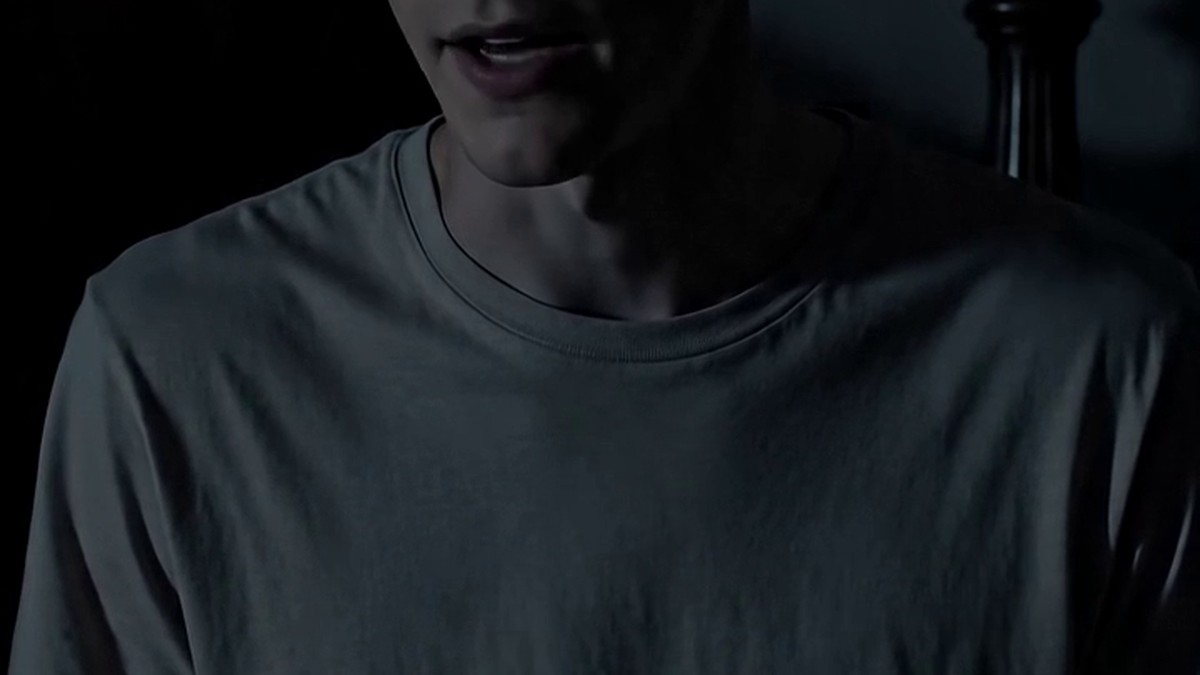
“I’m sorry — I didn’t mean to scare you.” His voice was barely above a whisper. “I heard something outside. Footsteps, maybe. I just wanted to make sure you were safe.”
I sat there in the dark, heart hammering against my ribs, trying to make sense of what I was seeing. He wasn’t threatening. He wasn’t lunging. He was standing in my doorway, barefoot, looking more frightened than I was.
“I should have knocked,” he said. “I’m so sorry.”
I let out a long, shaking breath.
We stood there for a moment — an old woman clutching her blankets, a young man with nowhere to go — and then I heard it too. Something brushing against the side of the house. Probably just a branch. Probably just the wind.
But he’d heard it first. And he’d come to check on me.
I told him to go back to sleep. He nodded, pulled the door shut quietly behind him, and padded back down the hall.
I lay awake for a long time after that, staring at the ceiling my husband had plastered by hand back in 1974.
In the morning, I made eggs. He sat across from me at the kitchen table — the same table where my son used to do his homework — and we ate without saying much. It didn’t feel like silence, though. It felt like something else entirely.
Before he left, he asked if he could come back sometime to check on me.
I told him yes.
That was almost a year ago. He comes by every week now. He fixed the loose step on the porch that I’d been meaning to get to for two years. He doesn’t talk much about where he came from, and I don’t push. Some wounds need time before they can be spoken out loud — I know that better than most.
I still set four extra places at the table on Thanksgiving. I don’t think I’ll ever stop.
But this year, at least one of those chairs won’t be empty.
He showed up that November morning with snow still caught in his hair and something tucked under his arm — a pie, store-bought, a little dented on one side, like he’d maybe dropped it and hoped I wouldn’t notice.
I noticed.
I didn’t say a word about it.
He stood on the porch in his good jacket — I’d never seen him in his good jacket before — and held that pie out toward me the way you’d offer something sacred. His eyes were doing what they always do when he’s not sure he belongs somewhere. Checking the exits. Waiting for the door to close.
I opened it wider instead.
“Get in here before you freeze,” I said. “And take your shoes off. I just mopped.”
He laughed. It was a real one — not the polite kind he sometimes serves up when he thinks laughter is what’s expected of him. This one came from somewhere lower and older, from whatever part of him still remembers what a home sounds like.
I had the turkey in already. The house smelled the way it used to — sage and butter and the particular warmth of a kitchen working hard all morning. He stopped just inside the door and breathed it in without seeming to know he was doing it.
I knew.
I went back to the stove and let him find his way to the kitchen on his own. He did, eventually. He stood for a moment in the doorway — different doorway than that night almost a year ago, better circumstances, better light — and then he pulled out a chair and sat down.
The same chair my son used to push back too far and tip on two legs until I told him he’d crack his skull open one day.
I didn’t say that either.
“Can I do anything?” he asked.
“You can tell me if this gravy needs more salt.”
He came and stood beside me at the stove and tasted it off the wooden spoon like I’d asked him to, very seriously, the way he takes most things I ask him to do — that focused, careful attention he gives to ordinary tasks, like he’s been let in on something and doesn’t want to waste it.
“Maybe a little,” he said.
I added a pinch. It was right. I didn’t tell him I’d already known.
—
We ate at two o’clock, the two of us, at a table set for six.
I have a system. I have had a system for nine years now. The chair at the head is Robert’s — my husband, gone since 2015, heart attack in the driveway on an ordinary Tuesday in March, which is still the cruelest thing I know about grief: that it doesn’t wait for a meaningful moment. Next to him is where my daughter Patricia would have sat, if we were still speaking, which we are not, though I leave her chair because I have not given up, exactly — I have just run out of ways to try. Then my son David, who lives in Portland now and sends a card every year without fail, a good man, a distant one. And the last two I can’t quite name, even to myself. Maybe they’re for the versions of things that didn’t happen. Maybe they’re just for the fact of absence itself, which deserves a seat at the table as much as anyone.
He didn’t ask about the extra settings. He looked at them, and then he looked at me, and he didn’t ask.
That is one of the things I’ve learned about him this year: he understands that some things are not questions.
We talked about small things mostly. The loose gutter on the east side of the house that he wants to rehang before the real cold comes. The library, which I still volunteer at on Tuesday afternoons, where a small boy had last week checked out the same book four times in a row because he said he needed to make sure he understood the ending. He laughed again at that. I told him I thought the boy had good instincts.
At some point, without planning to, I told him about Robert.
Not everything. Just a piece of it — the way Robert used to carve the turkey with tremendous ceremony and very little skill, and how every year we’d end up with a sort of geological disaster on the platter and he would present it like a masterwork, and we would applaud, and the children were young then, and everything was loud and slightly chaotic, and I never once, not once, thought to be grateful enough for the noise.
He listened the way he does — still, and fully present, like he’s holding something fragile and knows it.
When I finished, he said, “He sounds like someone worth missing.”
I had to look away for a moment.
“Yes,” I said. “He was.”
—
After dinner he washed the dishes, which I let him do because he asked and because his asking had some dignity in it. I sat at the table with my coffee and watched snow come down slow and sideways past the kitchen window, the kind of snow that’s not serious yet — just reminding you it’s there.
At some point I said, “You don’t have to tell me anything you don’t want to.”
He was elbow-deep in soapy water and didn’t turn around.
“I know,” he said.
“But if you ever wanted to,” I said, “there’s time.”
He was quiet for a moment. The faucet ran. Outside, the snow kept coming.
“I had a family,” he said finally. Not explaining, exactly. Just placing the fact down on the counter between us, carefully, where we could both see it. “It didn’t — it didn’t work out the way it was supposed to.”
I didn’t ask what that meant. I know what it means. It means what it always means: something that was supposed to hold, didn’t. Someone who was supposed to stay, left. A door that closed in a way that couldn’t be undone, and a person on the wrong side of it.
“Okay,” I said.
He nodded, still facing the window over the sink, snow blurring the glass.
“Okay,” he said back.
—
He left around five, when the dark was already solid and the porch light caught the falling snow in little swirling columns. He had his good jacket on again. The dented pie tin was rinsed and tucked under his arm.
At the door he paused. There was something he wanted to say — I could see him working up to it, testing the words before he spoke them the way you test a step before you put your full weight down.
“Thank you,” he said. “For the — I mean, for all of it. For today. But also for, just. All of it.”
He made a small gesture with one hand, which I understood to mean the year. The eggs in the morning. The extra key. The knocked-over pie he thought I hadn’t noticed. The night he stood in my doorway, frightened and barefoot, because he’d heard something and couldn’t not come to check.
I reached out and put my hand briefly on his arm, the way I would have with my own son, and he didn’t flinch. He used to flinch, a little, early on. He doesn’t anymore.
“Same time next week,” I said.
He smiled — that real one again, the low and old one.
“Same time next week.”
I watched him go down the steps, careful of the ice. He’d fixed the loose one back in September, but the new boards are slicker when they’re wet, and I’ve told him twice. He remembered. He went slow.
I stood in the open doorway until his car disappeared around the end of the block, cold air pressing in around me, snow collecting on the threshold.
Then I went back inside and stood at the kitchen table for a moment, looking at the six chairs. Five empty, one with a dent in the cushion where he’d sat.
I didn’t move any of them.
I just stood there in the warm kitchen that smelled of turkey and sage and someone else’s pie, and I thought about the boy at the library who’d checked out the same book four times because he needed to be sure he understood the ending.
I thought: *yes. You keep going back. You keep reading until you know how it holds together. Until you understand what it was actually about.*
Some things take time to be spoken out loud.
Some years, you set the table and the chairs stay empty, and you learn to live inside that. You learn the specific weight of absence, the way it differs by person, the way you can reach for someone in a crowded room nine years after they’re gone and still be startled, for just a half-second, that your hand finds nothing.
But sometimes a step is loose, and someone fixes it. Sometimes someone stands in your doorway in the dark, frightened on your behalf, having heard something you hadn’t heard yet.
Sometimes — not always, not enough, but sometimes — one of the chairs doesn’t stay empty.
I turned off the kitchen light and went to bed.
Outside, the snow was still falling, soft and indifferent and clean, covering everything evenly, the way weather does — the fixed things and the broken ones alike, the full and the empty, the healed and the ones still working on it.
It didn’t feel like an ending.
It felt like something else entirely.