For six years, she had held herself together with extraordinary care.
She moved quietly.
Spoke quietly.
Loved quietly.
In a house that size, survival meant being indispensable without ever being noticed. Helena knew this rule better than she knew her own reflection. She cleaned rooms no one acknowledged, pressed a cool cloth to feverish foreheads no one else bothered to check, and kept her eyes open through the long, sick hours of the night while the rest of the household retreated behind locked doors and the kind of silence that money buys.
To the staff, she was just the maid.
To the boys, she was the only place that felt like belonging.
And to their father…
she was the secret he had buried with the most care of all.
The collapse took no more than a few seconds.
One moment she was moving down the chandelier-lit hallway with a stack of freshly folded linens. The next, the sheets were scattered across the carpet and Helena was face-down among them, the impact sharp enough to pull screams out of both boys at once.
“Dad, do something!”
“She’s the only one who actually loves us!”
Their father ran.
He crossed that corridor faster than either boy had ever seen him move for any living person. He went straight to his knees beside her, turned her face toward him with impossible gentleness, and said her name with a terror that had no business existing between an employer and the help.
“Breathe, Helena. Stay right here with me.”
The older boy caught it immediately.
Not *Miss* Helena.
Not *somebody get help.*
Just her name — raw, close, instinctive — as if it had been living quietly in his father’s mouth for a very long time.
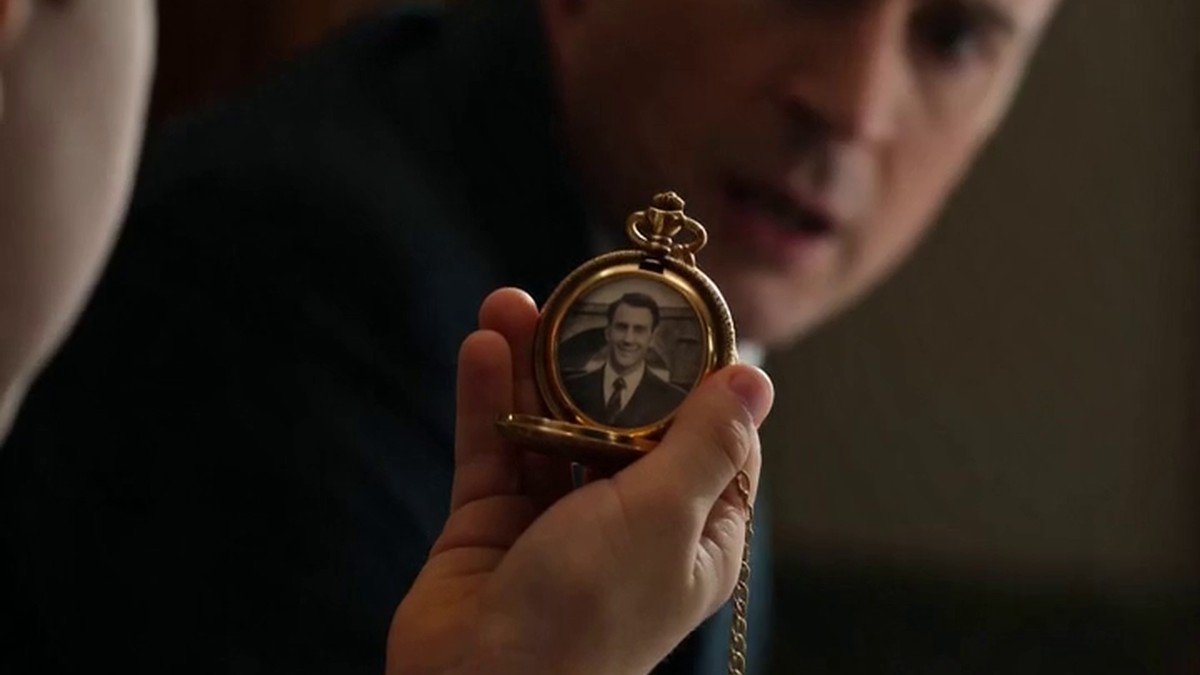
Then the younger boy spotted the locket.
It had skidded free when she hit the floor — small, gold, worn smooth at the edges, the kind of thing a person kept pressed against their skin because it held something they could not stand to lose.
The boy crouched down and picked it up with unsteady hands. He turned it over once, then opened it.
Inside sat a black-and-white photograph.
Not a child.
Not parents.
Not some long-dead stranger.
It was his father.
Younger. Smiling. Standing in front of a stone bridge the boy had never seen in his life.
The hallway seemed to seal itself shut around him.
“Dad…” he breathed.
His father turned — and went perfectly still the instant he registered the open locket in the boy’s hand.
Every drop of colour left his face.
The older boy raised it slowly, his arm trembling at the elbow.
“Why does Helena have a picture of you?”
For one suspended moment, no one in that hallway moved or breathed.
Then Helena’s eyes pulled themselves open — weak, struggling.
She took in the locket. She took in the look on the father’s face. And despite everything her body had just been through, she immediately tried to push herself upright, as if the fall were suddenly the least important thing in the room.
“No,” she whispered. “Please, don’t—”
Too late.
Because the younger boy had already noticed the folded paper that had slipped loose from inside the locket when it fell open. A hospital bracelet was coiled around it like a ring — tiny, faded, ancient-looking.
He unwrapped the bracelet. He unfolded the paper.
He read what was written there.
Then he looked up at his father, and the expression on his face was something close to horror.
“Dad.” His voice fractured on the single syllable.
“This says *Baby Boy A.*”
He swallowed.
“And it has my birthday on it.”
The hallway held its breath.
No one moved. Not the father, still on his knees beside Helena. Not the older boy, still holding the locket with his arm half-raised. Not Helena herself, propped on one elbow, her face the colour of old ash.
The younger boy turned the hospital bracelet over in his fingers once, twice — as if repetition might change what was printed on it.
It didn’t.
“Dad.” His voice was barely above a whisper. “Who is she?”
For six years, their father — Thomas Mercer, architect, widower, a man who had built his entire life on the principle of controlled surfaces — had never once lost his composure in front of his children.
He lost it now.
Not loudly. That was never his way. It came quietly, the way the most important things always came quietly in that house — a long, terrible exhale, and then the kind of stillness that follows a structure when it finally gives way.
“Help me get her to the sofa,” he said. “First.”
“Dad—”
“First.”
—
They moved her to the sitting room at the end of the hall. The older boy — Eli, sixteen, already carrying himself like a man who had learned to expect bad news — took one arm. Thomas took the other. Helena protested the entire way, soft and insistent, the word *please* falling out of her mouth over and over as if she were trying to stop a door from closing.
“Please. Thomas. Not like this. Not now.”
“It’s already like this,” he said quietly. “It’s been like this for six years. I just wasn’t willing to see it end.”
He said her name again. Naturally. Without thinking.
Eli heard it. Filed it. Said nothing.
The younger boy — Marcus, twelve, small for his age, with a habit of noticing things other people forgot to hide — sat down on the opposite chair and placed the bracelet and the folded paper on the coffee table between them like evidence. Which was exactly what it was.
Thomas stood in the centre of the room for a long moment with his back to his sons. Outside, the last of the evening light was being swallowed by the tree line. Inside, the chandelier threw gold across the carpet and the scattered linens no one had thought to retrieve.
He turned around.
“Her name,” he said, “is Helena Vasquez. She was twenty-three years old when I met her, and I was twenty-nine, and your mother and I had been separated for almost a year.”
Eli made a sound that wasn’t quite a word.
Thomas looked at the table. At the bracelet.
“She got pregnant. We both — we made choices. The kind you make when you’re young and frightened and you don’t understand yet what choices actually cost.” He stopped. “Your mother and I reconciled. Helena and I agreed that it was better — that it was *safer* for the child if—”
“If what?” Marcus said.
His voice was steady. Too steady for twelve.
“If I didn’t know him,” Helena said from the sofa.
She was sitting upright now. The pallor hadn’t left her face, but something else had entered it — something that looked like a woman who had rehearsed this sentence for a decade and was finally saying it out loud for the first and last time.
“We decided you wouldn’t know me,” she said to Marcus. “Or that I would — that I would be nearby, but—”
“Nearby,” Marcus repeated.
The word sat in the room like a stone dropped in still water.
“You’ve been here,” Eli said slowly. “You’ve been *here*. In this house. For six years.” He looked at his father. “You hired her.”
“Yes.”
“You hired his — you hired her—” Eli stopped himself. Started over. His jaw was working the way it did when he was trying to keep his voice from cracking. “Does that mean she’s—”
“She’s my mother,” Marcus said.
He hadn’t taken his eyes off Helena.
She flinched as if the word had struck her.
“I didn’t have the right to call myself that,” she said. “I still don’t know if I do.”
“But you’re here,” Marcus said.
“Yes.”
“You stayed close.”
“Yes.”
“You’ve been — you’re the one who—” He stopped. Something moved across his face, young and unguarded and confused as a held flame in wind. “You stayed up with me when I had the fever last February. You were the one in the chair when I woke up.”
“Yes.”
“You didn’t leave.”
“No,” Helena whispered. “I never left.”
The room was very quiet.
Thomas stood in the space between them — his son and the woman who had given him that son — looking at neither and both at once, the way a man looks when he finally understands what the architecture of his own cowardice has built.
“I told myself it was enough,” he said. “To have her close. To let her know him. I told myself it was—” He stopped. “I was wrong. I knew I was wrong every single day. I just didn’t know how to undo it without—”
“Without admitting you’d done it,” Eli said.
Thomas looked at his older son.
Eli looked back at him with sixteen years of quiet math in his eyes — all the mornings he’d caught his father watching Helena across the breakfast table, all the evenings he’d heard his name said too softly by a woman who had no formal reason to love him, all the small accumulated things a boy notices but doesn’t know how to name until someone finally hands him the equation.
“Does she love you?” Eli asked.
Thomas said nothing.
“Dad. Does she love you.”
“That’s not—”
“It’s the whole question,” Eli said. “It’s the only question.”
Helena’s hands, folded tight in her lap, tightened further.
Thomas crossed the room. He sat down beside her on the sofa — not across from her, not at a careful professional distance — beside her, the way a man sits when he has finally decided to stop building walls out of furniture arrangement.
“Helena,” he said.
“Don’t,” she said.
“I need to say it.”
“You don’t have to say it for them.”
“I’m not saying it for them.”
She turned her head and looked at him, and the expression on her face was every year of it — every day she had pressed a cool cloth to a forehead and folded linens with hands that wanted something else entirely and stood in doorways watching a child she’d carried grow into someone extraordinary with the help of a love she wasn’t supposed to name.
He took her hand.
She didn’t pull it back.
Marcus was watching them. He’d pulled his knees up to his chest in the armchair and was watching them with the wide, careful eyes of a boy who had spent his whole life sensing a shape in the dark that no one would illuminate for him — and who was now, finally, seeing it.
“Are you my mum?” he asked.
Helena’s eyes went liquid.
“Yes,” she said. “I’m your mum. I’m so sorry it took this long to say it right.”
He was across the room before anyone saw him move — all twelve years of him landing against her in the kind of collision that doesn’t require coordination or dignity, just the bone-deep need to close a distance that has been too long. She caught him the way she had been catching him for years without ever being able to say why she couldn’t seem to stop.
Her arms went around him.
She pressed her face into his hair.
Something inside her — some long-held structural thing — finally broke and finally held at the same time.
Eli stayed in his chair. He was watching his father.
Thomas was watching Helena and Marcus with an expression that had no name in polite company — grief and relief and the specific quality of love that has survived its own worst choices and come out the other side scraped raw and unashamed.
“What happens now?” Eli asked.
Thomas looked at him. Really looked — at his older son, the one who had learned to read the room before he’d learned to read words, the one who would carry this into adulthood with him whether Thomas made it right or didn’t.
“Whatever she wants,” Thomas said. “Whatever *they* want. For the first time in a long time, I’m going to stop making that decision for everyone else.”
Eli considered this for a moment.
He nodded once.
Then he unfolded himself from the chair, crossed the room, and sat down on the other side of Helena — not against her the way Marcus was, but close enough. Present.
The four of them sat in the chandelier light while the dark gathered fully outside the windows and the house settled around them, old and large and finally — for the first time in a very long time — honest.
The linens stayed on the hallway floor.
No one went back for them that night.