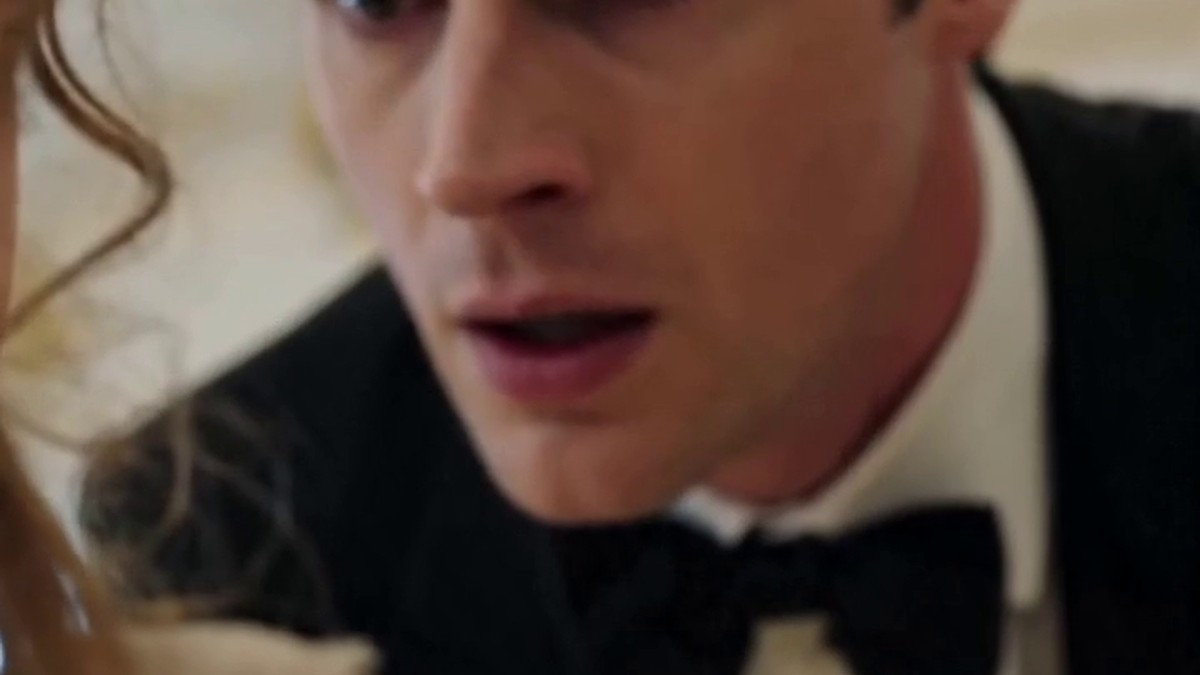
White roses cascaded across every surface. Chandelier light dripped gold over silk and diamonds and the lifted rims of champagne flutes. Julian stood at the altar beside Victoria — the woman his family had selected for him — while the city’s most powerful people watched from their pews.
Then the doors opened, and a little girl walked in.
She didn’t belong here. Anyone could see that in an instant. Her dress was the color of parched earth. Her hair hadn’t been brushed. She moved between the rows of billionaires like something the wind had carried in from another world entirely.
Clutched in both hands was a photograph — old, worn at the edges, faded almost to nothing.
Victoria’s expression curdled.
“Security,” she whispered, the word sharp as broken glass.
But the guards never reached her.
Because the child spoke first.
“I just don’t want my mum to go to heaven.”
The hall went absolutely still. Not quiet — *still*. The kind of stillness that presses against your ears.
Julian leaned forward without thinking.
The photograph trembled in the girl’s small hands. When he finally saw the face in the picture, something inside him came apart without a sound.
*Yohandra.*
Six years dissolved in a single breath. The woman he had loved before his family decided love was an inconvenience. The woman they had removed from his life the way you remove a stain. The woman he had spent years trying to stop thinking about.
He never knew she’d been carrying his child.
“What’s your mother’s name?” His voice came out barely above nothing.
The girl looked directly at him. No hesitation.
“Yohandra.”
Victoria’s fingers closed around his sleeve. “Sit *down*. Do you have any idea how this looks?”
Julian looked at her hand on his arm. Then he looked at the little girl.
He pulled free.
For the first time in longer than he could measure, he stopped performing the life his family had written for him. He lifted the child into his arms, turned his back on the altar, and walked — then ran — out of the hall toward the hospital.
Behind him, the perfect wedding came apart at every seam.
—
The elevator was the longest thirty seconds of his life.
Julian stood with the girl in his arms — he still didn’t know her name, hadn’t thought to ask, hadn’t been able to form words beyond directions to the driver — and watched the numbers climb. Three. Four. The doors opened onto a corridor that smelled of antiseptic and something quieter underneath it, something that made his throat close.
“What’s your name?” he finally asked.
She considered him with her mother’s eyes. Dark and unhurried and absolutely certain of what they saw.
“Camila.”
“How old are you, Camila?”
“Five and three quarters.”
Five years and nine months. He did the math without wanting to. The timing landed exactly where he’d feared it would.
“How did you know where to find me?” he asked. “How did you know about the wedding?”
Camila settled more firmly in the crook of his arm, as though the question required physical stability to answer. “Mum was on the phone with her nurse. She said your name. And that you were getting married today at the Belvedere.” She paused. “I looked it up on her tablet. It was in the society pages. There was a picture of you.”
She said it plainly, without drama. She had a photograph and an address and she had come. That was all there was to it.
Room 412 was at the end of the hall. The door was half-open. He could see the edge of a bed, the pale geometry of hospital linen, a window with afternoon light coming through it at an angle that made everything look both beautiful and exhausted.
He pushed the door open.
—
Yohandra was smaller than he remembered.
That was the first thing — the terrible first thing. She had always carried herself like weather, like something that occupied space with intention. Now she lay against the raised bed with an IV line in the back of her hand and dark circles pressed beneath her eyes, and she looked like she’d been slowly translated into a quieter language.
Then she saw him.
For one unguarded moment, every wall came down. He watched it happen — the shock, the fear, something raw moving underneath both — before she pulled herself back together with what was clearly a practiced effort.
“Camila.” Her voice was careful. “I told you to wait at the nurse’s station.”
“I went to find him.” Simple. Unashamed. “Like you said you wished someone would.”
Yohandra closed her eyes. “I said that while you were supposed to be sleeping.”
“I wasn’t sleeping.”
Julian set Camila down. The girl climbed immediately onto the foot of the bed and settled there like a small anchor, watching both adults with the calm attention of someone who understood that important things were happening and had decided to witness them properly.
Julian pulled a chair to the bedside. He sat down. He didn’t speak yet because there were six years between them and he didn’t know which year to start with.
Yohandra spoke first.
“You were getting married today.”
“Yes.”
“You left.”
“Yes.”
She looked at him for a long moment. “Your family is going to—”
“I know what my family is going to do.” He leaned forward, elbows on his knees, and made himself hold her gaze. “What’s wrong with you? What are the doctors saying?”
Something shifted in her face. Not softening exactly — more like a decision being made.
“Cardiac arrhythmia. They found it six weeks ago. It’s manageable, they say. With medication, monitoring, some restrictions on—” She stopped. Looked at Camila. “On how hard I’m allowed to push myself.”
“And before six weeks ago?”
“Before six weeks ago I was pushing very hard.”
He understood what she wasn’t saying. Single mother. No safety net. A five-year-old who needed things. He thought about the dress Camila had been wearing — the color of parched earth — and something in his chest pulled tight and didn’t release.
“Why didn’t you tell me?” He heard the inadequacy of the question the moment it left his mouth. “About the pregnancy. About any of it.”
Yohandra’s jaw shifted. “Because your mother came to see me.”
The room got very quiet.
“She came two weeks after you stopped calling. Which I assume was two weeks after she told you to stop calling.” She wasn’t accusing him. She was stating facts the way people do when they’ve had years to arrange them into something survivable. “She was very clear about what your family would do to any child of yours that came from me. Very specific.” A pause. “She had lawyers with her, Julian. I was twenty-three years old and I had a positive pregnancy test in my bathroom and she had three lawyers.”
He could picture it. He had spent years not picturing it, but now it assembled itself in his mind with horrible clarity. His mother in one of her pale suits, sitting across from Yohandra with the composed expression she wore when she was dismantling something. The way she used kindness like a blade.
“I’m sorry.” The words were nothing. He knew they were nothing. He said them anyway.
“I didn’t tell you because I was afraid of what they’d do to her.” Yohandra glanced at Camila, who was examining her own fingers with great concentration, pretending not to listen. “I still am.”
“They won’t.”
“You can’t promise that.”
“I’m promising it.”
“You were standing at an altar two hours ago, Julian. You were about to marry a woman your family chose for you. Again.” She said it without cruelty, which made it land harder. “What exactly are you promising? What are you able to give that you weren’t able to give six years ago?”
—
The door opened.
Julian heard it and turned, expecting a nurse.
It was his mother.
Genevieve Whitmore was sixty-one years old and had never in Julian’s memory looked anything other than composed. She looked composed now, standing in the doorway of Room 412 in her dove-gray wedding-guest ensemble, her pearls at her throat, her gaze moving from Julian to Yohandra to Camila and back again with the efficiency of a person calculating damage.
Behind her, two steps back, stood Victoria.
Victoria had removed her veil. That was the only concession to the catastrophe of the afternoon. Everything else — the dress, the posture, the expression of controlled fury — remained exactly as it had been at the altar.
“Julian.” His mother’s voice was the same voice she’d used when he was twelve and had broken something valuable. Quiet. Certain of its own authority. “The car is outside.”
He stood up from the chair. “No.”
“This is not the place—”
“This is exactly the place.” He moved so he was standing between his mother and the bed. It was not a subtle gesture. He meant it to be seen. “You went to see her. Six years ago. You had lawyers with you.”
Genevieve’s expression didn’t change. That was the tell — the absolute stillness of it. A guilty person flinches. His mother had never believed herself guilty of anything.
“I protected this family.”
“You took my child from me.”
“You didn’t know about the child.”
“Because you made sure of it.” His voice was level. He was surprised by how level it was. “Did you know? When you went to see her — did you already know?”
A beat. One single beat.
“She told me,” Genevieve said. “I made a decision.”
The room absorbed that.
Yohandra made a sound — not quite a laugh, not quite anything else. The sound of someone who had suspected this for years and still felt it arrive like a physical blow.
Camila looked up from her hands. She was watching Julian’s mother with the unfiltered assessment of a child who hasn’t yet learned to hide what she sees. What she saw, apparently, did not impress her.
Victoria stepped forward. She had been standing just inside the doorway, and something in her bearing had changed from the altar — tighter, more careful, the fury compressed into something that was trying to find its proper shape.
“Julian, I understand that this is—” She stopped. Started again. “I’m not without sympathy. But you made commitments. Our families made agreements. You cannot simply—”
“I can.” He turned to look at her fully, because she deserved that. She deserved to be looked at while he said it. “Victoria. You’re intelligent and capable and you deserved better than a man who was never going to love you. I’m genuinely sorry for today. I’m sorry for all of it.” He paused. “But I can.”
Victoria looked at him for a long moment. Her right hand — the one bearing the ring he had placed on it less than two hours ago — lifted slightly at her side, then stilled, as though she had caught herself reaching for something to hold onto and thought better of it. She looked past him at the bed. At Yohandra. At Camila.
She stood there one breath longer than necessary. Then she straightened, turned, and walked out.
Her heels made clean precise sounds down the hospital corridor and then were gone.
His mother remained.
“You’re throwing everything away,” Genevieve said. “The merger. The Ashworth alliance. Twenty years of—”
“Sit down, Mother.”
She blinked. He had never, not once in his adult life, spoken to her in that voice.
“Sit. Down.”
She sat. She sat because something in him had changed in the last two hours in ways that were apparently visible, and she was, beneath everything, a woman who understood power and recognized when it had shifted.
He pulled the second chair out and sat across from her. Same level. Same eye line. No altar, no lawyers, no distance of office or inheritance.
“You’re going to meet your granddaughter,” he said. “Her name is Camila. She is five years and three quarters old and she walked into my wedding today because she was afraid her mother was dying, and she had a photograph of her mother and a man she’d been told was her father, and she thought — correctly, it turns out — that he should know.” He let that settle. “That is what your decision produced.”
Genevieve’s eyes moved to Camila.
Camila looked back at her with absolute composure.
There was a long silence. Genevieve opened her mouth once, and closed it. The composure held — but only just, and Julian could see the effort now, the way you see the seams in something when the light shifts. She had not come here prepared to find a child. She had come here prepared to retrieve a situation.
“She has your jaw,” Genevieve said finally. Her voice had lost something in the saying of it — a degree of altitude, the precise upper register that made people want to agree with her preemptively.
“Yes.”
Another silence, longer than the first.
“I would like,” Genevieve said slowly, as though testing the weight of each word before she committed to it, “to have acted differently.”
It was not an apology. He understood it was not an apology. But it was the closest she was capable of, and he knew that too, and he filed it in the category of things that would have to be enough for now.
He turned back to Yohandra.
She was watching him with an expression he remembered from years ago — the one she’d worn when she was deciding whether to trust something. She had a careful face, Yohandra. She gave trust out slowly, like something precious, because she’d learned it was.
“I’m not asking you to decide anything today,” he said. “You’re in a hospital bed and this has been—” He exhaled. “This has been a great deal of a day. I’m not asking for anything.”
“Then what are you doing?”
“I’m staying.” He settled back into the chair. “If that’s alright.”
Yohandra looked at him for a long time.
Camila, apparently satisfied with the direction things were heading, lay down along the foot of the bed and closed her eyes with the boneless certainty of a child who has done what she came to do and can now rest.
“It’s alright,” Yohandra said finally.
Outside the window, the afternoon was going gold. The city was doing what it always did — moving, spending, performing — and somewhere across town, Julian was certain, the Belvedere was being quietly dismantled: white roses lifted from their arrangements, champagne flutes collected, the chandelier left to drip its gold light over empty tables.
The wedding he’d been built for, coming apart at every seam.
And here, in Room 412, something else — something with no name yet, something that would take time and honesty and the slow work of undoing years of careful damage — was putting down its first tentative root.
He reached out and covered Yohandra’s hand with his. The one without the IV. Just that — no pressure, no demand.
She didn’t pull away.
Camila slept.
The light changed.
—
Three months later, a cardiologist confirmed that Yohandra’s condition was responding to treatment. She would need monitoring — likely always would — but the prognosis was good. She was not, after all, going to heaven yet.
Camila received this news with the same measured calm with which she had processed most things since the afternoon she’d walked into a wedding and rearranged the world.
“Good,” she said. And went back to her drawing.
The drawing, Julian noticed, showed four figures. A tall man, a woman, a small girl.
And at the edge of the page, slightly apart from the others, a small seated figure who might have been a grandmother.
Camila caught him looking.
“I left space,” she said. “In case she learns.”
Julian looked at his daughter — his daughter, a word he was still learning the full weight of — and understood that she was wiser than everyone who had been in that wedding hall. Wiser than the lawyers and the alliances and the chandeliers and all the white roses.
She had walked in with a photograph and asked for the simplest thing.
She had gotten it.