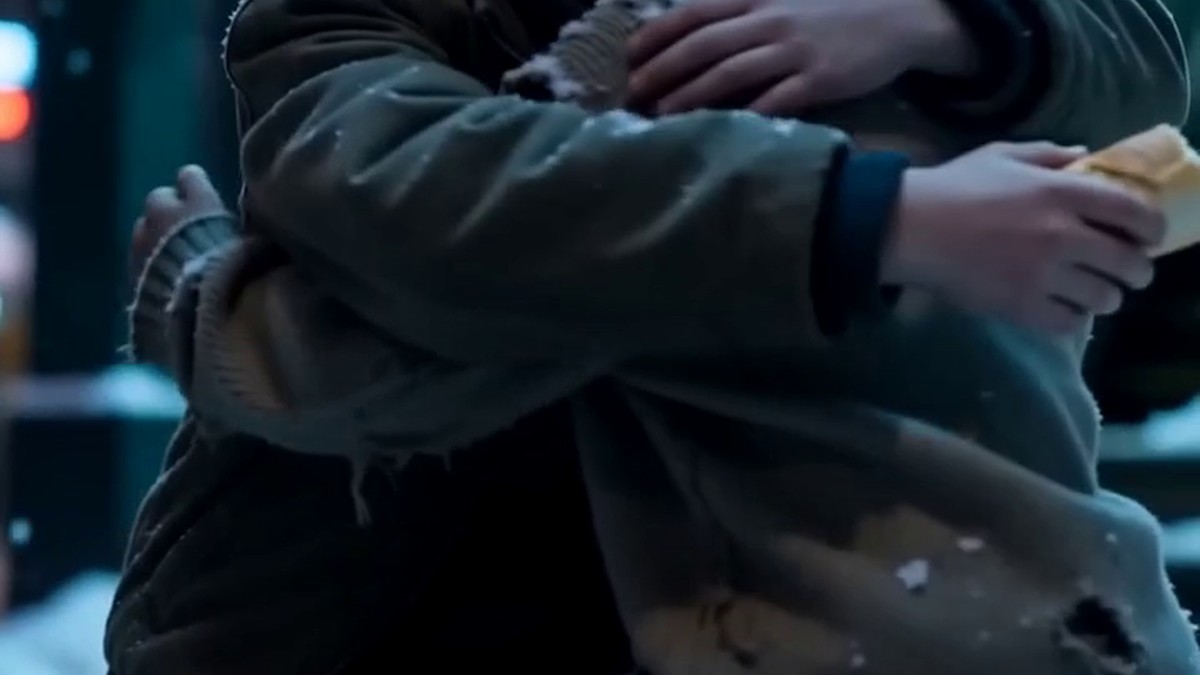
Outside the subway entrance, people streamed past without a second glance at the small boy pressed against the crumbling wall. His torn sweater hung loose from his bony shoulders. His fingers had gone blue.
Nobody stopped.
Then a café door swung open hard.
Another boy — clean coat, shoes that still had a shine to them — came bursting out, clutching a warm loaf of bread against his chest like it was something precious.
“Leo! Get back inside!” someone shouted from behind the door.
Leo didn’t slow down. He dropped to his knees in the snow, tore the loaf in half, and held out a piece to the hungry boy.
The boy stared at it the way people stare at things they don’t quite believe are real.
“Why are you giving me that?” he whispered.
Leo paused. Then, quietly:
“Because you’re freezing… and you shouldn’t be out here alone.”
The hungry boy took a shaking bite. Then Leo leaned in and wrapped both arms around him.
“You’re safe now.”
The boy in the torn sweater went completely still — and then he collapsed into that embrace.
From inside the café, a woman had watched every second of it. The cup slipped from her hand and shattered across the floor.
The color drained from her face.
“No…” she breathed.
And then she ran.
—
She hit the snow-covered sidewalk at a dead run, coat still unbuttoned, one arm outstretched like she could pull Leo back through sheer force of will.
“Leo—”
The word died in her mouth.
She stopped three feet away from them, breathing hard, cold air burning her lungs. The two boys looked up at her. Leo’s face was open, unafraid, the way children’s faces are before the world teaches them caution. The other boy — the one in the torn sweater — flinched back like he was waiting to be yelled at.
Like he had been yelled at before. Many times.
Elena stood there in the snow and couldn’t move.
Because she knew that flinch.
She *had been* that flinch.
—
Twenty-three years ago, a winter like this one. A different city, same wind. She’d pressed herself into a doorway near a bakery, too cold to cry anymore, watching people walk past with their hands buried in their pockets and their eyes looking at everything except her.
Nobody had stopped.
Or — one person had. An old woman, gray coat, moving slow. She’d pressed a bread roll into Elena’s hands without a word, patted her once on the cheek, and walked on.
Elena never learned her name. She never forgot her face.
—
“Mama?” Leo’s voice was small and careful. He was watching her the way children watch their parents when something is happening they don’t have a word for yet.
Elena dropped to her knees in the snow between them.
The cold soaked through immediately. She didn’t feel it.
She looked at the boy in the torn sweater — really looked at him. The hollow cheeks. The cracked lips. The blue hands curled around the half-loaf of bread like he was afraid someone would take it back. Brown eyes too old for his face. Nine years old, maybe ten.
Old enough to know what it meant that nobody had stopped.
“What’s your name?” she asked quietly.
The boy’s jaw worked. He glanced at Leo — checking, it seemed, whether this was safe.
Leo gave a small nod. The trust between them already sealed, just like that, in the space of a few minutes and half a loaf of bread.
“Danny,” the boy said.
“Danny.” She said it back like she was testing its weight. “Are you alone out here?”
A beat. Then a nod so small it was almost nothing.
“Do you have somewhere to go tonight?”
He looked down at the bread in his hands.
That was answer enough.
Elena’s throat closed. She made herself breathe through it — one slow breath, then another. Behind her, she heard the café door open. Mikhail’s voice, confused, calling her name. She didn’t turn around.
“Leo,” she said, without looking away from Danny. “Go inside and get your grandfather’s old coat. The green one. Back closet.”
“The good one?”
“The good one.”
A pause. Then her son’s feet hit the steps and the door banged shut, and she was alone with Danny in the snow.
She unwound her scarf — thick wool, bright red — and without asking permission wrapped it around the boy’s neck twice. He went very still. The precise stillness of someone who had learned that sudden movements could go either way.
“I’m not going to hurt you,” she said.
“I know,” he said.
But his shoulders only dropped from around his ears after she sat back on her heels and gave him room.
“How long?” she asked.
He understood what she meant. Kids like that always understood shortcuts.
“Three weeks,” he said. “My mom went to the hospital. They said someone would come.”
He paused.
“Nobody came.”
*Three weeks.*
Elena pressed her lips together until they stopped trembling.
Three weeks in which Danny had kept moving — doorway to doorway, shelter to shelter, never staying in one place long enough to leave a trace or be found. Three weeks in a city of four million people, and a boy with blue hands had been invisible to every single one of them. Except for her son, who was nine years old and hadn’t learned yet how to look away.
She should have taught Leo to look away.
She never had.
She never would.
—
Mikhail came out just as Leo reappeared with the coat — green, thick, good wool. Her husband’s face moved through confusion, then worry, then something softer as he read the shape of what was happening.
He crouched beside Elena without a word.
“Hey, buddy,” he said to Danny. “You hungry?”
Danny looked at the bread in his hands.
Mikhail almost smiled. “I mean *really* hungry. We’ve got borscht on the stove. Hot.”
Something shifted behind Danny’s eyes. Some locked door.
He looked at Elena, then at Leo standing there holding out the coat like an offering.
“You don’t have to,” Elena said. “But you can. You’re allowed to say yes.”
Danny blinked. Like that was a concept someone had forgotten to teach him.
*You’re allowed to say yes.*
Slowly, carefully, he let Mikhail help him into the coat. It swallowed him whole — sleeves hanging past his fingers, collar up around his ears. But the shivering, Elena noticed, was already starting to slow.
Leo fell into step beside him as they moved toward the door.
“I’m Leo,” he said, like they hadn’t already done this part.
“I know,” Danny said. “You told me.”
“I just wanted to make sure you remembered.”
Danny glanced sideways at him. And something happened to his face — not quite a smile yet. More like the muscles remembering what a smile was supposed to feel like.
“I remembered,” he said.
—
Inside, the café was warm and loud and smelled of coffee and dark bread and something frying in the back. Elena got Danny into the corner table — the warmest seat, nearest the kitchen — and within minutes there was a bowl of borscht in front of him and a plate of thick-cut bread and a glass of warm milk that her mother-in-law pressed into his hands with a look that dared anyone to argue.
Nobody argued.
Danny ate with his head down and both hands wrapped around the bowl even after it was empty. The way you eat when you’ve learned that food can be taken back.
Elena sat across from him and let him eat without asking anything.
Leo sat beside him and talked enough for both of them — about the café, about the dog they used to have, about a movie he’d seen twice and would describe in full detail to anyone willing to sit still. Danny didn’t say much. But Elena watched his eyes track from Leo’s face to the door and back, and she watched him slowly, slowly stop watching the door.
She stepped away from the table and made two calls.
The first: a social worker she’d met at a fundraiser three years ago. A woman with a reputation for actually picking up.
She picked up.
The second: the hospital. She had to ask Danny, quietly, for a name. He said it without hesitation, like he’d been carrying it in his mouth all along.
*Maria Kovacs. Ward 4.*
She was there. She was stable. She had been asking about her son since the morning she was admitted — but Danny had kept moving from place to place, nowhere long enough to leave a trace, and the system had kept missing him.
Elena hung up and walked back to the table.
“Your mom has been looking for you,” she said carefully. “She’s okay. She’s going to be okay.”
The stillness that came over Danny was different from the flinch on the sidewalk.
This one was the kind that happens when something held too long is finally set down.
His face broke — just for one second, one single unguarded second — before he pulled it back together with the particular dignity of a child who had been performing adulthood for three weeks straight.
“Yeah?” he said. His voice was steady. He made sure of it.
“Yeah.”
He looked down at the empty bowl.
“Okay,” he said. Barely a word at all.
But his hand came up and pressed flat against his chest — over his heart — and stayed there.
—
By the time the social worker arrived, Danny had eaten twice and fallen asleep in the corner chair, the old green coat pulled up to his chin.
Leo was asleep too, head on the table, one arm stretched out as if guarding something.
Elena stood in the doorway between the kitchen and the dining room and watched them both.
Mikhail came up behind her and put his hands on her shoulders.
“You’re going to worry about him,” he said. Not a question.
“Always,” she said.
“And you’re going to follow up.”
“Of course.”
He was quiet for a moment. Outside, through the glass, the wind was still tearing through the city. But in here the lights were warm and the borscht was still on the stove and two boys were sleeping in the corner like it was the safest place in the world.
“He’s lucky Leo saw him,” Mikhail said.
Elena thought about a gray-coated woman in a different city. A bread roll pressed into small frozen hands. One pat on the cheek, wordless, and then gone. A face she had carried for twenty-three years like a smooth stone in her pocket.
“Leo learned it somewhere,” she said.
Mikhail’s hands tightened on her shoulders.
She covered them with her own and held on.
—
Three months later, a photograph arrived in the mail.
No return address. Just a small square photo, slightly overexposed, with two handwritten words on the back.
In the picture: a woman sitting up in a hospital bed, color back in her face, no longer thin the way sick people are thin. Pressed against her side — like he was trying to climb back inside some earlier, safer version of childhood — was a boy in a green coat.
He was smiling.
On the back, in a child’s careful block letters:
*WE’RE OKAY.*
Elena taped it to the wall behind the counter, right beside the coffee machine, where she would see it every morning when the café first opened and the city was still dark and the first customers came in from the cold, stamping snow from their boots, not yet looking at anyone.
She never took it down.





