The hotel lobby glowed with warm golden light.
Marble floors.
Crystal chandeliers.
White flowers.
Elegant luggage arranged near the front desk.
And among all those well-dressed adults, a seven-year-old boy clutched a worn teddy bear as if it were the last thing left of his world.
He moved carefully through the crowd.
Eyes swollen with tears he was fighting to hold back.
A plain blue coat that had no business being in a place like this.
Then he bumped — softly, almost gently — into a woman dressed entirely in black.
The bear hit the floor.
She picked it up with a stiff, impatient expression.
“Watch where you’re going, little one.”
The boy flinched like she’d struck him.
“Please — don’t take it!”
The woman’s brow creased.
“I was only going to hand it back.”
But the boy balled his small fists and broke apart entirely.
“It was my mama’s!”
The lobby began to go quiet around them.
One by one, conversations dropped away.
The woman looked down at the stuffed animal in her hands.
And then she noticed something.
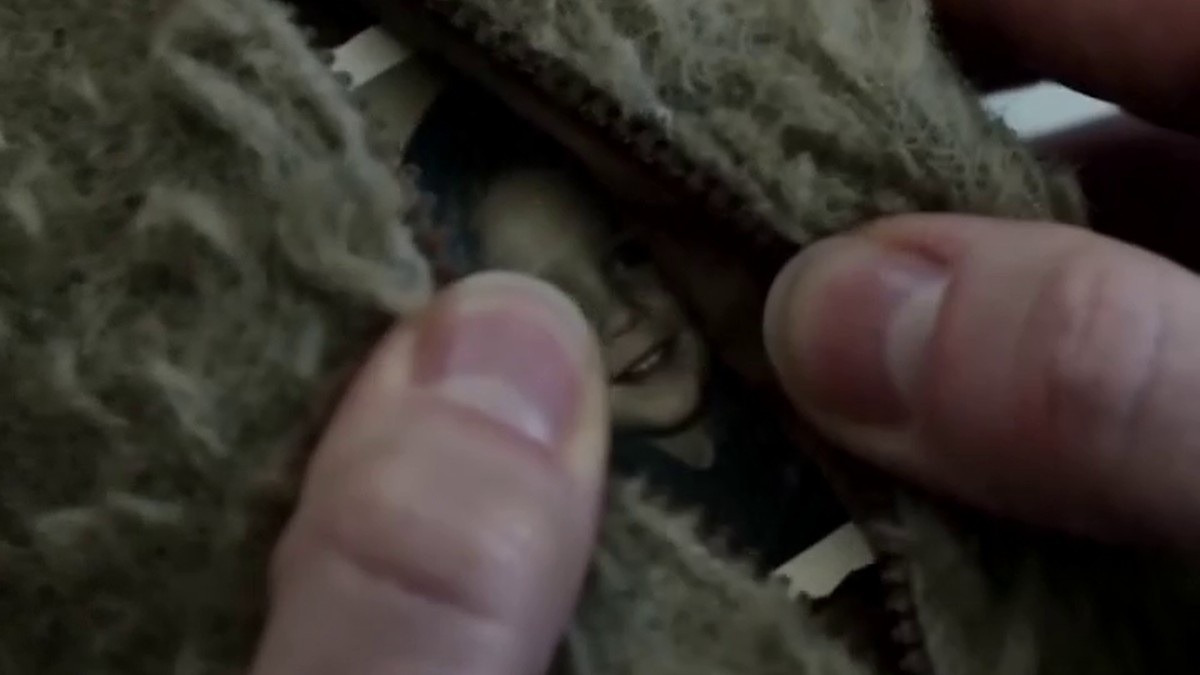
A small seam had come open along its side.
Tucked inside the bear was an old photograph.
Her fingers trembled the moment they touched it.
The front desk clerk stepped closer, uncertain.
“Ma’am… are you all right?”
She didn’t hear him.
She was staring at the image the way a person stares at something they buried long ago.
“This photograph…”
The boy whispered:
“My grandma told me never to lose it. Not ever.”
The woman looked up slowly.
Her eyes were no longer cold.
They were full.
She lowered herself to one knee in front of the boy and returned the bear with both hands, gently, as though it were made of something fragile and irreplaceable.
Then she asked, her voice barely holding together:
“What was your mother’s name?”
The boy searched her face, confused by a question he didn’t understand.
“My grandma said… you would already know.”
The air left the woman’s lungs all at once.
“That can’t be…”
In that moment, the old bear stopped being a simple keepsake.
It became the key to a family truth that had been locked away for years.
But who the boy’s mother really was —
And why that woman recognized the face in that photograph —
That was the secret about to shatter the silence of this golden, gleaming lobby.
The boy watched her.
He didn’t look away.
Seven years old, worn coat, swollen eyes — and somehow the steadiest person in the room.
The woman on one knee in front of him was shaking.
Not visibly. Not in a way the front desk clerk could measure. But her jaw was tight and her fingers had gone white around the edge of the bear she was still holding, even though she’d promised to give it back.
“Your grandmother,” she said slowly. “What does she look like?”
“Old,” the boy said. Then, after a pause: “She smells like lemons. And she cries sometimes when she thinks I’m sleeping.”
The woman closed her eyes.
One second. Two.
When she opened them again, something had shifted in her face. The coldness wasn’t gone exactly — it had cracked. And underneath it was something raw and unhealed, the way a wound looks when the bandage finally comes off.
“My name is Delia,” she said.
The boy nodded, very serious. “I know.”
Her breath caught. “She told you about me?”
“She showed me a picture. A different one.” He pointed at the bear. “Not that one. One she keeps in a tin box under her bed. She said you were someone who got lost.”
Delia pressed the back of her hand against her mouth.
The lobby had gone completely still. The clerk had stepped back. Two guests near the elevator stood frozen, coffee cups in hand, pretending not to listen and failing entirely.
“I didn’t get lost,” Delia said, and even as the words left her mouth she knew they weren’t true. “I left.”
“That’s what Grandma said too. She said those are different things. But she also said you were worth finding anyway.”
—
The photograph was small and faded at the edges, the kind of image that had been handled ten thousand times by careful hands. A young woman standing in front of a window, laughing at something off-camera. Early twenties. Dark hair pulled back loose. A round belly pressing against a white dress.
Delia held it near the light.
Her sister.
Clara.
Twenty-three years old in this photograph. Laughing that laugh she had — the one that filled every room she entered, the one that made strangers feel like they’d known her all their lives.
“Where is your grandmother now?” Delia asked.
“Waiting,” the boy said. “Outside. She said she wasn’t ready to come in yet. She said I should go first and see if you were still —” He stopped.
“Still what?”
He chewed his lip. “Still you.”
Delia stood up slowly. Her knees ached. She was fifty-one years old and she had spent the last nineteen of those years making herself into someone efficient and necessary and completely armored, and right now every plate of that armor was coming apart in a hotel lobby in front of a seven-year-old who had his mother’s eyes.
She could see it now. God, she could see it.
Clara’s eyes. Exactly.
“I have to —” She stopped. Steadied herself. “Can you take me to her?”
The boy reached up and took her hand.
Just like that. No hesitation. Small fingers wrapping around hers like it was the most natural thing in the world, like there hadn’t been nineteen years of silence between this moment and the last time she’d stood in the same room as her family.
He led her toward the revolving doors.
—
The evening air outside was cool and blue.
A taxi idling at the curb. A porter moving luggage. Pigeons scattering from the steps.
And on a bench near the corner of the building, wrapped in a wool coat the color of autumn leaves, sat a small woman with white hair and hands folded in her lap like a woman who has been waiting patiently for something for a very long time.
Delia stopped walking.
Her mother looked up.
Nineteen years.
Her mother’s face had changed the way all faces change — the lines had deepened, the hair had gone fully white, the body had grown smaller somehow, more compact, as though life had slowly been distilling her down to only what was essential. But her eyes were the same. Dark and direct and capable of seeing straight through everything Delia had ever built around herself.
“Delia,” her mother said.
One word. Just her name. And Delia felt it in her chest like a key turning.
“Mama.”
The boy let go of her hand and ran to the bench, climbing up beside his grandmother and tucking himself under her arm with the ease of long practice. He held the bear against his chest and watched with the calm, patient expression of someone who had been told this moment was coming and had decided to trust that it would be okay.
“I wasn’t sure you’d still be here,” her mother said. “In this city. I looked for a long time.”
“I know.” Delia sat down on the bench. On the other side. Her mother between them and the boy settled against her like ballast. “I wasn’t hiding. I just —”
“You were being stubborn,” her mother said. But not cruelly. The way you name a thing you understand completely.
“Yes.”
“Clara wasn’t angry with you. At the end.” Her mother’s voice didn’t waver. It was the voice of a woman who had said the hard things to herself so many times that she could say them aloud now without falling apart. “She asked me to make sure you knew that. She said she only wanted you to meet him.”
The boy looked up at the sound of his name implied in those words.
“My name is Mateo,” he said, with great dignity. “In case you didn’t know.”
Delia looked at him fully for the first time.
Really looked.
The dark eyes. The set of his jaw. Something in the angle of his expression that was pure Clara — that watchful, generous attention that Clara had always given to everyone she’d ever met, as though they were all worth understanding.
“Hi, Mateo.”
“Hi.” He considered her. “You look like the picture. But older.”
“I am older.”
“Grandma said you’re very smart but that sometimes smart people take longer to figure out the simple stuff.”
Her mother made no attempt to deny this.
Delia laughed.
It surprised her — the laugh. It came up from somewhere underneath all the careful composure, rough and unpracticed and real, and once it started it took a moment to stop, and when it did she found her eyes were wet and she was gripping the edge of the bench like something solid she needed to hold onto.
“She sounds right,” Delia managed.
“She usually is,” Mateo agreed.
Her mother reached across and put her hand over Delia’s.
Small. Warm. Worn smooth the way hands get when they have done a lifetime of work and comfort.
Delia turned her palm upward and held on.
—
They sat there as the evening deepened around them.
The hotel lights came on behind the glass. The city moved past in its ordinary beautiful chaos — cabs and voices and someone laughing loudly on a phone — and none of it touched the small circle of stillness on that bench.
Mateo fell asleep eventually, the bear tucked under his chin, his head tipped against his grandmother’s shoulder. His breathing went slow and even.
“She loved him so much,” her mother said softly. “From the first moment. She was made to be his mother.”
“I know she was.” Delia’s voice was barely above a whisper. “I should have been there.”
“Yes.”
No softening of it. No absolution offered cheaply.
“But you’re here now,” her mother continued. “And he needs people who will stay.”
Delia looked at the boy. At the worn teddy bear. At the small open seam where the photograph had been hidden — tucked there deliberately, she understood now. A message. A map. Clara’s final way of drawing a line between what was lost and what could still be found.
*You would already know.*
She had known. The moment her fingers touched that photograph she had known in her blood and her bone, in the deepest inarguable part of her.
“I’ll stay,” she said.
Her mother squeezed her hand once.
That was enough.
That was everything.
Mateo slept on between them, breathing peacefully, holding his mother’s bear — while above them the last light of the day faded from the sky and the city glittered and all around them the world continued, indifferent and vast, as it always does.
But the three of them were no longer lost in it.