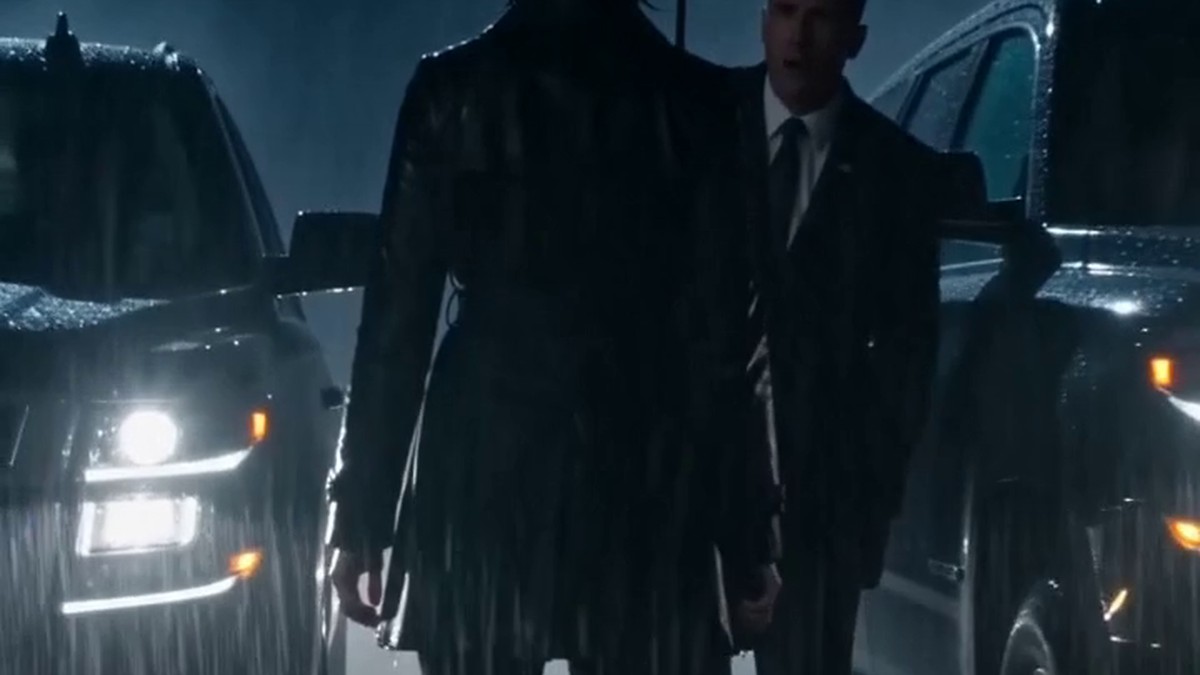
A woman stood alone on the side of the road, soaked to the bone, watching taillights disappear into the dark. The car that had just dropped her there belonged to her son.
Her own son.
He and his wife had made their decision quickly — cleanly, the way you dispose of something that embarrasses you. *The smell of old age*, they’d said. As if decades of sacrifice had curdled into something offensive. As if she were a problem to be solved rather than a mother to be loved.
Before driving off, he’d tossed a crumpled bill out the window. It landed in a puddle at her feet.
“You are no longer my mother.”
Seven words. Just like that, a lifetime erased.
She stood there in the downpour, small and still. To anyone passing by, she looked exactly like what they wanted her to be — helpless. Invisible. Forgotten.
They were wrong.
She reached into her coat and pulled out a phone. One call. That’s all it took. Thirty seconds of quiet conversation, and on the other side of the city, the airport went dark — gates sealed, flights frozen, no one in and no one out. Not a single plane lifted off the ground. A standard security hold, the kind that idles terminals for twenty minutes without public explanation — the kind only one person in the country can order on a moment’s notice.
Because this woman, this *inconvenient* old woman they’d left shivering in the mud, was the President.
By the time the motorcade arrived — black vehicles cutting through the rain in a tight, gleaming formation — the night had shifted entirely. Security personnel moved with precision. Umbrellas opened. Doors swung wide.
She didn’t rush. She smoothed her coat, looked down at the soaked bill still floating in the puddle, and left it there.
“Let them find out,” she said quietly, “what it actually means to have nothing.”
Then she got in the car, and the convoy rolled forward, and the darkness closed behind her like she’d never been there at all.
—
Three miles east, at Meridian International, the departure board went blank.
Every screen. All at once.
The man who had dropped his mother on the side of the road stood at Gate 34, roller bag at his feet, boarding pass folded in his palm. His wife had her hand on his arm. Around them, hundreds of passengers looked up at the dead monitors with the particular expression of people whose carefully arranged lives had just been interrupted — confused, annoyed, not yet afraid.
“What’s happening?” his wife asked.
No one answered. The gate agents had stepped back from their desks. Men in dark suits had materialized at the terminal entrances — quickly, soundlessly, the way shadows fill a room when the light shifts.
He checked his phone. No signal.
That was when the first cold thing moved up the back of his neck.
—
She walked through Terminal C at 11:47 PM.
No announcement. No fanfare. Just the sound of two hundred people simultaneously going quiet — the way a crowd goes quiet when something undeniable enters a space.
She was still wearing the same coat. Damp at the shoulders. The hem still carried a thin line of mud from the roadside where he had left her.
She hadn’t changed. She hadn’t needed to.
He saw her from forty feet away and felt the floor tilt under him.
She was walking toward him. Not because she’d gone looking — the manifest had been pulled, every flight, every passenger. He understood that now, in the way you understand something after it has already destroyed you.
Beside him, his wife made a small, strange sound.
He didn’t move. Couldn’t. His feet had become part of the floor.
She stopped three feet away. Close enough that he could see the rain still caught in the silver of her hair. She looked exactly like his mother. She also looked like something else entirely — something older, something with the specific gravity of a person who has learned to stand in storms.
He thought, suddenly and without meaning to: *Some people mistake silence for weakness. They spend the rest of their lives regretting that mistake.* It was not a thought he had ever applied to her before. He applied it now.
“Mom—” he started.
She raised one hand. Just slightly. And he stopped.
“I didn’t come here to punish you,” she said. Her voice was quiet in the way that doesn’t need volume — the kind of quiet a whole room arranges itself around. “I came because you left something back there on that road.”
He stared at her.
“Your decision. I wanted you to have to look at it.”
His wife stepped forward. “We didn’t *know*—”
“I know you didn’t.” The President turned to her daughter-in-law with an expression that was worse than anger. It was clarity. Complete and without performance. “That’s the part that matters. Not the power. Not who I am tonight. You didn’t know — and you still did it.”
The silence that followed was total. The entire terminal held its breath. Even the cleaning crews had stopped moving.
He felt his wife’s hand find his — not in solidarity, but in something closer to fear. The kind that doesn’t come from consequence, but from the moment you see yourself clearly for the first time and don’t recognize the face.
“What happens now?” he asked. His voice cracked on the last word.
She looked at him for a long moment. Her son. The boy she had carried. The man she had made sacrifices for that he would never fully know — and now, standing here in a frozen airport at midnight, she could see him beginning to calculate what those sacrifices might have actually cost.
“Now,” she said, “you go home. The airport opens in twenty minutes.”
He blinked. “That’s it?”
“That’s it.”
“But—” He searched her face for something he could hold onto. Rage with clean edges. A sentence. A punishment with borders he could measure. “You’re not going to do anything?”
“No.” A pause. “I already did everything I needed to do tonight. I made one phone call. I stood in the rain. I let you drive away.” She smoothed the lapel of her coat — a small, composed gesture, almost domestic. “The rest is yours to carry.”
She turned to leave.
He took one step forward. His throat tightened around something he had no language for — something between grief and the very specific shame of a man who has only just calculated the true weight of what he threw away.
“Mom.”
She stopped.
The word had come out differently than he intended. Smaller. Younger. Like something he’d said at seven, in a yellow rain jacket, when the weather turned and he was frightened.
“I’m sorry.” The words broke on the way out. Not performance. Not strategy. Just the sound a person makes when they have run out of everything else. “I’m sorry. I didn’t — I don’t know why I—”
She stood with her back to him for a moment that felt much longer than it was.
When she turned, her expression was not what he expected. Not cold. Not triumphant. Not even satisfied. It was something older than all of those things — the particular grief of a woman who had already mourned this loss and made her peace with the mourning, who had already done the hard interior work alone, in the middle of the night, the way she did most things.
“I know you are,” she said. “That’s the first honest thing you’ve said to me in a very long time.”
She looked at him one more time — the way you look at something you’re choosing not to hold onto. Not discarding it. Just setting it down.
Then she walked away, and the motorcade was waiting beyond the terminal glass, and the rain outside had slowed to a fine mist that turned the windows into something close to mirrors.
He stood at Gate 34 and watched until the last black vehicle rounded the curve and disappeared into the dark.
Beside him, his wife said nothing.
There was nothing left to say.
—
The departure board flickered back to life at 11:59 PM. Flights resumed. Gate agents returned to their desks. The passengers who had clustered in confused knots began moving again — reshuffling, checking phones, reclaiming the small irritations of ordinary travel, already forgetting that anything had happened at all.
He didn’t board his flight.
He sat down in one of the hard plastic chairs by the window and looked out at the tarmac — at the planes beginning their slow, heavy taxi toward the runways, at the lights of the city spread wide beyond the terminal glass, at the particular quality of a sky that is just beginning, somewhere at its edge, to think about morning.
His wife sat beside him. After a while, she reached over and took his hand. He let her.
At some point he found, pressed under his boarding pass in his jacket pocket, an old photograph. Creased at the corners, slightly soft with age. Him at maybe seven years old, in a yellow rain jacket, grinning wildly at whoever was holding the camera. Behind him, his mother, laughing — one hand raised to keep an umbrella from turning inside out in the wind. Her eyes were bright. She looked young. She looked like someone who had, in that particular moment, everything she needed.
He didn’t remember the photograph being taken.
He didn’t remember a lot of things.
He sat with it in his hands while the terminal emptied and the cleaning crews moved through with their quiet machines, and somewhere across the city, in a building whose lights were still burning at this hour, a woman who had been left in the rain was doing the work that had never stopped — the work of a country, of a responsibility she had carried in more ways than one, in more rooms than anyone would ever fully know.
She was not thinking about him.
She had already given him everything she had to give.
What he did with it now was entirely, irreversibly, his.