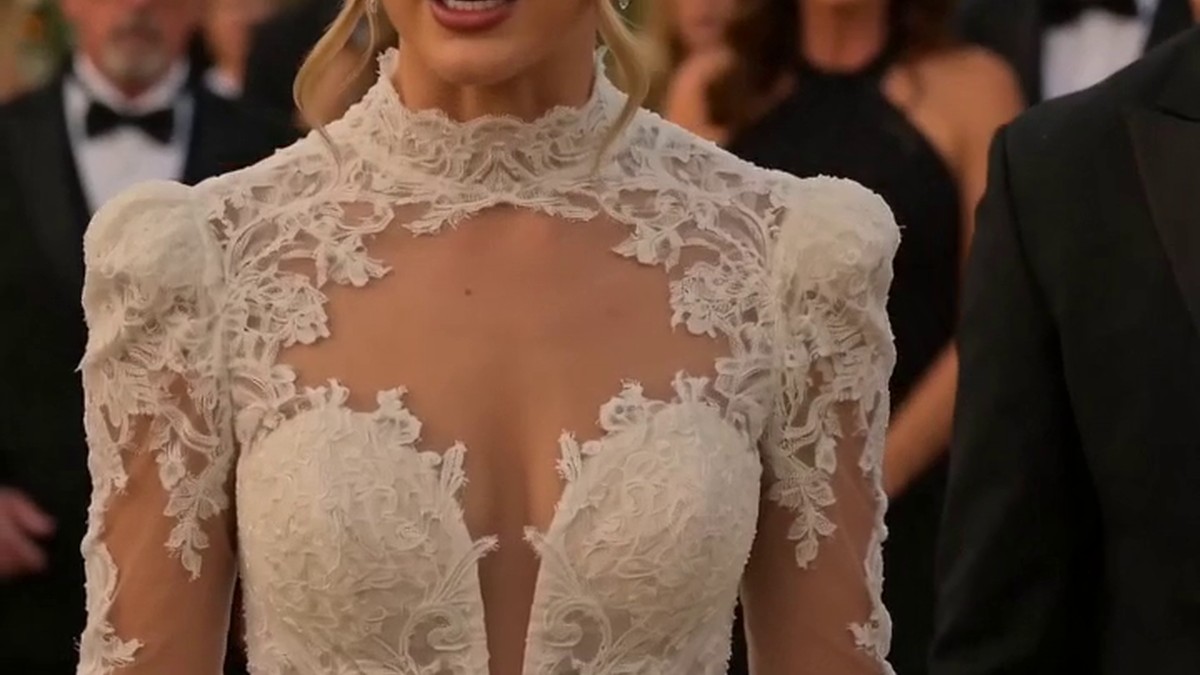
String lights swayed overhead, white flowers crowded every table, crystal glasses caught the glow, and a round fountain at the center of it all shimmered like something out of a dream. Guests murmured quietly among themselves, stealing glances at the bride, waiting for the toast.
Then a scream split the music open.
A young woman plunged into the fountain.
Water exploded up around her emerald-green dress. Her dark hair plastered itself across her face, and the nervous laughter that rippled through a few guests died the moment everyone realized — this wasn’t a stumble.
Her father had shoved her.
Don Emilio Vargas stood at the fountain’s edge, powerful and respected, his face burning red with rage.
“I told you not to ruin this wedding!”
The young woman — Valentina — raised her eyes from the water. Tears and fountain spray ran down her cheeks together.
“I didn’t come to ruin anything, Dad… I came to stop a lie.”
Across the garden, the bride, Lucía, felt her heart lurch.
“Why did you call her daughter?”
Silence.
The groom, Daniel, stood motionless beside the garden altar. The color had drained completely from his face. He kept his eyes away from Valentina, as if refusing to look at her might somehow erase what every single guest had just heard.
Valentina pulled herself out of the fountain slowly. Each step left a wet print on the stone. She looked broken — but not beaten.
“Because he hid me for years,” she said. “And your future husband knows exactly who I am.”
Lucía turned to Daniel.
“Tell me you don’t know her.”
Daniel swallowed hard.
“Lucía, this isn’t the time.”
“Then you do know her.”
Valentina reached inside her soaked dress and pulled out a small medallion. She opened it in front of everyone. Inside sat a faded photograph — Don Emilio Vargas, a woman no one recognized, and a newborn baby.
“I’m the daughter he erased so he wouldn’t lose his fortune.”
Don Emilio’s fists tightened.
“That woman was after money.”
Valentina met his eyes with something worse than anger. It was grief.
“My mother only wanted me to have a last name.”
The bride took a step back. Her gaze had shifted — away from the father, and straight to Daniel.
“And what exactly is your part in all of this?”
Valentina answered before he could open his mouth.
“Daniel found me six months ago. He promised he’d help me uncover the truth. But the moment he found out my father was the man funding this wedding, he went quiet.”
Lucía’s bouquet slipped from her hands and hit the ground.
“You were going to marry me knowing your family was tangled up in this?”
Daniel’s mouth opened. Nothing came out.
Then Valentina added one more thing.
“He didn’t just go quiet. He asked me to disappear until after the honeymoon.”
The garden went completely still.
The bouquet lay between them like something already dead.
Lucía didn’t move. She stood in her ivory dress with her hands open at her sides, staring at Daniel the way you stare at a stranger who just walked out of someone else’s face.
“Say something,” she said.
Daniel ran a hand through his hair. “It’s complicated, Lucía.”
“No.” Her voice was quiet. That particular kind of quiet that comes right before a door gets locked from the inside. “Complicated is a word people use when they’ve already decided the truth is too expensive. So try again.”
Guests had stopped pretending not to watch. The string lights swayed gently above a garden full of held breath.
Don Emilio Vargas stepped forward from the fountain’s edge, his jacket damp where the water had splashed up. “This is a family matter,” he said, in the voice he used to end conversations. “Everyone please—”
“Sit down, Dad.”
The word hit the air like a struck match.
Not Valentina. Lucía.
Don Emilio blinked. In thirty years of wielding that voice, no one had interrupted it. Not at a board meeting. Not at a funeral. Certainly not at a wedding he was paying for.
Lucía turned to him slowly. Something had shifted behind her eyes — not rage, something colder and more precise.
“Did you know?” she asked him. “Before you arranged this marriage. Before you wrote the checks and picked the venue and told my mother this was the match that would finally make you proud of me — did you know that Daniel had been in contact with your daughter?”
Don Emilio’s jaw tightened. “Valentina is not—”
“Answer the question.”
The silence that followed lasted exactly long enough to be its own answer.
Valentina was still standing near the fountain, her green dress heavy with water, her feet leaving dark prints on the pale stone. She was watching her father with the patient, exhausted attention of someone who has rehearsed this moment so many times it has lost its power to shock her.
“He knew,” she said quietly. “He’s known since February.”
Daniel made a sound — something caught between protest and confession.
“Valentina, don’t—”
“Don’t what, Daniel?” She turned to him. Her voice didn’t waver. “Don’t finish the sentence you started six months ago when you sat across from me in that coffee shop and told me you believed me? Don’t say out loud that you called me two days before the engagement party and told me to delete your number?” She paused. “Or don’t ruin the story you’ve spent a year constructing?”
The groom looked, for the first time, genuinely cornered. Not embarrassed — cornered. The way a man looks when all the exits he’d quietly mapped are closing at once.
Lucía watched his face with surgical attention.
“She’s telling the truth,” Lucía said. It wasn’t a question.
Daniel looked at her. And whatever he saw there — the stillness, the clarity, the absolute absence of the girl who might have been managed — seemed to deflate something in him. He exhaled.
“I didn’t want to hurt you.”
“You wanted to marry into the Vargas name,” she said. “And my father wanted his secret kept close enough to control it. So you made a deal.” She glanced between the two men. “When exactly did you two decide that I was the bridge?”
Neither of them spoke.
“That’s what I thought.”
She bent down and picked up the bouquet from the ground. Held it for a moment. Then set it deliberately on the edge of the fountain, beside the place where her father still stood — where Valentina still stood — like the closing of a chapter she hadn’t been told she was in.
Then she looked at Valentina.
For a long moment neither woman said anything. The guests didn’t exist. The lights didn’t exist. There was just the garden, and the water still settling in the fountain, and two women standing inside a story that had been built around them without their knowledge.
“I’m sorry,” Lucía said. “For what he did to your mother. And for what they both did to you.”
Valentina’s composure, which had held through everything — through the shove, through the water, through the stares — cracked open just slightly. Her eyes filled.
“I didn’t come here to ruin your wedding.”
“I know.” Lucía almost smiled. “You came here because you deserved a name. And you were right.”
She turned to face her guests then. The aunts with their frozen smiles. The business partners nursing their drinks. The priest who looked like he was quietly reconsidering his vocation.
“Thank you all for coming,” she said, with the calm of someone who has just survived something and already knows it will matter less than it feels like right now. “There isn’t going to be a wedding today. But the food has been paid for, so please, stay and eat.”
She walked past Daniel without looking at him.
She walked past her father without looking at him.
She paused only once, when she reached the garden doors, and turned back toward Valentina.
“I have a lawyer,” she said. “A good one. If you want, I can make a call Monday morning.”
Valentina stared at her.
“Why would you do that?”
Lucía considered the question honestly.
“Because somebody should have done it a long time ago,” she said. “And because your mother was right. You deserved a last name.”
Then she walked through the doors and into the house, her dress catching the light one final time before she was gone.
—
Don Emilio Vargas didn’t leave immediately. That was the thing about men like him — they were accustomed to outlasting the discomfort in a room. He stood by the fountain for several minutes after Lucía disappeared, jaw set, surveying the garden as though cataloguing the damage to his reputation and calculating how much it would cost to repair.
Valentina stood three feet from him.
She didn’t approach him. She didn’t perform forgiveness. She simply stood in her wet dress and looked at him, and let the looking be enough.
Finally he turned.
“Whatever you think you’ve accomplished tonight,” he said, low enough that only she could hear, “this isn’t over.”
“I know,” she said. “I’m not done, either.”
She reached up and closed the medallion in her palm — the photograph of a woman and a baby and a man who hadn’t wanted either of them to exist in any story he was telling. She closed her fingers around it.
“But I have a name now,” she said. “Everyone in this garden heard it. That part? That part is done.”
Don Emilio looked at her for a long moment. Something moved across his face — not softness, not regret, but something in the neighborhood of recognition. The acknowledgment, perhaps, that the particular wall he’d built around this secret had finally come down, and no amount of money was going to mortar it back up before morning.
He straightened his jacket and walked away through the garden.
Daniel was gone already — sometime in the last few minutes he had simply ceased to be present, the way people who are primarily concerned with self-preservation tend to do when there is nothing left to preserve.
Valentina stood alone by the fountain.
The string lights still swayed. The white flowers were still beautiful. A waiter was tentatively beginning to set out the appetizers at one of the long tables, because life, in its magnificent indifference, continues.
She looked down at her reflection in the fountain water.
She had walked into this garden with one thing. A photograph. A name. A truth she had carried alone for twenty-six years while her father built monuments to his respectability on top of it.
She walked out of it with something she hadn’t expected.
A witness.
Two, actually — though one of them was herself, finally, after all this time, paying attention.
—
On Monday morning, Lucía’s lawyer made a call.
By the end of the month, the case for recognition of paternity was filed.
Don Emilio Vargas contested it. Of course he did. Men like him don’t relinquish anything without a legal fight, and he had very good lawyers, and the process was slow and expensive and exhausting in all the ways that processes like that tend to be.
But Valentina had learned, in a soaking-wet dress in front of a garden full of strangers, that the truth has a certain momentum once it’s in motion.
She had a name. She had a witness.
She had time.
And somewhere across the city, in a smaller apartment than the one she’d grown up in, Lucía sat at her kitchen table with coffee going cold beside her and a phone that kept buzzing with calls she wasn’t answering yet, and felt — beneath the grief and the humiliation and the enormous relief — something that took her several days to identify.
Clarity.
The particular fierce, clean clarity of a woman who had almost chosen wrong and caught herself in time. Who had walked out of a story someone else wrote for her. Who had, in the wreckage of a ruined wedding on a beautiful night, accidentally done the right thing.
The flowers had been perfect.
The ending was better.