Daniel Carter was already smiling when he pulled the chair away — just as Emma reached for it.
She hit the marble floor hard.
The glasses shook.
A few guests laughed. That nervous, ugly laugh people use when they don’t want to take sides.
No one stood up. No one asked if she was hurt.
Margaret Carter lifted her wine glass with the grace of someone who had practiced cruelty her entire life.
“She can’t even sit down properly.”
Emma stayed on the floor for a moment.
It wasn’t the pain that was getting to her.
It was the familiarity of it. The same weight she’d been carrying for years, pressing down harder every time.
She breathed in slow.
Her hand moved to her finger.
She looked at the ring for a long second — the way you look at something before you let it go for good.
Then she took it off.
Daniel stopped smiling.
“Emma—”
She didn’t answer him.
She placed the ring in the center of the table.
*Clink.*
That small sound swallowed the entire room whole.
And then — footsteps. Measured, deliberate, coming from the front hall.
Every head turned.
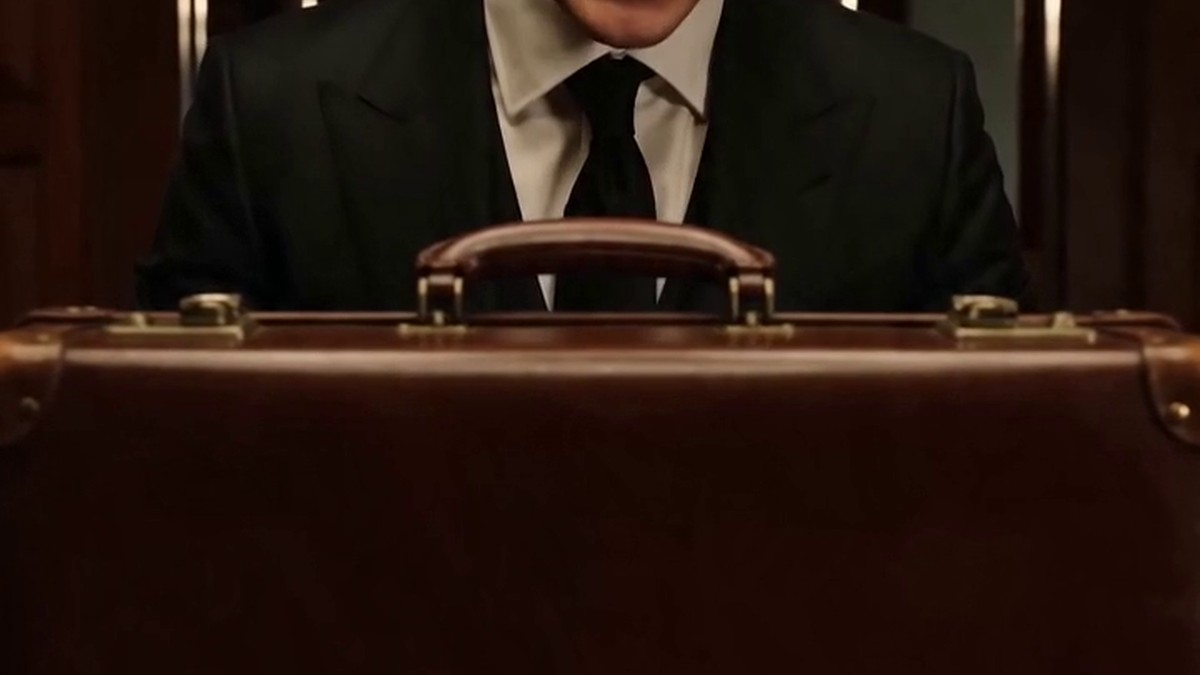
An elderly man in a dark suit appeared in the doorway, carrying a worn leather briefcase.
Jonathan Reed.
The Carter family’s attorney for over thirty years.
He crossed the room without hurrying. Glanced at the ring. Then at Emma. Then, last, at Daniel.
Vanessa’s smile was gone.
Margaret set her glass down slowly.
Daniel straightened in his chair, reaching for composure he no longer had.
“Jonathan — this is a family dinner.”
The old man’s voice didn’t waver.
“That’s exactly why I’m here.”
Emma raised her eyes. The tears were still there. But something in her had gone quiet and steady.
“My attorney just arrived.”
Daniel’s brow tightened. “Your attorney?”
Jonathan set the briefcase on the table.
“As of this morning, I have formally resigned as counsel for the Carter family.”
The silence that followed had weight to it.
“Effective immediately, I represent only Mrs. Emma Carter.”
Daniel let out a short, disbelieving laugh. “You’re not serious.”
“I have never been more serious in my life.”
Jonathan reached into the briefcase — and instead of pulling out documents, he placed a small digital recorder on the table, right beside the ring.
Daniel went pale.
“What is that?”
“A copy.”
“A copy of what?”
Jonathan looked at him steadily.
“Every recording Emma made over the last eighteen months. Starting the day I advised her to document everything. Every single thing.”
Emma’s voice came out even. Calm in a way no one at that table had ever heard from her.
“I didn’t start recording because I wanted a divorce.”
A beat.
“I started recording because I knew — if I didn’t — no one would ever believe what was happening inside this house.”
Not one person spoke.
Jonathan began laying folders on the table, one after another, neat and deliberate.
“Months of public humiliation. Psychological abuse. Financial control. Threats. More than enough evidence to initiate immediate legal proceedings.”
Vanessa stepped back.
Margaret opened her mouth.
Jonathan raised one hand, and she closed it again.
“I’d strongly suggest you listen before you speak.”
He pulled out the first document.
“Official divorce petition.”
Then another.
“Protective order.”
Then one more.
“Motion to freeze all marital assets — pending.”
Daniel felt the floor shift beneath him.
“You planned this.”
Emma looked at the ring sitting in the center of the table.
“No.”
“I just stopped pretending everything was fine.”
Then Jonathan reached for the last envelope. Sealed. He opened it carefully, unfolded the page inside, and looked directly at Daniel.
What he said next drained the color from every face in the room.
“What changes everything tonight — isn’t the divorce.”
A pause that stretched like wire pulled too tight.
“It’s the secret clause your grandfather buried in the Carter Holdings trust.”
Daniel forgot to breathe.
Because he was about to find out that the biggest secret his family had ever kept — could cost him far more than just his wife.
And that was only the first truth to surface that night.
Daniel’s throat moved. Nothing came out.
Jonathan smoothed the page against the table with two fingers, the way a man does when he wants everyone in the room to feel the weight of what he’s holding.
“Your grandfather, Robert Edward Carter, inserted a moral conduct clause into the founding trust of Carter Holdings in 1987. It was never disclosed to your father. Never disclosed to you.” He paused. “Emma’s team found it six weeks ago.”
Margaret’s hand came down flat on the table.
“That’s impossible.”
“It’s notarized. It’s witnessed. And it has been quietly validated by two independent estate attorneys in the last month.” Jonathan’s voice didn’t rise. It didn’t need to. “Your grandfather was a careful man, Margaret. He’d watched what your husband’s money did to people. He built a door — and he hid the key.”
Vanessa was no longer in the room.
At some point in the last thirty seconds, she had simply ceased to exist in the social sense — her body still standing near the window, her face stripped of everything that had made it readable.
Emma noticed.
She noticed the way you notice the exact moment a fire goes out.
Daniel pushed back from the table. “I want my own lawyers in here. Tonight. I’m not—”
“You’re welcome to call them.” Jonathan folded his hands. “The clause will read the same way it did this morning.”
“What does it say.” It wasn’t a question. It came out of Daniel like something torn loose.
Jonathan looked at him for a long moment.
“In the event that a Carter heir’s spouse initiates legal dissolution of marriage on documented grounds of abuse, coercion, or sustained psychological harm — and that documentation meets the evidentiary threshold set out in Schedule C of the trust — that heir’s voting shares in Carter Holdings are immediately placed into independent receivership.”
The chandelier light seemed to dim.
“For a period no less than five years.”
Daniel sat back down.
He didn’t choose to. His legs just stopped working.
“Five years,” Jonathan continued, “during which the heir exercises no voting authority, holds no board seat, and draws no distribution above operating salary. The receivership trustee — designated in the original document — assumes full stewardship of those shares.”
Margaret was on her feet now. “That’s our family’s company. That is *our—*”
“Margaret.” Emma’s voice.
Quiet. Just her name. Two syllables.
Margaret stopped.
Maybe it was the absence of apology in it. The complete lack of the flinch she had trained into Emma over years of dinners exactly like this one. Whatever it was, it worked.
Emma stood up from her chair.
She wasn’t shaking.
That surprised her most of all — that her hands were still, that the air in her lungs felt clean and full, that the floor felt solid under her feet in a way it hadn’t in a very long time.
“I want to say something.”
No one told her she couldn’t.
“I spent four years in this family trying to become something you would accept. I changed the way I dressed. I changed what I ordered at restaurants. I stopped calling my mother as often because the calls made Daniel uncomfortable.” She let that sit. “I laughed at things that weren’t funny. I cried alone in bathrooms at parties. I told myself the good parts were real and the rest was just — noise.”
She looked at Daniel.
Really looked at him. The way she hadn’t in a long time because looking meant feeling.
“You pulled a chair from under me tonight. In front of your family. In front of people who were supposed to be mine too.” A beat. “But you’ve been pulling chairs from under me since the beginning. I just kept hitting the floor and getting back up and pretending I’d slipped.”
Daniel’s jaw was tight. His eyes were somewhere between fury and the particular shame of a man who has just realized his audience has changed.
“Emma, this isn’t—”
“I’m not finished.”
He closed his mouth.
She reached into the small bag she’d set beside her chair — the bag she’d carried in without anyone paying attention, the way people never pay attention to the woman in the room they’ve already dismissed.
She pulled out a small envelope. Placed it on the table beside the recorder. Beside the ring.
“That’s a letter from my doctor. Dated fourteen months ago. It documents a fractured wrist consistent with a fall — that’s what I told him. That’s what I told everyone.” She breathed. “It wasn’t a fall.”
The room didn’t gasp.
It went the kind of silent that lives underneath sound.
Margaret sat down.
Not gracefully. Not with the practiced ease of a woman who had spent a lifetime performing composure. She sat down the way a very old building comes down — in stages, each one more final than the last.
Vanessa moved toward the door.
“Sit down.” Jonathan didn’t look at her. “You’re listed as a material witness in the protective order filing. Leaving now would be inadvisable.”
Vanessa sat.
Daniel’s voice came out strange. Flattened. Like something had pressed all the shape out of it.
“I never — Emma, I never *meant* to—”
“I know.” She said it without hesitation. Not because she was forgiving him. But because the knowing was the saddest part, and she was done pretending it wasn’t. “That’s what made it so hard to leave. People who mean it are easy. You were always just — careless. Like I was a thing that couldn’t break.”
She picked up the ring from the center of the table.
Held it between her fingers.
Set it down in front of him.
“Keep it.”
She reached for her bag.
Jonathan was already closing the briefcase, folders neatly squared, recorder back inside. A man who had done exactly what he came to do.
“The receivers will be in contact with your board by nine a.m.,” he said to no one and everyone. “I’d recommend you use tonight to retain separate counsel. All of you.”
He looked at Daniel one last time.
Not with cruelty. Not even with judgment. Just with the particular tiredness of a man who had watched powerful people underestimate the wrong person for the last time.
“Your grandfather believed that character was the only real asset. He spent thirty years watching your family spend it.” He picked up the briefcase. “He wanted someone to make it count.”
Then he looked at Emma.
Something in his face softened at the edges.
“Ready?”
She looked around the room once.
At the crystal glasses catching the light. At the untouched food going cold on fine china. At the family portrait above the fireplace — Daniel at twenty-five, already smiling that smile — and at Margaret’s face, which had finally run out of things to perform.
At Vanessa, who was staring at a fixed point on the wall, the careful architecture of her evening completely dismantled.
At Daniel, who was looking at the ring.
Not at Emma.
At the ring.
And that told her everything she still needed to know.
“Yes,” she said.
She walked out of the dining room.
Through the front hall with its marble floors and its fresh flowers and its careful, curated silence.
She pushed open the front door.
The night air hit her — cold and clean and indifferent — and she stood on the top step for just a moment, breathing it in like someone who had been in a low-ceilinged room for a very long time.
Behind her, through the closed door, she could hear it starting. The raised voices. The scrape of chairs. The sound of a family finally having the argument they had been avoiding for years, now that there was no one left to absorb it.
She walked down the steps.
Jonathan’s car was waiting at the end of the drive, engine running, the driver standing with the door already open.
She didn’t look back.
Not because she wasn’t sad.
She was. She was gutted and exhausted and somewhere underneath the steadiness there was a grief that would take a long time to work through — for the marriage she’d wanted it to be, for the family she’d tried to join, for the years she’d traded for something that was never going to give them back.
But grief and regret are different things.
She knew the difference now.
She got in the car.
The door closed behind her, solid and certain, and the driver pulled smoothly down the long Carter driveway, past the iron gate, out onto the open road where the streetlights came on one by one as if lighting something ahead of her rather than something she was leaving.
She leaned her head back.
Looked at her hand — her left hand, bare now at the fourth finger, a faint pale line where the ring had lived.
She pressed her thumb to it.
*I know you’re there,* she thought. *I know what it cost.*
Then she turned and looked out the window at the dark moving past, and she let herself feel it — all of it, the whole accumulated weight of four years — and somewhere inside that weight she found, to her own surprise, something that hadn’t been there before.
Room.
Just — room.
Space where the pretending used to be.
She exhaled slow and long, and the city opened up around the car, wide and lit and full of everything that happens after.