Isabel moved through the noise with a practised smile, balancing plates and pleasantries. But underneath the calm exterior, her pulse was running. She knew exactly who was sitting at the corner table.
Tomás Larios. Real estate kingmaker. A man whose name opened doors that didn’t officially exist.
He held court the way he always did — loud, generous with his laughter, his friends leaning in like satellites caught in his orbit. When Isabel approached to take the order, she kept her eyes neutral. Professional.
He didn’t extend the same courtesy.
— Look at this. Pouring wine for people who actually matter. — He glanced at his friends, and they laughed on cue. — Tell me something, sweetheart — do you even know what you’re holding right now, or does it all just look like purple liquid to you?
The heat climbed up Isabel’s neck. She said nothing.
— Go on. — He waved her off. — Fetch me something worth drinking. Something you could never afford.
More laughter. Isabel lowered her head and turned. Her hands didn’t shake. She’d learned to keep them still.
But when she reached back for the glass, Tomás stopped mid-sentence.
His eyes had landed on her hand.
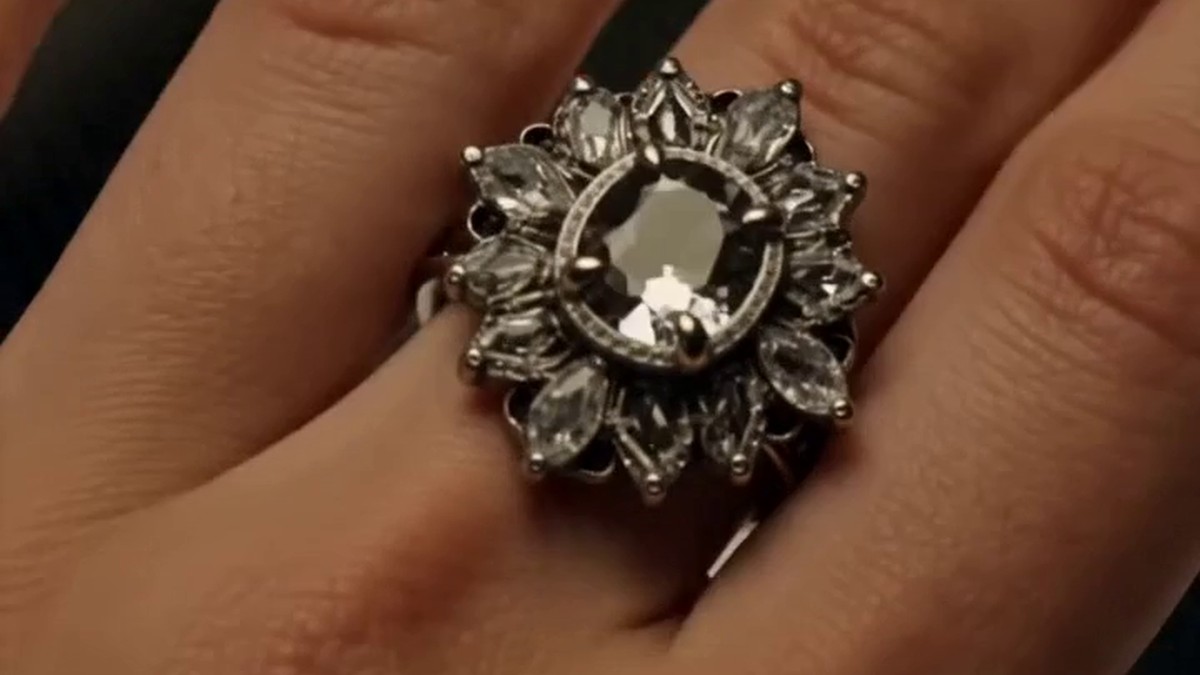
On her finger — a gold ring. Simple. Elegant. The kind of piece that whispers rather than shouts. And yet something about it hit him like a fist to the sternum.
— Hold on. — His voice dropped. The teasing was gone, replaced by something stripped raw. — Where did you get that?
Isabel turned, caught off guard by the shift in him.
— It was my grandmother’s. She left it to me when she passed.
Tomás went the colour of old ash.
Because that ring wasn’t a ring to him. It was a ghost. The same piece that had vanished from his family years ago, swept away in an incident no one in his circle ever spoke about openly. An old wound. A closed chapter — or so he’d told himself.
Isabel studied his face now, the power draining out of it in real time.
— It came from my mother. And she got it from hers. — A pause. — I’m not sure why it matters to you. But something tells me you want to know more.
Tomás Larios — the man who bought skylines and broke contracts without flinching — sank back into his chair like something inside him had given way.
The past doesn’t knock. It just walks in.
And his was standing right in front of him, wearing a waitress’s uniform and a gold ring that suddenly explained everything.
The restaurant kept moving around them — glasses clinked, laughter rippled across the room, a sommelier uncorked something expensive three tables over. The world didn’t notice that Tomás Larios had just stopped breathing.
He was staring at Isabel’s hand like it was evidence at a crime scene.
She didn’t pull it back.
— You’re going to want to sit down for this, — he finally said. Except he was the one already sitting. The irony of that seemed to register on his face.
— I’m working, — Isabel said flatly. The professional smile was gone. Something harder had taken its place. — Whatever this is, it can wait.
— It can’t. — He leaned forward, dropped his voice to something that barely qualified as sound. — That ring was my mother’s. Before it was your grandmother’s — it was hers.
The table went quiet. His friends — those satellite people who laughed on command — seemed to sense something seismic and retreated into their phones, their wine, their careful ignorance.
Isabel set the bottle down on the edge of the table. Slow. Deliberate.
— Say that again.
—
They ended up in the alley behind the kitchen.
Not romantic. Not cinematic. The kind of place where the grease traps get emptied and the line cooks smoke between rushes. Two plastic crates pulled up against the brick wall, a bare bulb overhead throwing sick yellow light.
But it was private. And right now, private was everything.
Tomás sat on one crate. Isabel on the other. Between them — the ring, which she’d slipped off and placed on the concrete, equidistant, like something to be negotiated.
— My mother’s name was Graciela, — he said. — Graciela Larios. Before that, Graciela Vega.
Something moved across Isabel’s face.
— My grandmother’s name was Esperanza Vega.
The bulb flickered. Neither of them acknowledged it.
— They were sisters, — Tomás said. And the word *sisters* came out of him like a wound reopening — carefully, with held breath, fully aware it was going to hurt. — Graciela and Esperanza. They had a falling out before I was born. Something about a man. Something about money. My mother never told me the whole story. Just that she had a sister once, and then she didn’t.
Isabel was very still.
— My grandmother never spoke about family. Not once. I used to think she was just private. — She looked at the ring on the concrete. — She wore that every day of her life. Every single day. And when she was dying, she made my mother promise to keep it in the family. Said it was the most important thing she owned. — A pause. — I always thought that was strange. It’s not valuable. Not really. Just gold.
— It’s not just gold, — Tomás said. — There’s an inscription. Inside the band.
Isabel picked it up. Turned it. Brought it close to the yellow light.
*Para las que vienen después. G y E.*
*For those who come after. G and E.*
Her throat worked.
— They had it made together, — Tomás said quietly. — My mother told me that much. Before the fight. Before everything. They had matching rings made — a set. My mother’s was lost years ago. I assumed it was gone forever.
— It wasn’t lost, — Isabel said. — She took it with her.
The word *she* landed between them like a stone dropped into still water.
Esperanza had taken it. When she left. When she walked away from her sister and built a new life somewhere her family couldn’t find her. She had carried that ring — that half of a matched pair — as proof of something. Maybe as punishment. Maybe as grief. Maybe as the only love she didn’t know how to let go of even after she’d decided to disappear.
Tomás pressed his hands against his knees. The restaurant sounds bled faintly through the back wall — muffled, distant, another world.
— How old are you? — he asked.
— Twenty-eight.
He nodded slowly.
— My mother died when I was thirty-one. She spent her last year trying to find Esperanza. Hired people. Nothing came of it. — He looked up. — She died not knowing.
Isabel said nothing for a long moment.
— My grandmother died three years ago. She spent her last night talking about someone named Graciela. We thought she was confused. We thought she was just — going. — Her voice stayed even, but her jaw tightened. — I didn’t know it was a name. I didn’t know it was a person.
The bulb threw its sick light down on them. Two people on plastic crates in an alley, assembling a story from pieces that had been scattered across decades.
—
He’d come in tonight like a man who owned the city. He’d sat down at that corner table and filled the room with his noise and his borrowed gravity, and he’d treated Isabel the way men like him sometimes treated women like her — as furniture. As backdrop.
Now he looked like a man who’d been handed a letter he thought had been lost at sea.
— I owe you an apology, — he said.
— You owe me more than that, — Isabel said. Not cruel. Just accurate.
— I know. — He looked at the ring. — I know I do.
She picked it up, turned it again in her fingers.
— I’m not giving it to you. — She said it quietly, without defensiveness. — I want you to know that now. It goes to my daughter someday. Or whoever comes after me.
— I’m not asking for it. — And he wasn’t. She could see that. The entitlement had drained clean out of him in the alley, and what was left was something smaller and more genuine. — I just — I needed to know it wasn’t lost. That she hadn’t — that Esperanza hadn’t just thrown it away.
— She kept it every day, — Isabel said. — Every single day.
Something in Tomás Larios’s face cracked open. Not dramatically. Not like a man breaking down. Just — a hairline fracture, like old wood settling. The kind that tells you the structure has finally accepted the weight it was always carrying.
He pressed his thumb and forefinger to the bridge of his nose.
— They wasted so much time.
— They did.
— And we almost — I almost walked out of here tonight not knowing any of this.
— You almost walked out of here having made a woman feel worthless for the entertainment of your friends, — Isabel said. Calm. Clear. No venom, just truth. — The ring was almost just a ring.
He absorbed that.
He let it sit.
— You’re right. — He dropped his hand. Met her eyes directly, without the performance or the power he’d walked in wearing. — You’re completely right.
—
She went back to work.
She had tables to turn and glasses to fill and a manager who’d been watching the back door for the last fifteen minutes. The restaurant didn’t pause for family histories assembled in alleys. The money kept moving. The evening kept its momentum.
But as she moved through the noise, the ring on her finger felt different. Not heavier. Not lighter.
*Older.*
Like she’d always been carrying something she didn’t fully understand, and now she did.
Before his table settled the check — a number that made her coworkers whistle quietly when they saw the card run — Tomás stopped her.
He pressed a card into her hand. Just the card. No performance.
— My cousin lives in San Diego. On my mother’s side. She’s been trying to piece the family history together for years. — He paused. — I think she’d want to know about you. I think — I think there are people who’d want to know.
Isabel looked at the card.
She didn’t say yes. She didn’t say no.
She slipped it into her apron pocket, next to her order pad and her pen.
— I’ll think about it, — she said.
He nodded. That was enough. That was more than he’d earned tonight, and something in his expression said he understood that clearly.
He left with his friends trailing behind him — those bright, easy people who would drink and laugh all the way to the next venue, who had no idea that their centerpiece had just been quietly undone and rebuilt in an alley behind a kitchen.
Isabel watched the door close.
Then she picked up a tray, squared her shoulders, and went back to work.
—
Later, at the end of the shift, she stood at the bus stop alone.
The city was doing its late-night thing — distant sirens, a cab with a cracked taillight, the smell of rain two hours away.
She held her hand up against the streetlight and looked at the ring.
*G y E.*
*Graciela and Esperanza.*
Two women who had loved each other enough to have something made. Who had fought hard enough that neither one found her way back. Who had carried the evidence of what they’d lost — separately, silently, across decades and distances they never closed.
She thought about her grandmother on that last night. Calling a name nobody recognised.
She thought about Tomás’s mother. Dying with a hired investigator’s phone number on her nightstand.
All that time. All that stupid, wasted time.
Isabel closed her fingers around the ring.
She wasn’t angry. She wasn’t sad, exactly. She was something more complicated than either — the feeling of inheriting a grief that wasn’t originally yours, of being handed the tail end of a story you were never meant to find.
The bus came. She got on.
The card was still in her apron pocket. She could feel it there — small, sharp-edged, carrying a phone number that led somewhere she didn’t know yet.
She would call. She knew that already. Not tonight. Not because Tomás Larios had asked her to. But because her grandmother had spent her whole life carrying something half-finished, and Isabel was done with half-finished things.
*For those who come after.*
She pressed her thumb against the inscription through her closed fist.
The bus moved through the city, lit from inside, heading somewhere.
She let it take her.