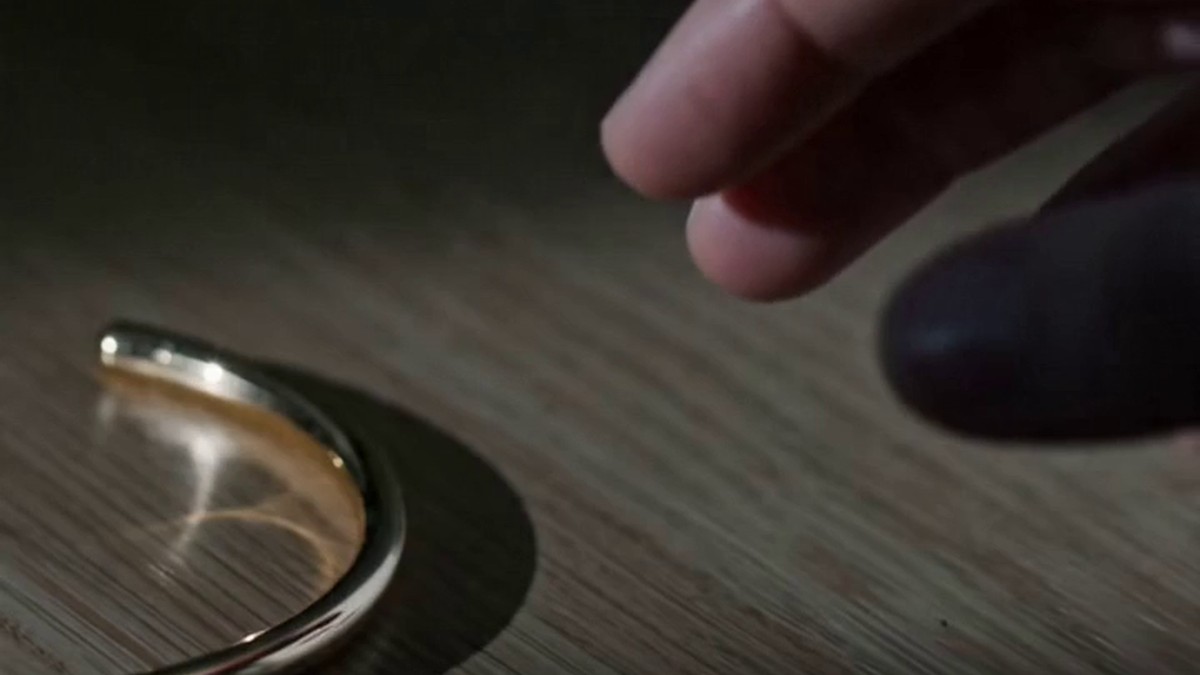
She never made it past the entryway.
She set her bag down on the front table — and stopped breathing.
A gold bracelet. Small, distinctive, unmistakable.
Elena’s bracelet.
Her best friend. The woman who knew every secret Clara had ever whispered in the dark. There was no innocent reason for that bracelet to be sitting in her home on a Tuesday afternoon.
Clara’s hands started shaking before her mind caught up.
The house was silent in that particular way houses get when something is being hidden. Not peaceful. Held. Like the walls themselves were holding their breath.
She moved without deciding to move.
Gone was the composed executive, the measured stride, the careful elegance she wore like a second skin. She ran down the hallway with her heart slamming against her ribs, chasing a feeling she desperately didn’t want confirmed.
She hit the bedroom doors with both palms.
They swung open.
And everything she had built — her marriage, her trust, a friendship she’d carried for decades — collapsed into nothing in the space of a single, terrible second.
A startled sound from the far side of the bed.
A voice she recognized.
Some betrayals you survive. Some rewrite you completely, leaving a person standing in a doorway who no longer knows her own name.
This was the second kind.
The first sound she made wasn’t a scream.
It was smaller than that. A soft exhale — the kind that escapes when a fist connects with your stomach and takes everything with it. Air. Certainty. The version of your life you thought you were living.
Daniel was on his feet before she could speak. She watched him move — that familiar body, those hands she had held through miscarriages and promotions and ordinary Tuesday evenings — scrambling, reaching for something to cover himself, his mouth already forming her name.
“Clara—”
“Don’t.”
One word. So quiet it barely existed.
Elena hadn’t moved. She sat on Clara’s side of the bed — *her* side, the side where Clara’s novel sat dog-eared on the nightstand, where her reading glasses were folded, where she’d slept for eleven years — with the sheet pulled to her collarbone and her dark eyes doing something Clara had never seen them do.
Avoiding.
Elena’s eyes were avoiding her.
That was the detail that finished it. Not Daniel’s bare chest. Not the dim afternoon light filtering through curtains Clara had picked out herself. It was Elena looking at the headboard, at the wall, at literally anything in this room that wasn’t her best friend standing in the doorway with her work bag still on her shoulder.
Clara realized she was still wearing her coat.
She thought, very clearly and very calmly: *I am still wearing my coat because I never made it home. I never actually made it home.*
—
“Say something,” Daniel said. His voice cracked on the second word.
She turned her eyes to him like she was turning a key in a lock she had no intention of opening.
“How long.”
Not a question. The grammar of it was wrong, deliberately. Questions implied she might not already know the answer in her bones.
He looked at Elena. He actually looked at Elena — for guidance, for permission, for some shared script they had presumably rehearsed for this exact disaster — and that single glance told Clara more than any confession could have.
*They had talked about this. They had planned for this.*
“Six months,” Elena said.
Clara looked at her then. Finally. Fully.
Elena had found her voice, which meant Elena had decided that honesty was now the shape her courage would take. Clara recognised the posture — chin lifted, shoulders squared. She had watched Elena use that posture in boardrooms and courtrooms and at her mother’s funeral. It was the posture of a woman who had decided the only way out was through.
“Six months,” Clara repeated.
“I’m sorry.” Elena’s voice didn’t shake. “I know that—”
“You sat across from me at dinner *three weeks ago*.” Clara heard herself speak and was faintly amazed by the steadiness of it. “Sophie’s birthday dinner. You held my daughter. You told me I looked beautiful. You toasted to — what did you say? You said, *to the woman who taught me what a real friendship looks like.*”
Elena closed her eyes.
“You said that.” Clara took one step into the room. “I remember because I thought: *that is what a best friend sounds like.* I remember because I thought about it on the drive home. I was *grateful*.”
The silence that followed was a living thing. It had weight. It moved around the furniture.
Daniel reached for her arm.
She stepped back before his fingers could land, a reflex so sharp it startled all three of them.
“Don’t touch me.” She said it the way you say *don’t move* to someone standing near a ledge. Absolute. Non-negotiable. Containing everything.
He let his hand fall.
—
What happened next, Clara would never be able to explain fully — not to her therapist, not to her sister, not to the version of herself she would slowly reconstruct over the following year. She didn’t cry. She didn’t throw anything. She didn’t say the ugly, specific things that were crowding the back of her throat like a dam about to fail.
She picked up the gold bracelet from where she’d left it in her memory — still seeing it on the front table, small and damning and real — and she walked back down the hallway.
They called after her.
Daniel’s voice first: her name, over and over, with an increasing desperation that would have broken her heart on any other day. Then footsteps. Then Elena’s voice — lower, more careful, shaped like an apology but not quite one.
Clara opened the front door.
She stood on the threshold — coat still on, bag still on her shoulder — and she turned around one final time because she needed to see it. She needed to look at them standing in her hallway together, in the home she had helped build, in the afternoon light of a Tuesday she had intended to spend quietly.
She needed to see it clearly, so she could never accidentally convince herself it hadn’t happened.
Daniel’s face was devastation. She had loved that face for thirteen years.
Elena’s face was something more complicated. Grief, yes. Guilt, yes. But beneath it — and this was the part Clara would turn over in her hands for a long time afterward — beneath it was something that looked almost like relief. Like a secret that had finally gotten too heavy to carry.
Clara thought: *you both let me carry it for you.*
She thought: *that is the thing I will not forgive.*
“I’m going to pick up Sophie from your mother’s,” she said to Daniel. Her voice came out like a statement of fact. A weather report. A small, precise fact in an afternoon of catastrophic ones. “I’ll stay at Meredith’s. Don’t call me tonight.”
“Clara, please—”
“Don’t call me tonight.”
She stepped outside.
The door closed behind her.
—
The street looked exactly the same as it always had. Ordinary. Indifferent. A neighbour’s sprinkler arced lazily across a lawn. A dog was barking two houses down. The sky was that particular late-afternoon blue that had always been her favourite, the kind that preceded a clear night, and it seemed almost offensive that it was still doing that.
She sat in her car.
She did not start the engine.
For three minutes — she watched the clock, for no reason except that it gave her something to watch — she sat in the driver’s seat of her car in front of her own house and let herself feel exactly what she felt.
It moved through her like weather. Like something large and inevitable passing over.
And when it had passed — not resolved, not finished, but *passed* enough to function — she started the engine.
Sophie would be awake from her nap by now. She would smell like sleep and the lavender lotion Clara’s mother-in-law used, and she would reach up with both arms when she saw Clara come through the door. She wouldn’t know anything was wrong. She was fourteen months old and the world was still entirely intact.
Clara could give her that. Today. She could give her that.
She pulled away from the curb.
She didn’t look in the rearview mirror.
—
Six weeks later, she called Elena.
She had gone back and forth on whether to do it a hundred times, lying awake in Meredith’s spare room while Sophie breathed softly in the travel cot and the new shape of her life arranged itself in the dark.
Elena picked up on the second ring, which told Clara she had been waiting.
“I’m not calling to forgive you,” Clara said, before Elena could speak. “I don’t know if I ever will. I’m calling because you were my best friend for twenty-two years and I needed to say this to you directly.” She paused. “You should have told me. Before it started, or when it started, or at any point before I was standing in my own bedroom finding out. You should have told me. And you didn’t. And that — not what you did, but the fact that you looked at me every day for six months and chose not to — that is what I will carry for the rest of my life.”
Silence on the other end. Then a sound that might have been breathing, or might have been the beginning of the word *I know.*
“Don’t contact me again,” Clara said. “Not yet. Maybe not ever. I need to figure out what I’m doing with the rest of my life, and I can’t do it while I’m managing yours.”
She ended the call.
She stood in Meredith’s kitchen in her socks, with coffee going cold on the counter, with her daughter babbling in the next room at a stuffed elephant, and she pressed both palms flat on the cool tile of the kitchen island and breathed.
In.
Out.
*Okay,* she told herself. *Okay.*
It wasn’t okay. It was going to be not-okay for a long time — the lawyers, the custody conversations, the eventual terrible dinner where she would have to explain something to Sophie that Sophie would be too young to understand and old enough to eventually ask about. The grief of losing Elena would ambush her in strange places: in the middle of a good film, reaching for a phone to call someone who wouldn’t be on the other end, laughing at something funny and landing in the absence of the person she would have called to share it.
Loss, she was learning, was not a single moment. It was an accumulation of all the ordinary moments the missing person no longer inhabited.
But she had walked out.
She had picked up her daughter.
She had sat in a kitchen in her socks and she was still standing.
That was enough, she decided.
For today, that was enough.