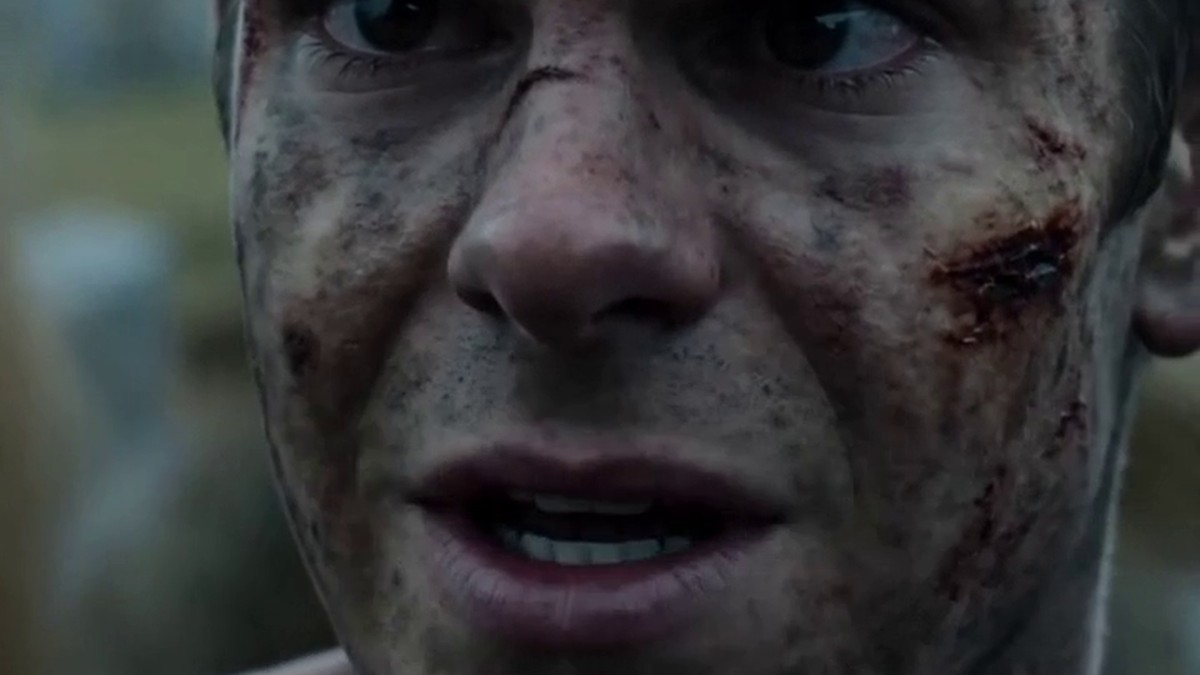
With shaking fingers, he lifted his burned hand and held up a small ring. A childhood ring, scorched and tarnished, engraved with the family name. The same ring that had disappeared the night the boy vanished.
Eleanor lurched backward. The ground didn’t feel solid anymore. Her husband Arthur grabbed her arm — grabbed it hard, fingers digging in like he intended to anchor her to reality whether she wanted to be anchored or not.
“Get him away from here!” Arthur bellowed, his voice cracking at the edges. “Someone call the police!”
Two men in dark suits moved immediately. They closed in on the wheelchair.
“Don’t you touch me!” The young man recoiled violently, hands seizing the wheels. “Look at it, Mom — look at the crest!”
Eleanor shoved Arthur’s hand off her arm. She couldn’t stop staring at that ring — small and battered, the silver nearly black with age. The scratches. The wear. And beneath all of it, those initials, still sharp, still unmistakable.
“Arthur.” Her voice came out as a breath. “Wait.”
“No.” Arthur seized her wrist. “Eleanor. This is a con. Julian is dead. We’ve known that for twenty years.”
The stranger looked at her — only at her. Tears carved pale tracks down his filth-covered face.
“The blue bedroom,” he said. His voice had gone raw, stripped to nothing. “When the thunderstorms rolled in, you’d sing that song. The one about the paper moon.”
Eleanor stopped breathing.
Nobody knew that. It had never appeared in a single newspaper. It wasn’t in any police report, any case file, any document that had ever existed. It lived in one place only — inside that bedroom, between a mother and a small boy who was afraid of storms.
“Who are you?” she breathed, one trembling step carrying her toward him.
“It’s me. I made it out. I’ve been trying to find my way back to you for so long, Mom.”
“This is insane!” Arthur planted himself between them, arms wide, voice thundering. “Julian burned in that house! The investigators found remains — there were remains!”
The young man’s eyes moved to Arthur. Something cold lived in that look. His scarred hands tightened on the armrests until his knuckles went pale.
“They found a body,” he said quietly. “It just wasn’t mine.”
Eleanor’s hand rose to her throat. She looked at her husband. She looked at the stranger. And somewhere in the space between them, a thought began to take shape — slow and terrible, like a crack spreading through ice.
“What are you saying?” she cried. “If it wasn’t you — then who was in that house?”
The young man’s gaze drifted past her, moving deliberately through the crowd until it settled on someone standing near the back — someone who had gone very, very still.
“Find the person who started the fire,” he said. “Ask them.”
Eleanor turned.
The crowd parted the way crowds do when something unspeakable moves through them — not all at once, but in ripples, person by person, each one registering the weight of the moment and stepping back from it. And there, at the rear of the gathered mourners, stood a man Eleanor had known for thirty-one years.
Martin Hale.
Arthur’s brother.
He hadn’t moved. That was the thing. Everyone else had shifted, turned, leaned toward the drama at the graveside — but Martin stood perfectly, deliberately still, the way a man stands when he has rehearsed stillness for a very long time.
His face gave nothing. His eyes gave everything.
“Martin.” Eleanor’s voice came out flat. Not a question. Not even an accusation. Just his name, dropped like a stone into still water.
He looked at her. He looked at Arthur. Then his gaze slid to the man in the wheelchair, and something passed across his expression — something that lasted only a fraction of a second, but Eleanor had been watching human faces for sixty-two years and she caught it, she caught it like catching a glass before it hits the floor.
Fear. Pure, ancient, exhausted fear.
“This is absurd,” Martin said. Calm. Measured. “Eleanor, you’re grieving. We all are. This person is exploiting—”
“The boathouse.” The man in the wheelchair spoke without raising his voice. “Uncle Martin kept a fuel canister in the boathouse. Red. With a dent on the side. I saw him take it to the main house that night. I watched him from the upstairs window.”
The cemetery went so quiet Eleanor could hear the highway a half mile away.
Arthur’s grip on her arm had gone completely slack. She could feel him beside her, could feel the quality of his silence change, could feel him becoming something other than the man who had grabbed her wrist thirty seconds ago.
“That’s not—” Arthur started.
“I was supposed to be in my room.” The young man pressed on, and his voice had found something now, some bedrock beneath all the years of wandering. “I wasn’t. I’d snuck down to get water. I saw him go in. I saw the light change in the windows downstairs. I ran. I ran out through the back garden, and I fell in the ditch by the old stone wall, and I just—” his voice fractured, “—I lay there. I was so scared I couldn’t move. And then the smoke started and I heard someone scream.”
“Who?” Eleanor’s question came out as barely a sound.
The young man’s jaw worked. His scarred hands trembled in his lap.
“I don’t know whose body was in there. I have never stopped trying to find out. That is the question that has followed me for twenty years.”
Arthur moved then.
Not toward Eleanor. Not toward the stranger in the wheelchair. He turned, fully and completely, toward his brother, and when he spoke his voice had dropped to something Eleanor had never heard from him in three decades of marriage — something ground down past anger into something older and more dangerous.
“Martin. What did you do?”
Martin Hale looked at his brother. He straightened his tie. He smoothed the lapel of his jacket with one hand — a small, fastidious gesture that Eleanor recognized suddenly as something she’d always seen him do when he was buying time, buying fractions of seconds, calculating exits.
“I didn’t do anything,” Martin said. “I’m not going to stand here and be accused by a filthy stranger at my sister-in-law’s mother’s funeral—”
“You were at the house that night.” Arthur’s voice cracked through him like a whip. “You told me you weren’t. You told the investigators you weren’t anywhere near Harrowfield Road.”
“I wasn’t—”
“The neighbors saw your car.” The man in the wheelchair. Quiet. Certain. “A green Rover, parked two streets over. Mrs. Connelly on Barton Lane told police she’d seen it. It was in the report. The investigators dismissed it because you’d already established your alibi through you.” A beat. “Through Arthur.”
Eleanor heard herself make a sound. She pressed her hand to her mouth.
She looked at her husband.
Arthur’s face had gone to ash.
“You asked me to cover for you,” Arthur said slowly. He sounded like a man reading words in a language he was only now understanding. “You said you’d been at a meeting. You said the car was borrowed. I didn’t question it. I said yes. I told them — I told them you were with me that evening—”
“Arthur.” Martin’s voice hardened. Just slightly. Just enough. “Think about what you’re doing.”
“What was in the house, Martin?” Eleanor stepped forward. She was shaking and she didn’t care. The ground under her feet felt like the surface of something very deep. “Who was in the house?”
Martin said nothing.
“There was a man,” the young man said, and his voice had gone very careful now, the way you carry something fragile over uncertain ground. “I found out eventually. It took me twelve years and I had to get into records that I had no legal right to access. His name was Thomas Keene. He was twenty-four years old. He was the private investigator your father hired, Mom. He’d been looking into the family accounts. Into where the Hale trust money was actually going.”
Eleanor’s knees threatened to give.
Thomas Keene.
She didn’t know that name. She had never heard that name. But she knew, looking at Martin Hale’s face — looking at the absolute, controlled blankness of it — that the name meant something. That the name was the center of something that had been buried under twenty years of her grief, her loss, her reconstructed life.
“He was going to find it,” the man in the wheelchair said. “Whatever Martin was taking. Whatever he’d been skimming from the estate for years before Grandfather died. Keene had come to the house to access the old financial records that were stored in the study. Martin found him there.”
A sound escaped Martin. Not words. Just a sound, short and involuntary, quickly suppressed.
It was enough.
It was the sound of a man whose carefully constructed world has just developed its first visible crack.
“You killed a man.” Arthur’s voice was barely human. “You burned our house down with a twenty-four-year-old man inside it. And my son—” his voice broke completely, “—my son ran, and you let us believe he was dead for twenty years—”
“I didn’t know he ran!” Martin’s composure finally came apart, the pieces separating and falling with startling speed. “I didn’t know anyone was in that house except Keene. I didn’t know Julian had seen—” He stopped. He heard himself. He pressed his mouth shut.
The confession hung in the air above the open grave like smoke.
No one in the crowd moved.
The two men in dark suits — Arthur’s corporate security, Eleanor had always assumed — looked at each other and then looked at Arthur, waiting. Arthur did not look at them. Arthur was staring at his brother with the expression of a man watching a thirty-year hallucination dissolve.
“Say it.” Eleanor stepped forward another pace. Her voice was completely level. It surprised her. “Say what you just almost said.”
Martin looked at her. His jaw was tight, his eyes bright with something terrible.
“I didn’t know Julian had seen me.”
“And if you had known?”
Silence.
“If you had known your eight-year-old nephew had watched you carry that fuel canister into the house—” Eleanor’s voice stayed level, stayed level, stayed level, “—what would you have done, Martin?”
The question detonated into the crowd and sat there, ticking.
Martin said nothing.
He didn’t need to. The answer to that question lived on the scarred hands of the man in the wheelchair, in twenty years of a child surviving alone, running, hiding, never daring to come back because he was afraid of what had started that fire and what it would do if he reappeared.
Eleanor turned away from Martin.
She walked to the wheelchair.
She was aware, distantly, of Arthur pulling out his phone, of voices behind her rising, of Martin saying something sharp and brittle that she didn’t bother to parse. None of it was the important thing. The important thing was directly in front of her, looking up at her with wet eyes and a filth-covered face and her mother’s jaw and her own father’s cheekbones and the ring — her God, the ring — still held up in one burned hand like an offering or a proof or both.
She took the hand. Both of them, the burned one and the other one. She held them, feeling the scar tissue, the roughness, the real, physical, undeniable thereness of them.
“The paper moon song,” she said softly.
His breath hitched. He nodded.
She crouched down in front of the wheelchair, right there between the grave and the crowd and everything that was already changing and would never stop changing, and she cupped his face in her hands the way she had when he was small, when the storms came in off the moor and rattled the blue bedroom windows.
“It’s a Barnum and Bailey world,” she whispered, and her voice only broke on the last word.
He closed his eyes.
The tears ran down over her fingers.
Behind them, she heard Arthur tell someone — his voice cracked clean down the middle — to call the police. And then she heard him say something she would think about for years afterward. He didn’t shout it. He didn’t perform it. He said it quietly, almost to himself, like a man finally setting down a weight that has disfigured his back.
He said: “My son is alive.”
The two men in dark suits reached Martin Hale at the cemetery gate before he made it to the road. He didn’t run. Maybe he’d known, somewhere deep in twenty years of careful management, that this particular ending had always been waiting. Maybe you can only hold the weight of a burned house and a dead man and a missing child for so long before your legs simply stop.
He went with them quietly. Eleanor didn’t watch it happen.
She was busy holding her son’s hands.
Later — much later, after the police, after the hospital, after the long and brutal process of beginning — Julian told her what he’d done after the fire. How he’d been taken in by a couple in the north who asked no questions. How he’d aged out of that house and into years of rough living that left their signature on his body. How he’d spent a decade trying to figure out what he’d seen before he fully believed it himself. How he’d tracked Thomas Keene’s death through old archives and cross-referenced it against the fire investigation reports. How he’d started twice before to come back and both times lost his nerve at the last mile.
“What made this time different?” Eleanor asked.
They were in a hospital room, the late afternoon light going amber across the floor. Julian looked at the window for a long time before he answered.
“I found out you were getting older,” he said finally. “I found out about Grandma’s funeral. And I thought — I’ve been afraid of what he would do to me for twenty years. But what I was more afraid of—” his voice dropped, “—was never saying it. Never getting to say it to you.”
Eleanor looked at him. Her son. Scarred and thin and present.
“Say what?”
He looked back at her. His eyes were her eyes. She had not let herself notice that until now, had been too overwhelmed, too flooded, but now she noticed it and it felt like the most significant thing she had ever seen.
“That I’m sorry it took so long,” he said. “To find my way back.”
Eleanor shook her head.
“You were eight years old,” she said. “Running from something that should never have existed. There is nothing — nothing — you need to be sorry for.”
She took his hand again. Outside the window, the afternoon light kept moving, the way light does, indifferent to everything it falls on, beautiful anyway.
Martin Hale was charged eleven months later. Two counts: the murder of Thomas Keene, and the arson of Harrowfield House. The trial lasted three weeks and was covered extensively, though Eleanor attended none of it. She had made peace, more or less, with what she needed to know and released the rest.
Arthur came to her in the first week after the funeral and stood in the kitchen doorway and said he was sorry for things she knew he could not fully name, and she let the apology land, and she didn’t tell him it was enough because she didn’t yet know if it was. That was a longer and more private story, still being written.
What she knew — what she held onto in the days when it was all still too loud, too much, too strange — was simpler than any of it.
The blue bedroom. The paper moon song. A small boy holding out his hand in the dark.
He had found his way back.
After everything — the fire, the years, the running, the silence — he had found his way back.
That was the part she kept. That was the part she pressed to her chest in the quiet moments and refused to put down.