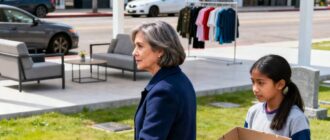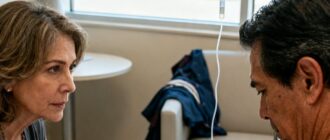
It sat half-swallowed by the reeds, dark water lapping at its sides, as though the lake itself had been slowly digesting it for years. Evelyn noticed the faint tremor first — a low, rhythmic pulse, almost alive, rising through the handle the moment her fingers closed around the latch. She pulled her hand back. Then reached again.
Some secrets refuse to stay buried.
She pried it open.
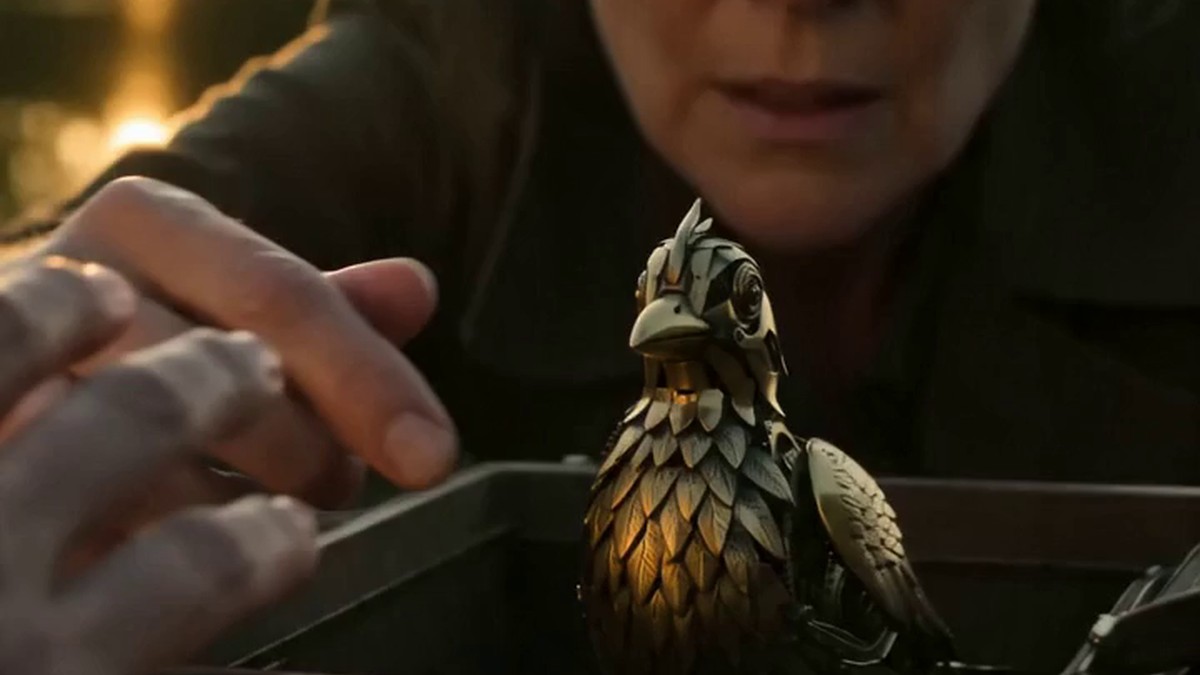
Inside, nestled in waterlogged velvet, sat a mechanical bird with brass wings — intricate, impossible, still faintly humming. Evelyn’s skin went tight. She looked up just as footsteps crunched through the gravel behind her.
The woman who appeared from the tree line was younger, mid-thirties maybe, with sharp eyes that softened the instant they landed on the suitcase. Then hardened again.
“Is it yours?” Evelyn asked. Her voice came out smaller than she intended.
The stranger didn’t answer. She moved closer, gaze locked on those brass wings like they were something she’d spent years trying to forget.
“Where did you find this?”
“In the reeds. Half under water.”
The stranger — Sarah, though Evelyn didn’t know her name yet — reached out. Her hand stopped inches from the metal, trembling with the effort of not touching it.
“This shouldn’t exist.” Her voice dropped to something raw. “My grandmother swore she destroyed every last one of them.”
Evelyn’s grip on the handle tightened. “Your grandmother?”
“Clara.” A pause so heavy it had weight. “Clara Vane.”
The name hit Evelyn like a stone dropped into still water — slow at first, then rippling outward through everything. She stepped back and found the trunk of an oak tree behind her, its bark wet and cold against her shoulders. The wind drove her hair across her face. She didn’t brush it away.
“That name hasn’t been spoken in this valley for a very long time,” she said quietly.
Sarah’s eyes sharpened. “How would you know that?”
Evelyn didn’t answer with words. She turned the mechanical bird over and pressed a small notch beneath its base — a hidden compartment, velvet-lined, barely wider than two fingers. From inside she drew out a photograph, yellowed and soft at the edges, and held it toward the younger woman.
Sarah went still.
The image was grainy, aged, shot in front of this very lake. A young woman stood at the water’s edge, chin lifted, expression unreadable. On her finger — unmistakable even through the decades of fading — a silver ring. Identical to the one currently on Sarah’s hand.
“She didn’t destroy them,” Evelyn said. Her pulse was loud in her own ears now. “She gave them to me.”
Sarah stumbled back a half-step, her eyes moving in rapid, disbelieving arcs — from the bird, to the photograph, and then down to Evelyn’s wrist. To the small, pale crescent of a scar just below the palm.
Her face changed. The color left it.
“But you’re—” The words dissolved before she could shape them into anything solid.
Evelyn watched the understanding move through her. Slow and terrible, like a weather system rolling in from the hills.
“The clock is starting again, Sarah.” She said it gently, the way you’d speak to someone standing at the edge of something. “Listen.”
The brass bird clicked.
One sharp, clean, metallic note that cut across the silence and carried out over the dark water. And then — not from the wind, not from anything on the surface — the lake began to ripple. A slow, deliberate pulse rising from somewhere far below.
Sarah’s voice came out barely above a breath. “Did you hear that?”
“It’s calling back what it lost,” Evelyn said.
The ripples spread wider.
Neither woman moved.
Somewhere beneath them, in the cold dark fathoms of the lake, something answered.
Not a sound, exactly. More a feeling — the kind that climbs up through the soles of your shoes and settles in your back teeth. The water churned in slow, deliberate rings, and the brass bird went on humming, its wings ticking against their hinges like a clock that had finally found its rhythm again.
Sarah pressed her fist to her mouth.
“She told me none of this was real.” Her voice came out stripped of everything except the bare fact of the words. “She said it was just a story she made up to — to make me feel special.” A short, wounded exhale. “I was nine.”
“She lied to protect you.”
“From what?”
Evelyn looked at the water. The rings were still spreading, each one larger than the last, the center now showing the faintest darkening — a shape rising, or approaching, or both.
“From the choice.” She tucked the photograph back into the hidden compartment and closed it with the same careful pressure she had used to open it. “Clara made hers a long time ago. She thought if she hid the birds and burned the record and moved far enough away, you’d never have to make yours.”
Sarah stared at the suitcase. “There are others. Other birds.”
“Were. This is the last one.”
“How many people — how many people knew about this?”
“Three.” Evelyn paused. “Now two.”
The implication arrived slowly, then all at once. Sarah’s gaze traveled up to the older woman’s face with a new and careful attention, the way you look at a stranger on a dark road when you’ve only just realized they’ve known your name from the beginning.
“Who are you?” she asked. Not hostile. Afraid. There is a difference.
Evelyn didn’t look away from the lake. The shape beneath the surface was clearer now — long, slow-moving, not monstrous exactly, but not not monstrous either. Something that had been patient for a very long time.
“I’m the reason your grandmother left,” she said. “And the reason the bird is here now, instead of at the bottom.”
—
She told the rest of it quickly, the way you rip a bandage — not cruelly, just fast enough that the mercy is in the speed.
Sixty years ago, give or take a season, Clara Vane had come to this lake with a problem that couldn’t be solved by ordinary means. She’d come because she’d heard the old stories about the valley, about what the water remembered, about the mechanism her own grandmother had built from grief and mathematics and something nobody had ever found a clean word for. The mechanical birds were keys. The lake was a lock. And what it locked away was time — not all of time, not the great sweep of it, but a single moment, suspended and preserved, the way an insect gets swallowed by amber and kept forever in the posture of its last living second.
Clara had wanted to preserve something. A person. Someone she was about to lose and could not bear to.
“My grandfather,” Sarah said.
Evelyn shook her head once. “Your grandfather came later. He was a good man. Your grandmother loved him as well as anyone can love a second choice.” She said it without cruelty, the same way she had said everything — like truth was a form of respect. “The person she preserved was someone else. Someone she had no business preserving. Someone who didn’t ask to be preserved.”
Sarah looked at her.
The lake was very still now. The shape had stopped rising, hovering somewhere just below sight, waiting.
“You,” Sarah said.
“I was twenty-three years old.” Evelyn said it the way people state facts they’ve had a long time to make peace with. “We were close. The kind of close that has no single name. She was terrified of watching me die — I had been ill, a long illness, the kind with a foreseeable end — and she built the last bird in one winter and she wound it and she didn’t ask me.” A beat. “She didn’t ask.”
The silence after that was very full.
“The moment the bird completed its first cycle,” Evelyn continued, “I stopped. Not died. Stopped. Time kept moving for everyone else. For me it was an afternoon, the one afternoon she captured, and I have lived inside it — or versions of it — for six decades.” She turned her wrist over. The pale crescent scar caught the flat gray light. “Every time the cycle ends, I find myself here. At this lake. With the suitcase. The memory of how I got here gone, as though someone took scissors to that part of the film.”
“But you remember now.”
“Because the bird is winding down.” Her voice was even. “The mechanism was never meant to run forever. Your grandmother knew that. She planned to destroy it before it stopped on its own, because she was afraid of what would happen when the preservation ended.” She finally looked at Sarah fully, without looking away. “She ran out of time before she could.”
“And if it stops on its own?”
“Then whatever was preserved gets released.” A pause. “All at once.”
Sarah understood. She understood it the way you understand a diagnosis — not immediately, but then completely, a door swinging open onto a very large room. She sat down on the damp bank without choosing to sit, her coat spreading dark against the wet grass.
“You’ve been suspended in a single afternoon for sixty years,” she said.
“Give or take.”
“And when the bird stops—”
“Yes.”
The word landed clean.
Sarah pressed both palms flat to the earth, grounding herself. “And you’re telling me there’s a choice.”
“I’m telling you the bird wound down enough to surface. That doesn’t happen by accident.” Evelyn crouched in front of her, and at this angle, in this light, Sarah could see something in her face that she hadn’t been able to place before — not age exactly, but duration. The look of someone who had been in one room for a very long time. “It surfaced because the mechanism recognized the ring. Because you’re Clara’s blood. Because it’s offering the key to someone who might use it differently.”
“Differently.”
“You could wind it again.” The brass wings had stilled. One final click, and they would stop entirely. “Another cycle. Longer, maybe, if the mechanism holds. Or you could let it run out.”
“And if I let it run out — you—”
“I don’t know what I become,” Evelyn said, with a kind of clean honesty that was almost impossible to look at directly. “I haven’t been alive, not in the ordinary sense, for sixty years. I’ve been a photograph. A moment. A held breath.” She glanced at the water. “What happens when you finally exhale — I genuinely don’t know.”
“That’s terrifying.”
“Yes.”
“And you’re not afraid?”
Something moved in Evelyn’s face. Not a smile, but the place where one might eventually form.
“I’m exhausted,” she said quietly. “There is a difference.”
—
Sarah sat with it.
The wind came off the water and the reeds bent and the lake lay there, ancient and indifferent, doing what lakes do. The shape below the surface had gone still — patient as a held breath, patient as everything that has learned that patience is the only power left to it.
She thought about her grandmother. Clara in the one photograph Sarah had, young and sharp-eyed at a kitchen table, a cup of tea half-raised, looking at the camera like she’d been caught in the middle of a thought she hadn’t finished. Clara who had moved three states away and never once explained why. Clara who had given her the silver ring on her deathbed and gripped her hand hard and said *don’t go back to the valley* and not said why. Clara who had apparently loved someone so completely and so wrongly that she had bent the laws of time to a shape that fit her own grief, and then spent the rest of her life outrunning what she’d done.
Sarah thought about what it meant to love someone badly. To love them in a way that took something from them without asking. To build a cage out of the most careful and devoted materials and still call it protection.
She looked at the bird.
One click left. Maybe less.
She picked it up.
It was lighter than she expected — almost nothing in her hands, like a thing that had already given most of itself away. The wings were motionless now. The hum had dropped below hearing into something she felt only in the center of her chest, a vibration at the frequency of a tuning fork held against bone.
Evelyn watched her. Not waiting. Not hoping. Just present, in whatever way she had left.
“She should have asked you,” Sarah said.
“Yes.”
“I’m sorry she didn’t.”
Evelyn was quiet for a moment. The lake was quiet. Even the wind had pulled back, as though the valley itself were holding itself very still.
“I know,” she said. “I know she was sorry too. That doesn’t change what she did, but I believe it.” A breath. “I’ve had a long time to believe it.”
Sarah turned the bird over in her hands. Found the notch her fingers knew somehow — inherited knowledge, passed through blood and ring and the particular shape of sorrow that runs in families. Her thumb rested on it.
She didn’t wind it.
She set it gently back in the velvet, in the waterlogged suitcase, and she closed the latch.
“Okay,” she said. Not to Evelyn, exactly. To everything. To the lake and the reeds and the sixty years and her grandmother’s long, guilty, loving, ruinous silence. “Okay.”
—
The last click came as the sun broke through the overcast — one thin, golden seam opening at the tree line and throwing a stripe of light across the water. The brass bird gave a single, final, clean note that carried out over the surface and didn’t echo. It just went.
And then the lake released everything it had been holding.
Not violently. Not catastrophically. The way breath releases — the way a hand unclenches after a very long time, finger by finger, muscle by muscle, until the palm lies flat and open.
Evelyn felt it happen.
She had expected it to feel like ending. It didn’t feel like ending.
It felt like walking out of a room where the air had been used up, into a morning she hadn’t known was waiting. It felt like the first full breath after a long fever. It felt like *sixty years* and *I’m here* and *that was real* and *I am still here* and *this is what now feels like* — all of it at once, tumbling through her in the way that moments do when you’ve been starved of them for long enough that a single one contains everything.
She sat down in the wet grass next to Sarah.
They didn’t speak for a while.
The lake settled. The rings smoothed away to nothing. The suitcase sat between them, ordinary now in the way that things become ordinary once what was inside them has been given back to the world.
After a while, Sarah reached over and rested her hand on the older woman’s. Not to comfort — or not only. More as a way of confirming that they were both there, both solid, both breathing in the same cold morning air.
“What do you do now?” Sarah asked.
Evelyn looked at the light on the water. At the tree line. At the long, unremarkable, extraordinary fact of an afternoon that would end, and be followed by an evening, and then a night, and then a morning, and then another one, in the ordinary sequential way that time moves when no one has stopped it.
“I don’t know,” she said.
She sounded, for the first time, like someone with that problem ahead of her instead of behind her.
“There’s worse places to start than not knowing,” Sarah said.
“There are,” Evelyn agreed.
The wind picked back up, easy and cold, moving through the reeds with a low sustained sound that wasn’t music but wasn’t not music either. The brass bird sat dark and silent in its velvet, finally, at last, just an object. Beautiful and stopped and done.
The two women sat beside the lake where Clara Vane had once made her terrible, loving, wrong decision, and they let the afternoon happen to them — all of it, every ordinary second — without preserving any of it at all.