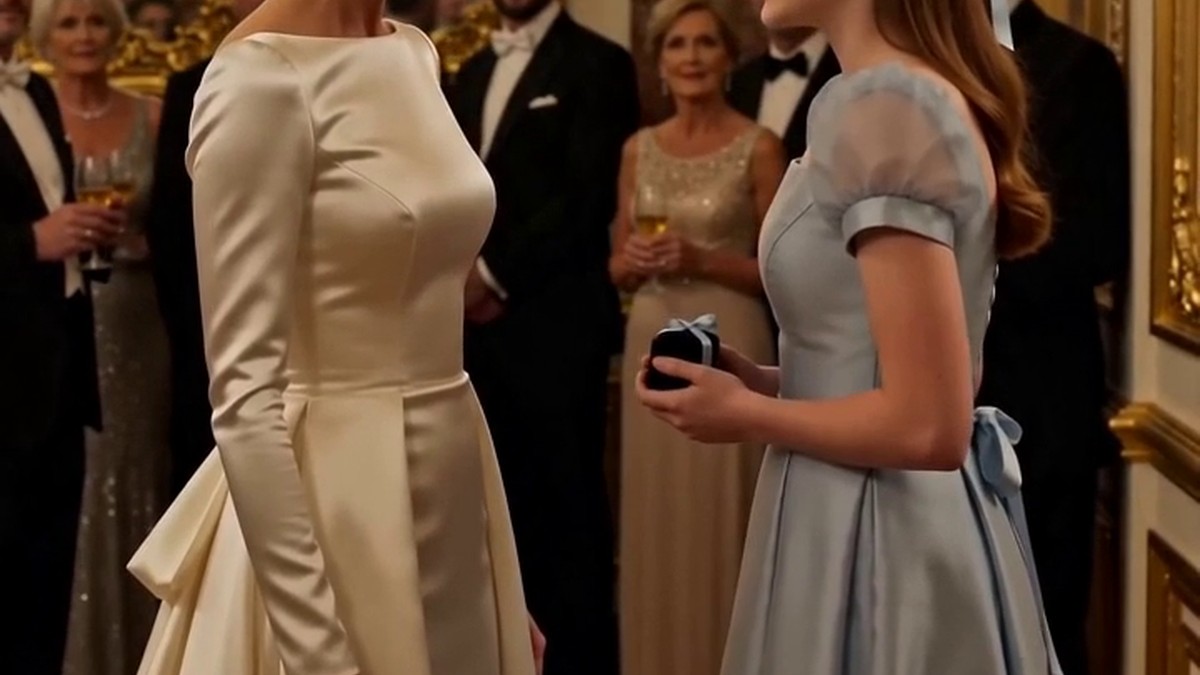
She stood near the entrance of the grand ballroom — a faded gray coat, flat black shoes, and a modest navy dress that looked painfully out of place beneath the crystal chandeliers. Her trembling hands clutched a small velvet box tied with a pale blue ribbon.
The room around her blazed with wealth.
White orchids lined the aisle. Gold-rimmed plates gleamed on every table. Champagne flutes caught the soft light like scattered diamonds. Guests in designer gowns and tailored tuxedos posed for photographers, murmuring to each other about how flawless everything looked.
The bride’s name was Sarah Monroe.
Twenty-eight years old. Radiant in white satin with lace sleeves and a diamond tiara nestled in her dark hair. To everyone watching, Sarah looked like a woman born into all of this.
But Sarah had never been born into anything.
She’d grown up in a cramped apartment above a laundromat, raised by Margaret Ellis — the same old woman now standing in the doorway with tears quietly gathering in her eyes.
Margaret wasn’t Sarah’s biological mother. She’d never pretended otherwise. She was the woman who had found a baby girl on the steps of Saint Anne’s Church on a bitter winter night, wrapped in a blue blanket, a velvet box tucked beside her.
No birth certificate.
No note.
No last name.
Just a single word stitched into the blanket:
*Sarah.*
Margaret was forty-nine at the time. Single. Poor. Already running on empty from working two jobs. Everyone told her to hand the baby over — to the police, to social services, to someone else.
But when that tiny hand closed around Margaret’s thumb, something in her locked into place.
So she kept her.
She fed Sarah when she barely had broth for herself. She worked nights so Sarah could have proper shoes for school. She washed the clothes of wealthy strangers by day and sat up through fevers by night. She never married. Never owned a home. Never took a single vacation.
Every dollar went to the little girl sleeping in the back room behind the washing machines.
For a long time, Sarah loved her fiercely.
She called Margaret “Mom” until she was sixteen.
Then the world taught Sarah to be ashamed.
At the private school, girls laughed when Margaret showed up in her laundromat uniform. At graduation, Sarah asked her to step away from the cameras. In college, she told people her mother was dead.
Margaret overheard that lie once.
She cried alone at a bus station for twenty minutes. Then she went home and ironed Sarah’s blouse for her interview the next morning.
Because mothers forgive what their children do to survive.
Even the cruel things.
Years passed. Sarah built herself into a polished PR consultant. She learned to walk into elegant rooms without flinching. She learned to smile like she belonged. Then she met David Whitmore — heir to a real estate fortune — and the life she’d been performing suddenly felt within reach.
David loved her.
His family loved who they thought she was.
They knew nothing about the laundromat.
They knew nothing about Margaret.
Sarah had made certain of that.
She only sent Margaret an invitation because David pushed for it.
*”She raised you,”* he said. *”She should be there.”*
Sarah smiled and agreed.
But she had already decided: Margaret would sit in the last row, far from the cameras, far from David’s parents, far from the carefully constructed story Sarah had spent years building.
Margaret arrived early.
She had saved for months to buy the navy dress beneath that tired gray coat. But no amount of careful dressing could change what the room saw — a weathered woman who looked like she’d stumbled into someone else’s life.
In her hands she carried the velvet box she had kept for twenty-eight years.
Inside it: a sapphire brooch shaped like a small blue rose.
She had never sold it.
Not when the rent was overdue.
Not when Sarah needed braces.
Not when Margaret had to choose between her medication and keeping the lights on.
Something had always told her the brooch mattered. That it was meant to wait.
That morning, before she left for the wedding, she placed it in the velvet box and whispered softly to herself: *”Maybe now is the time.”* She wanted to give it to Sarah before the ceremony.
Not to embarrass her.
Not to ask for anything.
Just to say: *You came to me with this. I kept us both safe.*
But when Sarah spotted Margaret near the front of the ballroom, her smile vanished like a light switching off.
*”What are you doing up here?”* she whispered.
Margaret’s face lifted with nervous joy.
*”I came early. I wanted to give you something before everything started.”*
Sarah glanced sideways. Two bridesmaids were watching. A photographer raised his camera.
Panic hardened her voice.
*”You’re supposed to be in the back.”*
Margaret blinked.
*”Oh. I thought family sat near the front.”*
*”Don’t say that here.”*
Margaret’s smile didn’t fade slowly. It just — stopped.
The velvet box trembled in her hands.
And in that moment, before a single vow had been spoken, Sarah looked at the woman who had pulled her from a church step and kept her alive through every cold winter — and decided she was the one thing in the room that needed to be hidden.
The bridesmaids looked away. The photographer lowered his camera. The silence between the two women lasted only a few seconds, but it had the specific weight of something irreversible.
Margaret nodded once.
She tucked the velvet box carefully under her arm, turned, and began the long walk toward the back of the ballroom. Her flat black shoes made almost no sound on the marble floor. She kept her chin level. She didn’t look at anyone.
Sarah watched her go and felt something she refused to name.
She turned back to her bridesmaids and smiled.
*”Where were we?”*
—
The ceremony began at two o’clock.
White roses. Candlelight. A string quartet playing something Sarah had spent four months choosing. David stood at the altar looking like he’d been assembled from a magazine — broad-shouldered, composed, with eyes that actually went soft when he saw her walking down the aisle.
He loved her. That part was real.
Sarah moved through the room like water, effortless and luminous, every rehearsed gesture landing exactly where she’d planned. The photographer captured her perfectly. David’s mother dabbed her eyes. The guests murmured their approval.
In the last row, Margaret sat very still.
She held the velvet box in her lap with both hands. Her eyes followed Sarah the entire length of the aisle — the way a woman watches something she built from nothing become something she barely recognizes.
She did not cry.
She had already used up whatever tears remained this morning, alone in the apartment above the laundromat, ironing her navy dress with the same iron she’d used for twenty-nine years.
—
It was during the cocktail hour that everything shifted.
David’s mother, Catherine Whitmore, was a woman who noticed things. It was her particular gift and her most dangerous quality. She noticed the hem on a hostess’s skirt. She noticed when a champagne glass had been refilled too quickly. And she noticed, from across a crowded room, an old woman sitting completely alone near the emergency exit with a velvet box on her knees.
Catherine excused herself from a circle of guests and walked over.
Margaret looked up.
*”I’m sorry,”* Margaret said immediately, instinctively. *”I’m not in anyone’s way.”*
*”Of course you aren’t.”* Catherine sat down beside her without hesitation, the way women of real confidence always do — without asking permission. *”I’m Catherine. David’s mother.”*
*”I know who you are.”*
*”And you are?”*
A pause.
*”Margaret Ellis.”*
Catherine waited. The name carried no flag of recognition. She tilted her head slightly.
*”How do you know Sarah?”*
The question hung in the warm, perfumed air.
Margaret looked down at the velvet box. Her thumbs moved slowly across the ribbon, the same way they’d moved across it ten thousand times in twenty-eight years.
*”I raised her,”* she said quietly.
Catherine Whitmore went very still.
*”I’m sorry?”*
*”Her mother — her birth mother — I don’t know who she was. No one ever came. I found Sarah when she was a newborn. I kept her.”* Margaret said it plainly, without drama, the way you describe something that simply happened, something you never once considered not doing. *”She grew up with me. Above the laundromat on Clement Street.”*
The string quartet drifted in from the next room.
Catherine looked at the velvet box.
*”What’s in that?”*
*”Something that came with her when I found her. I’ve been saving it.”* Margaret lifted the lid and showed her. The sapphire brooch caught the light — deep blue, shaped like a small rose, with a delicate silver setting that spoke of real craftsmanship. Old craftsmanship. The kind that told a story if you knew how to listen. *”I wanted to give it to her today. Before she started this new chapter. I thought she might want to know — she came from somewhere. That someone thought enough of her to leave her something beautiful.”*
Catherine stared at the brooch for a long moment.
Then she looked up at Margaret’s face — the lines carved by decades of night shifts, the careful way she held herself, the dignity that had not come from money or ease but from something much harder to acquire.
*”Stay right here,”* Catherine said.
—
Sarah was laughing at something one of David’s cousins had said when she felt David’s hand close around her arm — gently but firmly.
*”Can you come with me for a minute?”*
*”We’re in the middle of—”*
*”Sarah.”*
Something in his voice.
She excused herself.
David walked her to a quiet corner near the tall windows overlooking the garden. His mother was already there. And standing beside Catherine Whitmore, still holding the velvet box, was Margaret.
The blood drained from Sarah’s face so quickly she felt the room tilt.
*”David—”*
*”My mother found her sitting alone by the exit,”* he said. His voice was calm. That made it worse. *”She told her who she was.”*
*”David, I can explain—”*
*”I’d like to hear it,”* he said. *”I’d really like to hear you explain why the woman who raised you is sitting alone by the emergency exit at our wedding.”*
The garden windows framed all four of them in pale afternoon light. Somewhere behind them, guests clinked glasses and laughed.
Sarah looked at Margaret.
Margaret looked back at her without accusation. Without anger. Just with that exhausted patience she had always carried — the patience of someone who had learned, over a very long time, that love does not require fairness to continue.
That was somehow the worst thing.
*”I was ashamed,”* Sarah said.
The words came out before she could arrange them into something more defensible.
*”Of what?”* David asked.
*”Of where I came from.”* She pressed her lips together. *”Of the laundromat. Of the uniform. Of not being — of not looking like I belonged.” She was speaking to David but she was looking at Margaret. “I told people she was dead. I told your family I grew up differently. I built this whole — I built a story, and she was the part of the story that didn’t fit, and I—”*
Her voice broke cleanly in two.
*”She is the story,”* David said. Not harshly. Almost gently. *”Without her, there is no you.”*
Margaret took one step forward.
*”Sarah.”*
Sarah looked at her — really looked at her, maybe for the first time in years, without the reflex of shame firing between them like a circuit breaker. She saw the navy dress bought on a budget saved over months. She saw the hands that had ironed every blouse she’d ever worn to every interview that had changed her life. She saw the face of the person who had stood over her in every fever, who had chosen her on a cold church step when no one else would.
She saw, for the first time, what she had done.
*”I kept this for you,”* Margaret said softly, and held out the velvet box.
Sarah opened it with shaking hands.
The sapphire brooch glinted up at her. Blue as a winter sky. Blue as the blanket Margaret had described so many times when Sarah was small and would ask — *tell me how you found me, tell me again* — and Margaret would always tell her, every detail, making it a story of wonder rather than abandonment.
*”It was tucked beside you,”* Margaret said. *”Whoever left you with it — they wanted you to have it. I just held it until I could give it to you properly.”*
Sarah lifted the brooch from the box with two fingers.
Then she did something she had not done in twelve years.
She stepped forward and put her arms around Margaret Ellis, and she held on.
Margaret’s arms came up slowly — carefully, like she wasn’t sure she was allowed — and then they held on too.
*”I’m sorry,”* Sarah said into the gray coat that smelled of lavender and fabric softener and twenty-eight years of sacrifice. *”I’m so sorry.”*
Margaret closed her eyes.
*”I know, sweetheart,”* she said. *”I know.”*
—
Catherine Whitmore touched David’s arm and gently guided him back toward the reception. They gave the two women the window.
Later — long after — Catherine would tell close friends that she saw it happen, the precise moment the bride’s face changed. She said it was the most honest thing she witnessed in forty years of attending weddings. She also made it immediately clear, in the way that Catherine Whitmore made things clear, that Margaret Ellis was to be treated as family. Full stop.
The reception was rearranged.
Not dramatically. Just — quietly, the way real things happen. A chair was added to the front table. Margaret’s place card, handwritten by a coordinator who didn’t ask questions, appeared between the bride and the groom.
Margaret sat down and looked at the white orchids and the gold-rimmed plates and the crystal that scattered the light like small fires.
She folded her hands in her lap.
She did not feel that she belonged there. She knew that might never entirely change. But beside her, Sarah reached over and covered Margaret’s hands with her own — the same grip, the same instinct, that had locked something into place twenty-eight years ago on a bitter winter night.
The sapphire brooch was pinned to Sarah’s satin dress.
Blue against white.
Something old, something found, something kept through every hard year by a woman who never once let go.
The photographer raised his camera.
This time, no one looked away.