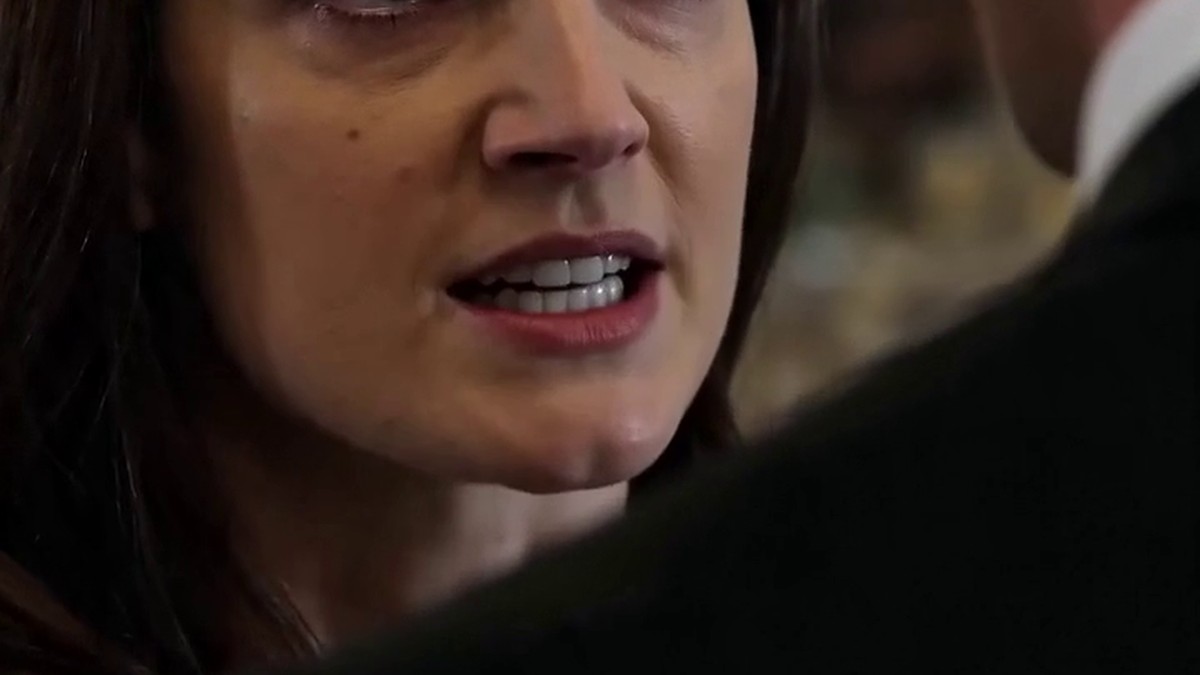
Then nothing. Then everything.
“You ruined my wedding.” Her voice didn’t shake — it cut. “Why were you touching my husband’s belongings?”
“Just — please. One minute. That’s all I’m asking.”
“Hand it over. Right now.”
“Not yet.” Elena’s fingers tightened around the watch. “Please. Let him open it first. Let him see it himself.”
“Dominic.” A single word, sharp as a slap. “Take it from her.”
He didn’t move right away.
“Elena.” His voice dropped to something almost private, almost careful. “What is this?”
She exhaled. Steadied herself. This was the moment she’d been rehearsing since six in the morning, when the world was still quiet and her hands were still shaking.
“It fell from your jacket. In the bridal suite. I was the one who found it.”
“And you opened it.”
“I opened it because I had to.” Her eyes held his. “Because I needed to know if it was the same one.”
“The same one as *what*, Elena?”
“As the watch in my mother’s photograph.” The words came out slower now, weighted. “The one she never explained. The one she kept hidden in a shoebox under her bed for twenty-five years — like it was something she couldn’t throw away and couldn’t look at either.”
Silence stretched between them like a held breath.
“I don’t know what you think you’re—”
“Open it, Dominic.” Her voice cracked, just slightly, at the edges. “Open it and look at the face inside the case. Look at it — and then stand there and tell me you don’t see exactly what I see.”
The watch sat in his palm.
Nobody moved.
The bride was the first to break.
Not Elena. Not Dominic.
Camille — all white silk and fury — stepped forward and snatched the watch from his open hand.
“Enough.” She turned it over, examined the case like it was evidence against her. “This is some desperate little game you’re playing. I don’t know what you think you’ll accomplish by—”
She stopped.
Her thumb had found the clasp. Old habit, maybe. Curiosity. Whatever it was, the case swung open before she could decide not to look.
The photograph inside was the size of a thumbnail. Faded at the edges, the way old things go when they’ve been opened and closed ten thousand times. A young woman sitting on the steps of a house Elena had never seen, laughing at whoever held the camera. Dark hair. Square jaw. Eyes that were unmistakably, undeniably familiar.
Camille’s breath caught. Not loud. Just enough.
“That’s my mother,” Elena said. “1987. She was twenty-three.”
Nobody spoke.
“She told me she spent that summer in Prague.” Elena’s voice was almost steady now. Steadier than she felt. “She said she met someone. She never said his name. She said it ended the way summer things end — clean, no mess, nobody’s fault.” A pause. “She lied about the clean part.”
Dominic hadn’t moved. His eyes were fixed on the photograph in Camille’s hands, and something in his face was changing — the careful social architecture of it crumbling, brick by brick, into something raw and unguarded.
“Where did you get this?” His voice had lost its polish. It came out rough, almost hoarse. “This watch was my father’s.”
“I know.”
“You *can’t* know that.”
“Your name is Dominic Hale. Your father was Richard Hale. He was posted to the American consulate in Prague in the summer of 1987.” She had memorised the words. She’d said them to her bathroom mirror at six-fifteen in the morning, watching her own face for signs of collapse. “My mother’s name was Anna Voss. She was a translator.” She stopped. Swallowed. “She was twenty-three that summer, Dominic. You’re thirty-six. Do the math.”
The room tilted.
She watched him do it. Watched the calculation move across his face — not a man who was confused, but a man who had suspected something for a long time and had chosen, very deliberately, not to press on it.
“No.” Camille’s voice was different now. Stripped of its imperious edge, down to something almost afraid. “No. You’re not doing this. Not today. Not here.”
“Camille—”
“She’s a *stranger* who walked into our wedding with a fairy tale and a dead woman’s watch, and you’re standing there like—” Her voice broke. She reassembled it. “No.”
“She opened it,” Elena said quietly. “She knew the photograph was there. She knew where the clasp was. She opened it without hesitating.” She looked at the bride — really looked at her, for the first time. “How long have you known?”
The silence was its own answer.
Camille set the watch down on the small table beside the door. The click of it against the wood was very precise. Controlled. The action of a woman who understood that if she didn’t control something in this moment, she would control nothing at all.
“His father told him,” she said finally. “Two years ago. Before he died.” She didn’t look at Dominic when she said it. “He said there might be someone. That it was probably nothing. That it was thirty years ago and people make mistakes and the woman had never contacted him, which meant she didn’t want to be found.” Her jaw tightened. “He said it was a closed door.”
“She died in April,” Elena said. “My mother. Eight weeks ago.” She felt the words land in her chest like stones, the way they always did. Fresh weight, every time. “I found the watch when I was cleaning out her apartment. And the photograph. And a letter she never sent.” She kept her eyes on Dominic. “She wrote to your father once. In 1989. She was going to tell him. She changed her mind. She said in the letter that she didn’t want to be someone else’s complication.”
Dominic pressed the heel of his hand against his mouth.
It was the first thing that broke her.
She had prepared for anger. For denial. For lawyers, maybe, eventually — the cold procedural machinery of a truth nobody wanted. She had not prepared for this: a man standing at his own wedding, in his good suit, with his eyes full, pressing his hand against his mouth like he was trying to hold something in that was twenty-five years old and had no name yet.
“I’m not here to ruin anything.” Her voice came out smaller than she intended. “I want you to know that. I’m not — I don’t want money. I don’t want a father. I had a father. He was a good man and he raised me and I loved him.” She stopped. Started again. “I just wanted to know if it was real. If she was real — the woman she was before she was my mother. I found the photograph and I thought, there has to be someone else in the world who knew her like that. Who knew what she looked like when she laughed.” A breath. “I just wanted someone else to know she existed.”
The room was very still.
Camille stood with her arms crossed, not in anger anymore — in something more like self-defence. She was staring at the watch on the table. Working through something that Elena couldn’t read and didn’t have the right to.
Dominic lowered his hand.
“She had a gap in her front teeth,” he said. “In the photograph. Just slightly. Like she’d never bothered to fix it.”
Elena’s breath stopped.
“Yeah.” It came out barely a whisper. “She did.”
“My father told me that detail. I don’t know why that’s the one he kept.” He looked up. His eyes were red at the edges, but steady. The face of a man deciding, in real time, who he was going to be. “He said she laughed like she meant it. Like most people don’t.”
“She did,” Elena said. “Until the very end, she did.”
Nobody moved for a long moment.
Then Camille uncrossed her arms. It was a small thing. Almost nothing. But Elena saw Dominic see it, and saw the complicated, private gratitude that moved across his face.
“I need—” Camille stopped. Reset. “Give us a few minutes. Please.”
“Of course.” Elena picked up her bag. Her hands were steady now, which surprised her. She’d expected them to shake for days. “I’ll be outside.”
She walked to the door.
“Elena.”
She turned.
Dominic was holding the watch again. He looked at the photograph one more time — the laughing woman on the steps, the Prague summer, the closed door that had just, quietly, opened. Then he closed the case.
“She looks like you,” he said. “Around the eyes.”
Elena smiled. She couldn’t help it.
“Everyone always said I looked like my father’s side.”
“Maybe,” he said. “But around the eyes — she’s there.”
She nodded once. Pressed her lips together. Got out the door before anything could break.
—
The hallway was cool and empty. Somewhere further down the corridor, she could hear the distant murmur of a wedding that hadn’t yet learned it was on hold. The string quartet, maybe. Or guests who still believed this was a normal afternoon.
She sat down on the bench by the window and tilted her face toward the light.
Her mother had been twenty-three. She had laughed like she meant it. She had written a letter she never sent, and kept a watch in a shoebox, and carried a secret with the specific tenderness of someone who understands that some things are too fragile to explain.
Elena had come here looking for proof.
She left carrying something different. Harder to name and harder to lose.
The door opened ten minutes later. Camille came out first. She stopped in front of Elena and looked at her for a long moment with an expression that was not warm, exactly, but was honest.
“The ceremony is in forty minutes,” she said. “If you want to stay—” She paused. Chose her next words carefully. “There’s room.”
It wasn’t an embrace. It wasn’t forgiveness or welcome or the beginning of anything easy.
But it was a door left open.
Elena stood up.
“Thank you,” she said. “I’d like that.”