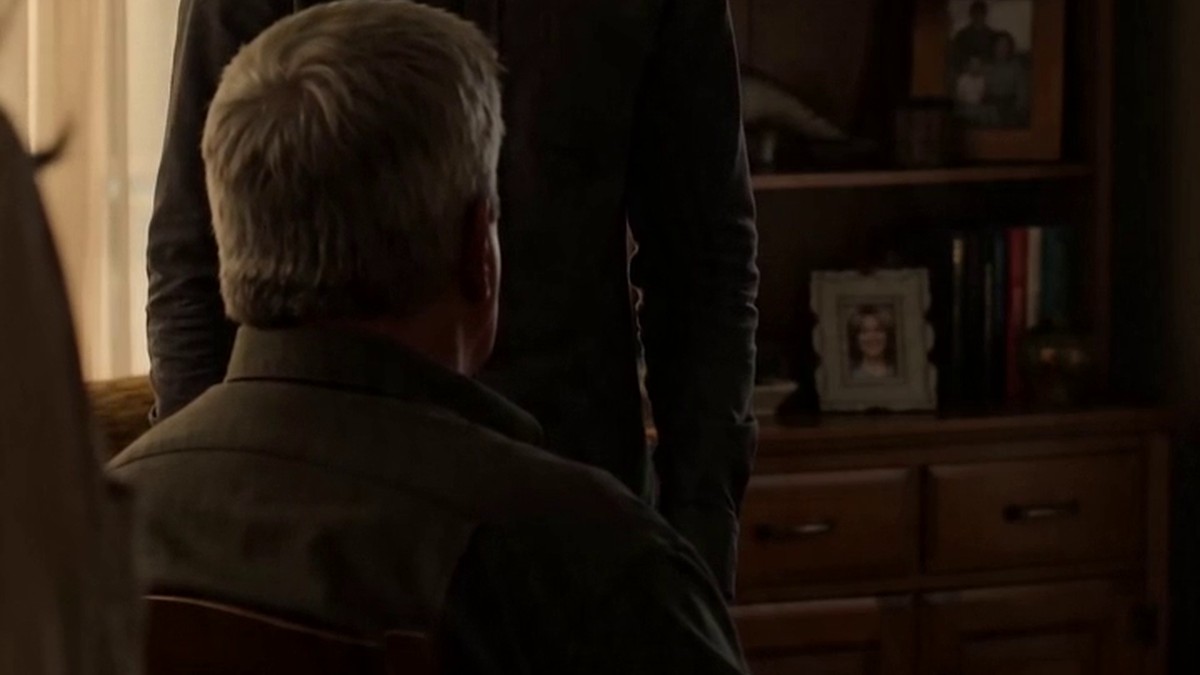
Gerald sat down on the edge of the nearest folding chair like someone had quietly removed his bones.
Patricia didn’t move. She was staring at Eli the way you stare at something you’ve seen before in a dream and hoped never to encounter in waking life.
“She never told us,” she said finally. It wasn’t an accusation. It wasn’t even really directed at Eli. It was the sound of a woman doing arithmetic she’d been avoiding for eleven years.
“She told me she couldn’t,” Eli said. “She said there were people who would have made it hard. For me. For my mom.”
“What people?” Gerald asked, but his voice had the tone of a man who already knew the answer and was asking anyway because saying nothing felt worse.
Eli didn’t respond to that. He set the photographs on the empty chair beside Gerald instead. Four of them. Color prints, slightly faded at the edges. Margaret at a small kitchen table. Margaret holding a mug. Margaret laughing at something outside the frame.
Margaret, in every single one of them, looking like herself. Looking whole. Looking like someone keeping a promise.
Gerald picked up the top photograph with both hands, the way you handle something fragile that you have no right to want this badly.
Patricia turned away.
Not because she was angry anymore.
Because she wasn’t.
And that was somehow harder.
Gerald held the photograph for a long time without speaking. His thumb moved once across the edge of it, careful, like he was afraid the image might smear.
“How old were you,” he said. Not a question, really. More like something he needed to hear out loud.
“Eleven when she died,” Eli said. “I’m twenty-two now.”
Patricia made a small sound. The kind that doesn’t have a name.
“She was sick for two years before,” Eli continued. “She didn’t tell me how bad it was until close to the end. She kept saying she had more time than the doctors thought.” He paused. “She was wrong about that.”
Gerald set the photograph down on his knee. He was still looking at it. “She always believed she had more time than she had. Even when we were kids. She’d push everything to the last minute and then act surprised when the last minute arrived.”
Something crossed Eli’s face. Not quite a smile. The shadow of one.
“She did that with Christmas,” he said. “Every year. Wrapping presents at two in the morning on the twenty-fourth.”
Gerald laughed. It came out broken in the middle, like it had snagged on something.
Patricia turned back around.
—
They sat like that for a while, the three of them, in a room that smelled like old hymnals and artificial flowers, while the murmur of the reception filtered under the door and neither of them moved to rejoin it.
Eli answered their questions as they came. He did it carefully, the way someone walks across ice they haven’t tested. He told them about the apartment in Duluth. About the woman named Helen who watched him after school when Margaret had late shifts. About the year his mother went back to school for her nursing certification and how she’d studied at the kitchen table after he was supposed to be asleep, and how he’d lie in his bed listening to her turn pages.
Patricia listened without interrupting. Which, Eli would understand later, was not something that came naturally to her.
“Did she have anyone?” Patricia asked eventually. “At the end.”
“Helen was there,” Eli said. “And me.”
“Just the two of you.”
“And a pastor she liked. He came twice a week the last month.”
Patricia pressed her lips together. It wasn’t disapproval. It was something that looked almost like relief — a woman finding out that her sister had not, after all, died entirely alone.
“She talked about you,” Eli said. He looked at both of them when he said it. “Both of you. More than she talked about anyone else from before.”
“Before,” Gerald repeated.
“Before me,” Eli said. “Before Duluth. She called it that — before.”
—
Gerald picked up the photographs again. Looked through all four of them in sequence.
In the last one, Margaret was standing near a window. Winter light behind her, pale and flat. She was looking just slightly off-centre from the camera, like she’d been caught in the middle of saying something, and whoever was holding the camera had gotten lucky with the timing.
“Who took these?” Gerald asked.
“I did,” Eli said. “She didn’t like having her picture taken. I had to pretend I was taking pictures of other things and get her when she wasn’t paying attention.”
Gerald turned the photograph over. Nothing written on the back.
“She knew,” Eli said. “She let me do it anyway.”
Gerald put the photograph face-down on his knee. Not because he didn’t want to look at it. Because he’d looked at it as long as he was able to right now, and he knew his own limits.
“Why did you come here today?” Patricia asked. Her voice wasn’t hostile. It was the voice of someone who needed to understand the architecture of a thing before they could trust it.
Eli took a breath.
“She asked me to,” he said. “Right at the end. She said — she said she knew she’d asked me to stay away, but she wanted someone to know. After. She said she’d spent a long time making herself into someone you didn’t know, and she was tired of it.” He stopped. “She said she wanted someone to remember her as herself. Not just as my mom.”
The room held that for a moment.
Patricia’s jaw moved. Once. Then she got herself under control by some internal mechanism Eli couldn’t see.
“She was herself with us,” Patricia said. “She was always—” Her voice broke on the second word and she stopped and started again. “She was the funniest person I’ve ever known. Did you know that? She could make anyone laugh. Strangers. People at the grocery store. She had this thing she did when she was telling a story—”
“She’d build up and build up and then completely deadpan the punchline,” Eli said.
Patricia stopped.
Stared at him.
“She kept that,” Patricia said, barely above a whisper.
“She kept that,” Eli said.
—
Gerald was crying by then, quietly, in the way of a man who has been holding something heavy for a long time and has simply become too tired to keep his grip. He wasn’t trying to hide it. He’d moved past that.
Patricia crossed the room and sat down on the folding chair on the other side of Eli. Not touching him. Not yet. But close enough that the distance was a choice instead of a fact.
“She should have called us,” Patricia said.
“Yeah,” Eli said.
“She was stubborn. She was always—”
“Yeah,” Eli said again. Softer this time. “I know.”
Outside, the reception was winding down. Eli could hear the polite sounds of departure, cars starting, someone thanking someone else for the potato salad. The whole ordinary machinery of a funeral in a small town rolling on without them.
None of them made a move to go back.
Gerald reached over and picked up the photograph again — the last one, the window light, Margaret mid-sentence — and held it so Patricia could see it too.
She looked at it for a long time.
“She looks good,” Patricia said, finally. Her voice was even again, or almost even, or something close enough to even that they could all pretend.
“She did,” Eli said. “Most of the time. She really did.”
—
They stayed until the room was quiet on both sides of the door.
When Eli finally stood to leave, Patricia stood too, and before he’d finished turning toward the door she had her arms around him — sudden, fierce, the embrace of a woman who has made a decision and intends to honour it. He stood there for a moment not knowing what to do with his hands, and then he put them around her and held on, because Margaret had taught him, if nothing else, that when someone offers you something they don’t have to offer, you take it.
Gerald gripped his shoulder when Patricia stepped back. Didn’t speak. Didn’t need to.
Eli had the four photographs. He’d brought them as a gift. He understood now that they were going home with him instead, not because the gift had been refused, but because Gerald and Patricia needed something they couldn’t hold in their hands. They needed to know the photographs existed. They needed to know someone else still carried them.
He would make copies and mail them. He knew this without being told.
He walked out through the emptied reception hall and into the cold afternoon air, and he stood for a moment on the front steps of the church with the photographs tucked inside his coat, against his chest.
The sky was the colour of old pewter. A few dried leaves skidded across the parking lot. Someone’s forgotten folding table was still set up near the side door, stripped of its tablecloth, holding nothing.
He had not known what he would find when he came here.
He had not known if they would want him.
But Margaret had asked. Right at the end, when she had very little breath left to spend on asking, she had asked him to go.
*So they’ll know*, she’d said. *So there’s someone.*
He understood now what she’d meant.
Not so there was someone to grieve her. She’d known they would do that without him.
So there was someone to bring her back to herself. To cross the years and return to them the version of her they’d lost. The woman who laughed at strangers and wrapped presents at two in the morning and had a son named Eli who had known her last.
He’d done that.
She’d asked, and he’d come, and he’d done that.
He pulled his coat tighter and walked to his car, and the leaves kept moving behind him across the empty lot, restless and dry and going nowhere in particular, the way ordinary things do in the aftermath of something that has just, quietly, been made whole.