The words hit the room like a slap before anyone had a chance to breathe.
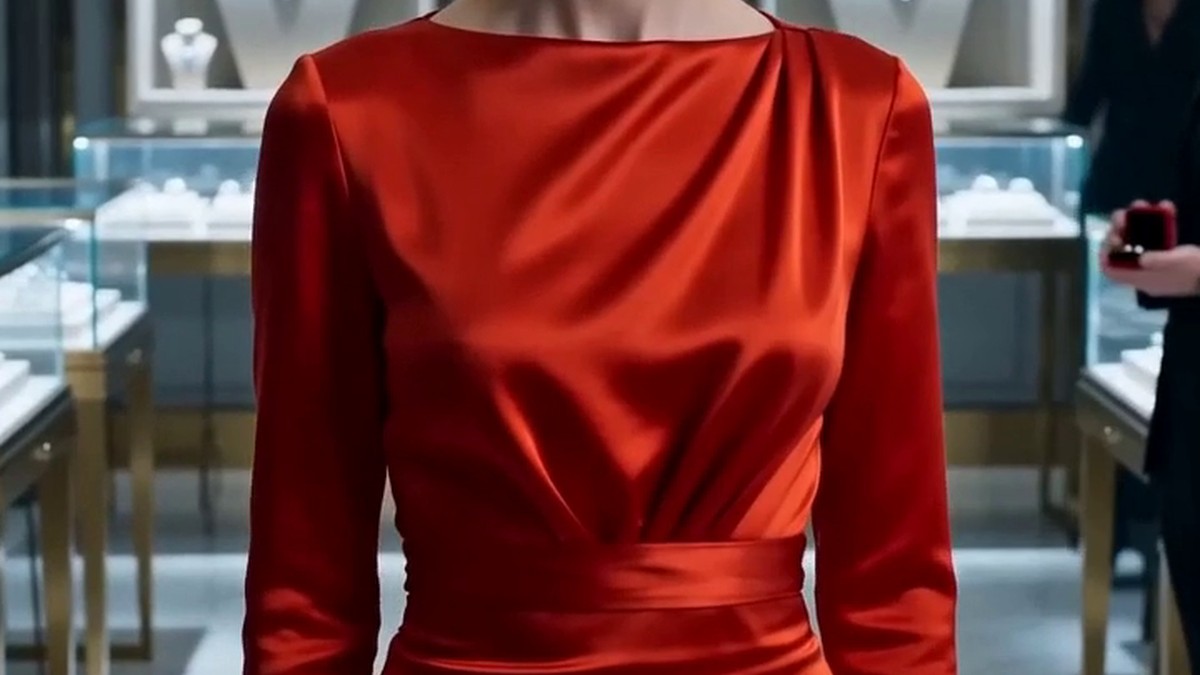
The boutique was the kind of place that made light feel deliberate. White LEDs poured down over marble floors and gold-trimmed display cases, bouncing off mirrors so perfectly polished they seemed almost cruel. Every surface was designed to make people feel either elevated or exposed.
For most people, it was the latter.
Diamond necklaces caught the light like small, silent fires. Silk scarves draped from their stands with the stillness of museum pieces. The sales associates hovered with their practiced half-smiles, telling themselves they weren’t sizing anyone up while doing exactly that.
Brianna Hale had already made up her mind.
Clara Voss stood at the center display as if she’d always been there. Burnt-orange dress. Hair pulled into a clean, low bun. The kind of posture that doesn’t ask permission from anyone. Beside her, Ethan Ward held a small velvet box, his expression shifting from warm to confused as the air in the room changed.
Then Brianna was moving — fast, deliberate, red silk catching the light — and before anyone could process what was happening, she drove her shoulder into Clara’s with enough force to make nearby customers flinch.
Ethan stepped back.
The room went rigid.
Clara didn’t.
She absorbed the impact, uncrossed and recrossed her arms, and looked directly at Brianna. Not through her. At her. Steady. Unhurried.
Brianna’s finger came up, and her voice rang through every corner of the boutique.
“You don’t belong here!”
The words floated between the glass cases like smoke.
Nobody moved. Not the staff, not the other customers with their eyes fixed on jewelry they’d already stopped seeing, not Ethan, who stood holding that velvet box like he’d forgotten what it was for.
Clara didn’t argue. She didn’t flinch, didn’t raise her voice, didn’t offer a single word of self-defense.
Instead, she dropped her arms and turned away.
She started walking.
Slow. Measured. Each step landing like a period at the end of a sentence.
Brianna’s lips curved. She thought she understood what she was watching. She thought this was retreat. She thought she’d already won.
Then Clara’s hand slipped into her handbag.
Her heels tracked a steady rhythm across the marble as she moved past the diamond bracelets, the golden counters, the careful smiles of people who had stopped pretending not to stare. She moved through the room the way someone moves through a space they own — not aggressively, not performatively. Just completely.
She raised the phone to her ear.
“You have no idea who you’re dealing with.”
Brianna’s smile slipped sideways.
Clara stopped beneath the brightest cluster of lights in the store. The LEDs caught the edges of her dress, the line of her jaw, the absolute stillness in her face.
And then, into the phone, quietly and without drama, she said:
“Transfer five billion to my account. Now.”
The silence that followed was a different kind of silence than before.
Before, the room had been frozen by spectacle — the sharp collision of bodies, the accusation hanging in the air, the spectators pretending to look elsewhere. That silence had been the breathless kind, the kind that waits to see what happens next.
This was the kind that doesn’t know what to do with itself.
Brianna’s finger was still raised. She hadn’t lowered it. Her body hadn’t caught up to her mind yet, and her mind was still trying to process a number that didn’t fit inside a sentence like that — five billion, spoken the way someone might say *pick up milk* or *I’ll see you at seven*.
The sales associates looked at each other. One of them — young, dark blazer, the practiced smile finally cracked open — took a small, involuntary step backward.
Ethan’s hand closed slowly around the velvet box.
Clara didn’t move. She stood under those LEDs like she’d chosen them personally, the phone still pressed to her ear, her eyes tracking nothing in particular. Just waiting. The way a person waits when they already know the answer.
Then, from the phone, a voice — male, clipped, European-accented — said: “Done.”
She lowered the phone.
Tucked it away.
And turned back to the room.
—
Brianna found her voice first. Because that was what Brianna did — she always found her voice. It was her sharpest instrument, the thing she’d spent thirty-four years perfecting, and it had never failed her inside a room like this one.
“That was theater,” she said. Her tone was light, almost amused, designed to signal to everyone in earshot that she wasn’t rattled. “You called someone and told them to perform a transaction. That doesn’t mean anything.”
“You’re right,” Clara said.
Brianna blinked. She hadn’t expected agreement.
“It doesn’t mean anything in here.” Clara let her gaze drift around the room — slowly, without contempt, just taking stock. The mirrors. The marble. The tiny chandelier throwing prisms across a display of anniversary rings. “In here, it’s just a number someone said out loud.”
She took one step forward. Not aggressive. Not theatrical. Just closing the distance the way water closes around a stone.
“The Meridian Group,” Clara said. “That’s yours, isn’t it? Your family’s development portfolio. The Harwick Street property, the tower on Claremont, the three blocks they’ve been sitting on in the financial district for the past two years, waiting for the right moment to flip.”
The color in Brianna’s face didn’t drain so much as rearrange itself.
“I bought the debt this morning,” Clara said. “All of it. About forty minutes before I came here.”
A bracelet rotated slowly on its display stand, catching light, catching light, catching light.
“You don’t belong here,” Clara said — and her voice was still quiet, still without drama. She wasn’t mimicking Brianna’s words to wound her. She was simply returning them, examined, emptied of their original meaning, reloaded with something new. “That’s true. I was raised in a two-bedroom apartment above a dry cleaner in East Baltimore. My mother worked nights. I wore the same three outfits to school for two years in a row, and I was very careful about it because I didn’t want anyone to notice.” A pause. “They noticed.”
Nobody was pretending to look at jewelry anymore.
“So no,” Clara said. “I didn’t grow up belonging here. I’m here because I chose to come. There’s a difference.”
—
Brianna moved.
Not the shoulder this time — this was different, this was a woman recalculating, repositioning, searching for new ground. She crossed to Clara’s left, putting herself between Clara and the door as if geography still meant something.
“You think buying my family’s debt makes you something.” Her voice had dropped, the public-performance register gone. This was the private one underneath — colder, more deliberate. “You think this is a story. Girl from nothing takes down old money in a boutique.” She tilted her head. “But I’ve been in worse positions than this, and I’ve walked out of all of them. Because you know what I have that you don’t?”
“Tell me,” Clara said.
“Thirty years of relationships in this city. Bankers, attorneys, city council, three sitting judges who have eaten at my table.” Brianna’s chin came up. “You can buy debt. You can call whoever that was. But you cannot buy the infrastructure I was born into. That takes generations.”
It was, Clara had to admit, not a foolish argument.
She reached into her handbag a second time.
What she produced wasn’t a phone. It was a slim manila envelope, the kind that looked deliberately unremarkable against the surroundings — no gold edges, no monogram, nothing. She held it loosely at her side.
“I know about the infrastructure,” Clara said. “I’ve been studying it for two years.” She extended the envelope. “Judge Harold Mentz. City Assessor Patrick Weld. The variance approval for the Claremont tower that shouldn’t have cleared environmental review.” She watched Brianna’s face. “I didn’t come here to buy your family’s debt, Brianna. That was just paperwork. I came here because I wanted to give you a chance to do this quietly.”
Brianna didn’t take the envelope.
Her eyes were doing something complicated.
“That’s why you were here today,” Clara continued. “Ethan told you I’d be here. He told you before I could reach him, because he thought warning you was the kind thing to do.” She glanced over at Ethan, who had gone the particular color of someone who has made a very recent and very significant error. “It wasn’t unkind. He was trying to give you time. He didn’t understand that the time I was offering was the gift, not the threat.”
Ethan set the velvet box down on the nearest counter. Carefully. As though volume mattered now.
“What do you want?” Brianna asked.
The question cost her something. The room felt it.
“A conversation,” Clara said. “About what the Harwick Street property becomes instead of a parking structure for a hotel chain. About who gets hired. About what gets built back in the neighborhoods where land values went down so yours could go up.” She held the envelope steady. “Take this. Look at it. And call me before Friday.”
—
For a long moment, Brianna didn’t move.
There was a version of this — Clara had run it a hundred times in her head — where Brianna didn’t take the envelope. Where pride won over calculation, where the infrastructure she’d named closed ranks around her and the whole thing became a years-long legal excavation. Clara had prepared for that version too.
But Brianna’s hand came out.
She took the envelope.
She didn’t open it. She just held it — still and careful, like something that might change temperature.
“Friday,” she said.
“Before noon,” Clara said.
Brianna looked at her for another moment. Not with warmth, not with defeat — with something more complex than either. Recognition, maybe. The particular discomfort of meeting someone who has done exactly what you would have done if circumstances had handed you different tools.
Then she walked past Clara toward the door, red silk catching the light one final time, and was gone.
—
The boutique exhaled.
One of the sales associates — the young one, the one who’d stepped back — suddenly became very interested in straightening a display of pearl earrings that didn’t need straightening.
Ethan was still standing beside the counter where he’d set the box down. He looked like a man reviewing a series of decisions in reverse order, assigning responsibility to each one.
“I thought I was helping,” he said.
“I know,” Clara said.
“She called me at eight in the morning. She said you were planning to humiliate her publicly—”
“She was right,” Clara said. “I was. Before I decided this was worth more than that.” She looked at the velvet box on the counter. “Whatever that was for, Ethan — now isn’t the time.”
He didn’t argue.
She picked up her handbag, settled it against her shoulder, and moved toward the door.
Outside, the city was exactly what it always was — loud, indifferent, burning forward without pause. The sun hit the sidewalk at a low angle and everything threw a long shadow. Clara stood at the edge of the curb for a moment, feeling the particular quiet that lives just after something finishes.
Her phone buzzed.
She looked at the screen. A confirmation number. Seven digits. A balance that would have meant nothing to the girl in the apartment above the dry cleaner in East Baltimore — would have been so far outside the edges of imaginable that it might as well have been a fairy tale number, the kind you hear in stories and forget because it doesn’t connect to anything real.
She put the phone in her bag.
Down the block, a bus exhaled at a stop. A man carried a child on his shoulders. A woman in a green coat argued pleasantly with someone on her own phone about where they were meeting for lunch.
Clara Voss walked south.
The afternoon moved around her, and she moved through it, and nothing about her posture asked permission from anyone at all.