“Wait—sir… please, take it. I can always eat later.”
Emma said it quietly, almost to herself, but somehow her voice sliced right through the chaos of recess like a bell struck in an empty church.
The old man looked up. Startled. His eyes—worn down, hollowed out by something longer than a single hard day—moved slowly across her face, as though he were trying to confirm she was actually there.
“You don’t have to pretend,” she said, softer now, both hands extending the peanut butter and jelly sandwich toward him. “I can already tell.”
And for just a moment, the whole world seemed to hold its breath. The shrieking laughter of children going nowhere. The low, indifferent rumble of traffic beyond the fence. Even the late afternoon sunlight—spread wide and golden across the schoolyard—seemed to go still.
Just a little girl. And an old man nobody had bothered to see.
Then Emma heard it. The low purr of an engine.
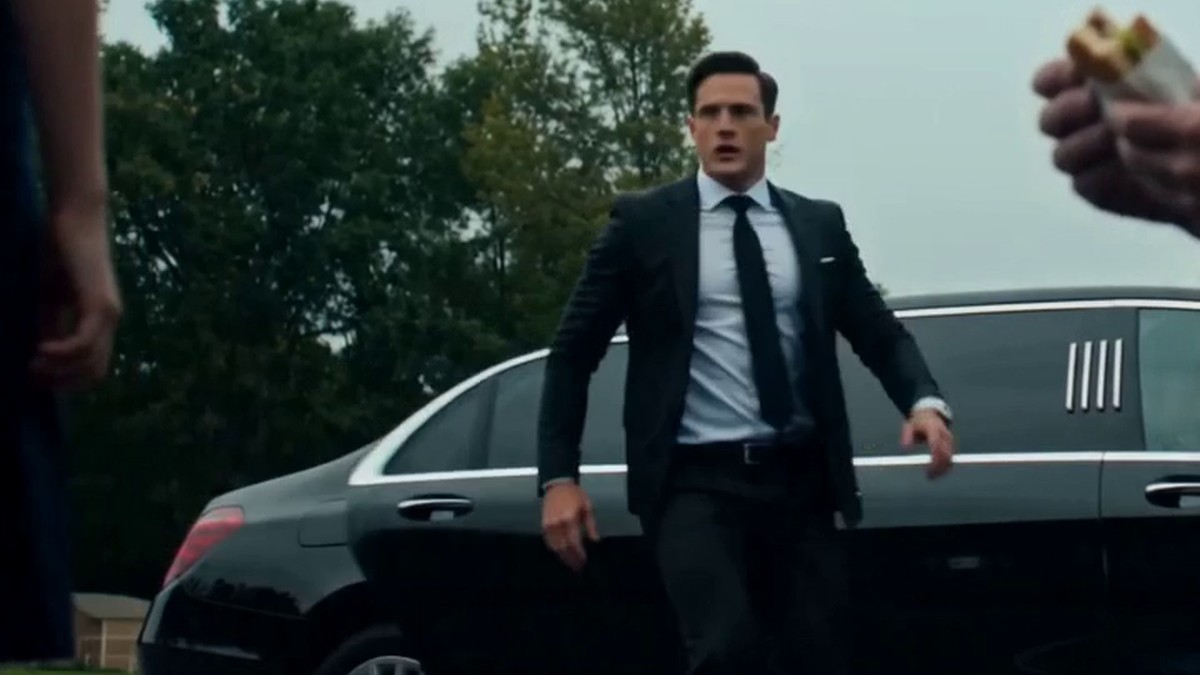
A black car—polished like a mirror, moving like it owned the street—glided to the curb without a sound. The door swung open and a man in a razor-pressed suit nearly stumbled out, his eyes sweeping the yard with barely concealed desperation until they landed on the old man. On the sandwich resting in his trembling hands.
The suited man went pale.
“Sir.” His voice cracked at the edges. “We’ve been looking everywhere for you.”
Emma turned. “You *know* him?”
The suited man opened his mouth—
And the old man raised one hand.
Just one hand. Barely a gesture. But it worked like a wall.
The silence that followed felt different from the one before it. Emma noticed it without knowing why. She looked at the old man again—really looked—and something had shifted behind his eyes. The exhaustion she’d seen there moments ago was simply gone. In its place was something measured. Settled. The kind of quiet that doesn’t ask permission.
“The entire board is assembled,” the suited man said, dropping his voice to a taut whisper. “They can’t move forward without your word.”
Emma’s pulse kicked hard against her ribs.
She looked down—at the cracked leather of his shoes, at the coat too thin for the season, at the hands now perfectly, unnervingly still.
“Who are you?” she whispered.
The old man didn’t answer right away. He looked at the sandwich in his grip, and something moved through his face—old and deep and not entirely painful.
“For years,” he said, his voice fraying at the seams, “not one person looked at me like I was still worth looking at.”
Then he stood.
No wobble. No reaching for support. Nothing fragile about it at all.
He rose like someone who had simply been waiting—spine straight, shoulders level, the entire bearing of a man accustomed to rooms going quiet when he entered them.
The suited man dropped his head immediately.
“Mr. Chairman.” Barely above a breath. “Everyone is waiting.”
Emma forgot how to breathe.
But the old man wasn’t looking at the car, or the suit, or the long afternoon ahead of him.
He was looking at her.
And he held the sandwich—that small, ordinary, peanut-butter-and-jelly sandwich—like it was something he intended to keep.
“You have no idea,” he said quietly, “what you just set in motion.”
The breeze moved through the schoolyard. Emma didn’t.
She stood exactly where she was, both arms still slightly extended, the ghost of the sandwich still warm in her palms. Around her the world had stitched itself back together—the shrieking kids, the fence, the distant traffic—but she was outside all of it now, stranded in a kind of stunned suspension.
*What you just set in motion.*
The words wouldn’t stop echoing.
—
The suited man—she’d hear his name later, Hargrove, spoken by other suited mouths with a kind of reverence usually reserved for weather systems—held the rear door open with both hands, his jaw locked into something between professional composure and raw relief.
The old man didn’t move toward the car immediately.
He turned back to Emma one more time, and the afternoon light caught his face at an angle that made him look, for just a second, like a portrait she might have seen somewhere. A photograph in a textbook. A face behind glass in a lobby she had never visited but somehow knew.
“What’s your name?” he asked.
“Emma.” Her voice came out smaller than she intended. “Emma Calloway.”
He nodded slowly, the way people nod when they are filing something away in a drawer they intend to open again.
“Emma Calloway,” he repeated. “Do you know what I was doing this morning, before all of this?”
She shook her head.
“Sitting in a room,” he said, “surrounded by people who needed something from me. Every face in that room—expensive faces, educated faces—and not one of them looked at me. Not really.” He paused. “They looked at what I control. What I can authorize. What I represent.” His fingers tightened slightly around the sandwich. “You looked at me like I was hungry.”
Emma didn’t know what to say to that. So she said the only thing that was true.
“You *were* hungry.”
Something broke open quietly behind his eyes. Not grief, exactly. Not joy either. Something older than both.
“Yes,” he said. “I was.”
—
Hargrove cleared his throat from beside the car—a sound like a polite earthquake.
The old man glanced at him. The glance alone was enough to reduce Hargrove to a statue.
“I’ll be one more minute,” the old man said. It was not a request.
He lowered himself back onto the bench—not with the careful fragility Emma had noticed before, but with the deliberate ease of someone who understood exactly how much time he had and had decided to spend one more minute of it here. He unwrapped the sandwich with the same precision she imagined he brought to documents and decisions worth more than she could fathom.
He took a bite.
Emma watched him chew.
He closed his eyes.
When he opened them again, he looked lighter. It was the only word for it. As though something he had been carrying without realizing it had been quietly set down.
“My daughter used to make these,” he said. “A long time ago.”
Emma sat down beside him. She wasn’t sure why. Her legs just decided.
“What happened?” she asked.
The question was too personal. She knew that even as she asked it. But the strange bubble of the afternoon held, and he didn’t seem to mind.
“She grew up,” he said simply. Then, after a beat: “And I worked.”
The two sentences sat between them like a small, complete tragedy.
—
Across the yard, Emma’s teacher—Mrs. Aldridge, perpetually anxious, perpetually scanning for liability—had spotted the black car at the curb and was now moving toward the fence with the focused urgency of a woman who had filled out too many incident reports. Emma saw her coming. So did the old man.
“I should let you go,” Emma said.
“Yes.” He began to stand. “And I should let you go back to whatever you were doing before you decided to see an old man.”
“I wasn’t doing anything important.”
He looked at her with an expression she couldn’t entirely decode. Something between amusement and something far more serious.
“That,” he said, “is where you’re wrong.”
—
Mrs. Aldridge arrived at the fence with her lanyard swinging and her voice already at an elevated register.
“Emma, what are you—” She stopped when she registered Hargrove. The car. The quality of the suit. The way Hargrove was looking at the old man with the specific anxiety of someone responsible for something extraordinarily valuable. “I’m sorry—is everything—”
“Everything is fine,” the old man said, and Mrs. Aldridge immediately ceased the sentence she had been building.
He turned to Emma one final time. He reached into the breast pocket of his thin, inadequate coat and removed a business card—cream-colored, heavy stock, the kind of weight you only feel in objects made to last. He held it out.
Emma took it.
The name on it meant nothing to her. But the way Hargrove watched her receive it—like she was being handed something radioactive with significance—told her it meant a great deal to a great many other people.
“If you ever need anything,” the old man said, “or if there’s a school that needs something.” He nodded at the building behind her. The peeling paint around the gymnasium windows. The cracked asphalt on the far side of the yard. “You have my word.”
Emma looked at the card. Then at him.
“You don’t have to do that,” she said. “I didn’t give you the sandwich because I wanted something.”
“I know,” he said. “That’s exactly why I’m doing it.”
—
He walked to the car.
Not slowly. Not quickly. With the measured certainty of a man who had made his decision somewhere between the first bite of the sandwich and the last, and was now simply enacting it. Hargrove held the door. The old man ducked inside. The door closed with the soft, expensive sound of a thing built to shut out the world.
The window lowered.
His face in the gap—older now in the direct light, every line earned, every shadow real.
“Emma Calloway,” he said one last time. “Remember this afternoon.”
The window rose.
The black car pulled away from the curb without hurry, gliding back into traffic as smoothly as it had appeared, and in thirty seconds it was gone and the street looked like a street again and the schoolyard sounded like a schoolyard again and Mrs. Aldridge was saying something about protocol and permissions and Emma wasn’t hearing any of it.
She was looking at the card in her hand.
She turned it over.
On the back, in precise, old-fashioned handwriting that must have been added before he’d ever sat down on that bench—as though he’d been waiting for the right moment to use it—were four words:
*For the right person.*
—
Three weeks later, a check arrived at the school district offices. The number attached to it made the superintendent sit down heavily in her chair and call three separate people to confirm it was real.
It was real.
The gymnasium got a new roof. The asphalt got repaired. The library—which had been operating without a functioning heating system since November—got entirely rebuilt from the walls out, and stocked with more books than it had held in its entire history.
Nobody at the district level could entirely explain where it had come from or why. There was a foundation name on the paperwork, something quiet and institutional, the kind of name that doesn’t announce itself.
But Emma knew.
She didn’t tell anyone. It didn’t feel like hers to tell.
She just walked into the new library on the morning it opened, ran her hand along a shelf of uncracked spines, and remembered the specific weight of a peanut butter and jelly sandwich extended toward an old man on a bench.
She remembered the way he had held it.
Like it was something worth keeping.
She had thought, then, that she was just giving him lunch.
She understood now that she had given him something he hadn’t known he was still looking for—proof, plain and ordinary and completely free, that he was still worth seeing.
And he, in his own way, had returned the favor.
Emma pulled a book from the shelf, found a chair in the corner by the window where the afternoon light came in wide and golden, and began to read.
Outside, the world went on making its noise.
In here, everything was quiet.
The right kind of quiet—the kind that doesn’t ask permission.