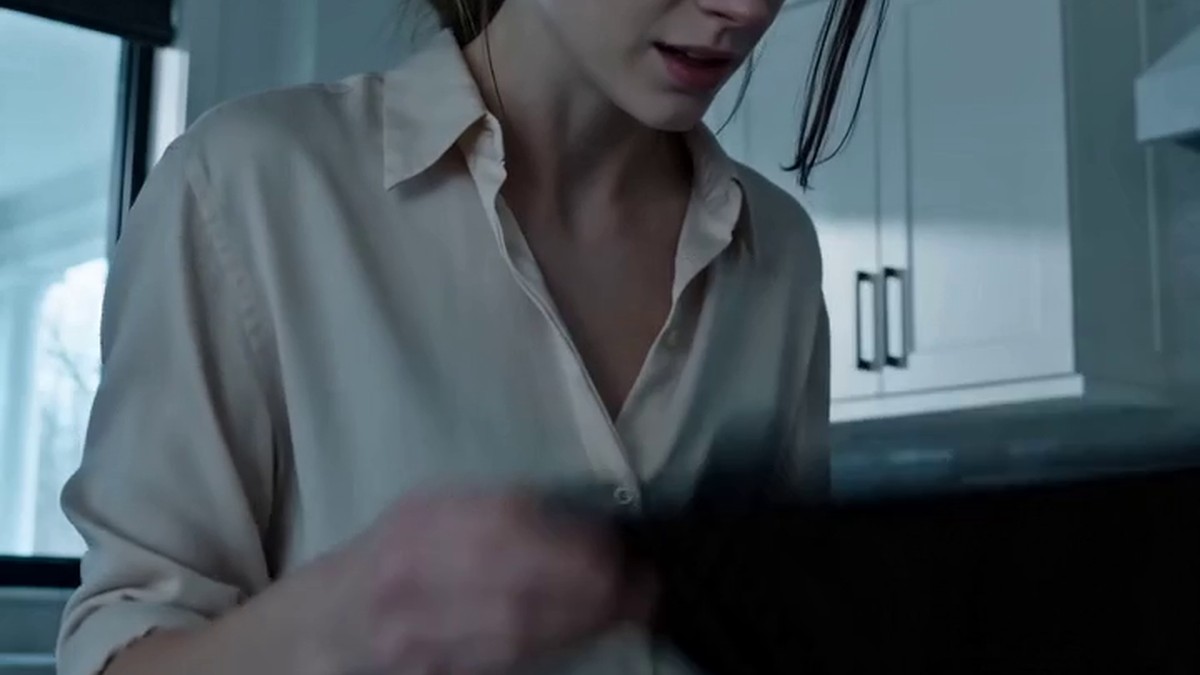
She figured it would be Julian. Something like *We’re heading out early* or even just a quick *Merry Christmas, Mom.*
It wasn’t Julian.
It was Brenda.
**We need space. Don’t call.**
Clara sat there, reading it twice.
No context. No softness. Not even the basic decency of punctuation that felt like a human being wrote it.
She looked out the kitchen window. The driveway was bare. Julian’s SUV — gone. She thought about Brenda’s suitcase propped against the staircase railing the night before, and those glossy resort brochures fanned out on the kitchen counter that Clara had made a point of not acknowledging.
Now she understood why.
They had driven off to some beachfront resort on Christmas Eve and left her alone in the house she and her late husband had spent decades paying off. They expected her to sit with that. To absorb it quietly, like she had absorbed everything else.
For two years, Julian and Brenda had been living in the renovated upstairs apartment. After her husband passed, Clara had told herself it would help — having family nearby, hearing footsteps above her instead of silence.
But somewhere along the way, Brenda had started treating her like an inconvenience that hadn’t quite gotten the message.
The laundry schedule was reorganized without a word. Clara’s family photographs disappeared from the hallway one by one. She was asked — told, really — to stay out of the backyard on weekends because they needed their *privacy.*
And Julian?
Julian had developed a habit of studying the floor whenever any of it happened.
Clara set the phone face-down on the table.
She didn’t cry. Didn’t reach for it again.
She walked to the hallway, opened the old black binder on the shelf, and looked at the house deed inside it. Something moved through her chest then — not grief exactly. Colder than that. Quieter.
They wanted space.
All right.
She had four days. Four days to give them something they had never once considered: the full weight of what they’d been taking for granted.
—
The call to her attorney came before the coffee went cold.
Howard Estes had handled the estate after Richard passed. He was a measured man — the kind who chose words like a surgeon chose instruments. Clara had always appreciated that about him.
“Clara.” He picked up on the second ring, even on Christmas Eve. “Everything all right?”
“I need to know how quickly I can file a formal notice of tenancy termination,” she said. “Upstairs unit.”
A beat of silence.
“Are we talking about Julian?”
“We are.”
She heard him exhale slowly, not with surprise but with the particular care of someone calibrating how to proceed. He asked a few questions. She answered them cleanly, without drama. She told him about the text. The suitcase. The two years of photographs disappearing off walls that her husband had hung them on with his own two hands.
Howard told her thirty days was standard, but he could have documents drafted and ready to sign by the twenty-seventh. He also told her what she already suspected: the lease had never been formalized. Julian and Brenda had been living there on a handshake arrangement — her handshake, her house, her generosity that had been mistaken for weakness so gradually that nobody had even bothered to mark the moment it happened.
“I’ll have everything ready,” he said. “You’re sure?”
“Howard,” Clara said. “I’ve been sure for longer than I realized.”
She hung up and stood in the kitchen for a moment with both hands flat on the counter. The refrigerator hummed. Outside, a cardinal landed on the back fence, sat there briefly, red as a signal flare against all that gray winter sky, and then was gone.
—
She spent Christmas Eve the way she might have spent it years ago, before she’d learned to make herself smaller in her own rooms.
She pulled Richard’s Sinatra records out of the cabinet and played them on the turntable in the living room. She made a proper dinner — roast chicken, roasted potatoes, the green beans with the slivered almonds that Julian had always said were his favorite, which felt like its own quiet statement, cooking them now for herself alone. She ate at the dining room table with the good china. She lit the candles.
She did not touch her phone.
She slept better than she had in months.
—
They came back on the twenty-eighth.
She heard Julian’s SUV in the driveway at half past two in the afternoon. She was in the sitting room with a book. She didn’t go to the window.
She heard them on the stairs — Brenda’s voice, low and carrying the particular brightness of someone returning from a trip still coated in their own good mood, not yet aware of the weather indoors. The door to the upstairs apartment opened and closed.
Clara turned a page.
Twenty minutes later, footsteps on the interior staircase. A knock at her door.
Julian.
She opened it. He looked tan, slightly tired, wearing one of those resort sweatshirts that men buy on vacation and somehow always look wrong in. His smile was reflexive at first, then something in her face adjusted it.
“Hey, Mom. We’re back.” He held up a small paper bag. “We grabbed you those shortbread cookies from the gift shop. The ones you like.”
Clara took the bag. Set it on the hall table without looking at it.
“Come in,” she said.
He followed her into the sitting room. She gestured to the chair across from hers. He sat in it the way a man sits in a chair when he’s not sure what he walked into.
“How was the trip?” she asked.
“It was good. Nice weather, good food.” He paused. “Look, about Christmas Eve — Brenda just wanted—”
“I know what Brenda wanted,” Clara said. “Sit down, Julian. Really sit.”
He stopped adjusting himself and looked at her directly, maybe for the first time in longer than either of them would have admitted.
She told him about the call to Howard.
She told him plainly, without performance, the way she’d rehearsed it in her head because she knew if she let herself feel it fully she might lose the thread. She told him she loved him and that loving someone did not require handing them your dignity with both hands and watching them forget to say thank you. She told him about the photographs. She told him about the backyard. She told him about Richard — about the particular silence of a house after forty-one years of marriage ends, and how she had asked for family nearby because she could not bear that silence, and how instead of quieting it they had somehow found a way to make it louder.
Julian didn’t interrupt.
He had his elbows on his knees and his eyes on the floor — that familiar posture — but this time he wasn’t using it to exit the conversation. He was just holding the weight of it.
When she finished, he looked up.
“I didn’t know it felt like that,” he said.
“You didn’t ask.”
“I should have.” His voice thickened slightly. “I kept telling myself it wasn’t that bad. That you were fine. That Brenda just needed time to settle in.” He stopped. Pressed his lips together. “I was telling myself stories.”
“Yes,” Clara said. “You were.”
He sat with that for a moment, not looking away this time.
“The notice gives you thirty days,” she said. “Howard can walk you through the details. I’m not rushing you into the street, Julian, but I need this to be a home again. Mine.”
He nodded slowly. His jaw worked.
“What about Brenda?” he said — and she understood the question underneath the question. He was asking whether there was any version of this where Brenda was included in the reprieve. Whether there was a conversation to be had.
“That,” Clara said, “is between the two of you.”
—
Brenda came down an hour later.
She stood in the doorway of the sitting room with her arms crossed and her resort tan and the particular expression of a woman who had decided in advance how this conversation was going to go. There was a set to her jaw that Clara recognized — the practiced readiness of someone who had already rehearsed their grievances on the drive home, who had spent four days at a beachfront resort quietly building a case.
It didn’t go that way.
“Clara,” Brenda started, her voice carrying the careful brightness of someone managing a difficult subordinate, “I think if we just talked about boundaries—”
“We’ve had that conversation,” Clara said. “For two years, silently, every time a photograph came down off that wall.”
Brenda’s mouth stayed open a moment, the next sentence already loaded and now suddenly without a target.
Clara had nothing left to perform. No anger worth spending on theater. She simply told Brenda what she had told Julian, in the same clear voice — the photographs, the backyard, the laundry schedule reorganized without a word, the accumulated quiet erosion of two years — and then she said one additional thing that she had not planned to say but found was true.
“You married my son,” Clara said. “That matters to me. It will always matter to me. But this house was built by people who loved each other for a very long time, and I will not have it treated like a convenience to be managed.”
Brenda uncrossed her arms.
Something shifted in her face — not softening exactly, but rearranging. The prepared response she’d walked in with didn’t fit the room anymore. And for just a moment, something else moved across her expression — a flicker of what might have been recognition, or exhaustion, or the particular discomfort of a person who has outrun a feeling for a long time and finds it waiting for them anyway. Clara didn’t know what Brenda carried. She didn’t pretend to. But she saw, in that unguarded second, that there was more to her daughter-in-law than the adversary she’d become in this house.
She didn’t apologize. Not that day. Clara didn’t need her to.
What she needed was for both of them to understand that there had been a before and there was an after, and they were standing in it.
—
They were out by the end of January.
Julian called on a Sunday in February, just to call. No specific occasion. They talked for forty minutes about nothing in particular — a documentary he’d watched, a plumbing issue in the new apartment, a story about his father that Clara hadn’t heard in years and wasn’t sure Julian even remembered knowing.
She stood at the kitchen window while they talked. The cardinal was back, or maybe a different one. Red against the bare branches, burning quietly in the cold.
Before they hung up, Julian said, “I’m sorry, Mom. I should have said that sooner.”
“You’re saying it now,” Clara said.
And that was enough. Not everything. Not a restoration of something that had existed before. But a real thing, between two real people who had not finished the work of knowing each other yet.
She set the phone down and looked at the house around her.
Her photographs were back on the hallway wall. She’d rehung them herself, on a Wednesday afternoon, with the same small hammer Richard had kept in the junk drawer for thirty years. She had taken her time with it, getting the levels right, stepping back to check.
The house was quiet.
But it was the right kind of quiet now — not a silence that pressed down on you, but the kind that simply waited, patient and open, for whatever came next.





