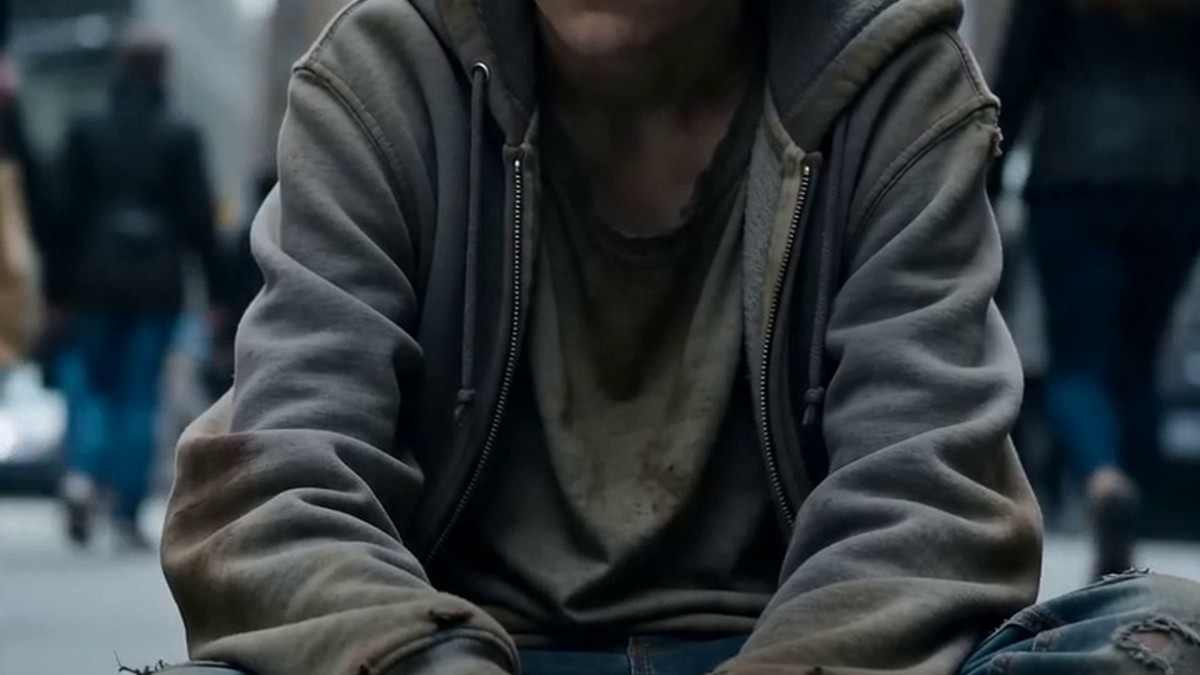
The words landed on a packed Manhattan sidewalk like a stone dropped into still water. And somehow — impossibly — the city went quiet.
No horns. No sirens. No shuffling feet.
Just three people standing inside a truth that none of them were ready to hold.
Ethan went still.
“Mom…” His voice came out low, careful. “What are you saying?”
She couldn’t answer him. Couldn’t even look at him.
Her eyes were fixed on the hospital bracelet circling the homeless boy’s wrist. Faded almost to nothing. The edges gone soft and ragged, worn down by years of weather and forgetting. But the letters — those stubborn, faint letters — were still there.
Still readable.
“That’s not possible…” she breathed.
The boy on the pavement shifted slightly, his body weak but his gaze steady, holding her face like he’d memorized it a long time ago.
“I waited,” he said. Quietly. Without accusation.
A woman passing by pressed her hand over her mouth. Around them, strangers slowed to a stop, phones rising instinctively — that collective reflex of people who sense they’re watching something they’ll never be able to explain.
Ethan turned toward the boy.
“Waited for what?”
The child’s throat moved as he swallowed.
“For you to come back.”
The air thickened. Something invisible pressed down on all of them.
The mother stepped backward — one step, then another — shaking her head in short, broken movements, like she was trying to refuse what her own mind was already beginning to show her.
“No… that day… they told me…”
She stopped.
Because it was coming back now.
Fast. Vivid. Merciless.
“They said…” Her voice fractured into barely a sound. “They said one of the twins didn’t make it.”
Ethan’s chest seized.
“Then who is he?”
Silence swallowed the question whole.
The homeless boy slowly raised his arm — trembling, thin — and reached toward her. His voice dropped to almost nothing.
“I never died.”
And the moment those words left his mouth, the mother collapsed into tears — the kind that come from somewhere so deep they don’t make a sound at first.
Then, from somewhere back in the crowd, a man’s voice cut through everything.
“Wait — I remember this case.”
Heads turned.
The crowd parted like water around a stone.
He was older — mid-sixties, maybe, with silver hair and the kind of face that had seen too much to show surprise easily. A gray overcoat, a battered leather satchel slung over one shoulder. His eyes were locked on the mother with an expression that wasn’t quite recognition and wasn’t quite guilt, but lived somewhere painful between the two.
He pushed through the last row of bystanders and stopped a few feet away.
“You were at Mercy General,” he said. “December. A long time ago.” He swallowed. “I was the attending physician that night.”
The mother looked up at him.
Something in her face went absolutely white.
“You told me,” she whispered. “You came into the recovery room. You sat down next to the bed.” Her voice was shaking now, but steady underneath — the way a wire shakes in wind without breaking. “You told me Baby B didn’t survive the delivery.”
The doctor didn’t flinch. But something behind his eyes cracked open.
“There was a mistake,” he said.
Three words. Small, clean, devastating.
“What kind of mistake?” Ethan’s voice was quiet but hard — the voice of someone who had just understood that the architecture of his entire life might have been built on someone else’s error.
The doctor’s jaw tightened. He looked down at the boy on the pavement — really looked at him, maybe for the first time. The sunken cheeks. The hospital bracelet. The eyes that had survived things they shouldn’t have had to.
“The night you delivered,” he said slowly, “there was a second emergency two floors down. Mass casualty event. A fire in a parking structure. We had — ” He stopped. Pressed his lips together. Started again. “The ward was overwhelmed. Your second boy was taken to a different wing for resuscitation. He was critical. We didn’t expect him to — ” Another pause. “There was a miscommunication between two nurses at shift change. One chart. Two babies. Someone marked the wrong line.”
The silence that followed was not quiet.
It was loud in the way that only silence can be loud — stuffed full of years, of absences, of birthdays that never happened and a name that was never spoken aloud because speaking it felt like reopening a grave.
“You told me he was dead.” The mother’s voice was not angry yet. It was something worse than angry. It was the voice of someone standing at the edge of an enormous drop, looking down, not yet falling. “I buried him. In my mind, I buried him. I grieved him. I let him go.”
“I know.”
“I had a funeral. There was a small box. They told me it was — ” She couldn’t finish it.
“There was an administrative error in the records. By the time it was caught — ” The doctor’s voice faltered. “You had already been discharged. The hospital’s legal team — ” He stopped himself again, and what crossed his face in that moment was not legal liability or institutional damage control. It was something rawer than that. “I should have come to you myself. I chose not to. That is something I have carried every day since.”
Ethan took one step toward him.
“You chose not to.” He repeated the words slowly, like he was tasting how wrong they were. “He was living on the street.”
“I know.”
“He was living on the street, and you chose not to.”
“Yes.”
The single syllable landed like a confession in a courtroom. No defense mounted. No explanation offered to soften it.
Around them the crowd had gone utterly still — phones lowered, forgotten. No one was filming anymore. Some moments are too real to watch through glass.
The boy on the pavement had been listening to all of it without moving. His eyes tracked from the doctor to his mother to the brother he had never been allowed to know. He seemed, somehow, the calmest person on the sidewalk — as though he had imagined this conversation so many times in so many doorways and alleyways and park benches that the actual version of it couldn’t surprise him anymore.
He looked at his mother.
“I knew it wasn’t your fault,” he said. “I figured that out when I was pretty young, actually.”
She made a sound — a short, sharp exhale — like she’d been holding that breath for years and only just now had permission to release it.
She crossed the distance between them and went down onto her knees on the cold concrete, right there on the Manhattan sidewalk, and put both hands on either side of his face.
Up close she could see it. She didn’t know how she hadn’t seen it immediately. The shape of his jaw. The way his brows pulled together. The exact angle of something in his eyes that she had been looking at every day for eighteen years in the face of her other son.
“What’s your name?” she asked.
He blinked. Something shifted in his face — a question he hadn’t expected.
“People call me Eli.”
She made a sound that was not quite a laugh and not quite a sob.
“I named you Eli,” she said. “Before you were born. Before any of this. That was the name I chose.”
His mouth opened slightly.
For the first time, something in his composure broke — not collapsed, not shattered, but gave way in the small, specific way that a person breaks when they hear the one thing they had quietly stopped believing they would ever hear.
That they were expected. That they were wanted. That someone had held a name for them before the world had a chance to take it away.
Ethan crouched down beside his mother, both of them level with Eli now, and no one said anything for a long moment.
The doctor behind them had gone very still. He didn’t leave — whatever he had spent decades avoiding, he seemed to have decided, at last, to stand inside.
An ambulance worked its way down the block. The city sounds gradually returned — distant, irrelevant, going on without them.
Ethan exhaled. Looked at his brother — at this stranger who shared his face, who had grown up in the cold while Ethan grew up in warmth, who had found them somehow through some gravity neither of them could name.
“Where have you been staying?” he asked. Not accusatory. Just — needing to know the shape of the years.
Eli glanced at him sideways. “Here and there. Mostly here.”
“That’s over,” their mother said. She said it the way you say something that isn’t a decision because it was always the only possible answer. “That’s done now.”
Eli looked at her. His expression was careful, measured, built out of years of not trusting things that seemed too good.
“You don’t have to — ”
“Stop,” she said gently. “You were mine before I lost you. You are still mine now. Nothing that happened in between changes the first fact or the last one.”
He looked at her for a long time.
Then something in him — years of it, weight of it — quietly came undone.
He leaned forward, and she caught him, both arms around him, right there on the cold sidewalk in the middle of Manhattan, and held on with the particular force of a mother who had been told her child was gone and had just now, after all this time, been handed the chance to be wrong.
Ethan put his hand on his brother’s back.
Around them, strangers stood and watched — not with phones raised, not with the gawking hunger of people watching spectacle, but with the hushed, careful stillness of people who have just accidentally witnessed something true.
A few feet back, the doctor in the gray overcoat stood with his head bowed and his hands at his sides. He didn’t move. He didn’t interject. He stayed.
It wasn’t absolution. It wasn’t forgiveness — that would be a longer road, a harder one, with conversations nobody was ready to have yet.
But it was presence.
And maybe that was the only place left to start.
The mother pulled back just far enough to look at her son’s face. Really look. Memorizing it — or maybe recognizing it, finally, after all the years of not knowing what had been missing.
“We’re going to take care of you,” she said. “Both of us.”
Eli glanced at Ethan.
Ethan nodded once — simple, unambiguous, no hesitation in it.
Something loosened in Eli’s expression. Not all the way. Not yet. There were too many winters in him for that to happen on a sidewalk in a single afternoon.
But enough.
Enough to stand up.
Enough to walk forward.
The three of them rose together from the cold pavement, and the crowd, without quite realizing it, opened a path.
And the city, which had briefly, impossibly held its breath —
moved on.