Crisp floral arrangements. Crystal stemware catching the light. A ballroom packed with people who mattered.
Then a single remark cracked the evening wide open.
The groom’s mother swept her gaze across the head table, landed on the woman sitting next to the bride, and her expression curdled.
“Who let her in?”
The room lost a few decibels.
The bride stiffened. “That’s my mother.”
The older woman let out a short laugh — the kind designed to sting. Her eyes did a slow, deliberate tour: the unassuming dress, the scuffed handbag, the sensible shoes that had never seen a boutique.
She smiled the way people do when they want you to know they’re not smiling.
“I assumed you came from better breeding than that.”
A handful of guests laughed. Others found something fascinating to study on the tablecloth.
The bride’s cheeks went scarlet. “Please. Don’t.”
The older woman wasn’t finished.
“Learn where you stand,” she said, her voice dropping to something colder and more precise. “This table is for people who actually belong at it.”
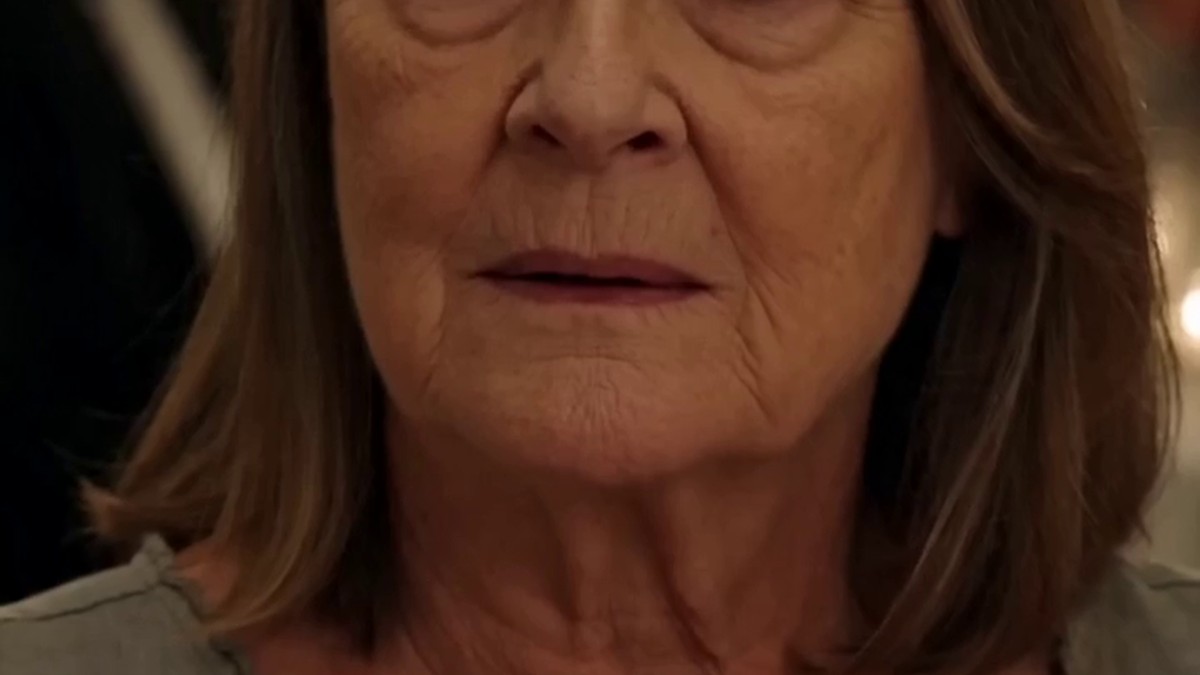
The woman in the plain dress said nothing.
No raised voice. No trembling lip. No desperate scramble for words to shield herself with.
That stillness — that absolute, unreadable calm — seemed to irritate the groom’s mother far more than any argument would have.
Then the woman moved.
She rose from her chair slowly, deliberately, as though she had nowhere to rush and nothing to prove. Every eye in the ballroom followed her without meaning to.
She lifted the worn leather handbag from her lap and set it on the table with a quiet, final thud.
“Is she leaving?” someone nearby breathed.
The woman’s mouth curved — barely. “No.”
She unclasped the bag.
And then, one by one, she began drawing items out and laying them flat on the white linen.
Folders. Legal folders, thick as fists. Contracts bound with metal clips. Ownership documents stamped and notarized. Official paperwork that had no business being in a handbag like that.
The groom leaned forward, brow furrowed.
The bride went very still, watching her mother as though seeing a stranger.
The groom’s mother exhaled through her nose. “What is all this theater supposed to—”
The first document turned over.
She stopped mid-sentence.
She recognized the company name. Recognized it the way you recognize something that has the power to remake a room.
The color shifted in her face.
Because the woman she had spent the last ten minutes cutting down to size — the woman with the scuffed shoes and the old bag and the dress that cost nothing — was suddenly someone else entirely.
The second document landed on the linen.
Then the third.
Each one placed with the same unhurried precision — the kind that belongs to someone who has spent decades being underestimated and learned to weaponize the moment of revelation.
The groom’s mother reached for the first folder without asking permission. Her fingers moved quickly, almost greedily, the way hands move when the brain is still catching up. She scanned the header. Scanned it again.
Her champagne glass tilted in her other hand. A small, dark crescent of liquid kissed the tablecloth.
Nobody mentioned it.
—
The woman’s name was Margaret Hale.
Not that anyone in that ballroom had thought to ask.
She had arrived alone, taken her seat without fanfare, ordered water when the waiter offered wine, and spent the cocktail hour listening more than she spoke — which was to say she had spent it learning everything worth knowing about every person in the room.
That was habit. That was survival. That was forty years of building something from a number that was as close to zero as a number can get without actually touching it.
She had started with a single storage unit she couldn’t fully afford, subletting half of it to cover the rent on the other half. She had driven a truck she fixed herself because mechanics cost money she didn’t have. She had eaten sandwiches over ledgers at midnight and woken up at five and done it again.
She had not done any of it loudly.
Quiet was the medium she worked in. Results were the only language she trusted.
And now the folder in the groom’s mother’s hands — the first one, the thinnest one, the one that was merely an introduction — bore the corporate seal of a logistics and real estate holding company valued at something that had eleven digits before the decimal point.
Margaret Hale, Founder and Principal.
The groom’s mother read it three times. Her lips moved on the third pass.
—
“I don’t—” she started.
“The second folder is more relevant,” Margaret said. Her voice was pleasant. Unhurried. “That one concerns the properties.”
The woman’s husband — a barrel-chested man who had been enjoying his filet and staying wisely out of it — leaned over and caught a glimpse of the second document. He set down his fork.
The groom — her son, Daniel, twenty-nine years old and thoroughly mortified — pressed two fingers to his temple and stared at the tablecloth.
“Mom,” he said quietly.
She wasn’t listening.
She was reading.
The room had gone the particular kind of silent that happens when everyone is pretending very hard not to be paying attention while paying total attention. Silverware moved slowly. Wine was sipped without tasting. A woman near the back of the ballroom put her phone away, which was how you knew the moment had transcended documentation.
—
The bride — Clara, Margaret’s daughter — had not moved.
She sat with her hands folded in her lap and watched her mother the way a person watches a controlled burn: knowing it was necessary, knowing it would take exactly as long as it needed to, knowing there was no point rushing it.
She had known, her whole life, what her mother was.
Not what her mother had. What her mother *was*.
She had also known, her whole life, that her mother chose not to announce it. That the scuffed shoes and the plain dress and the battered handbag were not poverty and not neglect — they were a deliberate act of defiance against a world that had always tried to measure her worth before she could open her mouth.
“I don’t need to look like money,” Margaret had told her once, back when Clara was small enough to fit on her lap. “Money already knows what it is.”
Clara had not understood it then.
She understood it perfectly now.
—
Margaret reached into the bag a final time and produced one last document.
This one she didn’t place on the table.
She held it.
“Mrs. Whitmore,” she said — and the use of the groom’s mother’s name, spoken that calmly, was itself a kind of authority — “the building your son’s firm occupies on Meridian Street.”
The woman looked up sharply.
“I own it,” Margaret said. “Have for eleven years. Your husband negotiated the lease renewal two springs ago with my property manager.” A brief pause. “He never thought to ask who the principal was. Most people don’t.”
The husband’s face did something complicated.
Margaret set the final document on the table, face up, and let it speak for itself: a single ownership certificate, clean and notarized, that confirmed what she had just said and nothing more. She didn’t reach for a second revelation. She didn’t need to. The point had already been made — not to humiliate, but to clarify. The record was simply what it was.
Someone near the center of the room let out a breath that was almost a laugh and immediately converted it into a cough.
Mrs. Whitmore’s jaw had gone very tight. The muscles at the hinge of it were working. Her posture, which had been the whole evening a perfect architecture of inherited superiority, had not collapsed — she was too practiced for that — but it had *shifted*. Something structural had gone out of it.
“I don’t understand what you think this proves,” she said.
Her voice was still controlled. But it was controlled the way a dam is controlled — by the pressure behind it.
“It doesn’t prove anything,” Margaret said simply. She gathered the documents and slid them back into the folders with the same unhurried efficiency with which she had produced them. “I’m not here to prove something. I’m here because my daughter married your son today, and I was invited to the reception.”
She closed the bag.
Clasped it.
Set it back in her lap.
“I sat down at this table because it’s where Clara is sitting. Not because of who belongs where.” A beat. “But since you wanted to establish credentials — now you have them.”
—
The silence that followed was the kind that rewrites a room.
Mrs. Whitmore looked at her son. Daniel was looking at Clara. Clara was looking at her mother with something that had moved past admiration into something quieter and deeper — the specific tenderness of finally watching someone you love be fully seen.
The husband cleared his throat. “Eleanor,” he said, low and deliberate. His wife’s name, nothing else. But it carried the full weight of a conversation they would be having later, privately, at significant length.
Eleanor Whitmore set down the folder.
She picked up her champagne glass, put it down again without drinking.
For a moment she simply sat with the evening she had constructed so carefully and watched it mean something different than she had intended.
Then she did the only thing there was left to do with any dignity.
“I apologize,” she said.
The words came out clipped. Imperfect. The apology of someone who had not had much practice and knew it. “That was — I was out of line.”
She looked at Margaret. Not warmly. Not yet. Maybe not ever, in the way warmth usually means. But she looked at her directly, which was more than she had done all evening.
“I didn’t know who you were.”
Margaret’s expression didn’t change.
“You didn’t ask,” she said — quietly, without cruelty. “But that’s all right. You know now.”
—
The band started up again somewhere near the edge of the moment, the way bands do, reading a room’s need to breathe. A slow song, something without edges. Couples began to drift toward the floor.
Daniel stood and held his hand out to Clara.
She took it.
At the door to the dance floor she paused and looked back at her mother, still seated, still composed, the battered leather bag resting in her lap like it always had — like it was exactly where it was supposed to be.
“You could have told me,” Clara said. “Before tonight. About the building. All of it.”
Margaret smiled. The full version this time, unguarded.
“I could have,” she agreed. “But then tonight wouldn’t have been yours to handle. And I wanted to see what kind of family you were marrying into.” She glanced briefly, almost imperceptibly, toward Eleanor Whitmore. “Now I know.”
Clara held her gaze a moment longer.
“And?”
Her mother tilted her head. Considered.
“And she apologized,” Margaret said. “People who can do that — even badly, even late — those people can learn.”
It wasn’t a verdict. It wasn’t absolution. It was something more useful than either: a door left open, exactly one inch, by someone who had spent a lifetime deciding which doors were worth pushing on.
—
Clara squeezed her husband’s hand and walked onto the dance floor.
Margaret Hale sat alone at the head table for a moment — and it was the most comfortable she had looked all night.
She caught the eye of a passing waiter.
“I’ll take that wine now,” she said.
He poured it. She lifted the glass once, barely, to no one in particular — to the room, to the evening, to forty years of being underestimated by people who should have known better — and drank.
The crystal caught the light perfectly.