A billionaire groom.
An aristocratic bride.
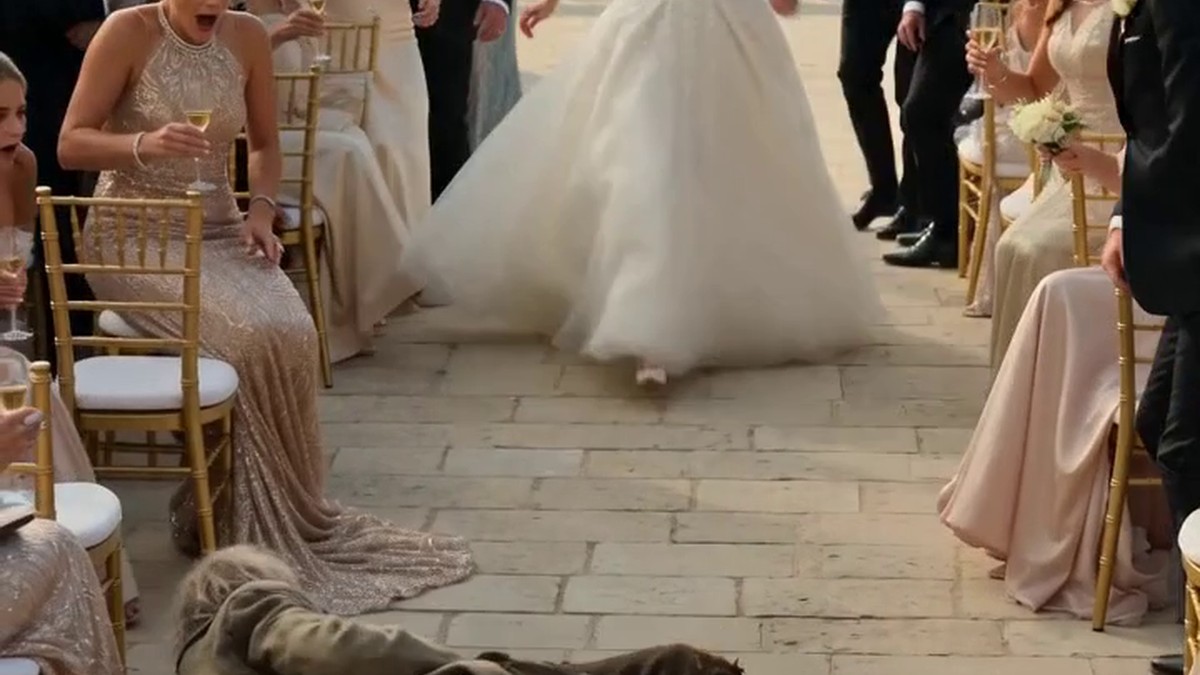
Hundreds of Europe’s most powerful guests arranged beneath white floral arches, the Loire Valley sprawling golden behind them.
Every detail was flawless.
Then came a sound no one had prepared for.
**Scuff. Drag. Scuff. Drag.**
Heads turned.
An old man shuffled out of the château corridor and into the light.
His clothes were shredded at the seams.
His boots carried the weight of dried mud and hard miles.
His beard had gone untouched for what looked like months.
Surrounded by diamonds and tailored silk, he looked like something that had crawled out of another world entirely.
A current of horror moved through the crowd.
Whispers ignited like brushfire.
*”How did he get past the gate?”*
*”Where on earth is security?”*
*”Get him out. Now.”*
The old man heard none of it — or didn’t care.
His eyes held only one target.
The bride.
Emma.
At the altar, Emma felt something cold move through her chest without warning.
She couldn’t name it.
But something about the way he moved, the way he looked at her — it reached somewhere deep and ancient inside her.
Something she had buried.
The old man took another step forward.
Slow.
Labored.
Unstoppable.
Then the calm broke apart completely.
Richard — the groom, the billionaire, the man who owned every room he walked into — came thundering down from the altar.
His face was a storm.
This was *his* day. *His* triumph. *His* stage.
And this broken stranger had walked right into the middle of it.
“Get out of my sight!” Richard’s voice cracked across the terrace like a whip.
Silence fell over every guest.
Emma reached for him. “Richard, wait —”
He was already moving.
He drove both hands into the old man’s chest and shoved — *hard* — with everything he had.
The old man left the ground.
Gasps tore through the crowd.
His body hit the limestone with a sound that made several guests flinch and look away.
Others froze, too stunned to breathe.
No one moved to help him.
The old man lay collapsed between two rows of white chairs.
Groaning.
Chest heaving.
Fighting just to stay conscious.
Security came rushing in moments later.
But before any hand could reach him, something stopped the entire terrace cold.
The old man reached inside his ragged coat.
Half the crowd tensed. Someone stepped back. Someone else grabbed their partner’s arm.
Slowly — painfully slowly — he drew out a small envelope.
Worn thin at the corners. Yellowed like old bone.
His trembling hand lifted it toward Emma.
And the instant she saw the name written across the front, every drop of color left her face.
Because it wasn’t addressed to Richard.
It wasn’t addressed to the wedding planner or the family or the staff.
It was addressed to *her*.
In handwriting she had not seen since she was a child.
Handwriting that belonged to someone who was supposed to be dead.
—
The envelope hung in the air between them.
Emma’s legs stopped working.
She didn’t realize it until she felt the altar rail catch her wrist — she’d grabbed it on instinct, the way a drowning person grabs anything solid.
The handwriting on the envelope was her father’s.
She knew it the way she knew her own heartbeat. The heavy slant of the *E*. The way the *m* looped twice, like a small wave, like something she had traced with her finger a thousand times on birthday cards and grocery lists and the last note he’d ever left her — *Back by dinner, sweetheart* — before he drove into a rainstorm and never came back.
Twelve years.
Twelve years she had spent making peace with that absence. Rebuilding around it. Filling the hole with purpose and ambition and eventually, Richard — solid, powerful Richard who had never once made her feel uncertain about anything.
And now the handwriting was here.
On an envelope held by a stranger who looked like he’d walked through hell barefoot to deliver it.
“Emma.” Richard’s voice came from somewhere to her left, sharp and low, a warning dressed as her name. “Don’t.”
She was already moving.
—
She crossed the terrace in twelve steps — she counted them without meaning to, the way the mind finds strange things to hold onto when the world tilts sideways.
She crouched beside the old man.
Up close, he was worse than he’d looked from the altar. His left hand was wrapped in cloth that had once been white. A bruise had bloomed purple-yellow under his left eye. His breathing was shallow and effortful, like each inhale cost him something.
But his eyes — pale gray, watery, fierce — found hers immediately.
“You came,” he said. His voice was barely above a scrape.
“I don’t know you,” Emma said.
“No.” A faint pull at the corner of his mouth. “But *he* did.”
He pressed the envelope into her hand.
The paper was warm from being carried close to his body. She could feel the slight stiffness of something folded inside — not just a letter. Something more.
“Emma.” Richard again, directly behind her now. She could feel the heat of him, the contained fury. “Give security the envelope and get up.”
She didn’t move.
She slid her thumb beneath the seal.
“Don’t you *dare* open that here.” Richard’s hand came down on her shoulder — not gentle.
She stood up slowly and turned to face him.
In ten months of engagement she had never looked at him the way she looked at him now: with perfect, unblinking stillness. Like she was seeing the shape of something she’d always sensed but never let herself name.
“Take your hand off me,” she said quietly.
The words hit the terrace like a stone hitting water. Rings of silence expanded outward through the crowd.
Richard’s hand dropped.
His jaw tightened. His eyes went to the envelope, then to the old man still struggling to sit upright on the limestone, then back to Emma — and in that triangle of movement something revealed itself. Something quick. Something he hadn’t meant to show.
He knew what was in that envelope.
Emma saw it.
And from the slight change in his breathing — the almost imperceptible tightening — he knew that she saw it.
—
She opened the envelope.
Inside: a letter, and a photograph.
The photograph first.
Her father. Younger than she remembered, or perhaps just less worn. Standing in front of a building she didn’t recognize — glass and steel, somewhere urban — beside a man in a suit who stood with the casual ease of someone accustomed to being obeyed.
A younger Richard.
She turned the photograph over.
*Geneva. March, eleven years ago. The meeting that started everything. Keep this safe. Keep yourself safer. I’m sorry I waited so long — D.*
*D.*
Daniel. Her father’s name.
Her hands were shaking now. She unfolded the letter.
It was short. Four paragraphs. The handwriting deteriorated as it went, as though written in stages, as though the person writing it was running out of something — time, or strength, or both.
She read it twice.
Then she folded it carefully, the way you fold something you intend to keep forever, and she put it in the pocket of her wedding dress.
She looked at Richard.
“The accident,” she said. “The night my father died.”
Richard said nothing.
“There was another car. The police report said the other driver couldn’t be identified.” She paused. “You could, though. Couldn’t you.”
The five hundred guests on the terrace had become a single held breath.
“You’re upset,” Richard said, and his voice had shifted into something practiced and smooth, the voice he used in boardrooms and depositions. “This man has clearly disturbed you. Whatever is in that letter —”
“My father was going to testify.” Emma’s voice didn’t shake. She was surprised to find it didn’t shake. “About the Geneva accounts. The shell companies. The thing that would have cost you everything eleven years ago.”
“Emma —”
“He wrote it all down.” She touched the pocket where the letter rested. “Before the accident. He gave it to someone he trusted to find me when the time was right — when there was enough corroborating evidence that the case couldn’t be buried.” She looked at the old man, who had managed to get himself upright against the chair leg, watching her with those fierce gray eyes. “When there was enough proof to go with it.”
“Enough proof,” the old man confirmed. His voice was stronger now, or maybe the terrace was just that quiet. “Eleven years of documents. In the car. Trunk. Every wire transfer, every shell account, every name.” He exhaled slowly. “I drove here today because today was the last day I could.”
Emma held his gaze for a moment before she understood.
Today was the last day she was still free of Richard legally. Once the ceremony concluded, once the register was signed, the financial structures of their marriage would have insulated him from her testimony, complicated any claim she might make, entangled her name with his in ways that took years to undo. Her father had known that. Brennan had known that.
They had timed it to the hour.
Richard’s composure cracked.
Not all at once — it happened the way expensive things break, not with a bang but with a series of hairline fractures spreading until the whole structure gave. The smooth voice went first. Then the stillness. He took one step toward the old man and his hand came up in a gesture that was not the gesture of a man making a point.
“Richard.”
The voice came from the back of the terrace.
Three people in dark suits were moving through the crowd, which parted for them with the instinctive deference people show to authority they don’t fully understand.
The woman in the center held up a credential wallet.
*Interpol*.
“Richard Hargrove.” She stopped eight feet away. “We’ve had this case staged for weeks — everything in place, waiting on the physical documentation to activate the arrest warrant.” She glanced at the old man, at Emma, at the photograph still in Emma’s hand. “It just arrived.”
Richard stood between the woman in the suit and the woman he’d been about to marry.
For a moment he looked genuinely unsure which direction to move.
Then the calculation in him reasserted itself — Emma could see it happening, could see him reaching for some version of this that he could still control — and he turned to her one last time.
“Everything I gave you was real,” he said. Quietly. Like it was an argument he actually believed.
Emma considered that.
“I know,” she said finally. “That’s the saddest part.”
—
They took him through the main gate.
The guests stood in clusters, some crying, some filming, most just stunned — the way people look when the performance they paid to see turns out to be something true and terrible underneath.
Emma knelt beside the old man again.
“What’s your name?” she asked.
“Brennan.” He exhaled slowly. “I worked with your father. A long time ago.”
“You’ve been carrying this for eleven years.”
He looked at her steadily. “He asked me to wait until there was enough. Until they couldn’t make it go away.” A pause. “And until you were somewhere he could be sure you’d be safe after.”
Emma absorbed this.
*He planned for the after.* Even at the end, her father had planned for the after.
She felt something crack open in the center of her chest — not painfully, more like a window she hadn’t known was sealed.
“Can you walk?” she asked.
Brennan attempted to stand. His legs didn’t cooperate. Emma put her arm under his and took his weight without ceremony, the way practical people handle practical problems.
“There’s a doctor in the second row,” she said. “I remember thinking it was strange we needed one at a wedding.”
Brennan made a sound that might have been a laugh.
They walked through the white chairs together — the bride in her cathedral-length veil and the wreckage of a man who’d spent eleven years keeping a dead man’s promise — and the guests moved aside to let them pass.
—
The Loire Valley went gold and then amber and then deep rose as the afternoon bled out.
The flowers stayed up. Nobody had thought to take them down yet.
Emma sat on the low stone wall at the edge of the terrace as the last of the official cars disappeared down the long driveway. She’d changed out of the dress — borrowed a jacket from a catering staff member who’d offered it without being asked, one of about a dozen small human kindnesses that had happened in the last two hours and that she found she couldn’t stop thinking about.
The letter was still in her pocket. Transferred.
She took out the photograph again.
Her father looked young in it. Younger than she’d ever really thought of him as being — she’d known him only as a father, which is a specific and adult-shaped thing, and somewhere along the way she’d forgotten he’d been a person first. A person who made choices. Some of them wrong. Who spent eleven years making it right the only way he still could.
She heard footsteps on the stone.
She didn’t look up.
“There’s a car,” said her maid of honor, Cate, sitting down beside her. “Whenever you want it.”
“In a minute.”
Cate looked out at the valley. “Are you okay?”
Emma thought about this honestly.
“I don’t know yet,” she said. “I think I might be, eventually. That’s more than I could have said this morning.”
Cate nodded.
“He left me something,” Emma said. “My father. All those years ago, he left me something, and it just took a long time to arrive.” She turned the photograph over in her hands. “I’ve been so angry at him for leaving. I don’t think I knew until today that underneath the anger I was mostly just — waiting. For some sign that he’d thought of me at the end.”
She tucked the photograph carefully back into her pocket, beside the letter.
“He did,” she said.
The valley held the last of the light a little longer than seemed possible.
Then the sun went down, and the white flowers dimmed to grey, and Emma stood up.
“Okay,” she said. “Let’s go.”
She walked through the gate without looking back.
The wedding of the century was over.
What came next was entirely hers.