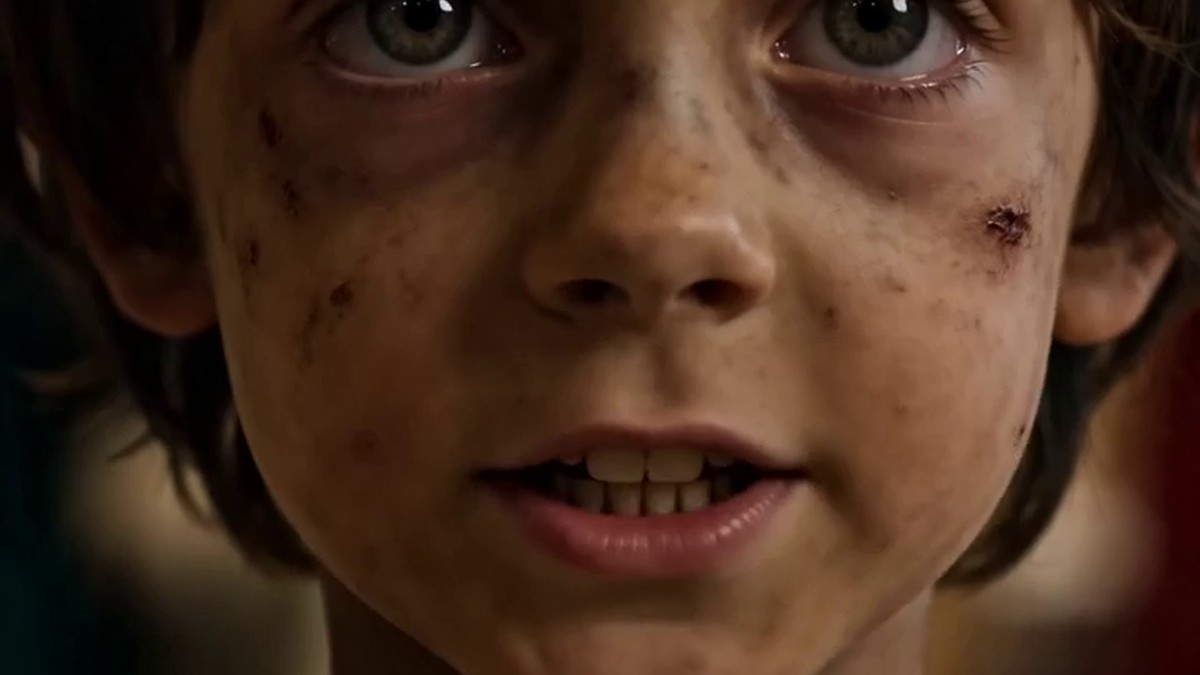
Hundreds of aristocrats packed the grand hall to its gilded edges. Crystal chandeliers threw shards of light across every surface. Laughter bounced freely between the marble columns, rich and self-satisfied.
Then a small boy stepped through the doors.
No shoes.
Filthy.
Dressed in rags stitched together by desperation and fraying thread.
Every head turned at once. Some faces twisted into smirks. Others pulled back in open revulsion. The child paid none of them any attention whatsoever.
He moved in a straight line — directly toward Princess Elena.
The most powerful young woman in the entire kingdom.
The instant he reached her table, his small hand grazed the edge of her golden hair.
The hall detonated.
Guards surged forward from every corner. Steel rang against scabbards. Nobles lurched to their feet so fast their chairs toppled and cracked against the stone floor.
“Remove him — now!”
The boy flinched hard.
But his feet didn’t move.
Princess Elena looked down at him from what felt like a great distance. Her expression was cold. Unreadable. Confused in a way she rarely allowed herself to be.
“Who are you?”
The child worked to swallow around the knot in his throat.
“My mother said you’d recognize me.”
Laughter cascaded through the room like water breaking over rocks. One nobleman nearly aspirated his wine.
The princess’s frown deepened.
“Recognize what, exactly?”
The boy’s hand moved toward his pocket.
Every guard in the room went rigid. Grips tightened on weapons. Knuckles whitened.
Silence fell over the hall like a heavy cloth.
Slowly — carefully — he drew out a tiny silver hairpin.
Tarnished. Bent. The kind of thing a person would throw away without thinking twice.
The assembled nobles looked thoroughly unimpressed.
Until Princess Elena’s eyes landed on it.
Her expression cracked open.
Because she knew that symbol. She had seen it exactly once before. Years and years ago, in a wing of the palace that no one mentioned anymore, as though the very corridor had been erased from memory.
“Where did you get that?”
The boy studied the pin in his own palm.
“She kept it hidden. My whole life.”
The princess moved toward him without deciding to. Something deep inside her had shifted — some internal certainty that felt like the floor giving way beneath her feet.
Then her gaze dropped to his neck.
And she stopped breathing.
A small crescent-shaped birthmark sat just above his collarbone. Precise. Unmistakable. Identical to the one that had belonged to a child who vanished in the palace fire fifteen years ago — a child whose disappearance had never been fully explained, whose name had been quietly buried alongside the ruins.
The room seemed to rotate around her.
The boy carefully unwound a strip of faded blue thread from around the pin’s stem. Something slipped loose from the wrapping and settled into his open hand.
A royal signet ring.
Ancient. Undeniably real.
The crest of House Valerith caught the candlelight and held it.
The child raised his eyes directly to hers. And in a voice barely above a whisper — a voice that somehow silenced every soul in that vast and glittering hall — he said:
“My mother told me this is proof of who my father really was.”
The silence lasted three full seconds.
Then it collapsed.
Every voice in the hall erupted at once — shock, outrage, disbelief layered over disbelief. A countess near the back actually fainted, her body folding sideways into her husband’s lap. Men who had spent decades navigating court politics suddenly looked like they didn’t know which direction to face. The sound was enormous, oceanic, the kind of noise a building makes when its foundation shifts.
Elena heard none of it.
Her entire world had narrowed to the span of about three feet. To a small boy’s upturned face. To a signet ring catching candlelight in a dirty palm.
The ring of House Valerith.
Her father’s house.
Her father’s ring — the one that had supposedly melted in the fire. The one they’d told her was gone. The one she had quietly, privately, grieved like a second death.
She reached out and took it from him.
The metal was cold and heavier than she remembered. She turned it once. Twice. There — on the inner band — a tiny scratch in the shape of a crescent moon. Her father had done it himself, years before she was born. A private mark. Known to exactly three people in the world, all of whom were supposed to be dead.
“What is your name?” she asked.
“Ren,” the boy said. “My mother called me Ren.”
“And your mother’s name?”
He hesitated. Just barely. But she caught it.
“Seris.”
The word hit Elena like something physical. She actually stepped back — one foot behind the other, her heel catching on the stone — and a guard materialized at her elbow instantly, steadying her without being asked.
Seris.
A name she had not spoken in fifteen years. A name she had promised herself she would never speak again, because grief had teeth and she was tired of bleeding.
Her father’s ward. Raised in the east wing. Gone the same night as the fire, the same night as the child, the same night as everything.
Elena’s hand closed around the ring.
She turned to face the room.
The noise dropped immediately. It always did when she looked at a crowd that way — with that particular stillness she had spent her entire life perfecting. The stillness that said: *I am not afraid of you, and you would do well to remember it.*
“Clear the hall.”
Lord Casimir, her father’s oldest surviving advisor, rose from his seat at the high table. He was seventy years old and had the posture of a man who had never once been told no.
“Your Highness — absolutely not. This child is clearly —”
“Lord Casimir.” Her voice didn’t rise. It didn’t need to. “I said clear the hall.”
He looked at her for a long moment. Something moved behind his eyes — something quick and dark that she filed away for later.
“Of course,” he said, and his smile was thin as a blade. “Of course, Your Highness.”
—
They brought the boy to the small antechamber off the main hall. Three lanterns. A carved table. Two chairs. The kind of room used for conversations that weren’t supposed to be witnessed.
Elena sat across from him and studied his face.
Now that the chaos had quieted, she could see it more clearly. The shape of his jaw. The way his brow sat heavy over his eyes when he concentrated. The particular darkness of his hair, which wasn’t black but wasn’t quite brown — a color she associated with old portraits and a face she still couldn’t think about without something in her chest going tight.
“How old are you?” she asked.
“Fourteen,” Ren said. “I think. Mama wasn’t sure of the exact day.”
Fourteen.
The fire had been fifteen years ago.
She had been twelve years old, standing in a corridor that no longer existed, watching smoke pour under a closed door.
“Your mother,” Elena said carefully. “Is she alive?”
Ren’s expression flickered. It was brief, barely perceptible, but she had spent her entire life reading rooms full of people trying to hide things.
“She was sick,” he said. “For a long time. She died three weeks ago.”
The words landed quietly. Elena absorbed them.
“She sent you here,” Elena said. “Before she died. She told you to find me.”
“She made me memorize what to say.” He recited it flatly, the way a child recites something learned by rote. “Find the princess. Show her the pin. Show her the ring. Tell her the truth she was never meant to know.” He paused. “She said you’d be angry. She said to show you anyway.”
Elena looked at the hairpin now sitting on the table between them.
She remembered it. She remembered it perfectly, which was the worst part — the mind’s insistence on preserving what hurt. It had been her mother’s. Given to Seris on the day Seris turned sixteen. A small ceremony, private. Elena had watched from the doorway.
“Did she ever explain why she left?” Elena asked.
Ren shook his head. But then, slowly, he reached into his pocket again. A folded piece of paper, worn along the creases to near-translucency. He slid it across the table.
Elena unfolded it.
The handwriting was shaky. The hand of someone very ill, she thought. But the words were deliberate. Every sentence placed with care.
*I left because they told me the child would be killed if I stayed. They told me the ring was proof of a claim that threatened someone powerful, and that powerful people do not allow threats to live. I believed them. I was seventeen and I believed them and I ran. I have lived my whole life since then not knowing if I chose correctly. I think you will know better than I did. I think you always saw more clearly than anyone gave you credit for. Please protect him. Please be angry at me if you need to. Just protect him first.*
*— S*
Elena read it twice.
Then she set it down and looked at the boy sitting across from her — this slight, shoeless, extraordinary boy who had walked into the most fortified social arena in the kingdom armed with nothing but a bent hairpin and a dead woman’s instructions.
“Who knows you’re here?” she asked.
“Nobody. Mama said to tell nobody.”
“How did you get into the city?”
“Walked.”
“And into the palace?”
For the first time, something almost like humor crossed his face. “The kitchen entrance. Nobody looks at a hungry kid near a kitchen.”
Elena stared at him.
Then, despite everything — despite the ring in her hand and the letter on the table and the fifteen years of accumulated wreckage sitting between them — she almost smiled.
Almost.
—
She didn’t sleep.
She sat in her study until the small hours with the ring and the hairpin and the letter arranged in front of her, and she thought about Lord Casimir’s eyes when she’d cleared the hall. That quick dark flicker. The blade-thin smile.
She thought about the fire.
She had been told it was an accident. Everyone had been told it was an accident. A candle, they said. Old curtains. A tragedy, they said. How terrible. How terribly unfortunate.
She had never entirely believed it.
She had believed it enough, because disbelieving it required asking questions that led to other questions that eventually led somewhere she didn’t have the power to go. Not at twelve. Not even at twenty-seven, if she was being honest with herself.
But she was being honest with herself tonight.
She picked up the ring.
A child’s existence. A ward’s disappearance. A fire that had consumed, conveniently, almost every person who had been present at her father’s private marriage ceremony three years before Elena’s mother had died. An event that, according to official record, had never happened. An event that would mean, if it had happened, that her father had a son before Elena was born.
An heir.
A legitimate heir who outranked her.
A reason for someone to be very, very motivated to make sure certain things stayed buried.
She set the ring down.
The door to her study opened.
She had not heard a knock.
Lord Casimir stepped inside with two men behind him — palace guards, but not ones whose faces she knew well. New assignments. Recent transfers. She filed that away too, even as her pulse jumped.
“My apologies for the hour,” Casimir said, and his voice carried the particular warmth of a man who was not apologizing at all. “I felt we should speak privately. About the boy.”
“It’s the middle of the night, Casimir.”
“Yes. These things are better handled at night.” He smiled. “Less witness to the handling.”
Elena stood.
She didn’t reach for anything. She had nothing to reach for — she had come to her study to think, not to arm herself. A mistake. She recognized it now as a mistake.
“Where is he?” she asked.
“The boy is being looked after.” He folded his hands together. “He’ll be relocated before morning. Quietly. These things require discretion.”
“He will not be relocated anywhere.”
“Your Highness —”
“He is a child under my protection, in my palace, and he will not be touched.” Her voice stayed level. She was very good at keeping her voice level. “Stand down, Casimir. Think very carefully about what you’re doing.”
“I think very carefully about everything I do.” His smile didn’t waver. “I have thought carefully for fifty years. I thought carefully fifteen years ago. I am thinking carefully now.” He tilted his head. “The ring, if you’d be so good. And the letter. It’s simpler that way.”
“You knew,” she said.
Not a question.
He spread his hands slightly — a gesture that wasn’t quite an admission and wasn’t quite a denial.
“I knew what needed protecting,” he said. “The line of succession. The stability of this kingdom. Your position. Your *mother’s* position, at the time.” He took a step forward. “That boy’s father was a secret that certain people went to significant lengths to keep. I did not create those lengths. I only maintained them.”
“You burned that wing of the palace.”
The words were out before she’d decided to say them.
Casimir’s smile didn’t disappear. It simply changed character — became something older and colder and stripped of any pretense at pleasantry.
“The ring,” he said again, quietly.
She looked at the two guards behind him.
They were watching her with the careful, flat attention of men who had been given specific instructions.
She looked at Casimir.
And then — from behind him, from the open doorway — there was a sound.
A small sound.
The particular sound of a floorboard in the corridor that creaked in a very specific way — a way that Elena had learned at age nine and had never forgotten, because her father’s study had the same board, and she had learned to step around it to avoid detection on nights when she was somewhere she wasn’t supposed to be.
Ren stepped into the doorway.
He had a fire iron in his hand.
He must have taken it from somewhere — the servants’ hall, probably, or one of the guest hearths. He held it the way a boy holds something when he doesn’t quite know how to hold a weapon but has decided that the holding of it matters anyway.
He looked at the two guards. He looked at Casimir. He looked at Elena.
“I heard shouting,” he said.
“You should not be here,” Elena said, and her voice came out rough in a way she hadn’t expected.
“She told me to find you,” Ren said. He wasn’t looking away from Casimir. “She said you’d protect me. She didn’t say anything about me hiding while someone else needed protecting.”
Casimir looked at the boy for a long moment.
Something passed across his face. Something Elena might have called recognition, in another context. He was old enough to have known Ren’s father. He was old enough to see, now, in this boy’s face, exactly what she had seen.
It seemed to make him tired.
The two guards shifted.
And Elena moved.
She crossed the room in four steps, put herself between Ren and the nearest guard, and lifted the ring directly in front of Casimir’s face.
“Look at it,” she said.
He didn’t look away from her.
“Look at it, Casimir. Look at what you’ve spent fifteen years trying to erase.” Her voice was shaking now, and she let it shake. She was done managing herself for this man’s comfort. “You burned people. You scattered a woman and a child into poverty and fear and thirty years of hiding because you decided the line of succession mattered more than their lives. And they *still* found their way back.” She stepped closer. “He walked in through the *kitchen door*, Casimir. Shoeless. You couldn’t stop him. Your fire couldn’t stop him. None of it stopped him.”
The room was very quiet.
One of the guards — the younger one — took a small step back.
Casimir’s jaw tightened.
“You don’t understand,” he said, “what this claim does to the stability of —”
“I understand *exactly* what it does,” she said. “It complicates things. It requires work and legal proceeding and probably a great deal of unpleasant historical accounting. It means I may not be who I was told I am in the order of things.” She held his gaze. “I don’t care. I am choosing not to care. And if you make another move toward this boy or toward anything in this room, I will see you answer for every single decision you made fifteen years ago in front of every court that will sit on this matter. Do you understand me?”
Silence.
The younger guard took another step back.
Casimir looked at Elena.
He looked at Ren.
He looked, finally, at the ring in her hand — and she watched something in him recognize that it was over. Not surrendered. Not repented. Simply calculated and found to have reached its limit.
He inclined his head.
A fraction of a bow.
“Your Highness,” he said, with all the warmth of a closing door.
He turned and walked out.
His guards followed him.
—
For a long time neither of them spoke.
Ren set the fire iron carefully against the wall.
Elena looked at the ring in her hand — her father’s ring, returned from the dead, holding all its implications quietly in the dark.
“Are you all right?” she asked.
“Yes,” Ren said. Then: “Are you?”
She almost laughed again. She seemed to keep almost laughing, which felt like the most uncharacteristic response she could have to any of this, and yet here she was.
“Not entirely,” she said honestly.
He nodded. He seemed to find that reasonable.
She looked at him standing there in the doorway — ragged, barefoot on her palace floor, holding the posture of a boy who had walked a very long road and was no longer entirely sure what he was supposed to do now that he’d arrived.
She thought about Seris at seventeen, running into the dark with a baby and a ring and a hairpin and enough terror to power a lifetime of silence.
She thought about a corridor she had stood in at age twelve, watching smoke pour under a closed door, and the way she had screamed for people who didn’t come.
She thought about everything that had been taken — from Ren, from Seris, from her, from her father’s memory — by a man who had decided that stability was worth more than truth and that small lives were an acceptable cost.
She was furious.
She was going to remain furious for quite some time.
But underneath the fury, something else was present too. Quieter than the fury. More durable.
She crossed the room and held the ring out to Ren.
He looked at it.
“Mama said to give it to you,” he said.
“Your mother gave it to you,” Elena said. “She walked through fifteen years of hiding to make sure it reached you. It belongs with you.”
He took it slowly. Turned it over in his hands the way she had. Traced the crest with one dirty fingertip.
“What happens now?” he asked.
She considered the question.
The truth was that she didn’t know entirely. There would be hearings. There would be documentation and legal argument and people who would fight the claim and people who would fight on behalf of it and months — probably years — of complicated institutional reckoning. There would be a very difficult conversation with Lord Casimir before a very different kind of audience than tonight’s.
There would be, she suspected, a great deal of work.
But standing in the lamplight of her father’s study, looking at a fourteen-year-old boy who had walked barefoot into the most hostile room in the kingdom because his mother had told him the truth mattered — Elena found she was not afraid of the work.
“You stay,” she said. “To start with. You stay, and you’re safe, and nothing Lord Casimir or anyone else decides changes that. The rest we figure out.”
Ren looked up at her.
In his face — in the set of his jaw and the shape of his brow and the particular darkness of his hair — she saw her father so clearly that it knocked the breath sideways out of her.
She had grieved that face for fifteen years.
She was not done grieving it.
But grief, she was beginning to understand, could coexist with something that felt almost like relief.
She picked up the hairpin from the table and held it for a moment — this tarnished, bent, thoroughly unremarkable little piece of silver that had crossed fifteen years and a hundred miles and walked into a gilded room full of people who thought they had already won.
She closed her fingers around it.
“Come on,” she said. “Let’s find you some shoes.”