On the floor, a woman clutched the splintered half of a broken crutch, each breath a fight she was losing. The circle of onlookers stood frozen — watching, doing nothing, offering nothing.
Then the sound cut through.
Boot heels. Heavy. Measured. One step at a time.
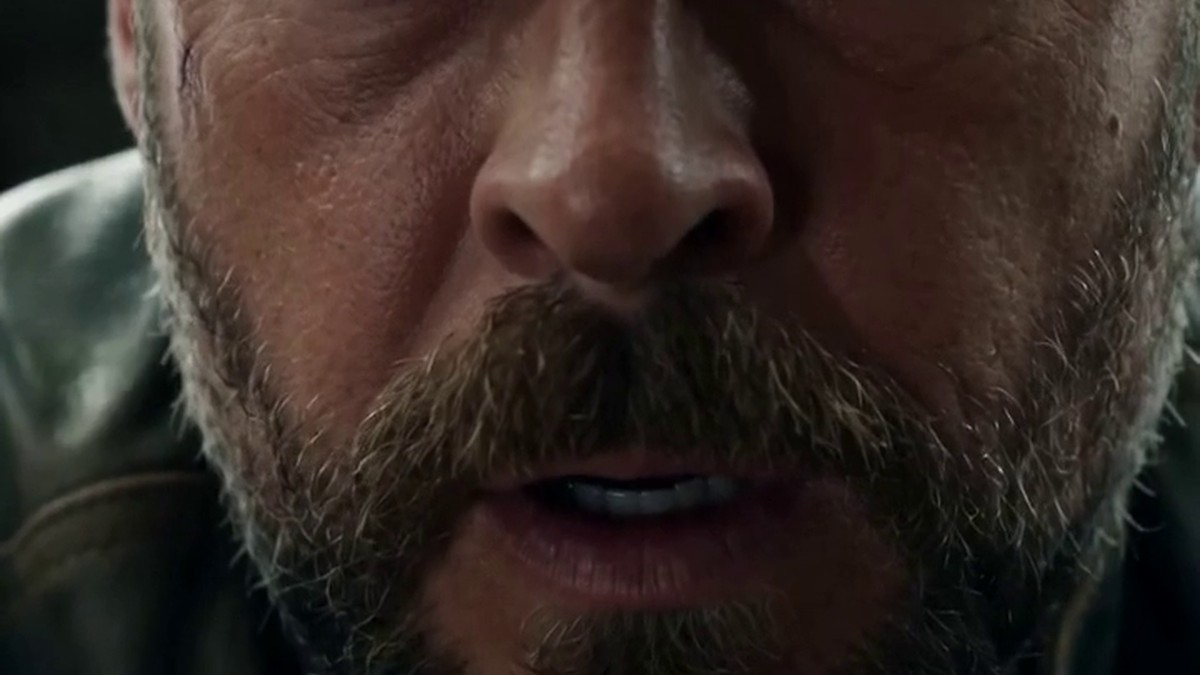
A biker parted the crowd without a word. He dropped to one knee, picked up her other crutch from the floor, and wiped it clean with the side of his hand. Then he set it down beside her. Gently. Like it mattered.
The wealthy woman across the room crossed her arms tight.
“Mind your own business.”
He didn’t look at her.
His eyes had already found the torn handbag — and something that had spilled out from it. Small. Silver. Worn down to almost nothing.
A bracelet.
He turned it over slowly in his fingers.
And stopped.
Four words, engraved on the inside. Faded, but still there.
*Never stop looking.*
The air left his lungs.
The woman on the floor lifted her eyes to him. Hers were wet with tears she hadn’t meant to shed.
“You…”
The word barely made it out of her throat.
“…Daniel?”
Murmurs rippled through the crowd. Confused looks. No one understood.
The biker peeled the leather glove from his right hand. Slowly. Deliberately.
A scar ran across his wrist — long, pale, unmistakable.
The woman’s breath caught. With a shaking hand, she pulled back her own sleeve.
The same scar. Same wrist. Same shape, like two halves of the same wound.
The wealthy woman backed up a step. Her composure cracked, just slightly.
“What exactly is going on here?”
Neither of them answered her. Neither of them even looked her way.
The biker stared at the bracelet resting in his palm. When he finally spoke, his voice was barely above a whisper — meant for no one but himself.
“I’ve been looking for you for twenty years.”
The room forgot how to breathe.
And then — before she could get a single word out —
Tires screamed against pavement outside.
A black SUV jolted to a stop at the curb. Three men in dark suits were out the doors before the vehicle fully stopped moving. Their eyes swept the room, landed on the bracelet, and hardened instantly.
One of them raised his voice.
“Nobody leaves.”
The biker didn’t look up right away.
He closed his fingers around the bracelet slowly, deliberately, the way you close your hand around something you’ve spent half your life trying to hold onto. Then he rose to his feet.
Six-foot-two. Shoulders built like a doorframe. Twenty years of road and grief packed into the set of his jaw.
He looked at the three men.
“Wrong room,” he said.
The one who’d spoken — heavyset, silver tie, the kind of face that had never once been told no — took a step forward. His hand moved toward his jacket.
“The bracelet. Hand it over. Right now.”
A woman near the back whimpered. Someone’s coffee cup clattered to the floor. The crowd began pressing toward the walls, slow and instinctive, like a tide pulling back before something breaks.
The biker didn’t move.
Behind him, on the floor, the woman — his sister, his blood, the person he’d driven through three states and fourteen years of dead ends chasing ghost-thin rumors to find — pushed herself up against the wall with her one good crutch. Her sleeve was still pulled back. The scar caught the light.
“Daniel.” Her voice was a wire pulled tight. “They’ve been following me for six months.”
He didn’t turn around. His eyes stayed on the men.
“I know,” he said. “I know about Hargrove. I know about the account. I know about the night they came to the house.”
The heavyset man went very still.
Behind him, the other two spread sideways. Professional. Practiced. They’d done this before, in other rooms, with other people who hadn’t walked away to tell anyone about it.
The wealthy woman near the window — silk blouse, diamond stud earrings, the crossed arms she’d never quite uncrossed — finally moved. She stepped backward toward the service corridor. Quietly. Like she was trying to become invisible.
Daniel noticed.
“Don’t,” he said. Not to the men. To her.
She froze.
“You called them,” he said. “Didn’t you.”
It wasn’t a question. The silence that followed was its own answer.
Her composure did something complicated — tried to hold, cracked, held again in a different shape. Not guilt. Something colder.
“I protect what I’m paid to protect.”
“You’re a lawyer,” his sister said from the floor. Her voice had gone flat and hard. “You’re supposed to protect me. You drafted his will. You knew what was in it. You knew what they’d do when I found it.”
The lawyer said nothing.
The heavyset man’s patience ran out.
He pulled the jacket back.
The gun was there.
“Last time,” he said. “The bracelet. And whatever she told you.”
Daniel held his ground. The floorboards were old beneath his boots. The light was the watery gray of a morning that hadn’t decided what it wanted to be yet. He could hear his own heartbeat — steady, strange, almost calm.
Twenty years.
Twenty years of phone calls that went dead. Of driving past the house three times before he found the nerve to stop. Of a PI in Columbus who took his money and vanished. Of a photograph — one single photograph — tucked behind the lining of his jacket, cracked at the fold, her seven-year-old face smiling up at him every time he reached for his wallet.
He hadn’t come this far to hand anything over.
He moved.
Not toward the men. Sideways — fast, cutting the angle — and his shoulder hit the nearest display rack hard enough to send it across the floor in a sprawl of metal and merchandise. The rack took the heavyset man’s legs out. He went down with a sound that was more surprise than pain.
The second man lunged.
Daniel caught the wrist, used the momentum, put him into the wall at the kind of speed that ends arguments. Plaster cracked. The man’s knees buckled and he slid down it slowly, eyes gone somewhere distant.
The third one had his weapon out.
Everyone in the room screamed at once — a single ragged collective sound — and the crowd collapsed into itself, surging for the door in a wave of elbows and dropped bags.
Daniel stood still.
The gun was level. Ten feet. The man behind it was breathing hard and trying to look like he wasn’t.
“You have no idea,” the man said, “who you’re dealing with.”
“Hargrove,” Daniel said. “Import firm. Three warehouses in Jersey. The money goes in as equipment costs and comes out somewhere the IRS has never thought to look.” He watched the man’s eyes. “Your boss has been laundering through my father’s estate for fifteen years. And my sister found the documentation. All of it. Because she’s smarter than any of you gave her credit for.”
A beat.
“The documentation isn’t in that bracelet,” Daniel continued. “It’s already transmitted. It went out forty minutes ago to a federal inbox and two investigative journalists whose names you probably know.” He tilted his head slightly. “So you can shoot me. Or you can think about what happens next either way.”
The gun wavered. Just slightly. Just enough.
Sirens.
Not far. Getting closer fast — the kind of wall of sound that means someone had already called it in, that the dominoes were already falling before anyone in this room had said a word.
The lawyer by the corridor door made a sound — a sharp, short exhale, something between a laugh and a collapse — and sat down on the floor in her silk blouse like her legs had simply stopped working.
The man with the gun looked at his two associates. One still down. One conscious but not functional. He looked at the door. Looked at Daniel.
He set the gun on the floor.
Stepped back.
Put his hands up.
—
The paramedics came in behind the police.
One of them crouched beside Daniel’s sister with the practiced calm of someone who had seen worse, though she was quick and gentle about the crutch and the wrist she needed to examine. His sister let herself be examined. She was looking at Daniel the whole time.
He was sitting on the floor beside her. His back against the wall. The bracelet still in his hand.
She had their mother’s eyes — he’d forgotten that, or maybe blocked it, or maybe just never let himself remember it because it was too much to carry. Brown, dark, a little too direct. She looked at you like she was deciding whether you were worth the trouble and had already decided you were.
“How did you find me?” she asked.
“A woman in Akron.” He turned the bracelet over. “Said she’d bought a crutch secondhand from a woman who fit your description. The crutch had your name scratched on the grip. Figured you’d been through there.” He paused. “That was six weeks ago.”
She was quiet for a moment.
“I scratched my name on everything after they got into the apartment. So if anything happened, there’d be—”
“A trail.”
“Yeah.”
He nodded slowly.
Outside, the SUV was getting taped off. The three men were on the curb in zip ties, the heavyset one loudly explaining his rights to an officer who wasn’t listening. The lawyer sat in the back of a squad car with a look on her face that had passed through denial and was working its way toward the arithmetic of consequences.
“I never stopped,” Daniel said. He wasn’t looking at her now. Looking at the bracelet. “Looking. I never stopped.”
She reached over and put her hand over his. The scarred wrist against his scarred wrist, the two pale lines that matched — that had always matched — because they’d been seven and nine years old and they’d made a promise the way children make promises, with a piece of glass and absolute certainty and no idea what it would cost.
“I know,” she said.
The morning outside had made up its mind. Light came through the storefront glass in long flat angles, catching the dust still settling from the fallen rack, making it look almost like snow.
She leaned her head against his shoulder.
He closed his hand around the bracelet — both their hands now — and held on.
The room around them was all noise and movement and the crackle of radios and strangers asking questions no one was quite ready to answer yet.
But right there, in that corner, against that wall, in the middle of everything —
it was quiet.
The way it is when something that’s been lost for twenty years finally stops moving.