Champagne without end. Imported cars three rows deep at the entrance. And the kind of laughter that only comes when people believe nothing can touch them.
It was that kind of laughter — cruel, thoughtless, absolute — that erupted when a young hotel employee lost her footing and plunged into the pool.
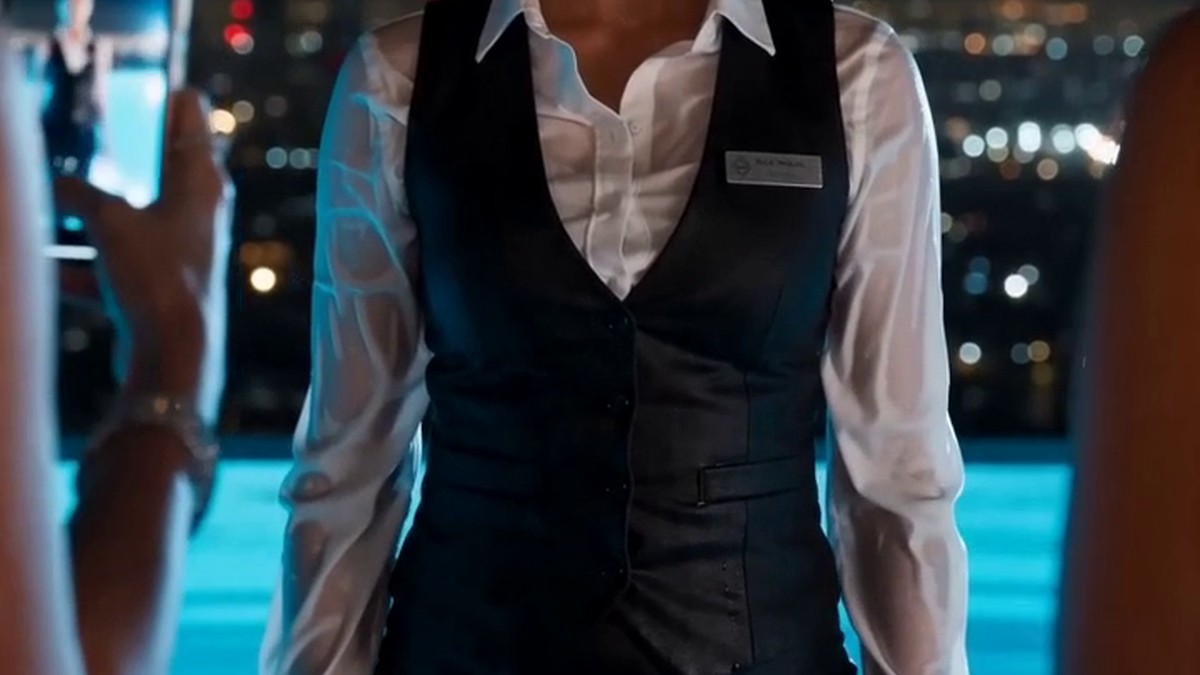
Maya broke the surface gasping. Soaked uniform. Ruined composure. Dozens of phones already raised, already recording.
The two socialites responsible were nearly doubled over.
“Maybe she belongs in the water,” one of them said.
The crowd rewarded that with more laughter.
Maya didn’t cry.
She didn’t raise her voice. She didn’t plead with anyone to stop.
She simply pulled herself out of the pool, stood upright, and looked directly at the two women who had done this to her.
Then she spoke — one quiet sentence that cut through the noise like a blade.
“My father warned me this would happen.”
The laughter died instantly.
Confusion rippled across the terrace. Guests exchanged uncertain glances.
Maya reached beneath her soaked collar and drew out a silver pendant. She had kept it hidden all summer — tucked beneath every uniform she’d worn, a private reminder of who she was and why she was here. She hadn’t planned to reveal it. But the experiment was over now, and she lifted it fully into the light.
The official crest of Jakarta’s municipal government.
Several people recognized it before the pendant had finished swaying.
Cassandra went pale. The color left her face all at once, like a tide pulling back.
Olivia’s smile didn’t fade — it simply ceased to exist.
Because the woman they had mocked and humiliated all evening wasn’t just a hotel employee.
She was Maya Santoso.
The mayor’s daughter.
And every phone still recording suddenly held something far more dangerous than a viral moment.
—
The silence on that rooftop had weight.
You could feel it pressing down on every bare shoulder, every silk blouse, every carefully constructed version of someone’s best self. The kind of silence that doesn’t just stop sound — it reverses it, pulls it back into your throat before you can make a sound you’ll regret.
Cassandra recovered first. That was her gift — the ability to reassemble herself in seconds, to layer confidence back on like armor she’d been wearing since boarding school.
“Maya Santoso.” She said the name slowly, testing it, as if she might be able to neutralize it by simply speaking it aloud. “I had no idea. You should have said something. We were just—”
“Playing,” Maya said.
One word. Flat as concrete.
“We were just playing around,” Cassandra continued, her voice finding its old smoothness. “No harm meant. You know how these parties get.”
Maya stood at the edge of the pool in her soaked uniform, water still running in rivulets down her forearms, dripping from the hem of her skirt onto the tile. She hadn’t moved to dry herself. She hadn’t reached for a towel. She held the pendant between two fingers and let it catch the overhead light.
“I know exactly how these parties get,” she said. “That’s why I’m here.”
Olivia, who had not spoken since her smile disappeared, finally moved. She stepped forward with the careful precision of someone who knows she’s made a terrible mistake and is trying to calculate whether charm can still save her.
“Look,” Olivia said, “let’s start over. Let me get you something dry to wear. There’s a boutique on the lobby level — I’ll cover whatever you need—”
“I’m not cold,” Maya said.
“I didn’t say you were cold, I just thought—”
“I know what you thought.” Maya looked at her directly, the way she had looked at both of them from the water. No anger in it. No performance. Just total clarity. “You thought I was no one. And when you think someone is no one, you don’t calculate. You just act.”
The phones were still up. Not recording to post anymore — people had quietly lowered those ambitions — but up because no one wanted to be caught off guard. Everyone could feel that the night had pivoted on its axis and was now tilting somewhere new, somewhere none of them had dressed for.
A man near the bar muttered something to the woman next to him. She shook her head and moved slightly away, as if proximity to the wrong person could still be managed.
—
The hotel manager arrived seven minutes later.
His name was Darmawan, and he was a compact, silver-haired man who had spent twenty-two years learning to read a room before he crossed its threshold. He read this one from the elevator. He read it from the look on the bartender’s face. He read it in the specific way that Cassandra Lim was standing — too straight, too still, the body language of someone who has decided that movement might be interpreted as guilt.
He went directly to Maya.
“Miss Santoso.” He spoke quietly enough that it wasn’t a broadcast. “Your father has been informed. He asked me to relay that he’s on his way.”
Something moved across Maya’s face then. Not relief. Not triumph. Something older than either of those — the expression of someone who made a decision a long time ago and is now watching it arrive.
“Tell him I’m fine,” she said.
“He’ll want to see that for himself.”
“Yes,” she said. “He will.”
Darmawan gave a small, careful nod and withdrew. But the word had moved through the terrace before he’d even reached the elevator. *Her father is coming.* It traveled mouth to ear in a matter of seconds, and with it came a recalibration so swift it was almost physical — people straightening, setting down glasses, suddenly finding reasons to drift toward the far end of the terrace or slip indoors.
Cassandra did not drift. She stayed.
That surprised Maya, she admitted to herself. She’d expected the retreat. The vanishing act. The sudden urgent phone call that required stepping away. Cassandra had enough lawyers on speed dial to make anyone disappear temporarily.
But she stayed. She smoothed the front of her dress and she stayed.
—
Mayor Santoso arrived at twenty past eleven.
He was not a large man — that was always the first thing people noticed, then immediately forgot, because he moved through space as though he were larger than it. He had his daughter’s eyes. The same quality in them: not hard, not cold, but absolutely, uncomfortably present.
He stepped onto the terrace without looking at anyone except Maya.
He crossed to her, took both her hands in his, and looked at her the way fathers look at children they’ve spent a lifetime trying to protect from exactly this kind of thing.
“You’re all right,” he said. Not a question.
“I told you I would be.”
“You did.” A pause. Something flickered behind his eyes — not anger, but the particular ache of a man who had warned his daughter precisely because he knew the warning would not be enough to stop her. *This is what I meant*, that look said. *This is exactly what I meant.* He held her hands a moment longer. Then he turned.
The terrace had arranged itself, without anyone consciously deciding to, in a rough semicircle. Guests who’d tried to leave had found themselves somehow still present. The few who’d actually made it to the elevator had been intercepted by staff — politely, firmly, in the way that only well-trained staff in expensive hotels can intercept people without technically stopping them.
The mayor’s gaze moved across the assembled faces until it found Cassandra’s.
“Miss Lim,” he said.
Cassandra Lim was the daughter of a shipping magnate. She had attended schools in Geneva and London. She had navigated boardrooms, charity galas, political fundraisers, and every other theater where power dressed itself up and performed. She knew how to hold ground.
She could not hold it now.
“Mayor Santoso,” she said. “I owe your daughter an apology.”
“Yes,” he agreed. “You do.”
The word *yes* contained no warmth. It wasn’t cruel either. It was simply accurate — a man who dealt in facts delivering one.
Cassandra turned to Maya. She did something then that no one on the terrace expected, least of all Maya: she didn’t offer a polished speech. She didn’t invoke the chaos of the evening or the champagne or the crowd. She didn’t explain.
She said: “I’m sorry. What I did was degrading and unkind. I have no excuse for it.”
The silence that followed was different from the earlier silence. That one had been shock. This one was something rawer — the particular discomfort of watching someone actually reckon with themselves.
Olivia, who had been standing two steps behind Cassandra all this time, came forward. Her face had lost everything it usually wore — the gloss, the performance, the thousand practiced expressions.
“I’m sorry,” she said to Maya. “I laughed. I made it worse. I’m sorry.”
Maya looked at both of them for a long moment.
The phones were down now. All of them. No one was recording. Whatever happened next belonged only to the people on this rooftop, under this sky, in this specific and unrepeatable moment.
“I know you are,” Maya said finally.
Not *it’s fine.* Not *don’t worry about it.* Just: *I know.*
Because she did. She could see it. And she had not come here to perform cruelty any more than she’d deserved to receive it.
—
The mayor did not press charges.
The footage — and there was footage, hours of it on dozens of devices — did not circulate. Not because it was suppressed, but because the people who held it had stood on that terrace and watched what came after, and found that they no longer wanted to be part of a story whose ending they had witnessed.
Some of them would talk about that night for years. Not the push, not the laughter — but the moment a young woman stood dripping at the edge of a pool and looked her humiliators in the eye with something that wasn’t anger and wasn’t forgiveness exactly, but was steadier than either. The moment she chose what the night would be about.
Maya went back to work two days later.
Not at the hotel. At her father’s office, where she had been interning since the beginning of the summer — the internship she’d convinced him to let her do undercover, in the field, at ground level, because she’d wanted to understand what the city he governed actually felt like from the bottom of it.
He had agreed, reluctantly. But he’d made her promise one thing: *Keep the pendant. If it ever gets bad enough, use it.* She’d thought he meant danger. She understood now that he’d meant something broader — that there would come a moment when the experiment had given her everything it could, and pretending to be no one would cost more than it was worth.
She understood now.
She sat at her desk by the window and looked out at Jakarta — its rooftops and its traffic, its heat and its noise and its ten thousand daily humiliations and dignities — and she wrote three pages of notes.
About hotel labor policy. About worker protections. About the specific and corrosive way that class moved through a room. About what it felt like to be shoved into a pool while strangers laughed and reached for their phones, and how that feeling didn’t leave you just because you turned out to be the mayor’s daughter. How it stayed in your body, available, useful, impossible to unfeel.
Her father knocked and entered without waiting. He looked over her shoulder at what she was writing. He didn’t say anything for a moment.
Then: “Your mother would say you get the stubbornness from me.”
“She’d be right,” Maya said.
He laughed — the kind of laugh that has grief folded inside it — and then he grew quiet, and she could feel him standing there the way he’d stood on the terrace, looking at her with that complicated mixture of pride and pain.
“I told you it would happen,” he said.
“You did.”
“I didn’t think you’d turn it into three pages of policy notes.”
Maya looked up at him. “What did you think I’d do?”
He considered this seriously, the way he considered everything. “I thought you’d come home.”
“I’m still here,” she said.
He set a hand briefly on her shoulder and left her to her work.
Outside, Jakarta moved through itself the way cities do: indifferent and inexorable, full of people who were no one until they were, full of moments that meant nothing until they meant everything.
Maya kept writing.