Crystal chandeliers threw fractured light across floors buffed to mirror-shine.
Champagne materialized the moment a glass emptied.
Politicians rubbed elbows with CEOs. Celebrities air-kissed old-money heiresses. Every seat at every table represented a dynasty.
This wasn’t a wedding.
It was a coronation.
And the woman doing the crowning was Victoria Sterling.
Three decades. One empire. Zero compromises.
She ran the company like a general runs a war — with total information and no mercy.
She ran the family the same way.
So when her son Julian chose Elena, Victoria didn’t rage.
She plotted.
Elena was wrong. Wrong background, wrong bloodline, wrong everything. Victoria had decided that before the introductions were even finished.
All evening she’d kept her feelings barely submerged — forced smiles sharp as broken glass, compliments that landed like open-handed slaps.
But patience had limits.
Just before the first dance, Victoria reached hers.
She moved to the center of the ballroom with the easy authority of someone who had never once been told no.
She grabbed Elena’s left hand.
Before a single guest could process what they were seeing —
She stripped the diamond engagement ring clean off the bride’s finger.
The room sucked in its breath as one.
Julian was already moving. **”Mother. Give it back.”**
She didn’t look at him.
She raised the ring above her head like a verdict, letting the chandelier light tear through the stone for every witness in the room.
**”This family,”** she said, her voice carrying to the farthest corner, **”is not something you inherit.”**
**”It is something you earn.”**
Then she pivoted toward the open terrace doors.
A hundred phones rose above the crowd like raised hands at a revival.
One flick of the wrist.
Effortless. Decisive. Final.
The multimillion-dollar ring tumbled into the dark river below and disappeared without ceremony.
Silence swallowed the ballroom whole.
Victoria turned back to the room wearing the expression of someone who had just closed a deal.
She expected Elena to crumble. To dissolve into tears, into begging, into the kind of humiliation that follows a woman for the rest of her life.
Elena laughed.
Barely audible. Quiet and unhurried.
Just loud enough for Victoria to hear every note of it.
The satisfaction drained from the older woman’s face.
**”Something amusing you?”**
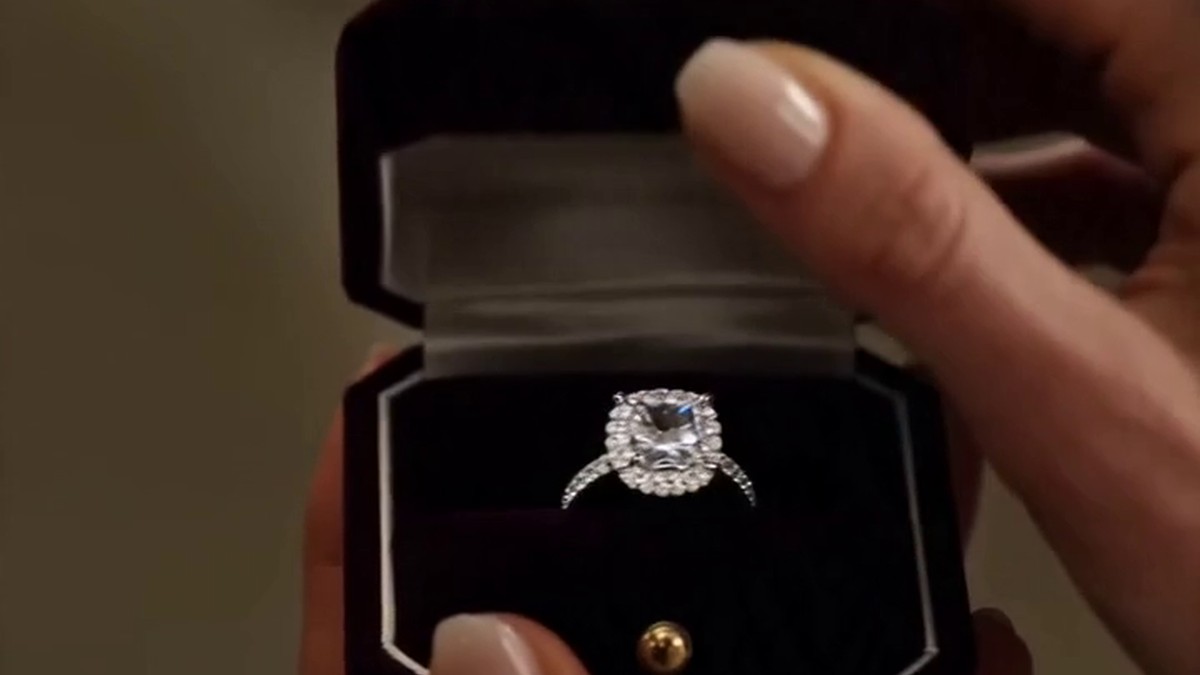
Elena reached into her handbag and produced a small velvet box.
She opened it without haste.
Inside sat a diamond ring — cut for cut, stone for stone, identical to the one now resting on the riverbed.
The guests looked from ring to ring to Victoria. No one spoke.
Victoria’s jaw tightened. **”What kind of game is this?”**
Elena slid the second ring onto her finger and smoothed it into place as though she were finishing a sentence.
Then she looked Victoria directly in the eyes and held her gaze there.
**”The ring you just threw into that river wasn’t my engagement ring.”**
Dead silence.
**”It was the encrypted master key your financial adviser has been tearing his office apart looking for all week.”**
The color left Victoria’s face like water leaving a drain.
Only a handful of people alive knew such a key existed.
Sealed inside that stone was the sole portable access device connected to thirty years of buried financial architecture — shadow accounts, shell companies, laundered transactions, confidential records that had somehow survived every audit, every investigation, every subpoena ever pointed at the Sterling name.
Elena’s gaze drifted, unhurried, toward the ballroom entrance.
Three black SUVs had rolled silently into the driveway, headlights cutting through the dark.
She let the moment breathe before she spoke again.
**”You should have let me keep it.”**
A beat.
**”Now nobody can touch the evidence before they walk through that door.”**
Every head in the room turned.
The front doors were already opening.
Victoria Sterling stood in the center of her ballroom, under her chandeliers, surrounded by every person whose opinion she had ever valued —
And for the first time in thirty years, she was not running the evening.
She was the story.
The agents came in clean and quiet, the way authority does when it doesn’t need to perform.
Six of them. Dark suits, federal credentials already in hand, eyes scanning the room with the practiced calm of people who had rehearsed this moment more carefully than any of Victoria’s caterers had rehearsed the canapés.
The ballroom, which had survived three decades of calculated spectacle, did not survive the next ninety seconds with its dignity intact.
Champagne flutes lowered in slow motion. The orchestra — a twelve-piece ensemble flown in from Vienna — let their instruments die one by one, strings trailing off like questions nobody wanted to finish asking.
The lead agent was a woman. Early forties, dark hair shot through with silver, a bearing that suggested she had stood in rooms like this before and found them considerably less impressive than the people inside them believed.
She stopped two feet short of Victoria Sterling.
“Mrs. Sterling.” Not a greeting. A filing.
Victoria’s chin came up. Thirty years of boardroom survival instinct fired all at once. Her expression reset itself into something composed, almost serene — the face she wore when she intended to make someone feel very small.
“I don’t know who invited you,” Victoria said, “but I can assure you, this is a private—”
“Jacqueline Mercer, FBI Financial Crimes.” The badge came up, held steady. “We have a warrant for your arrest and authorization to seize all financial records connected to Sterling Group Holdings, its subsidiaries, and sixteen associated shell entities operating under—”
“This is absurd.” The composure held. Barely. “My attorneys—”
“Are being contacted as we speak.” Mercer’s voice carried no heat. That was somehow worse than anger. “You can call whoever you’d like, Mrs. Sterling. The warrant is valid. The grand jury indictment was filed this morning.”
The word *indictment* moved through the crowd like a slow electrical charge. Across the room, a senator — whose campaign Victoria had personally funded three election cycles running — took two quiet steps backward, as though proximity itself might be incriminating. A CEO whose company had benefited enormously from one of Victoria’s shadow arrangements suddenly became very interested in his phone. An old-money heiress who had air-kissed Elena forty minutes ago turned to her husband and said something barely audible.
Everyone was triangulating. Everyone was calculating distance.
That was the thing about power built on favors and fear. The moment the center stops holding, every single person who benefited from it begins reconstructing their own history as fast as they can think.
Victoria Sterling, who had spent thirty years knowing exactly who owed her what, watched it happen in real time.
Julian had not moved from where he stood.
He was watching his mother the way you watch something you once loved and no longer recognize — with a grief that hadn’t quite figured out how to be anger yet.
“Julian.” Victoria’s voice changed register. The general retreated. Something older and more frightened took the controls. “Julian, you need to call Marcus. You need to—”
“Marcus Hale,” Elena said quietly, “resigned this morning and has been cooperating with federal investigators for eleven days.”
Marcus Hale. Victoria’s financial architect. The man who had built thirty years of hidden infrastructure, account by account, shell by shell. The man currently tearing his office apart for a key sealed inside a ring that was now resting somewhere dark and cold at the bottom of a river.
Victoria turned to look at Elena. Really look.
She had been looking at her all evening — cataloguing her flaws, measuring her wrongness, engineering her humiliation. But she had never once actually *seen* her.
She saw her now.
“Who are you?” The words came out stripped of performance. Raw in a way Victoria’s voice had probably not been in a very long time.
Elena didn’t answer immediately. She stood with the second ring on her finger — the real one, Julian’s ring, the one that had never been anywhere near a river — and she let the question hang in the chandelier light for a moment.
Then: “I’m the woman who spent eight months building a case that your own people were too afraid to build. Because I watched what you did to the people who couldn’t fight back. The employees. The families. The ones who didn’t have enough money to make the problem go away.”
Her voice was even. It was the evenness that made it devastating.
“The ring you threw into that river was a decoy. We built it four weeks ago. We knew you’d find a way to get close to me tonight. We knew you’d try something.” A pause. “You’re predictable, Mrs. Sterling. When you’re frightened, you reach for destruction. You always have.”
Victoria’s mouth opened. Closed.
“The actual key,” Elena continued, “has been in federal custody since yesterday.”
The air in the ballroom had weight now. Something collapsed — not dramatically, not with noise, but with the quiet finality of a structure that has lost its load-bearing wall.
Agent Mercer produced a second document and held it where Victoria could see it.
“Ma’am, I’m going to ask you to come with us now.”
Julian finally moved.
He walked toward his mother — not quickly, not with anger — and he stopped close enough that the conversation belonged only to them.
“I tried,” he said. “I tried to tell you. I tried for three years.”
Victoria looked at her son. Something flickered across her face that might have been, in another life, the beginning of an apology.
But she had spent too long being Victoria Sterling to know how to finish it.
“The lawyers will—”
“Mom.” His voice broke on the word. Quietly. Just once. “Stop.”
She stopped.
The agents stepped forward. Mercer moved to Victoria’s right side with a professionalism that left no room for argument or theater.
Victoria Sterling — who had entered the room as its architect, its empress, its gravitational center — walked out of it between two federal agents, through the doors she had chosen, across the marble floors she had commissioned, past every face that had once arranged itself into deference when she entered a room.
Nobody moved to stop her.
Nobody said her name.
The chandeliers kept throwing their fractured light. The champagne sat in its glasses, going warm and flat.
Julian stood where she had left him.
Elena came to him. Not with words — there were no words architecture for the next few minutes. She came with presence. She took his hand and stood beside him and let him feel whatever he needed to feel without requiring it to be anything else.
Outside, car doors closed with bureaucratic finality.
The sound reached the ballroom through the open terrace doors — the same terrace where the ring had disappeared, where the first fissure in Victoria’s careful evening had opened up.
Someone, somewhere in the ballroom, set down a champagne glass.
The sound of it, crystal on tablecloth, was somehow the most human thing that had happened all night.
Julian turned to look at Elena.
“You could have told me,” he said. It wasn’t an accusation. It was something quieter. The bruised question of a man who understood why and still needed to ask.
“I wanted to. Every day for eight months.” She turned his hand over in hers, the ring catching the light between them. “But you love her. And I needed you to be able to live with yourself after. If you’d known, it would have felt like choosing. This way—” She exhaled slowly. “This way, you didn’t have to choose. It chose itself.”
He was quiet for a long moment.
Around them, the ballroom had begun its own slow reorganization — people finding their coats, finding their composure, finding the exits. The catering staff moved through the aftermath with the silent efficiency of people paid to pretend that extraordinary things are ordinary.
“Did you actually love me,” Julian said, “or was I part of the case?”
The question fell between them like a stone.
Elena looked at him. Steady. Unflinching. The same way she had looked at Victoria — except softer now. The difference between a weapon at rest and a weapon in use.
“I loved you before I found the files,” she said. “I kept working the case because I loved you. Because somebody had to stop her before she handed you a legacy you couldn’t put down.”
A beat passed. Then another.
Outside, the first SUV pulled away down the drive.
Julian closed his hand around hers — slowly, deliberately, the way you hold something you almost lost — and he brought her knuckles to his mouth and kept them there.
The ballroom that had started the evening as a coronation ended it as something smaller and truer. No dynasties. No verdicts from on high. Just two people standing in the wreckage of something enormous, deciding what to build in the space it left behind.
The chandeliers kept burning.
The river kept moving.
Somewhere at the bottom of it, a decoy ring sat in the dark, holding no secrets at all.





