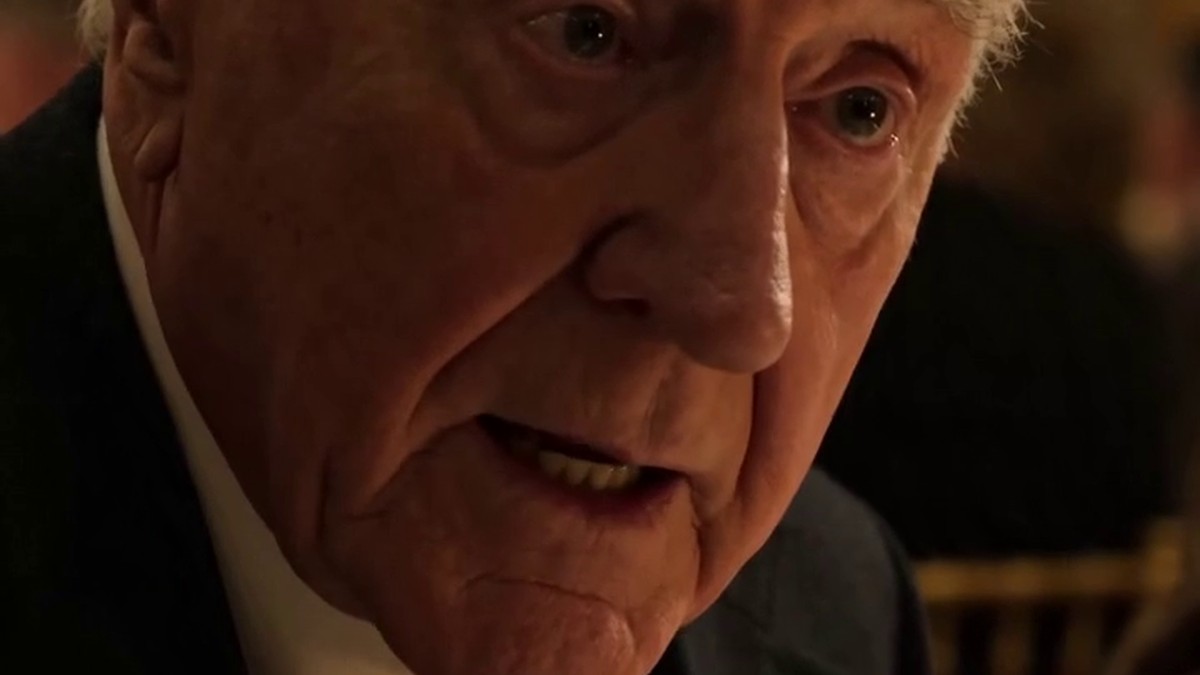
She stood beside the old man’s private table like something the night had blown in — a child who clearly belonged to a different world entirely.
Her brown jacket was two sizes too big, swallowing her narrow shoulders whole.
Her hair was a mess of tangles.
Dirt traced thin lines down both her cheeks.
And her eyes — exhausted, hollow with hunger — had locked onto the untouched bread beside his plate like it was the only fixed point in her universe.
Her voice came out barely above a breath.
“Can I sit here?”
The old man hadn’t even opened his mouth before a security officer materialized behind her and closed a hand around her shoulder.
“You need to leave. Now.”
The girl flinched like she’d been struck. Her whole small body went rigid.
But she didn’t bolt.
She held the old man’s gaze, her lips trembling, and whispered,
“I’m just hungry.”
The ambient hum of the dining room — silverware against porcelain, murmured conversations, soft laughter — began dissolving around them.
Heads turned at neighboring tables.
The officer tightened his grip and started walking her back.
Then the old man raised one hand.
“Wait.”
One word. Quiet. Absolute.
The officer stopped mid-step.
The entire room seemed to hold its breath.
The old man studied the child — really studied her. The grime on her face. The faint tremor in her tiny hands. The way her jaw was clenched tight against tears she refused to let fall.
Something shifted in his expression.
Not pity.
Something heavier than that. Older.
“Sit,” he said softly. “Eat. Stay.”
The girl stared at him the way people stare at something they don’t quite trust — as if his kindness scared her more than the guard’s grip had.
Then, slowly, she climbed into the gilded chair beside him.
He tore a piece of warm bread and set it gently in front of her.
Her eyes welled up immediately.
But she didn’t reach for it.
Instead, she dug both hands into her jacket and carefully withdrew a small folded napkin, creased like it had been handled a hundred times.
She extended it toward him with the gravity of someone delivering something sacred.
“My mom said to give this to the man with white hair.”
The old man’s brow creased. He unfolded the napkin slowly.
Inside lay an old family ring.
His hand began to tremble the instant his eyes found it.
The color drained from his face all at once — like a light being switched off.
He stared at the ring. Then at the girl. Then back at the ring, as though he were peering down into something long buried and sealed shut.
His voice came out fractured, barely there.
“Where is your mother?”
The little girl looked up at him — eyes tired, eyes honest, eyes carrying no weight of what any of this meant.
“She said you left us here.”
The old man’s chair shrieked against the marble floor as he lurched back.
Every head in the restaurant turned.
Because whatever this child had just carried through the door with her in that small folded napkin —
it wasn’t finished.
And the look spreading across the old man’s face — raw, hunted, the look of a man watching a wall come down — made one thing perfectly clear.
This was a secret he had spent years convincing himself would never find him.
It just did.
The bread sat untouched between them.
Neither of them moved.
The old man’s hand — the one holding the ring — had closed into a fist so tight his knuckles had gone white as bone. The other hand lay flat against the tablecloth like he was bracing himself against a current.
He looked at the girl again.
Really looked.
And the room seemed to tilt slightly on its axis.
Because he could see it now. Had been seeing it the whole time without letting himself see it. The particular shape of her eyes. The way her mouth set when she was trying not to cry. The stubborn, dignified refusal to collapse — even hungry, even dirty, even alone in a room full of people who thought she didn’t belong there.
He knew that expression.
He’d seen it in the mirror for decades.
“What’s your name?” he asked. His voice was very quiet and very careful, the way you speak when you’re afraid of what an answer might do to you.
“Maya,” the girl said.
Something in his chest cracked open like dry wood.
“And your mother.” He paused. Steadied himself. “Her name.”
“Lena.” Maya watched him with those old, patient eyes. “She said you’d know it.”
He did.
God help him, he did.
—
Lena Voss.
Twenty-three years ago she had been twenty-two years old and radiant in a way that made people stop in the middle of sidewalks. She’d been studying architecture, living in a one-room apartment above a bakery, and she had laughed — *laughed* — at everything he said, even when he wasn’t trying to be funny.
He had been fifty-one. Newly widowed. Newly hollowed out. And catastrophically foolish.
It had lasted eight months. Long enough to matter. Long enough to break things that couldn’t be put back the way they were.
When it ended, it ended the way cowardly things end — without ceremony, without honesty, without looking someone in the eye and telling them the truth. He had simply gone back to his life, his board rooms, his country house, his name. Left her a sum of money wired to an account she hadn’t asked for and told himself that was the shape of a clean conscience.
He had never once looked back.
Because looking back would have required a different kind of man than he had been willing to be.
—
“Where is she?” he asked again, and this time he couldn’t keep the urgency out of his voice. “Maya. Your mother — where is she right now?”
“Outside,” Maya said simply.
The old man was already rising from his chair.
“Outside *where*?”
“On the steps.” The girl blinked at him. “She was too scared to come in.”
He crossed the restaurant floor the way a man walks through fire — not fast, but without hesitating, without looking left or right at the faces turning to follow him. The maître d’ moved to intercept him and thought better of it. The security officer stepped aside. The crystal chandeliers burned above him in total indifference.
He pushed through the heavy brass door.
—
The night outside was cold and clear, the city lit below the steps in a long glittering sprawl.
And there she was.
Sitting on the bottom step with her arms wrapped around her knees.
She had aged the way struggle ages people — honestly, unsparing, every year written plainly in her face. Her hair was the same dark color but the light had gone dull in it. There were lines around her eyes that hadn’t been there before. Her coat was thin for the weather.
But her jaw was set exactly the way he remembered.
And when she heard the door and looked up — when her eyes found him — she didn’t flinch. Didn’t look away.
That surprised him. He had expected anger. He had expected shaking. He had deserved both.
Instead she just looked at him the way someone looks at a problem they’ve been solving for a very long time and have finally run out of alternatives.
“She found you,” Lena said.
“She found me.” He stood at the top of the steps. Didn’t trust himself to go closer. “Why didn’t you come in?”
“Because.” She exhaled slowly. “I didn’t want to beg you for anything. I never wanted that.” A pause. “But she’s hungry, and I’m out of ways to fix it myself.”
The admission cost her something. He could see it in the slight tightening of her mouth.
He walked down the steps.
She watched him come without moving — straight-backed, guarded, her pride worn right there on the surface like armor she’d had to put on so many times it had fused to her skin.
He stopped one step above her.
The ring was still in his closed hand. He opened his fist and held it out to her.
“You kept this,” he said.
“I almost sold it three times.” She looked at it but didn’t take it. “I couldn’t.”
“Why not?”
She was quiet for a moment. Then: “Because I needed her to understand, someday, that the story wasn’t simple. That people aren’t only one thing.” She looked up at him. “Even you.”
He stood there under the cold open sky and let that land.
Let it land the way it deserved to.
“I was wrong,” he said. “What I did. The way I left.” He stopped. Started again. Because hollow apologies were something he could manufacture easily, and she had earned more than that. “I was afraid. Of what it meant. Of what it would cost me. And I decided that *you* should pay that cost instead. That was — ” His voice broke, just slightly, at the edge. He held it. “That was a monstrous thing to do.”
Lena looked at him for a long time.
The city hummed below them. Somewhere far off, a siren. The warm amber light from the restaurant bled out through the door left ajar behind him.
“I know,” she said finally.
Just that.
No forgiveness delivered. No door swung dramatically open.
But no door slammed shut either.
—
He insisted on feeding them both — *properly*, not as charity but as an obligation, which was a distinction she made him understand she cared about. They came back inside together, the three of them. He watched Maya eat with a quiet, focused ferocity that wrecked him completely. She ate the bread. Then soup. Then everything put in front of her without embarrassment and without excess, with a concentration that told him this was not the first time she’d sat across a table from real hunger and it was probably not going to be the last.
He watched his daughter eat and understood, with absolute clarity, the scope of what he had missed.
Not just years.
A *person*. An entire human being who had grown up fierce and patient and exhausted and brave, with her mother’s jaw and his eyes and the particular dignity of someone who had learned not to ask for things.
He had not made her. He had only — in the most biological and least meaningful sense — contributed to her existence.
The world had made her. Lena had made her.
He was simply the man who had left.
—
After, they sat at the table with the remnants of the meal between them. Maya had fallen asleep in the gilded chair with her cheek resting on her folded arm, utterly boneless with the deep, total unconsciousness of a child who has finally felt safe enough to stop fighting.
He and Lena sat across from each other in the quiet.
“I’m not asking you to be her father,” Lena said. “I want to be clear about that.”
“I know.”
“She doesn’t need a father. She needs stability.” A beat. “I need help getting her stable. And then we’re done. You can go back to — ” she gestured vaguely at the gilded room ” — all of this.”
“No,” he said.
She looked at him.
“I’m not going back,” he said. “To the way I was living this. The pretending.” He turned the ring over in his fingers. “I don’t want to be done.”
“That’s not your decision.”
“No,” he agreed. “It’s not.”
She studied him across the table with the same unhurried patience he had seen in her daughter’s face all evening. Measuring. Calculating risk the way someone who’d been burned calculates everything.
“We’ll see,” she said finally.
It was not a yes.
But it was not the wall he had expected. And considering what he had earned, *we’ll see* was something close to mercy.
—
He arranged for a car to take them somewhere safe and warm that night. He did not ask for gratitude and did not receive it, and that felt right.
Before Lena got into the car, she stopped on the sidewalk and turned back.
“She talked about you,” she said. “For the last two years, since she was old enough to understand pieces of it. She asked me what you were like.”
His throat tightened. “What did you tell her?”
Lena was quiet for a moment.
“I told her you were someone who made a serious mistake,” she said. “And that the most important thing about a mistake isn’t that you made it. It’s what you do after.”
She held his gaze for one long, steady moment.
Then she got into the car.
He stood on the sidewalk as it pulled away, the cold working through his jacket, the ring still warming in his closed fist. The city moved around him — indifferent, continuous, alive with ten thousand other stories breaking open and closing shut at this very moment in the dark.
He stood there until the car’s taillights disappeared around the corner.
Then he stood there a while longer.
Because the wall had come down.
And standing in the rubble of what you’ve spent years constructing is not something you rush through.
You stay.
You look at what you built, and what it cost, and what remains.
And then — if you are finally, at the end, the man you should have been twenty years ago — you start figuring out how to make it right.