Celebrities beamed on cue. Reporters hurled questions into the noise. Fans crushed themselves against the barricades, reaching, screaming, desperate to be seen.
Then a little girl ducked under the velvet rope.
Her dress was faded at the hem. Her shoes had been scuffed down to nothing. She looked like a mistake — a smudge on an otherwise perfect canvas of diamonds and designer gowns.
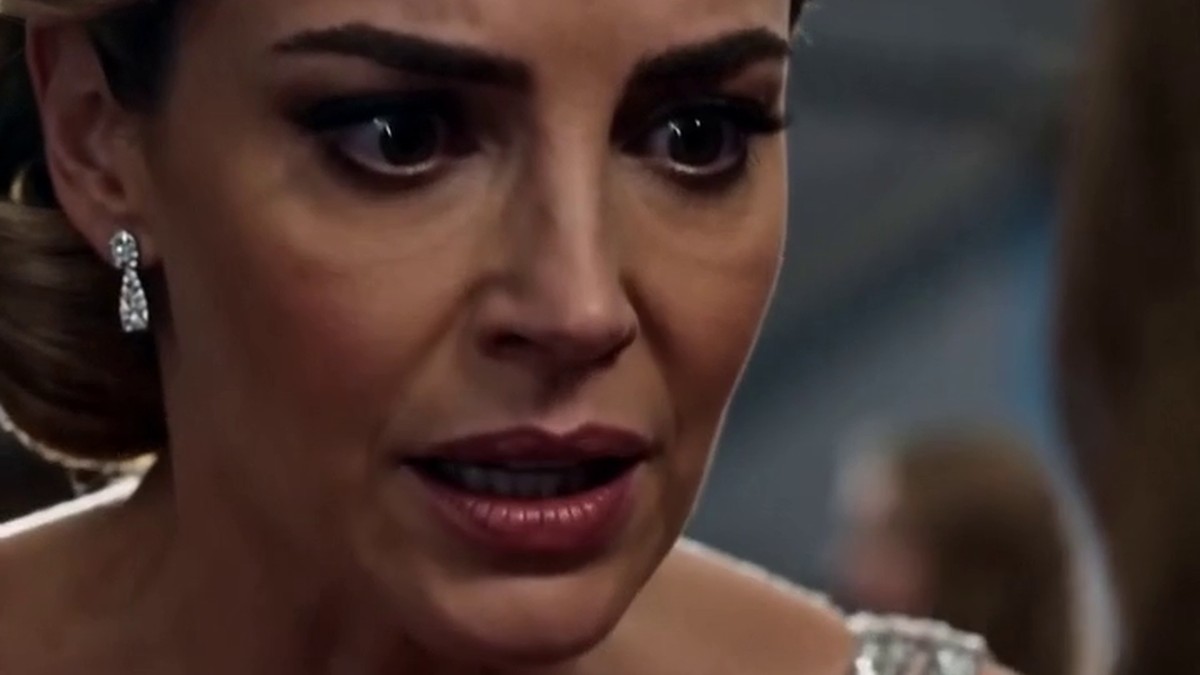
The actress barely cut her eyes toward her.
“Get her away from me.”
Security moved in without hesitation. The crowd barely registered it. Just a disruption. Just a child. Nothing worth slowing down for.
But the girl didn’t flinch.
She stood her ground, both hands wrapped tight around something small. Something old. An hospital bracelet, brittle with age, tied to her thin wrist with a ribbon that had once been pink.
The actress glanced at it.
Then stopped breathing.
The smile drained from her face like color from a wound. Her eyes locked onto the handwriting on that strip of plastic — a name, a date, letters pressed into the surface by someone pressing hard, writing like it mattered, writing like it was the last chance to leave proof of something.
Handwriting she would have recognized anywhere.
Handwriting she knew better than her own reflection.
The little girl swallowed hard.
“My grandmother told me to find you.”
The red carpet noise collapsed into silence around them. Cameras drifted down. Security went still. The whole glittering machine just — stopped.
The actress took one step forward. Her hands had started to shake.
“Where did you get that?”
The girl looked down at the bracelet. Then back up, steady and quiet in a way that made the actress feel unsteady.
“You wrote on it.”
The ground seemed to tilt.
Because she had.
Years ago. In a hospital room she had spent the better part of her life trying to bury — trying to drink under, work under, smile under, until it felt less like a wound and more like a scar.
The little girl turned the bracelet over slowly, deliberately.
There was writing on the back.
Hidden. Pressed tight against the skin. Words meant for no one — or meant only for one person, one moment, one unbearable night that was never supposed to surface again.
The actress read the first few words.
And the blood left her face entirely.
👇 Full story in the 𝘾𝙊𝙈𝙈𝙀𝙉𝙏𝙎.
The writing said: *If she lives, find her. If she doesn’t — forgive me.*
Four words the actress had pressed into the plastic with a ballpoint pen she’d stolen from a nurses’ station at 3 a.m., twenty-two years ago, shaking so hard the letters came out crooked. She’d wrapped the bracelet around the baby’s wrist herself. She’d kissed it. She’d walked out of that hospital before sunrise and told herself it was the only merciful thing she had ever done.
She had told herself that story so many times it had calcified into something that felt like truth.
It wasn’t truth.
It was just the only story she could survive.
—
Her name was Celeste Morrow — though the world knew her by the name her publicist had crafted at twenty-three, sleek and forgettable and easy to print. She had won two awards this year. She had a penthouse. She had a smile that read as warm from fifty feet away and meant absolutely nothing up close.
She had a daughter she had left in a hospital bassinet in a city that no longer existed in the way she remembered it.
And now that daughter was standing in front of her.
Except — no.
She looked at the girl again. Really looked.
Eight, maybe nine years old. Too young. The math didn’t work.
The actress’s voice came out barely above a whisper.
“Who is your grandmother?”
The girl’s chin lifted. There was something in the gesture that was almost defiant, like she’d been coached for this moment, rehearsed it, maybe dreamed it.
“Elena Vasquez.”
The name hit Celeste like a fist to the sternum.
Elena.
Elena, who had been her roommate in that apartment with the broken radiator. Elena, who had held her hand during twelve hours of labor and hadn’t once asked who the father was. Elena, who had been there when Celeste walked out, and who had — apparently — stayed.
“Is she here?” Celeste asked. Her voice sounded like it belonged to someone else. Someone smaller.
The girl nodded toward the far end of the barricade.
Celeste looked up.
And there she was.
Twenty-two years older. Gray threading through the dark hair. Wearing a coat that was too thin for the November air, standing very still with her arms folded across her chest like she was holding herself together by force of will. She wasn’t looking at the cameras. She wasn’t looking at the girl.
She was looking directly at Celeste.
Not with anger.
That would have been easier.
She was looking at her with something that had outlasted anger — something tired and old and stubborn, like a fire that had burned down to its last coal and refused, even now, to go out.
—
Security had reshuffled. A handler materialized at Celeste’s elbow — Marcus, her head of PR, already calculating, already damage-controlling, already building the sentence that would explain this away to the outlets that were currently pointing lenses at her from every angle.
“Ms. Morrow, we should get you inside—”
“Don’t.” She said it quietly. “Don’t touch me right now.”
She looked down at the girl.
“What’s your name?”
The girl met her eyes without flinching. It was unnerving. It was also, Celeste realized with a slow and terrible clarity, familiar — the particular directness of it, the way the girl seemed to be doing math behind her gaze, measuring and deciding.
“Rosa.”
“Rosa.” She let the name sit in her mouth. Turned it over. “How old are you?”
“Eight.”
Eight. So Elena had raised her — Elena had raised someone.
Celeste’s throat closed.
“Whose daughter are you, Rosa?”
A pause. Not the pause of a child uncertain of the answer. The pause of a child who had been told exactly what the answer was, and was deciding whether to say it.
“My mother’s name was Daniela.” She glanced toward Elena, just briefly. “She died last spring.”
The last spring of Celeste’s life had been carefully scheduled: a press tour, a film festival, a charity gala in Monaco, a magazine shoot where she’d worn a white dress and laughed with her whole body for the camera. She had been laughing in Monaco when someone named Daniela was dying.
She had no idea who Daniela was.
That was the thing that split her open.
She had walked out of that hospital and the life inside it had continued — had grown and suffered and loved and died — entirely without her. There had been a whole person. A whole arc. And at the end of it, this child.
And the child had her grandmother’s courage and her own mother’s eyes and a hospital bracelet tied with a ribbon that had once been pink, and she had walked onto a red carpet like it was the most natural thing in the world, like she had every right, like she was not afraid of any of it.
Because someone had told her to.
—
Celeste crossed the barricade herself.
Marcus made a sound. Her publicist grabbed her arm and she shook him off without looking back. The cameras went absolutely feral — a full constellation of flashes detonating at once — and she didn’t care. She walked the thirty feet to the end of the barricade while every light in the world was pointed at her spine, and she stopped in front of Elena Vasquez.
For a moment neither of them spoke.
Elena had worry lines that hadn’t been there before, deep ones, the kind that came from years of loving something fragile. But her jaw was set exactly the way Celeste remembered it — that particular stubbornness, that refusal to let you off the hook.
“You came,” Celeste said. It was a stupid thing to say.
“She deserved to know where she came from.” Elena’s voice was steady, but it cost her. Celeste could hear the cost. “I didn’t do this for you.”
“I know.”
“Daniela spent her whole life not knowing. I told her what I knew — which wasn’t much, because you never told me much.” Elena’s eyes didn’t waver. “I’m not here to make you feel better about it.”
“I don’t feel better about it.”
“You walked away from a baby.”
“I know what I did.”
“She was a good person.” Elena’s voice cracked on the last word — just slightly, just once, like a hairline fracture in something that had been holding. “Daniela. She was a genuinely good person, and she spent years thinking there was something wrong with her because her biological mother couldn’t be bothered to—”
“Elena.” Celeste said it gently. “I know.”
“You don’t know. You weren’t there.”
“No.” She exhaled. “I wasn’t.”
The silence between them had weight.
Behind Celeste, the red carpet machine had gone fully sideways. She could hear Marcus on his phone. She could hear someone shouting about editorial clearance. She could hear the sustained, bewildered roar of a crowd watching something happen that it didn’t have a category for yet.
She didn’t turn around.
Rosa had come to stand beside Elena, and now she was watching Celeste with those precise, measuring eyes. Eight years old, already navigating a world that had handed her one loss after another and apparently decided she could take it.
Celeste crouched down until she was at eye level with her.
“Rosa. Can I ask you something?”
The girl waited.
“Why did your grandmother bring you here tonight?”
Rosa considered this with a seriousness that was almost painful to witness.
“She said you needed to see us.” A beat. “She said you’d been not-seeing us for a really long time, and that was making everyone sadder, including you.” Another beat, precise and unhurried. “She said sometimes people need to be made to look at the thing.”
Celeste’s eyes burned.
She pressed them closed for one second. Just one.
Then she reached out slowly — carefully, like something could still break — and she touched the hospital bracelet. Just a fingertip against the worn plastic edge. The girl didn’t pull back.
The handwriting was her own. Crooked from shaking. Pressed hard like it mattered.
*If she lives, find her.*
She had written it in the dark, when she was twenty years old and terrified and so thoroughly alone that alone had stopped feeling like a condition and started feeling like a fact about the universe. She had written it and wrapped it around the baby’s wrist and walked out because she had been convinced — she had been absolutely certain — that walking out was the kindest thing, the most selfless thing, the gift of not burdening this new and helpless life with everything that Celeste already was.
She understood now, with the particular clarity that only twenty-two years of not-knowing can produce, that this had been a lie she had told herself so she could live with what she did.
She had not been selfless.
She had been afraid.
—
She stood back up.
She looked at Elena.
“I’m sorry.” It came out rough, stripped of performance. “I’m not asking you to accept it. I’m not asking for anything. But I need you to know that I’m sorry — not the kind of sorry that asks you to make it easier for me, just — I’m sorry.”
Elena studied her for a long moment.
The cold wind moved through the space between them, lifting a strand of Elena’s gray-threaded hair.
“She left a letter,” Elena said finally. “Daniela. In the event that — she was sick for almost a year, she had time to get things in order.” She reached into her coat pocket and produced an envelope, plain white, sealed. She held it but didn’t yet extend it. “She said to give it to you if I ever found you. If I decided you deserved it.”
Celeste felt the question sitting in her chest like a coal.
“Have you decided?”
Elena looked at Rosa. Rosa, who was watching this exchange with that ancient eight-year-old gravity, who had walked onto a red carpet with scuffed shoes and a faded dress and had not flinched once, not for a second.
Then Elena held out the envelope.
Celeste took it with both hands.
—
She didn’t read it on the red carpet.
She didn’t read it in the greenroom, with Marcus trying to salvage the night and her assistant pressing a glass of water into her hands. She didn’t read it in the car, or in the elevator, or in the bright-lit silence of her penthouse with the city sprawled out below it like a vast indifferent circuit board.
She read it at the kitchen table, at midnight, alone.
The handwriting was looping and unhurried, the kind of handwriting that belongs to someone who believed what they were writing.
*I don’t know if you’ll ever read this. My mom says you’re famous now, which is funny to me — I spent a long time imagining who you were, and I never imagined that. I’m not angry. I want you to know that first. I spent some time being angry, but I grew out of it, I think, the way you grow out of certain kinds of pain that are really just confusion in disguise.*
*I had a good life. I want you to know that too. Mom gave me everything she had, and it was enough. It was more than enough.*
*Rosa is the best thing that ever happened to me. She’s stubborn and funny and she already argues better than most adults I know. I think you’d like her. I hope you get to meet her. I told my mom — if I don’t make it, take Rosa and find the actress with my bracelet. Shake her until she looks up.*
*You don’t owe her anything. But she might need you.*
*And honestly? I think you might need her too.*
*Take care of yourself, whoever you are.*
*— Daniela*
—
The letter was four pages long.
Celeste read it three times.
Then she sat with it in the silence of her bright and empty apartment and felt, for the first time in years — maybe decades — the specific weight of a life unlived pressing against the life she had actually lived, the two shapes finally in the same room together, not competing, not accusing, just occupying the same space and asking her what she intended to do with what was left.
In the morning, she called Elena.
It rang four times. Then:
“Hello.”
“It’s me.” A pause. “It’s Celeste.”
A longer pause.
“I know who it is.”
Celeste looked out the window at the gray city morning, at the ordinary world moving through its ordinary business, entirely uninterested in her.
“I’d like to meet Rosa again,” she said. “Properly. No cameras. No event. Just — if she’s willing, and if you think it’s right.” She stopped. “I understand if the answer is no. I understand if the answer is no for a long time.”
The silence on Elena’s end stretched out long enough that Celeste gripped the phone tighter.
Then:
“Saturday.” Elena’s voice was carefully neutral, carefully unmerciful, which was — Celeste understood — exactly what love looked like from someone who had been burned before and decided to try anyway. “We’ll be at the park on Clement Street at ten. The one with the fountain. She likes the fountain.”
“Okay.”
“Don’t be late.”
“I won’t.”
The line went quiet.
Celeste stood at her window for a long time after that, the letter still on the table behind her, the city still going about its enormous indifferent life below. She thought about a hospital room in the dark. She thought about a bracelet pressed against a small wrist. She thought about a girl with scuffed shoes who had walked onto a red carpet like she owned it, carrying the one piece of proof that the world had decided not to lose.
*If she lives, find her.*
She’d written it as a plea into the dark.
It had taken twenty-two years, but someone had listened.
Saturday, she would not be late.