The wealthy lady across the room let a slow smile crawl across her face.
“So he left you too? The baby’s father — he just walked away?”
She leaned into every syllable like a knife finding a seam. To her, this girl wasn’t a person. She was a lesson. A cautionary tale dressed in pale pink.
And maybe, in that moment, the girl believed it herself.
She stood apart from the glittering crowd — one hand pressed against her swollen belly, the other hanging limp at her side — while laughter crashed over her in waves. The kind of laughter that doesn’t invite you in. The kind that drowns you.
On one side: diamonds. Power. The particular cruelty that only comfort can breed.
On the other: a young woman in a faded pink dress, barely keeping herself upright.
Then the sky split open.
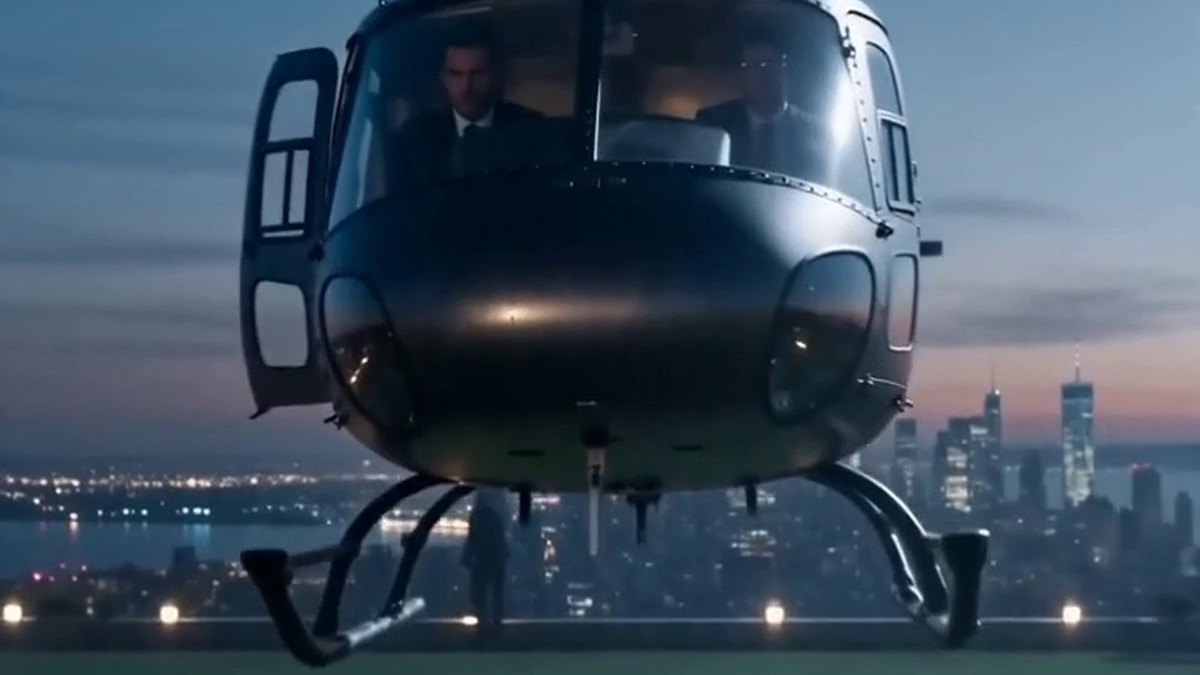
The thundering chop of helicopter blades silenced the room before anyone understood why. Every sequined shoulder turned. Every champagne glass paused mid-air. Out on the manicured lawn, an aircraft descended like a declaration.
He stepped out before the rotors even stilled.
Broad-shouldered. Unhurried. A dark suit, a bouquet of red roses so large it could’ve filled a doorway. He moved through the stunned crowd like they were furniture — didn’t glance left, didn’t glance right.
His eyes found only her.
“Forgive me,” he said quietly, stopping in front of the girl in the pale pink dress. “I should have been here sooner.”
The color drained from the wealthy woman’s face.
Her smile — that slow, vicious smile — collapsed completely. Her eyes went wide. Not with surprise.
With fear.
Because she knew exactly who he was.
What followed wasn’t chaos. It was something worse — absolute silence. The kind that fills a room like water, pressing against eardrums, stealing breath.
The wealthy woman — Helena Voss, to those who moved in circles where that name still opened doors — took one step backward. Then another. Her heel caught the edge of an ornamental rug and she grabbed the arm of the man beside her, a city councilman whose face had gone the color of old chalk.
Nobody laughed now.
He didn’t look at them. Not yet.
He was still looking at her — at Maya, twenty-six years old, seven months along, standing in a dress she’d worn twice already because it was the only one that still fit. He reached out and touched her face with one hand, roses still cradled against his chest, and his thumb brushed the tear track on her cheek the way you’d handle something that had almost shattered.
“I’m here,” he said. Just that.
And Maya, who had spent the last three hours telling herself she wasn’t going to cry, cried harder.
—
His name was Dmitri Sorel.
If you didn’t recognize it, you didn’t need to know it — that was the logic of the world he inhabited. He had been away for eleven days. A situation in Singapore that couldn’t wait. A board that wouldn’t hold without him in the room. He had called her every night. He had not been *here.* And here, it turned out, was everything.
Maya had come to this charity gala because his mother had asked her to. Represent the family, she’d said. You’re carrying the family, after all. It had seemed reasonable at the time, over tea, in a sunlit kitchen that smelled of cardamom.
She hadn’t anticipated Helena Voss.
Helena, who had once believed she would be the one standing in Maya’s position. Helena, who had spent seven years cultivating a particular proximity to Dmitri — lunches, galas, charity boards, strategic proximity — and had understood with cold clarity, six months ago, that he had chosen otherwise. Had chosen *this girl.* This quiet, unremarkable girl with steady hands and a laugh that didn’t perform itself.
The rejection had curdled into something that needed an audience to survive.
So when Maya had walked in alone, soft-bellied and uncertain, Helena had seen opportunity the way a hawk sees a field mouse — with pure, uncomplicated focus.
—
“She doesn’t even know your last name,” Helena said now.
Her voice had recovered. That was the thing about women like Helena — they didn’t stay down. They recalibrated. She stepped forward, away from the councilman’s arm, and her composure resettled over her features like a mask being pressed back into place.
“She didn’t know what she was walking into tonight,” Helena continued, addressing the room now as much as Dmitri. “No security. No preparation. You left her completely exposed, darling, and you know it. What does that say about—”
“Helena.”
One word. Quiet as the first one.
She stopped.
He turned from Maya then — gently, making sure she was steady — and he looked at Helena Voss for the first time since landing. It wasn’t a long look. It wasn’t theatrical. It was the kind of look that simply takes a full accounting, the way an engineer examines a structure before deciding it doesn’t need to be rebuilt. Just decommissioned.
“I know what you said to her tonight.”
“I was simply—”
“I know the exact words,” he said. “I know the order you said them in. I know where you were standing when you said them.” He let that settle. “I’d like you to consider very carefully whether there’s any version of the next sixty seconds that ends well for you if you say another one.”
Helena’s mouth opened.
Closed.
The mask slipped. Just slightly. Just enough for the room to see what was underneath it — not cruelty this time, but something smaller and uglier. Something that knew it had miscalculated.
“You would threaten me,” she said, very quietly. “Here. In front of all these people.”
“I’m not threatening you,” Dmitri said. “I’m informing you. There’s a difference. Threats involve uncertainty.” He picked up a champagne flute from the tray of a passing waiter — easy, unhurried — and held it without drinking. “You have a seat on three charitable foundations where my family has been the primary donor for a combined total of nineteen years. You have a standing invitation to events like this one because my mother believed, generously, that you were her friend.” He set the glass back down. “She’s going to be very sorry to hear about tonight.”
“Your *mother* invited me—”
“My mother is going to call you tomorrow morning,” he said, “and she is going to be heartbroken. Because she trusted you with something she loves. And you used that access to try to hurt it.”
The word *it* landed wrong, and he caught it.
“Her,” he corrected, his voice softening by a fraction. “Something she loves.”
Helena Voss looked at the room around her. All those faces she’d known for twenty years. All those alliances carefully tended, those friendships that were really agreements, those smiles that were really assessments.
Not one of them moved toward her.
The councilman had developed a sudden interest in the floral arrangement to his left.
She gathered herself. It was the only dignified option remaining. She picked up her clutch from the side table, adjusted the strap of her gown, and walked toward the exit with the careful, deliberate gait of someone who has decided that leaving was their idea.
At the door, she paused.
“You’ll regret choosing her,” she said, not turning around. “Men like you always do.”
Dmitri didn’t answer.
He had already turned back to Maya.
—
Outside, the helicopter sat quiet on the lawn, blades still, pilot waiting. The party had resumed its noise behind beveled glass — muted now, decorous, the way sound gets when people are pretending not to watch something.
Maya stood at the edge of the terrace, her arms wrapped around herself, the roses Dmitri had pressed into her hands so large she had to tilt them sideways. The night air was cool and smelled of cut grass and the distant promise of rain.
“You didn’t have to do that,” she said.
“I know.”
“The whole entrance. The helicopter. The—” She gestured vaguely at all of it.
“Would you have preferred I took a cab?”
Something cracked open in her chest. She laughed — sudden and real and slightly undignified, the kind of laugh that had startled him, once, the first time he’d heard it. The kind that didn’t perform itself.
He caught it like it was something he’d been waiting for.
“I should have been here,” he said again, quieter now, just for her. “Not for the room. For you. You shouldn’t have walked in there alone.”
“I thought I could handle it.”
“You did handle it.” He said it plainly, without decoration. “You were still standing. That’s not nothing.”
Maya looked down at the roses. Deep red, almost black at the edges in the dark. She counted them without meaning to, the way her mind worked when it was trying not to feel something too fast — eleven. One for each day. She hadn’t asked. He hadn’t explained. He didn’t need to.
The baby moved.
She pressed one hand flat against her belly, automatic, the way she always did — and then she looked up at him, because she still wasn’t used to the wonder of it, even now.
“She’s awake,” Maya said.
Dmitri reached out without asking, without ceremony, and placed his hand over hers. He waited. Still. More patient in this moment than she had ever seen him in any boardroom, any negotiation, any room full of people wanting things from him.
Then — a flutter. A kick, small and definitive and absolute.
His face did something complicated. Something that Helena Voss, in all her calculations, had never once factored in.
“Hello,” he said, very softly, to no one but the child.
—
Later — after the doctor’s appointment he’d rescheduled for morning, after she’d finally eaten something, after they’d sat long enough on the terrace for the night air to cool the last of the evening off their skin — they got into the back of the car and the city opened up around them, amber and quiet.
Maya leaned her head against his shoulder and closed her eyes.
“She said you’d walked away,” Maya said. Not accusing. Just naming the thing.
“I know.”
“Part of me—” She stopped.
“I know,” he said again. He put his arm around her. “I’m sorry that existed, even for a moment. I’m sorry I wasn’t there to make sure it couldn’t.”
Maya thought about Helena’s face when Dmitri had walked through the door. Not the fear. The *before* — that slow, vicious smile, the certainty that she held all the power in the room, the pleasure of it.
She thought about how quickly that had inverted.
She thought about herself, standing there with one hand on her belly and the other hanging limp, and she felt something complicated about both versions of herself — the one who had nearly believed it, and the one who had stayed standing anyway.
“She’ll come back,” Maya said. “People like that always find another angle.”
“Let her,” Dmitri said. “Let her spend the energy. It won’t buy her anything.”
Outside the window, the city moved past in fragments — a lit restaurant, a couple walking a dog, a traffic light cycling green in an empty intersection. Normal things. The ordinary texture of a world that didn’t know or care what had happened tonight.
Maya thought: *I am going to be someone’s mother.*
She thought: *I stayed standing.*
She thought: *He came back.*
Not like a fairy tale — nothing was resolved and cleaned away; Helena was still out there somewhere, gathering herself, recalibrating; there were other rooms, other galas, other women with slow smiles and long memories. The world didn’t get small and safe just because a helicopter landed on a lawn.
But his arm was around her. And the baby was awake. And the red roses were enormous and slightly absurd on the seat beside them, and he’d brought exactly eleven.
That was real. That was enough.
The car moved through the amber city, carrying all three of them home.