The ballroom went silent — then erupted in laughter.
Ice cubes skittered across the gleaming marble. The cold soaked through her thin brown dress in seconds, the wet fabric pressing against her skin like a punishment she hadn’t earned.
Lady Celeste stood over her, luminous in silver satin, diamonds catching every candle in the room. She was smiling the way people smile when they’ve never once been afraid of consequences.
“Do watch yourself,” Celeste said, her voice warm with contempt. “Those dirty hands nearly grazed my gown.”
Mara dropped her gaze to the floor.
She had reached for a fallen handkerchief.
Nothing more.
But girls like her didn’t need to commit a wrong to be made to suffer. They only needed to exist somewhere they weren’t supposed to.
The laughter swelled as Mara wrapped her shaking arms around herself, trying to disappear inside her soaked dress.
At the far end of the ballroom, the old king stood and said nothing.
He had been saying nothing for seventeen years.
Silent since the night someone carried his infant daughter out of a burning wing of the palace and never brought her back.
Silent since the royal physicians declared that no child could have lived through those flames.
Silent while Celeste — his brother’s daughter — grew comfortable with the idea of a crown.
Mara pushed wet strands of hair away from her throat.
A cold rivulet slipped beneath her collar.
And then something happened.
A glow — faint at first, barely a shimmer.
The laughter stopped one mouth at a time, like candles being snuffed.
Mara looked down. Along her collarbone, burning gold against ice-pale skin, a phoenix was blooming — brilliant and unmistakable, blazing as if the cold water had lit it rather than killed it.
The king’s wine cup slipped from his fingers.
It rang against the marble and went still.
Celeste’s smile collapsed.
“No,” she breathed.
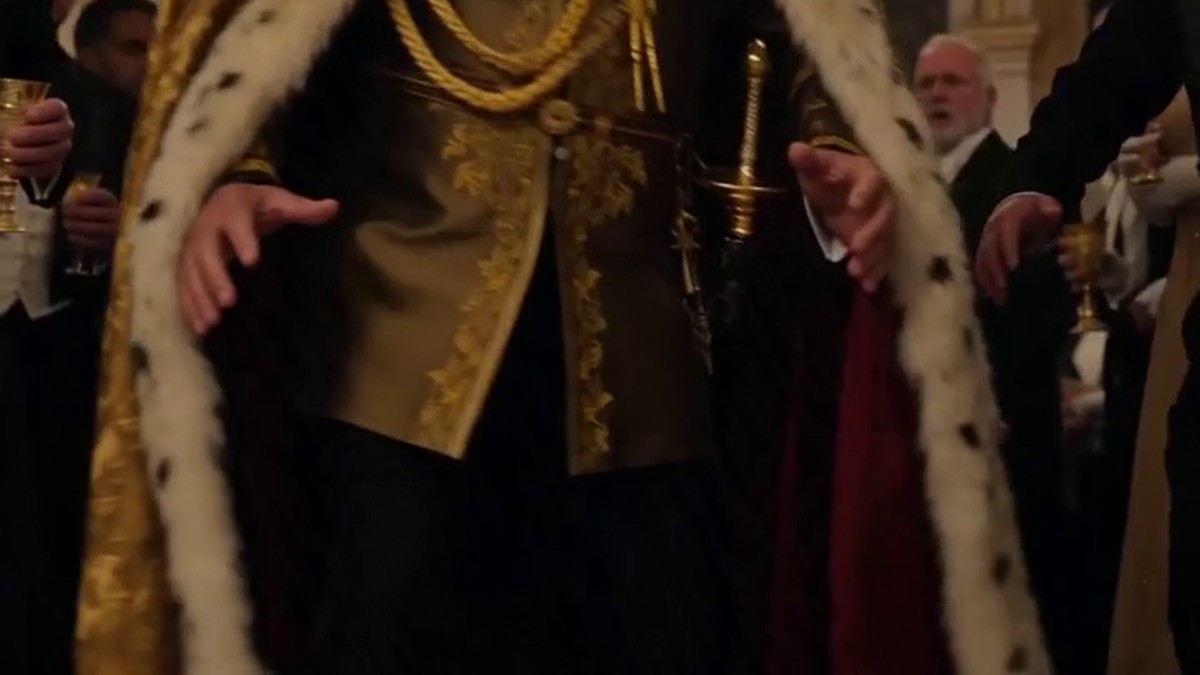
The king was already moving, shouldering past frozen courtiers, his fur-trimmed cloak sweeping the floor behind him. His face was undone — raw with something that had been buried under seventeen years of silence.
Mara stepped back, frightened by the grief pouring off him.
He stopped close enough that she could hear him breathing. His eyes locked onto the glowing mark. Then his hand rose — slowly, as though the moment might shatter — toward the small crescent scar at her temple.
The same mark his daughter had been born with.
His lips couldn’t quite form the shape of the words.
But they came anyway.
“My daughter.”
Mara stood perfectly still, the air gone from her lungs.
It was Celeste who moved — stumbling backward, one hand groping for something solid.
Because she knew exactly who had hidden that mark.
And she knew exactly how long she had been running from this moment.
The silence stretched like held breath over the entire ballroom.
No one coughed. No one moved. Even the candles seemed to pause.
Mara’s hand rose without thinking to the crescent scar at her temple — the small curved mark she had touched a thousand times without understanding, the one the woman who raised her had always called *a birthmark, nothing more, stop asking*.
The glow along her collarbone was fading now, but slowly, the way embers fade — reluctantly, as if something beneath her skin was deciding whether to stay lit.
The king’s eyes hadn’t moved from her face.
Seventeen years of grief had a particular look, she was learning. It didn’t look like sadness. It looked like a man who had forgotten how to stand upright and was only now remembering.
“Your Majesty,” she said, because she didn’t know what else to say. “I think there’s been a mistake.”
“There has been,” he said quietly. “A very long one.”
—
Celeste recovered faster than anyone deserved to.
She stepped forward, silver gown catching the light, chin lifting with the particular angle of someone who has practiced authority in mirrors.
“This is absurd.” Her voice rang clear and cool across the marble. “The girl is a servant. A kitchen girl. Whatever trick of light you’ve all just witnessed—”
“It was not a trick of light,” said Lord Ashmont from the left gallery, and several heads turned. He was eighty years old, half blind, and had served three kings. He said it the way men say things they have been waiting decades to say. “I knew the queen. I knew what the mark looked like. I was there at the naming ceremony.”
“Then you are as senile as everyone suspects,” Celeste said, but the warmth had gone entirely from her voice.
“Celeste.” The king turned to face her. Just her name — but the weight of it was devastating. “You will be quiet.”
Color flooded her cheeks. Her jaw tightened.
But she was quiet.
—
Mara’s knees wanted to buckle.
She locked them.
The wet dress clung. Ice water dripped from the ends of her hair onto the marble, each drop loud as a drumbeat in the silence. She felt every eye in the room like a physical pressure, two hundred people leaning forward in unison, and she made herself breathe.
*Think*, she told herself. *Think the way you always have.*
Seventeen years of existing in rooms where she wasn’t supposed to be had taught her one thing above all others: panic was a luxury. You didn’t get to panic until you were somewhere safe.
She looked at the king. Really looked at him — past the grief, past the crown, past the desperate hope shaking through him like fever.
He had kind eyes. She hadn’t expected that.
“What was her name?” Mara asked. “Your daughter. What did you call her?”
His breath caught. “Seraphine. After her mother.”
Something moved in Mara’s chest. Not recognition — or not only that. Something older. Like a door she’d always known was there, finally swinging open.
“The woman who raised me,” she said carefully, “called me Mara. But she said—” She stopped. *She said I came to her already named.* “She said she didn’t choose it.”
“No,” the king said. “She wouldn’t have.”
“Who brought me to her?”
The question fell into the room like a stone into water, and the ripples moved outward until they touched Celeste, standing at the edge of the crowd.
Every head turned.
—
Lady Celeste had not survived this long by being slow.
She moved for the door.
She was fast — genuinely fast, skirts gathered in both fists, heels ringing against the marble, and she had the advantage of surprise because no one quite believed, for one half-second, that she was actually running.
That half-second ended.
“Stop her.”
The king’s voice wasn’t loud. It didn’t need to be.
Four guards stepped into the doorway before Celeste reached it. She pulled up short, chest heaving, diamonds blazing at her throat, and turned back to face the room with the expression of someone calculating every remaining exit.
There weren’t any.
Mara watched her work through it — the excuses, the denials, the angles. She watched the moment Celeste realized none of them would hold. It was a small moment. Barely a flicker in those pale eyes.
Then Celeste did something Mara hadn’t expected.
She laughed.
It was a short, sharp sound. Not warm. Not amused. The laugh of someone who has decided that if the game is over, they will at least choose how to leave the table.
“You want the story?” Celeste said. She spread her hands — a gesture almost theatrical. “Fine. Here is the story.”
The room didn’t breathe.
“Your daughter didn’t die in that fire,” she said to the king, and her voice was steady in the way a blade is steady — because it has no feeling, only edge. “The fire wasn’t an accident. I paid for it. I was nineteen years old and your brother had just told me the crown would never be mine if there was a living heir, and I was *nineteen*, and I was afraid—”
“You had a child carried out of a burning building,” the king said. His voice had gone somewhere flat and unreachable.
“I had a child *saved*,” Celeste said, and for a single moment something crossed her face that might — might — have been the ghost of a conscience. “I could have let her burn. I didn’t. I paid someone to take her somewhere far, somewhere she’d be cared for, somewhere she’d never be found.” She paused. “I thought that was — I told myself it was mercy.”
“You told yourself it was mercy,” he repeated.
“For seventeen years.” Her voice cracked at last — just slightly, one fault line. “Yes.”
Silence.
Then the king crossed the floor toward her — not quickly, not dramatically, just steadily — and Celeste didn’t back away. She held her ground the way people hold their ground when they have already understood that the ground has given out beneath them.
He stopped two feet from her.
“Take her,” he said to the guards, and stepped away.
It was the absence of rage that was most terrible. Celeste had clearly prepared for rage. She hadn’t prepared for the exhausted, undeceivable calm of a man who had simply been waiting too long for the truth to be surprised by its ugliness.
Two guards stepped forward. Celeste went with them without another word, her silver gown sweeping the floor one last time, her chin still lifted — habit, maybe, or the only dignity she had left.
—
The ballroom felt different after the doors closed behind her.
Looser. Like a fist unclenching.
Mara realized she’d been holding her arms around herself since the water hit her, the same posture she’d had when the laughter started — and she made herself let them fall. She made herself stand up straight.
The king turned back to her.
Up close, in the candlelight, she could see how much older he was than his portraits. Grief had a way of carving the years deeper than time managed on its own.
“I don’t know how to—” He stopped. Started again. “I don’t expect anything from you. I have no right to expect anything. You don’t know me. You’ve had a life I know nothing about, and I—” His voice failed him completely, finally, after holding steady through all of it.
Mara looked at him for a long moment.
She thought about the woman who had raised her — tired hands, flour-dusted apron, the particular smell of woodsmoke and sage. Not a palace. Not diamonds. Not any of this. She thought about the seventeen years of narrow corridors and sidelong looks and pitchers of ice water thrown with impunity, and the slow, grinding education in exactly how little space she was permitted to take up.
She thought about the mark on her collarbone, still faintly warm.
“I don’t know how either,” she said honestly. “I don’t know who I am in any of this yet.”
“No,” he said. “Neither do I. Not entirely.” He hesitated. “But I know what I see standing in front of me.”
“What do you see?”
“Someone who didn’t fall down.”
Mara felt something give way in her chest — not collapsing, but releasing. The particular release of a tension held so long you’d forgotten it was there.
She looked at her father — that word enormous and new and strange in her mind, a word she turned over carefully, the way you handle something that might be fragile — and she took one breath.
Then another.
“I think,” she said slowly, “you’re going to have to tell me everything. All of it. From the beginning.” She glanced down at the wet ruined dress, the melted ice, the ridiculous, dignified mess of this moment. “And I think,” she added, “someone is going to need to find me dry clothes.”
The king let out a sound — half laugh, half something that wasn’t a laugh at all, the involuntary sound of a man who had forgotten there was anything left in him that could do that.
“Yes,” he managed. “Yes. Both of those things.”
Lord Ashmont began to applaud.
A single pair of hands, slow and deliberate, from the left gallery.
Then another. Then another.
Mara didn’t look at the crowd. She kept her eyes on the king’s face — on the grief still there, raw and real and not going anywhere quickly, but alongside it now, something else. Something that had not been there at the start of the evening.
The long-delayed arrival of hope.
The ballroom filled with sound.
And this time, not one note of it was laughter at her expense.