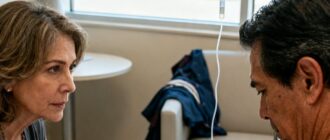
“I don’t want anything,” he finally said.
“That’s different from not being hungry.”
He looked at her then. Really looked, the way sick people sometimes do when someone says the one thing they weren’t expecting.
“What’s the difference?” he asked.
“Hunger is the body,” Clara said. “Not wanting is something else.”
He turned back to the window.
Clara let the silence breathe.
“Is there anything,” she said eventually, “that you used to want? Before.”
Owen’s jaw tightened slightly. A small movement, but she caught it.
“Red velvet cake,” he said.
The words came out like something dredged up from somewhere he hadn’t meant to reach.
—
Clara didn’t mention the cake that day.
She tidied the room without making a production of it, replaced the untouched tray with a glass of cold water and left it close enough that he could reach it without asking, and spent the rest of the morning staying out of his way in the specific manner of someone who knew exactly where she was.
By afternoon, the glass was half empty.
She counted that as something.
That night, long after the house had gone quiet and the only sounds were the monitors’ soft rhythm and the wind pressing against old window frames, Clara sat at the kitchen table with a notebook and wrote down everything she had observed.
Not symptoms. Not nursing notes.
Just Owen.
The way he tilted toward the window. The way he said *my mother planted it* like he was guarding the words and releasing them at the same time. The way his hands rested in his lap, open, like a person who had stopped making fists because it no longer seemed worth the effort.
She wrote: *He is not refusing to live. He has simply forgotten what living felt like.*
Then she underlined it and closed the notebook.
—
Saturday morning, Nathan Whitmore passed through the kitchen at six-fifteen in a suit that probably cost more than Clara’s car.
He was on his phone.
He stopped when he saw her.
She was at the counter with flour on her hands, a mixing bowl in front of her, and three different shades of red food coloring lined up like paint.
He lowered the phone.
“What are you doing?” he asked.
“Baking,” Clara said.
“I can see that.” He glanced at the food coloring. At the buttermilk. At the cocoa powder. “We have a chef.”
“The chef makes what’s on the dietary plan,” Clara said. “This isn’t on the dietary plan.”
Nathan stared at her the way men who run buildings stare at things that aren’t behaving according to their purpose.
“You’re the new girl,” he said.
“Clara Bennett,” she said. “Yes.”
“Has my son eaten?”
“Half a glass of water yesterday.”
Nathan’s jaw did something complicated. He looked at the bowl, then at Clara, and she could see him deciding whether to assert authority or let the thing play out.
He was very used to asserting authority.
“He mentioned red velvet cake,” Clara said. “I thought I’d try.”
The silence that followed was not empty.
Nathan’s hand tightened on his phone.
“His mother used to make that,” he said. The words came out scraped-sounding, like they’d been stored somewhere rough.
“I know,” Clara said. “He told me.”
Nathan looked at her for another moment. Then he put the phone to his ear and walked out of the kitchen, and Clara heard him say something sharp and professional into the receiver, his voice assembling itself back into the version of him that ran things.
She turned back to her bowl.
—
She carried the cake up at noon on a plain white plate.
No announcement. No production. She simply came into the room, set it on the table beside his wheelchair, pulled her chair to its usual spot a few feet away, and sat down.
Owen looked at the plate.
He didn’t speak for a long moment.
“That’s red velvet,” he said.
“Yes.”
“Did Mrs. Ellis make it?”
“No.”
He looked at it the way you look at something you stopped believing in.
“My mother’s recipe was very specific,” he said. “She put a tablespoon of apple cider vinegar in it. And real buttermilk. Not the stuff in the regular carton.” He paused. “She said the acid was what made it taste like something.”
Clara reached into her pocket and set a small index card on the table beside the plate. Handwritten, in neat letters.
*Grace Whitmore’s Red Velvet Cake. From Mrs. Ellis, who watched her make it thirty-one times.*
Owen picked up the card.
He read it.
Clara watched his face move through something she didn’t have a name for — not happiness exactly, but the country just outside of happiness, the place where grief and memory and desire all press against the same border.
He set the card down.
He picked up the fork.
The first bite was cautious. The second was not.
He ate half the slice before he stopped, and when he stopped it wasn’t because he didn’t want it. It was because his body had simply gotten small.
“It’s right,” he said. “It tastes right.”
Clara didn’t say anything.
Owen looked out at the maple tree.
“She would have liked you,” he said. “She didn’t like people who hovered.”
“I’ve been told I’m bad at hovering.”
“No,” Owen said. “You’re good at something else.” He considered the tree. “She used to say there was a difference between people who show up for you and people who just show up. She said most people only know how to do the second one.”
Clara looked at the maple.
“She sounds like she was worth listening to.”
“She was,” Owen said. Then, quieter: “So was my father, once.”
—
Nathan found out about the cake the way he found out about most things in his own house — through Mrs. Ellis, who told him carefully and watched his face to see what it would do.
What it did surprised her.
He didn’t say anything for a full ten seconds.
Then he said, “Did he eat it?”
“Most of half a slice, sir.”
Nathan nodded once.
He went upstairs.
He stood outside Owen’s door.
He had stood outside this door so many times in the past weeks — arriving and then not entering, his hand raised and then falling back, the knob never turning. The reasons shifted but the result was always the same. He always ended up back in his office, behind glass, on the phone, converting his helplessness into transactions.
Today his hand stayed raised.
He knocked.
“Come in,” Owen said.
Nathan opened the door.
Owen was in the wheelchair, the plate with the half-eaten cake still on the table beside him. He looked at his father with the careful, assessing look of someone who had learned not to expect much and was keeping score.
Nathan looked at the cake.
“Mrs. Ellis said it tastes like your mother’s,” he said.
“It does.”
Nathan moved to the window. He stood with his hands in his pockets and looked at the Japanese maple. Up close, it was larger than it looked from the driveway. The red leaves trembled in a breeze neither of them could feel from inside.
“I watched her plant that,” Nathan said. “She made me dig the hole and then told me I’d done it wrong and dug it herself anyway.” He paused. “She was right. I’d made it too shallow.”
Owen was watching him.
“Dad,” he said.
Nathan turned.
“I don’t want you to fix this,” Owen said. “I know you want to. I know that’s what you do.” His voice was thin but steadier than Nathan had heard it in months. “I just want you to sit here for a while. That’s all.”
Nathan Whitmore, who had built towers and buried grief under square footage, who had not cried in a decade, who had made himself into a man that rooms went quiet for — Nathan stood at his dying son’s window and felt something give way underneath the architecture of himself.
He pulled the chair close.
He sat down.
Outside, a red leaf let go of the maple and drifted in a slow, unhurried spiral toward the garden below, as if it had all the time in the world.
Neither man spoke.
Neither needed to.
Clara came back up an hour later to collect the plate.
She stopped in the doorway.
Nathan was still in the chair. Owen had fallen asleep in his wheelchair, his head tilted slightly toward the window, his hands resting open in his lap the way they always did. Nathan was watching him sleep with the specific stillness of someone who had recently stopped being afraid of what he might see.
He heard Clara and looked up.
She held his gaze for a moment, then stepped quietly into the room, lifted the plate, and stepped out again without a word.
On the stairs, she allowed herself one small breath.
—
The following Tuesday, Owen asked for the other half of the slice.
“I should have finished it the first time,” he said. “I didn’t know if it would keep.”
“Red velvet keeps three days in the fridge,” Clara said. “You had time.”
“Good to know.”
She brought it up on the same plain white plate. He ate it slowly, looking out at the maple, and when he finished he set the fork down with something almost like ceremony.
“I’d like to go outside,” he said.
Clara looked at him.
“The garden,” he said. “I want to see the tree.”
“I’ll need to check with—”
“Clara.”
She stopped.
“I know what the answer is going to be,” Owen said. His voice was quiet, but it had an edge in it now, a thin blade of something that sounded almost like the man he must have been. “I know what the progression looks like. I’m not asking you to pretend otherwise.” He looked at the window. “I just want to sit under my mother’s tree while I still can. That’s not a complicated request.”
Clara set down the empty plate.
“No,” she said. “It isn’t.”
—
It took thirty minutes to manage the logistics — the portable monitoring equipment, the warm blanket across his lap, the wheelchair’s wheels on the garden path, which was older than anyone had thought to account for when it was laid.
Nathan appeared from somewhere in the house without being called for, and if he had arranged his face carefully before he came outside, he’d done a good enough job that Owen didn’t mention it.
The three of them made their way down the flagstone path in a loose procession: Clara at the handles, Nathan walking slightly ahead in the instinctive way of a man who was used to leading, catching himself, and falling back.
The garden in late October had the quality of a room where most of the furniture had been moved out. The beds were cut back. The roses were wrapped. But the Japanese maple stood in full color at the garden’s center, its canopy burning red and orange in the flat afternoon light, every leaf catching the sun like something lit from within.
Owen made a sound when he saw it.
Not words. Just sound. A low, involuntary exhalation, the way a person breathes when they’ve been holding something in longer than they knew.
Clara stopped the wheelchair at the maple’s edge where the roots had lifted slightly through the earth in long, smooth arcs.
The wind moved through the branches above them, and leaves came loose — two, then five, then a slow, continuous shedding that drifted around them like something ceremonial.
Owen put his hand out, palm up.
A leaf landed in it.
He looked at it for a long moment.
“She planted this the year I was born,” he said. “She told me it was mine. That I was supposed to take care of it.” A pause. “I never took care of anything, really.”
“It’s still standing,” Clara said.
“Because she did the work before I had to.”
Nathan stood three feet away with his hands at his sides. Clara watched him out of the corner of her eye — the tight set of his shoulders, the way he was looking at the tree instead of his son, the way men sometimes look at a fixed point when their face is in danger of doing something they haven’t given it permission to do.
“Dad,” Owen said.
Nathan looked at him.
“Come here.”
Nathan crossed the three feet.
He stood next to the wheelchair, and Owen reached up with the hand that still held the leaf and put it briefly on his father’s forearm — just a touch, just a second, just the lightest possible pressure — and then his hand dropped back into his lap.
Nathan looked down at his own arm.
Then he crouched beside the wheelchair so he was level with his son, and for a moment the two of them just looked at each other in the watery October light, without posture, without transaction, without the versions of themselves they had been performing for each other for years.
Clara took three quiet steps back and found something to look at in the middle distance.
She heard Nathan’s voice, low and unsteady. She couldn’t make out the words and didn’t try.
She heard Owen say, *I know.*
She heard Nathan say something else.
She heard Owen say, *I know, Dad. I know.*
—
He lived another six weeks.
There were bad days — days when the pain was larger than the medication could account for, days when Owen turned back toward the window and stayed there and Clara let him, days when Nathan arrived and sat and left without much having been said and both of them seemed to understand that this was acceptable, that presence itself was the thing.
There were other days.
Owen asked Clara once to read to him — not anything meaningful, he said, nothing symbolic, just something with a story in it — and she read him the first four chapters of a detective novel she found on the hallway shelf, doing different voices badly enough that he laughed, which neither of them had been expecting.
He asked her another time why she’d become a nurse.
She told him about her grandmother, who had been cared for badly in the last year of her life, by people who were technically competent and humanly absent, and how Clara had sat in the corner of that hospital room at sixteen years old and thought, *someone should be better at this.*
Owen listened to the whole thing.
“So you’re doing it for her,” he said.
“I thought so at first,” Clara said. “Now I think I’m doing it because it turns out I’m good at it.”
“There’s a difference?”
“Hunger is the body,” Clara said. “This is something else.”
He smiled. It was a small smile, but it was real, and it reached somewhere behind his eyes that had been closed off for a long time.
—
He died on a Thursday morning in November, the maple outside bare now, its branches making clean lines against a white sky.
Nathan was in the room.
Clara had gone to get water, and by the time she came back it was already done — quietly, without drama, in the specific unhurried way of someone who had finally made peace with the schedule.
She set the glass of water on the table.
She stood with Nathan for a while.
He didn’t say anything. She didn’t either. Outside, the bare maple stood in the gray morning light, its branches perfectly still.
—
Three days later, a card arrived at Clara’s apartment.
The handwriting on the envelope was sharp and forward-leaning, the penmanship of a man who had learned to write in a different era and never softened.
Inside, one sentence, no salutation:
*He ate something.*
Clara read it twice.
She put the card on her kitchen windowsill, where the morning light would hit it, and stood looking at it for a moment.
Then she went to her notebook, opened it to the page where she had written *He is not refusing to live. He has simply forgotten what living felt like,* and underneath it, in the same careful hand, she wrote one more line.
*And then he remembered.*
She closed the notebook.
Outside her own window, the November sky was the particular pale blue that only comes after cold has truly arrived, clean and final and somehow, in its very emptiness, full of light.